Tag: male infertility market trends

  • Male Infertility Market Expansion to $4.63 Billion by 2029: Key Drivers and Trends

    Male Infertility Market Expansion to $4.63 Billion by 2029: Key Drivers and Trends

    Uncover key drivers, emerging technologies, and competitive movements shaping the male infertility market from 2025–2034 with trusted insights from The Business Research Company

    What Is The Base Market Size For The Male Infertility Market Today And What Will It Reach By 2029?

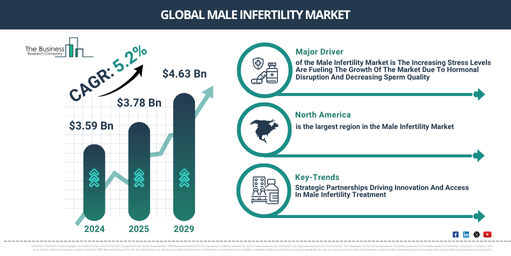
    The male infertility market size has experienced significant growth in recent years. It is anticipated to expand from $3.59 billion in 2024 to $3.78 billion in 2025, demonstrating a compound annual growth rate (CAGR) of 5.3%. This historic period’s growth can be linked to heightened awareness concerning male reproductive health, the escalating occurrence of lifestyle-related conditions, the increasing utilization of assisted reproductive technologies (ART), the proliferation of fertility clinics and diagnostic centers, and advancements in semen analysis technologies.

    The male infertility market is projected to experience robust expansion over the coming years. Its valuation is set to reach $4.63 billion by 2029, exhibiting a compound annual growth rate (CAGR) of 5.2%. This anticipated growth throughout the forecast period can be attributed to several factors, including a heightened emphasis on genetic and epigenetic elements, a growing desire for customized infertility solutions, an increase in medical tourism for fertility services, advancements in techniques for sperm retrieval and preservation, and the increasing prominence of telehealth in fertility consultations. Key trends expected during the forecast period encompass a wider adoption of genetic testing for infertility diagnosis, significant progress in sperm retrieval methods such as micro-TESE, an escalating need for non-invasive fertility options, the introduction of tailored male fertility treatment programs, and the increasing application of stem cell therapy for restoring spermatogenesis.

    Access A Free Sample Of The Report:

    https://www.thebusinessresearchcompany.com/sample.aspx?id=24286&type=smp

    What Factors Are Boosting The Male Infertility Market?

    The increasing levels of stress are anticipated to drive the expansion of the male infertility market moving forward. Stress levels refer to the intensity of emotional, physical, or mental pressure experienced in response to challenging situations or demands. The rise in stress levels stems from escalating work demands, where constant pressure and high expectations result in burnout and disrupt mental well-being and work-life balance. Elevated stress can interfere with hormone balance, diminish sperm quality, and impair sexual function, leading to male infertility. Chronic stress disrupts cortisol and testosterone levels, contributing to an increase in infertility cases. For instance, in May 2024, according to the American Psychiatric Association, a US-based professional organization of psychologists, 43% of adults in the US reported feeling more anxious in 2024, compared to 37% in 2023 and 32% in 2022, indicating a consistent rise in anxiety levels. Therefore, the increasing stress levels are propelling the growth of the male infertility market.

    How Is The Male Infertility Market Categorized By Application, Type, And Region?

    The male infertility market covered in this report is segmented –

    1) By Treatment Type: Medication, Surgery, Assisted Reproductive Technology

    2) By Test Type: Sperm Agglutination, Deoxyribonucleic Acid Fragmentation Technique, Oxidative Stress Analysis, Computer Assisted Semen Analysis, Sperm Penetration Assay, Other Test Types

    3) By Distribution Channel: Hospitals Pharmacies, Pharmacies And Drug Stores, Online Pharmacies

    4) By End-User: Hospitals And Clinics, Fertility Centers, Research Institutes, Other End-Users

    Subsegments:

    1) By Medication: Hormone Treatments, Gonadotropins, Antibiotics, Antiestrogens, Dopamine Agonists

    2) By Surgery: Varicocelectomy, Vasovasostomy, Epididymovasostomy, Transurethral Resection of the Ejaculatory Duct (TURED), Sperm Retrieval Procedures

    3) By Assisted Reproductive Technology (ART): In Vitro Fertilization (IVF), Intracytoplasmic Sperm Injection (ICSI), Intrauterine Insemination (IUI), Sperm Donation, Cryopreservation Of Sperm

    How Are Technological Trends Affecting The Male Infertility Market Growth?

    Major companies operating in the male infertility market are increasingly focusing on strategic partnership approaches to enhance the availability of advanced fertility treatments across global markets. Strategic partnerships are defined as collaborations between organizations that combine their resources and expertise to achieve shared objectives, helping to drive innovation, broaden market presence, and strengthen research and development efforts. For instance, in June 2024, Ferring Pharmaceuticals, a pharmaceutical company based in Switzerland, partnered with Posterity Health, a US-based male fertility clinic, to launch a male fertility program on Ferring’s Fertility Out Loud platform designed to educate men about their fertility. This initiative offers men a confidential online assessment and educational resources developed by reproductive urologists to help them understand their fertility status and reduce the stigma around male infertility, which contributes to up to 50% of infertility cases. The program aims to empower men to take early action, potentially improving a couple’s path to parenthood by addressing male fertility issues sooner and more conveniently through digital tools and telehealth.

    Who Are The Global Leaders Steering The Male Infertility Market Forward?

    Major companies operating in the male infertility market are Novartis AG, Amgen Inc., Teva Pharmaceutical Industries Ltd., Intas Pharmaceuticals Ltd., NYU Langone Hospitals, Sun Pharmaceutical Industries Ltd., Cipla Limited, Ferring Pharmaceuticals, Fortis Healthcare, Vitrolife, Max Healthcare, CinnaGen Co., Aytu BioScience Inc., Zydus Hospitals and Healthcare Research Private Limited, Apricus Biosciences Inc., SCSA Diagnostics Inc., Andrology Solutions, Halotech DNA, Indira IVF, Conduit Pharmaceuticals, Shree IVF Clinics

    Download The Full Report Here:

    https://www.thebusinessresearchcompany.com/report/male-infertility-global-market-report

    Which Region Is Projected To Achieve The Fastest Growth In The Male Infertility Market?

    North America was the largest region in the male infertility market in 2024. The regions covered in the male infertility market report are Asia-Pacific, Western Europe, Eastern Europe, North America, South America, Middle East, Africa.

    Get A Report Customized For You Here:

    https://www.thebusinessresearchcompany.com/customise?id=24286&type=smp

    Browse Through More Reports Similar to the Global Male Infertility Market 2025, By The Business Research Company

    Infertility Treatment Global Market Report 2025

    https://www.thebusinessresearchcompany.com/report/infertility-treatment-global-market-report

    Male Fertility Global Market Report 2025

    https://www.thebusinessresearchcompany.com/report/male-fertility-global-market-report

    Male Hypogonadism Global Market Report 2025

    https://www.thebusinessresearchcompany.com/report/male-hypogonadism-global-market-report

    Get in touch with us:

    The Business Research Company: https://www.thebusinessresearchcompany.com/

    Americas +1 310-496-7795

    Asia +44 7882 955267 & +91 8897263534

    Europe +44 7882 955267

    Email us at info@tbrc.info

    Follow us on:

    LinkedIn: https://in.linkedin.com/company/the-business-research-company

    YouTube: https://www.youtube.com/channel/UC24_fI0rV8cR5DxlCpgmyFQ

    Global Market Model: https://www.thebusinessresearchcompany.com/global-market-model
  • Male Infertility Industry Forecast to Hit $4.63 Billion by 2029 With a Strong 5.2% CAGR

    Male Infertility Industry Forecast to Hit $4.63 Billion by 2029 With a Strong 5.2% CAGR

    Unlock Global Insights – Save 20% on Market Reports with Code ONLINE20

    What Is The Future Market Size Estimation For The Male Infertility Market Covering 2025–2034?

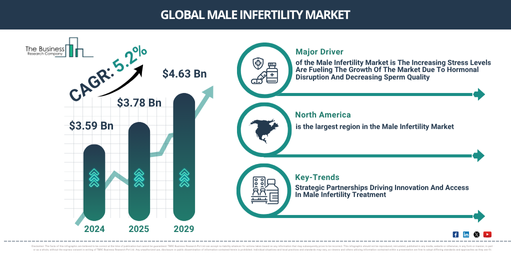
    The male infertility market size has experienced robust growth recently. It is anticipated to expand from $3.59 billion in 2024 to $3.78 billion in 2025, indicating a compound annual growth rate (CAGR) of 5.3%. This past growth is primarily due to increased awareness of male reproductive health, the rising occurrence of lifestyle-related disorders, wider adoption of assisted reproductive technologies (ART), the expansion of fertility clinics and diagnostic centers, and continuous advancements in semen analysis technologies.

    The male infertility market size is predicted to undergo robust expansion in the coming years, with expectations for it to reach $4.63 billion in 2029, growing at a compound annual growth rate (CAGR) of 5.2%. This projected growth throughout the forecast period can be attributed to a heightened emphasis on genetic and epigenetic factors, a growing demand for tailored infertility treatments, an increase in medical tourism for fertility care, technological breakthroughs in sperm retrieval and preservation, and the evolving significance of telehealth in fertility consultations. Key trends during the forecast period include the increasing adoption of genetic testing for infertility diagnosis, advancements in sperm retrieval techniques such as micro-TESE, a rising preference for non-invasive fertility treatments, the introduction of personalized male fertility treatment strategies, and the expanding use of stem cell therapy for spermatogenesis restoration.

    Unlock Your Free Sample Report for Exclusive Market Data:

    https://www.thebusinessresearchcompany.com/sample.aspx?id=24286&type=smp

    What Are The Top Growth Drivers Impacting The Male Infertility Market Outlook?

    Rising stress levels are anticipated to drive the expansion of the male infertility market in the future. Stress levels denote the degree of emotional, physical, or mental strain encountered due to demanding circumstances or pressures. These heightened stress levels originate from growing work demands, as continuous pressure and high expectations lead to burnout, negatively impacting mental well-being and work-life equilibrium. Increased stress can disrupt hormonal balance, diminish sperm quality, and hinder sexual function, thereby contributing to male infertility. Persistent stress disturbs cortisol and testosterone levels, fostering an increase in infertility instances. For example, in May 2024, data from the American Psychiatric Association, a US-based professional organization of psychologists, showed that 43% of adults in the US reported feeling more anxious in 2024, in contrast to 37% in 2023 and 32% in 2022, demonstrating a steady rise in anxiety. Consequently, the escalating stress levels are propelling the expansion of the male infertility market.

    What Are The Leading Segments Analyzed In The Male Infertility Market?

    The male infertility market covered in this report is segmented –

    1) By Treatment Type: Medication, Surgery, Assisted Reproductive Technology

    2) By Test Type: Sperm Agglutination, Deoxyribonucleic Acid Fragmentation Technique, Oxidative Stress Analysis, Computer Assisted Semen Analysis, Sperm Penetration Assay, Other Test Types

    3) By Distribution Channel: Hospitals Pharmacies, Pharmacies And Drug Stores, Online Pharmacies

    4) By End-User: Hospitals And Clinics, Fertility Centers, Research Institutes, Other End-Users

    Subsegments:

    1) By Medication: Hormone Treatments, Gonadotropins, Antibiotics, Antiestrogens, Dopamine Agonists

    2) By Surgery: Varicocelectomy, Vasovasostomy, Epididymovasostomy, Transurethral Resection of the Ejaculatory Duct (TURED), Sperm Retrieval Procedures

    3) By Assisted Reproductive Technology (ART): In Vitro Fertilization (IVF), Intracytoplasmic Sperm Injection (ICSI), Intrauterine Insemination (IUI), Sperm Donation, Cryopreservation Of Sperm

    What Key Innovation Trends Are Fueling Advancements In The Male Infertility Market?

    Key companies active in the male infertility market are concentrating on strategic alliance methods to enhance the availability of sophisticated fertility treatments across international markets. Strategic partnerships represent collaborations between entities that merge assets and specialized knowledge to accomplish shared aims. They contribute to stimulating innovation, expanding market reach, and strengthening research and development endeavors. For example, in June 2024, Ferring Pharmaceuticals, a pharmaceutical company based in Switzerland, collaborated with Posterity Health, a male fertility clinic situated in the US, to roll out a male fertility program on Ferring’s Fertility Out Loud platform, intended to educate men regarding their fertility. This initiative furnishes men with a confidential online evaluation and educational materials created by reproductive urologists to assist them in understanding their fertility condition and diminishing the stigma surrounding male infertility, which accounts for up to 50% of infertility instances. The program seeks to enable men to take prompt measures, potentially bettering a couple’s progression to parenthood by tackling male fertility issues earlier and with greater ease via digital instruments and telehealth.

    Which Key Players Are Driving Competition In The Male Infertility Market?

    Major companies operating in the male infertility market are Novartis AG, Amgen Inc., Teva Pharmaceutical Industries Ltd., Intas Pharmaceuticals Ltd., NYU Langone Hospitals, Sun Pharmaceutical Industries Ltd., Cipla Limited, Ferring Pharmaceuticals, Fortis Healthcare, Vitrolife, Max Healthcare, CinnaGen Co., Aytu BioScience Inc., Zydus Hospitals and Healthcare Research Private Limited, Apricus Biosciences Inc., SCSA Diagnostics Inc., Andrology Solutions, Halotech DNA, Indira IVF, Conduit Pharmaceuticals, Shree IVF Clinics

    Download The Full Report For Exclusive Market Findings:

    https://www.thebusinessresearchcompany.com/report/male-infertility-global-market-report

    Which Region Is Projected To Lead The Male Infertility Market During The Forecast Period?

    North America was the largest region in the male infertility market in 2024. The regions covered in the male infertility market report are Asia-Pacific, Western Europe, Eastern Europe, North America, South America, Middle East, Africa.

    Request A Customized Version Of The Male Infertility Market Report:

    https://www.thebusinessresearchcompany.com/customise?id=24286&type=smp

    Browse Through More Reports Similar to the Global Male Infertility Market 2025, By The Business Research Company

    Infertility Treatment Global Market Report 2025

    https://www.thebusinessresearchcompany.com/report/infertility-treatment-global-market-report

    Male Fertility Global Market Report 2025

    https://www.thebusinessresearchcompany.com/report/male-fertility-global-market-report

    Male Hypogonadism Global Market Report 2025

    https://www.thebusinessresearchcompany.com/report/male-hypogonadism-global-market-report

    Get in touch with us:

    The Business Research Company: https://www.thebusinessresearchcompany.com/

    Americas +1 310-496-7795

    Asia +44 7882 955267 & +91 8897263534

    Europe +44 7882 955267

    Email us at info@tbrc.info

    Follow us on:

    LinkedIn: https://in.linkedin.com/company/the-business-research-company

    YouTube: https://www.youtube.com/channel/UC24_fI0rV8cR5DxlCpgmyFQ

    Global Market Model: https://www.thebusinessresearchcompany.com/global-market-model
  • $4.63 Billion Forecast for Male Infertility Market by 2029, Backed by Demand and Innovation

    $4.63 Billion Forecast for Male Infertility Market by 2029, Backed by Demand and Innovation

    Claim your 30% discount on Global Market Reports with code ONLINE30. Limited time only.

    How Has the Male Infertility Market Growth Performance Trended Historically, And What Lies Ahead?

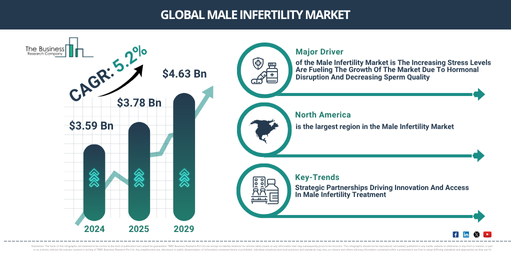
    The market for male infertility has been on a robust upward trajectory recently. The projections suggest a growth from $3.59 billion in 2024 to $3.78 billion in 2025, translating to a compound annual growth rate (CAGR) of 5.3%. This significant progress over time can be attributed to increasing consciousness about male reproductive health, higher incidence of disorders related to lifestyle, a rising trend towards the use of assisted reproductive technologies (ART), growth in the number of fertility clinics and diagnostic centers, along with innovative upgrades in semen analysis technologies.

    The market for male infertility is set to witness robust expansion in the forthcoming years, reaching $4.63 billion in 2029 with a CAGR of 5.2%. The projected growth within this time frame can be ascribed to an escalating emphasis on genetic and epigenetic factors, a surge in the need for individualized infertility solutions, an expansion in medical tourism catering to fertility care, breakthroughs in technology pertaining to sperm extraction and storage, and the growing influence of telehealth in fertility discussions. Important trends during the forecast period encompass an increasing reliance on genetic testing for diagnosing infertility, advancements in sperm extraction methods like micro-TESE, a heightened demand for non-invasive fertility procedures, the launch of tailored male fertility treatment protocols, and an escalation in the application of stem cell therapy for the reestablishment of spermatogenesis.

    Download a free sample to assess the report’s scope and structure:

    https://www.thebusinessresearchcompany.com/sample.aspx?id=24286&type=smp

    What Are the Core Growth Drivers Propelling the Male Infertility Market Forward?

    The surge in stress levels is anticipated to hasten the expansion of the male infertility market. These levels of stress refer to the severity of emotional, physical, or mental burdens experienced when facing demanding situations. This increase in stress largely originates from growing job-related demands where constant pressure and high expectations may lead to burnouts, negatively impacting an individual’s mental wellbeing and work-life equilibrium. Heightened stress levels have the potential to disrupt hormone balance, degrade sperm quality, and impede sexual function, resulting in male infertility. It’s found that long-term stress alters cortisol and testosterone levels, leading to an upsurge in infertility cases. For example, as reported by the American Psychiatric Association, a professional body of psychologists based in the US, in May 2024, about 43% of adults in the US were more anxious in 2024 than 37% in 2023, and 32% in 2022. This suggests an ongoing increase in levels of anxiety. Thus, the accelerating stress levels are fuelling the growth of the male infertility market.

    What Segment Types Define the Male Infertility Market Structure?

    The male infertility market covered in this report is segmented –

    1) By Treatment Type: Medication, Surgery, Assisted Reproductive Technology

    2) By Test Type: Sperm Agglutination, Deoxyribonucleic Acid Fragmentation Technique, Oxidative Stress Analysis, Computer Assisted Semen Analysis, Sperm Penetration Assay, Other Test Types

    3) By Distribution Channel: Hospitals Pharmacies, Pharmacies And Drug Stores, Online Pharmacies

    4) By End-User: Hospitals And Clinics, Fertility Centers, Research Institutes, Other End-Users

    Subsegments:

    1) By Medication: Hormone Treatments, Gonadotropins, Antibiotics, Antiestrogens, Dopamine Agonists

    2) By Surgery: Varicocelectomy, Vasovasostomy, Epididymovasostomy, Transurethral Resection of the Ejaculatory Duct (TURED), Sperm Retrieval Procedures

    3) By Assisted Reproductive Technology (ART): In Vitro Fertilization (IVF), Intracytoplasmic Sperm Injection (ICSI), Intrauterine Insemination (IUI), Sperm Donation, Cryopreservation Of Sperm

    Request customized data on this market:

    https://www.thebusinessresearchcompany.com/customise?id=24286&type=smp

    Which Geographic Areas Hold the Strongest Growth Potential in the Male Infertility Market?

    North America was the largest region in the male infertility market in 2024. The regions covered in the male infertility market report are Asia-Pacific, Western Europe, Eastern Europe, North America, South America, Middle East, Africa.

    Which Emerging Trends that Are Influencing theMale Infertility Industry Evolution?

    Several leading businesses in the male infertility market are focusing on forming strategic alliances to enhance the accessibility of advanced fertility treatments in global markets. This involves collaborations between companies that pool their resources and knowledge to meet common goals. Such partnerships spur innovation, widen market exposure, and intensify R&D endeavors. To illustrate, in June 2024, Ferring Pharmaceuticals, a pharmaceutical company based in Switzerland, joined forces with Posterity Health, a male fertility clinic in the US. Their collaboration led to the launching of a male fertility program on Ferring’s Fertility Out Loud platform designed to enlighten men about fertility. This campaign provides men confidential online analysis and informative resources created by reproductive urologists. They aim to help men comprehend the status of their fertility and diminish the shame associated with male infertility, which is implicated in approximately 50% of infertility cases. The program seeks to embolden men to act early, potentially easing the journey to parenthood for couples by addressing male fertility concerns more promptly and more conveniently using digital tools and telehealth services.

    View the full report here:

    https://www.thebusinessresearchcompany.com/report/male-infertility-global-market-report

    What Is the Definition of the Male Infertility Market?

    Male infertility is defined as a man’s inability to cause pregnancy in a fertile female partner after one year of regular, unprotected sexual intercourse. It is typically due to problems with the quantity or quality of sperm and results from structural issues, hormonal imbalances, genetic conditions, or other health factors.

    Purchase the full report and get a swift delivery:

    https://www.thebusinessresearchcompany.com/purchaseoptions.aspx?id=24286

    About The Business Research Company:

    With over 15000+ reports from 27 industries covering 60+ geographies, The Business Research Company has built a reputation for offering comprehensive, data-rich research and insights. Armed with 1,500,000 datasets, the optimistic contribution of in-depth secondary research, and unique insights from industry leaders, you can get the information you need to stay ahead in the game.

    Get in touch with us:

    The Business Research Company: https://www.thebusinessresearchcompany.com/

    Americas +1 310-496-7795

    Europe +44 7882 955267

    Asia & Others +44 7882 955267 & +91 8897263534

    Email us at info@tbrc.info

    Follow us on:

    LinkedIn: https://in.linkedin.com/company/the-business-research-company

    YouTube: https://www.youtube.com/channel/UC24_fI0rV8cR5DxlCpgmyFQ

    Global Market Model: https://www.thebusinessresearchcompany.com/global-market-model
  • Male Infertility Forecast Report – Designed for Decision Makers and Product Teams

    Male Infertility Forecast Report – Designed for Decision Makers and Product Teams

    Claim your 30% discount on Global Market Reports with code ONLINE30. Limited time only.

    What Is the Growth Rate of the Male Infertility Market?

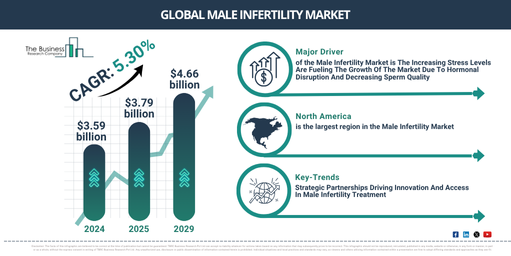
    The market size for male infertility has seen solid growth in the past few years. The market is projected to expand from $3.59 billion in 2024 to $3.79 billion in 2025, reflecting a compound annual growth rate (CAGR) of 5.6%. Factors contributing to the growth during the historic period include increased awareness about men’s reproductive health, growing instances of lifestyle-related diseases, rising adoption of assisted reproductive technologies (ART), proliferation of fertility clinics and diagnostic centres, and progress in semen analysis technologies.

    What Growth Rate Is Forecasted for the Male Infertility Market by 2029?

    A robust expansion is anticipated in the male infertility market in the coming years, with an expected valuation of $4.66 billion by 2029. The market’s compound annual growth rate (CAGR) is projected to be 5.3%. This predicted expansion during the forecast period could be credited to a heightening focus on genetic and epigenetic aspects, an escalation in the demand for custom-made infertility treatments, development in the realm of fertility care medical tourism, advancements in sperm retrieval and storage technology, and the burgeoning incorporation of telehealth into fertility consultations. Key trends during the forecast period encompass an increasing implementation of genetic testing for diagnosing infertility, innovations in sperm retrieval procedures like micro-TESE, elevated demand for non-intrusive fertility treatments, the launch of tailored treatment plans for male infertility, and the upsurge in the utilization of stem cell therapy to restore spermatogenesis.

    Download The Free Sample Report Here:

    https://www.thebusinessresearchcompany.com/sample.aspx?id=24286&type=smp

    Which Key Companies Are Shaping the Future of the Male Infertility Market?

    Major companies operating in the male infertility market are Novartis AG, Amgen Inc., Teva Pharmaceutical Industries Ltd., Intas Pharmaceuticals Ltd., NYU Langone Hospitals, Sun Pharmaceutical Industries Ltd., Cipla Limited, Ferring Pharmaceuticals, Fortis Healthcare, Vitrolife, Max Healthcare, CinnaGen Co., Aytu BioScience Inc., Zydus Hospitals and Healthcare Research Private Limited, Apricus Biosciences Inc., SCSA Diagnostics Inc., Andrology Solutions, Halotech DNA, Indira IVF, Conduit Pharmaceuticals, Shree IVF Clinics

    Which Factors Are Driving Demand in the Male Infertility Industry?

    The male infertility market is anticipated to grow due to the escalating stress levels. Stress levels pertain to the severity of emotional, physical, or mental distress experienced when facing difficult situations or burdens. The surge in stress levels arises from mounting workloads, whereby relentless stress and high expectations contribute to burnout, disrupting mental health and the equilibrium between work and life. Heightened stress can disturb hormone balance, negatively affect sperm quality, and hinder sexual performance, resulting in male infertility. Persistent stress can alter cortisol and testosterone amounts, leading to an uptick in infertility incidents. For example, in May 2024, as per the American Psychiatric Association, a US-based association of psychology professionals, 43% of American adults reported feeling more anxious in 2024, compared to 37% in 2023 and 32% in 2022, illustrating a steady rise in anxiety rates. Thus, the rising stress levels are propelling the expansion of the male infertility market.

    Request For A Customized Report:

    https://www.thebusinessresearchcompany.com/sample.aspx?id=24286&type=smp

    How Is the Male Infertility Market Segmented by Several Divisions?

    The male infertility market covered in this report is segmented –

    1) By Treatment Type: Medication, Surgery, Assisted Reproductive Technology

    2) By Test Type: Sperm Agglutination, Deoxyribonucleic Acid Fragmentation Technique, Oxidative Stress Analysis, Computer Assisted Semen Analysis, Sperm Penetration Assay, Other Test Types

    3) By Distribution Channel: Hospitals Pharmacies, Pharmacies And Drug Stores, Online Pharmacies

    4) By End-User: Hospitals And Clinics, Fertility Centers, Research Institutes, Other End-Users

    Subsegments:

    1) By Medication: Hormone Treatments, Gonadotropins, Antibiotics, Antiestrogens, Dopamine Agonists

    2) By Surgery: Varicocelectomy, Vasovasostomy, Epididymovasostomy, Transurethral Resection of the Ejaculatory Duct (TURED), Sperm Retrieval Procedures

    3) By Assisted Reproductive Technology (ART): In Vitro Fertilization (IVF), Intracytoplasmic Sperm Injection (ICSI), Intrauterine Insemination (IUI), Sperm Donation, Cryopreservation Of Sperm

    What are the Emerging Market Trends Driving the Growth of the Male Infertility Industry?

    Leading businesses in the male infertility market are adopting strategies for partnerships with the aim of enhancing accessibility to superior fertility treatments worldwide. These strategic partnerships, essentially collaborations that merge the resources and expertise of different organizations, have the capacity to foster innovation, extend the market reach, and strengthen research and development activities. For example, in June 2024, Switzerland’s Ferring Pharmaceuticals formed a partnership with Posterity Health, an American male fertility clinic. Their collaboration resulted in the launch of a male fertility program on Ferring’s Fertility Out Loud platform, a major educational resource to enlighten men on fertility issues. This initiative provides a private online appraisal and educational materials curated by reproductive urologists to help men understand their fertility state and decrease the stigma associated with male infertility – a problem accounting for about 50% of infertility instances. The ultimate goal of the program is to inspire men to take prompt actions that could enhance the journey towards parenthood for couples by addressing male fertility complications earlier and in a more accessible way via digital tools and telehealth services.

    Access The Full Report Here:

    https://www.thebusinessresearchcompany.com/report/male-infertility-global-market-report

    Which Regions Are Driving Growth in the Male Infertility Market?

    North America was the largest region in the male infertility market in 2024. The regions covered in the male infertility market report are Asia-Pacific, Western Europe, Eastern Europe, North America, South America, Middle East, Africa.

    Purchase The Full Report Today:

    https://www.thebusinessresearchcompany.com/customise?id=24286&type=smp

    This Report Delivers Insight On:

    1. How big is the male infertility market, and how is it changing globally?

    2. Who are the major companies in the male infertility market, and how are they performing?

    3. What are the key opportunities and risks in the male infertility market right now?

    4. Which products or customer segments are growing the most in the male infertility market?

    5. What factors are helping or slowing down the growth of the male infertility market?

    About The Business Research Company:

    With over 15000+ reports from 27 industries covering 60+ geographies, The Business Research Company has built a reputation for offering comprehensive, data-rich research and insights. Armed with 1,500,000 datasets, the optimistic contribution of in-depth secondary research, and unique insights from industry leaders, you can get the information you need to stay ahead in the game.

    Get in touch with us:

    The Business Research Company: https://www.thebusinessresearchcompany.com/

    Americas +1 310-496-7795

    Europe +44 7882 955267

    Asia & Others +44 7882 955267 & +91 8897263534

    Email us at info@tbrc.info

    Follow us on:

    LinkedIn: https://in.linkedin.com/company/the-business-research-company

    YouTube: https://www.youtube.com/channel/UC24_fI0rV8cR5DxlCpgmyFQ

    Global Market Model: https://www.thebusinessresearchcompany.com/global-market-model