Featuring market attractiveness scoring, total addressable market sizing, company benchmarking matrices, interactive Excel dashboards, deeper supply chain intelligence, emerging startup tracking, and granular product-level insights, The Business Research Company’s 2026 market reports are built to deliver research that is both more actionable and more strategically valuable.
Mammography Workstation Market Revenue Growth On Track For A 8.9% CAGR Through 2030
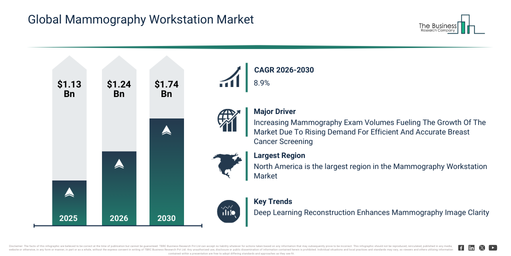
The mammography workstation market has experienced robust growth in recent years. It is projected to expand from $1.13 billion in 2025 to $1.24 billion in 2026, demonstrating a compound annual growth rate (CAGR) of 9.2%. This historical expansion can be attributed to various factors including the increasing adoption of digital mammography systems, a growing demand for early breast cancer screening, a notable shift from film-based imaging to softcopy reading, the increasing deployment of mammography workstations in hospitals, and the growing use of the breast imaging reporting and data system (BI-RADS).
The mammography workstation market size is set for significant expansion over the next few years, with projections indicating it will reach $1.74 billion by 2030, demonstrating a compound annual growth rate (CAGR) of 8.9%. This growth throughout the forecast period stems from the increasing adoption of three-dimensional breast tomosynthesis workstations, greater integration of multimodality breast imaging, and a rising demand for advanced clinical review and diagnostic screening tools. Furthermore, the expansion of government-led breast cancer screening programs and a heightened preference for workstation software upgrades and automation are also contributing factors. Prominent trends expected during this period include technological progress in artificial intelligence-assisted breast image analysis, innovations in high-resolution five-megapixel and eight-megapixel displays, developments in multimodality diagnostic imaging workstations, ongoing research and advancements in synthetic two-dimensional imaging and breast tomosynthesis, and improvements in workflow automation along with smart hanging protocols.
Get A Free Sample Report With In-Depth Market Insights:
Mammography Workstation Market Growth Catalysts And Demand Drivers
The escalating number of mammography exams is anticipated to stimulate the expansion of the mammography workstation market. This rise in annual breast imaging procedures is driven by an aging global populace and enhanced public health initiatives focused on early cancer identification. Progress in digital imaging technology mandates sophisticated tools to manage the growing volume of mammography exams, as they require high-performance systems for efficient interpretation of intricate 3D tomosynthesis data. Mammography workstations facilitate optimized diagnostic workflows through the incorporation of advanced visualization software and artificial intelligence, thereby assisting radiologists in detecting abnormalities with improved speed and accuracy. For example, the United States Food and Drug Administration (FDA), a US-based federal agency responsible for protecting public health, reported 8,823 total certified mammography facilities with 25,098 accredited units as of August 1, 2023, an increase from 8,790 certified facilities recorded on October 1, 2022. Consequently, the increasing mammography exam volumes are propelling the growth of the mammography workstation market.
Mammography Workstation Market Segment Trends And Revenue Contributors
The mammography workstation market covered in this report is segmented –
1) By Product Type: Multimodality Mammography Workstations, Standalone Mammography Workstations
2) By Modality: Two Dimensional (2D) Mammography, Three Dimensional (3D) Mammography, Digital Mammography, Other Modalities
3) By Deployment Mode: On-Premises Workstations, Cloud-Based Workstations
4) By Application: Diagnostic Screening, Clinical Review, Advanced Imaging, Other Applications
5) By End-User: Hospitals, Diagnostic Centers, Specialty Clinics, Other End-Users
Subsegments:
1) By Multimodality Mammography Workstations: Breast Imaging Integration, Advanced Image Processing, Artificial Intelligence Assisted Analysis, Workflow Optimization Tools, Reporting And Documentation Modules, Quality Assurance And Compliance Tools
2) By Standalone Mammography Workstations: Dedicated Image Viewing, High Resolution Display Systems, Image Storage And Archiving, Annotation And Measurement Tools, Case Management And Review, Data Security And Access Control
Mammography Workstation Market Trends Shaping Long-Term Demand
Companies operating in the mammography workstation market are concentrating on developing advanced products, such as deep learning reconstruction software, to enhance efficiency, boost diagnostic confidence, and minimize manual effort and reading time. Deep learning reconstruction software involves sophisticated algorithms that leverage artificial intelligence to process and reconstruct mammography images, thereby improving their clarity and detail. As an illustration, in November 2025, GE HealthCare Technologies Inc., a US-based medical technology company, secured U.S. Food and Drug Administration (FDA) Premarket Authorization for Pristina Recon DL, a deep learning-based 3D mammography image reconstruction technology. This new AI-driven technology utilizes two sequential deep learning models to distinguish meaningful signal from noise, yielding high-fidelity 3D volumes with fewer artifacts and clearer synthesized 2D views. The company states it is the first mammography technology to combine deep learning with iterative reconstruction for digital breast tomosynthesis (DBT) without increasing radiation dose. The system features zero-click acquisition and personalized protocols, allowing for seamless workflow integration and a patient-centric design, which improves operational efficiency for breast imaging centers.
Mammography Workstation Market Leading Players And Competitive Positioning
Major companies operating in the mammography workstation market are Siemens Healthineers AG, Fujifilm Holdings Corporation, Koninklijke Philips N.V., GE Healthcare Technologies Inc., Hologic Inc., Agfa-Gevaert N.V., Barco N.V., Carestream Health Inc., EIZO Corporation, Konica Minolta Business Solutions India Pvt. Ltd., Sectra AB, Candelis Corporation, Planmed Inc., iCAD Inc., Medequal Systems & Supplies Inc., Aycan Medical Systems LLC, Metaltronica S.p.A., Three Palm Software Inc., IMS Giotto S.p.A, Medi-Future Inc.
View The Full Mammography Workstation Market Report:
Mammography Workstation Market Regional Split: Which Areas Are Fueling Growth?
North America was the largest region in the Mammography Workstation market in 2025. Asia-Pacific is expected to be the fastest-growing region in the forecast period. The regions covered in the mammography workstation market report are Asia-Pacific, South East Asia, Western Europe, Eastern Europe, North America, South America, Middle East, Africa.
Reach Out To Our Team:
The Business Research Company: https://www.thebusinessresearchcompany.com/
Americas: +1 310-496-7795
Asia: +44 7882 955267 & +91 8897263534
Europe: +44 7882 955267
Email us at: marketing@tbrc.info
Follow us on:
LinkedIn: https://in.linkedin.com/company/the-business-research-company
YouTube: https://www.youtube.com/channel/UC24_fI0rV8cR5DxlCpgmyFQ
Global Market Model: https://www.thebusinessresearchcompany.com/global-market-model