Built to provide research that’s more actionable and strategically valuable, The Business Research Company’s 2026 market reports include market attractiveness analysis, total addressable market sizing, company benchmarking matrices, interactive Excel dashboards, broader supply chain intelligence, emerging startup tracking, and in-depth product insights.
Microproteins Skincare Market CAGR Outlook And Future Development
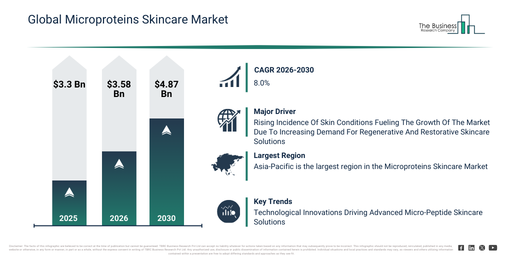
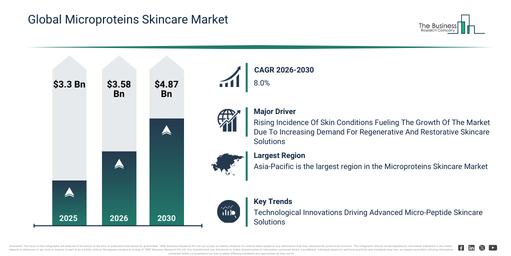
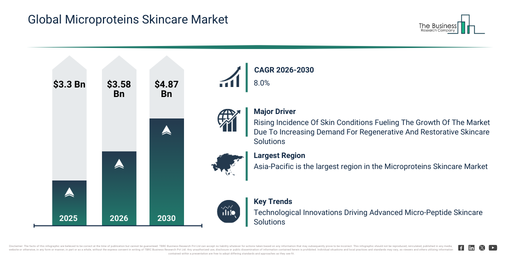
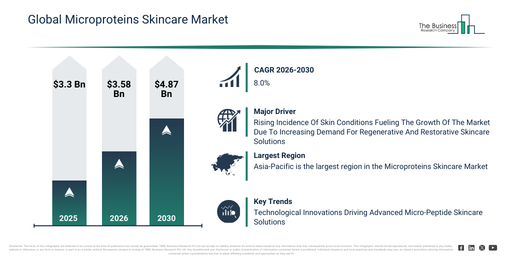
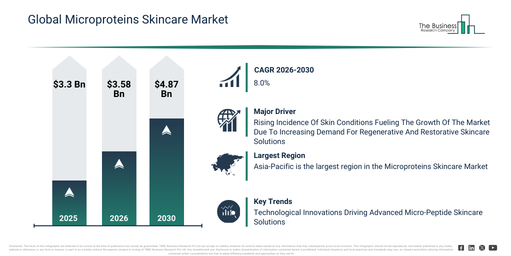
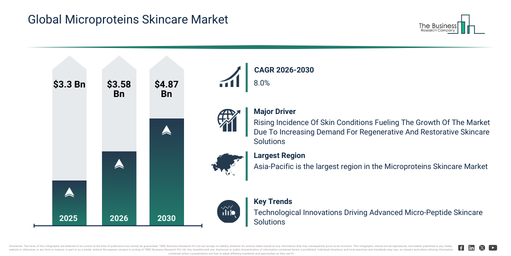
The microproteins skincare market has experienced robust expansion over recent years. It is projected to increase from $3.3 billion in 2025 to $3.58 billion in 2026, achieving a compound annual growth rate (CAGR) of 8.3%. This historical growth can be ascribed to a growing consumer emphasis on anti-aging skincare, rising demand for premium cosmetic products, the expansion of clinical-grade skincare offerings, the increasing influence of dermatological research, and the wider availability of advanced cosmetic formulations.
The microproteins skincare market is poised for robust expansion in the coming years, with its size projected to reach $4.87 billion by 2030, demonstrating a compound annual growth rate (CAGR) of 8.0%. This anticipated growth during the forecast period is fueled by increased investments in protein-based skincare research and development, a growing preference for non-invasive anti-aging solutions, the proliferation of biotech-enabled cosmetic innovations, a rising demand for multifunctional skincare products, and the greater adoption of personalized beauty treatments. Significant trends expected during this period include the broadening acceptance of microprotein-based anti-aging items, an escalating need for deep-penetration skincare actives, a heightened emphasis on stimulating collagen and elastin, the development of advanced high-performance skincare formulations, and a stronger focus on cellular repair solutions.
Get A Free Sample Report With In-Depth Market Insights:
Microproteins Skincare Market Demand Drivers: What’s Powering Industry Growth?
The increasing occurrence of skin conditions is anticipated to propel the expansion of the microprotein skincare market in the future. These conditions refer to disorders or abnormalities impacting the skin’s structure, appearance, or function, including acne, eczema, psoriasis, and infections. The prevalence of skin conditions is growing as more consumers and healthcare professionals recognize the influence of environmental, lifestyle, and genetic factors on skin well-being, leading to a prioritization of targeted skincare solutions to manage and prevent these issues. Microprotein skincare products play a vital role in addressing skin conditions by promoting skin regeneration, repairing damaged tissues, enhancing barrier function, and reducing inflammation to restore overall skin health. For instance, in March 2025, according to the Chronic Skin Conditions statistics report published by the British Dermatological Nursing Group, a UK-based independent professional organization, melanoma cases in Northern Ireland are projected to increase by 28% by 2040, potentially adding an estimated $4.8 million (£3.8 million) in annual healthcare costs. Consequently, the rising incidence of skin conditions is driving the growth of the microprotein skincare market.
Microproteins Skincare Market Segments: Where Is Growth Concentrated?
The microproteins skincare market covered in this report is segmented –
1) By Product Type: Creams, Serums, Masks, Lotions
2) By Distribution Channel: Online, Offline
3) By Application: Anti-aging, Moisturizing, Acne Treatment, Sensitive Skin
Subsegments:
1) By Creams: Anti-Aging Creams, Brightening Creams, Hydrating Creams, Firming Creams
2) By Serums: Anti-Wrinkle Serums, Hydration Serums, Brightening Serums, Repair Serums
3) By Masks: Sheet Masks, Clay Masks, Gel Masks, Cream Masks
4) By Lotions: Moisturizing Lotions, Brightening Lotions, Firming Lotions, Soothing Lotions
Microproteins Skincare Market Innovation Trends: What Developments Are Reshaping The Industry?
Leading companies in the microprotein skincare market are prioritizing the development of technologically innovative solutions, such as proprietary micropeptide technology, to improve skin regeneration, boost collagen synthesis, and deliver targeted anti-aging benefits. Proprietary micro-peptide technology describes a unique, company-specific process that generates bioactive micro-peptides engineered to penetrate the skin deeply and activate natural regeneration, collagen synthesis, and repair mechanisms for superior skincare results.
Microproteins Skincare Market Key Participants And Competitive Landscape
Major companies operating in the microproteins skincare market are BASF SE, Kenvue Inc., Natura Bissé International S.A., Croda International Plc, Indeed Laboratories Inc., Geltor Inc., HydroPeptide LLC, BeautyStat Inc., Numaferm GmbH, AnteAGE Inc., CLR Chemisches Laboratorium, Erasa Skincare LLC, Intoxicated Cosmetics LLC, Kiwla Co. Ltd., Loti Labs LLC, Merz Pharma GmbH & Co. KGaA, OneSkin Inc., Peach and Lily Inc., Skin Actives Scientific LLC, Topaz Biosciences Inc.
View The Full Microproteins Skincare Market Report:
Microproteins Skincare Market Geographic Landscape: Which Region Leads Industry Growth?
Asia-Pacific was the largest region in the microproteins skincare market in 2025. North America is expected to be the fastest-growing region in the forecast period. The regions covered in the microproteins skincare market report are Asia-Pacific, South East Asia, Western Europe, Eastern Europe, North America, South America, Middle East, Africa.
Reach Out To Our Team:
The Business Research Company: https://www.thebusinessresearchcompany.com/
Americas: +1 310-496-7795
Asia: +44 7882 955267 & +91 8897263534
Europe: +44 7882 955267
Email us at: marketing@tbrc.info
Follow us on:
LinkedIn: https://in.linkedin.com/company/the-business-research-company
YouTube: https://www.youtube.com/channel/UC24_fI0rV8cR5DxlCpgmyFQ
Global Market Model: https://www.thebusinessresearchcompany.com/global-market-model