Tag: microtubule inhibitor chemotherapy drugs market forecast

  • Microtubule Inhibitor Chemotherapy Drugs Market Outlook 2025: Mapping Growth, Innovation, and Regional Shifts

    Microtubule Inhibitor Chemotherapy Drugs Market Outlook 2025: Mapping Growth, Innovation, and Regional Shifts

    Claim your 30% discount on Global Market Reports with code ONLINE30. Limited time only.

    What is the Projected CAGR for the Microtubule Inhibitor Chemotherapy Drugs Market Size from 2025 to 2034?

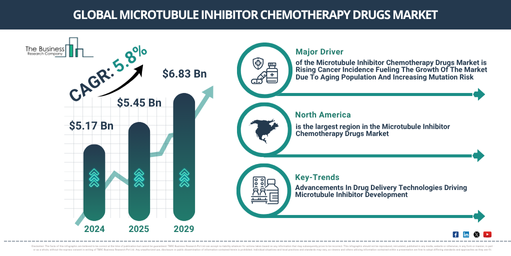
    In recent times, the microtubule inhibitor chemotherapy drugs market has witnessed robust growth. The market size, which is poised at $5.17 billion in 2024, is projected to escalate to $5.45 billion in 2025, registering a compound annual growth rate (CAGR) of 5.5%. The surge observed in the historic period can be linked to the expansion of precision medicine, the upswing in research for targeted cancer therapy, the growing incidence of metastatic cancer, an increase in healthcare investments, and a heightened emphasis on cancer survival rates.

    The market for chemotherapy drugs that inhibit microtubules is anticipated to experience robust expansion in the forthcoming years. Its worth is estimated to reach $6.83 billion by 2029, with a compound annual growth rate (CAGR) of 5.8%. This considerable increase in the projection period can be due to a rise in cancer cases, an enlarging aging demographic, enhanced awareness about cancer, an increase in chemotherapy alternatives, and favorable policies from the government. The forecast period is also set to see significant trends such as enhanced drug formulations, the availability of generics, the development of combined treatment options, progress in nanotechnology, and bettered delivery systems.

    Download a free sample to assess the report’s scope and structure:

    https://www.thebusinessresearchcompany.com/sample.aspx?id=24323&type=smp

    What External and Internal Drivers Are Contributing to the Growth of theMicrotubule Inhibitor Chemotherapy Drugs Market?

    The burgeoning incidence of cancer is predicted to be a key factor propelling the growth of the microtubule inhibitor chemotherapy drugs market. Cancer encompasses a group of disorders characterized by uncontrolled cell growth with the capability of invading or spreading to other body parts. The rise in cancer cases is being influenced by the aging population, as older people are more prone to genetic mutations and extended exposure to carcinogens, elevating their cancer risk. Microtubule inhibitor chemotherapy drugs serve to treat cancer by impeding cell division, targeting critical microtubules required for mitosis, effectively limiting cancer cell expansion. For example, in February 2024, the World Health Organization, an intergovernmental organization based in Switzerland, predicted a considerable upsurge in cancer cases, from 20 million in 2022 to an additional 35 million by 2050. Therefore, the escalating incidence of cancer is a significant driver for the growth of the microtubule inhibitor chemotherapy drugs market.

    What Segment Types Define the Microtubule Inhibitor Chemotherapy Drugs Market Structure?

    The microtubule inhibitor chemotherapy drugs market covered in this report is segmented –

    1) By Drug Type: Vinca Alkaloids, Taxanes, Epothilones, Other Drug Types

    2) By Mechanism Of Action: Spindle Poisoning Agents, Microtubule Stabilizers, Microtubule Destabilizers, Dual-Action Inhibitors

    3) By Administration Route: Intravenous (IV), Oral, Subcutaneous, Intraperitoneal

    4) By Patient Demographics: Pediatric Patients, Adult Patients, Geriatric Patients, Gender-Specific Considerations

    5) By Application Area: Breast Cancer, Lung Cancer, Ovarian Cancer, Lymphomas, Other Application Areas

    Subsegments:

    1) By Vinca Alkaloids: Vincristine, Vinblastine, Vinorelbine, Vindesine

    2) By Taxanes: Paclitaxel, Docetaxel, Cabazitaxel, Nab-paclitaxel

    3) By Epothilones: Ixabepilone, Epothilone B

    4) By Other Drug Types: Eribulin, Estramustine, Novel Synthetic Microtubule Inhibitors

    Request customized data on this market:

    https://www.thebusinessresearchcompany.com/customise?id=24323&type=smp

    Which Geographic Areas Hold the Strongest Growth Potential in the Microtubule Inhibitor Chemotherapy Drugs Market?

    North America was the largest region in the microtubule inhibitor chemotherapy drugs market in 2024. Asia-Pacific is expected to be the fastest-growing region in the forecast period. The regions covered in the microtubule inhibitor chemotherapy drugs market report are Asia-Pacific, Western Europe, Eastern Europe, North America, South America, Middle East, Africa.

    What Long-Term Trends Are Transforming the Competitive Landscape of the Microtubule Inhibitor Chemotherapy Drugs Market?

    Leading firms in the microtubule inhibitor chemotherapy drugs market are concentrating their efforts on creating sophisticated solutions such as albumin-bound formulations to improve the delivery of drugs to tumours. These formulations are a type of drug format where the active pharmaceutical component is bound to albumin, a protein known to enhance drug solubility, stability and the precision of delivery to cancer cells. A case in point is Sandoz AG, a pharmaceutical entity based in Switzerland, that revealed in October 2024 that it would launch its generic version of paclitaxel in the United States. The freshly introduced formula is a freeze-dried powder for injection contained in a 100 mg single-dose vial. The use of paclitaxel protein-bound particles for injectable suspension (albumin-bound), a microtubule inhibitor, is recommended for metastatic breast cancer patients who didn’t respond to combined chemotherapy for metastatic diseases or suffered a recurrence within six months of adjuvant chemotherapy.

    View the full report here:

    https://www.thebusinessresearchcompany.com/report/microtubule-inhibitor-chemotherapy-drugs-global-market-report

    What Is the Definition of the Microtubule Inhibitor Chemotherapy Drugs Market?

    Microtubule inhibitor chemotherapy drugs are anticancer agents that interfere with the function of microtubules, which are essential for cell division. These drugs prevent cancer cells from successfully dividing by disrupting the normal formation and breakdown of microtubules during mitosis.

    Purchase the full report and get a swift delivery:

    https://www.thebusinessresearchcompany.com/purchaseoptions.aspx?id=24323

    About The Business Research Company:

    With over 15000+ reports from 27 industries covering 60+ geographies, The Business Research Company has built a reputation for offering comprehensive, data-rich research and insights. Armed with 1,500,000 datasets, the optimistic contribution of in-depth secondary research, and unique insights from industry leaders, you can get the information you need to stay ahead in the game.

    Get in touch with us:

    The Business Research Company: https://www.thebusinessresearchcompany.com/

    Americas +1 310-496-7795

    Europe +44 7882 955267

    Asia & Others +44 7882 955267 & +91 8897263534

    Email us at info@tbrc.info

    Follow us on:

    LinkedIn: https://in.linkedin.com/company/the-business-research-company

    YouTube: https://www.youtube.com/channel/UC24_fI0rV8cR5DxlCpgmyFQ

    Global Market Model: https://www.thebusinessresearchcompany.com/global-market-model

  • Microtubule Inhibitor Chemotherapy Drugs Industry Growth Expected to Reach $6.99 Billion by 2029 at a CAGR of 6.2% | Segmentation and Growth Opportunities

    Microtubule Inhibitor Chemotherapy Drugs Industry Growth Expected to Reach $6.99 Billion by 2029 at a CAGR of 6.2% | Segmentation and Growth Opportunities

    Claim your 30% discount on Global Market Reports with code ONLINE30. Limited time only.

    What Is the Forecast for the Microtubule Inhibitor Chemotherapy Drugs Market Growth in 2025?

    The market size for chemotherapy drugs that inhibit microtubules has been experiencing substantial growth in the previous years. There will be an increase from $5.17 billion in 2024 to $5.50 billion in 2025, at a Compound Annual Growth Rate (CAGR) of 6.5%. The growth during the historic period can be linked to the rise of precision medicine, expanded research for targeted cancer therapies, the escalating occurrence of metastatic cancer, increasing healthcare investments, and a notable emphasis on improving cancer survival rates.

    What Is the Forecast for the Microtubule Inhibitor Chemotherapy Drugs Market Size Through 2029?

    The market size for chemotherapy drugs that inhibit microtubules is predicted to show robust growth in the forthcoming years. By 2029, it’s anticipated to reach a value of $6.99 billion with a compound annual growth rate (CAGR) of 6.2%. This expected growth during the projected period can be associated with factors such as an increase in cancer rates, an ageing populace, heightened awareness of cancer, an increased array of chemotherapy treatments, and helpful initiatives from the government. The forecast period also sees trends such as enhanced drug formulations, the presence of generic drugs, progression in combination therapies, developments in nanotechnology, and advancements in delivery mechanisms.

    Download The Free Sample Report Here:

    https://www.thebusinessresearchcompany.com/sample.aspx?id=24323&type=smp

    What are the Key Market Players in Microtubule Inhibitor Chemotherapy Drugs Market and How They’re Evolving?

    Major companies operating in the microtubule inhibitor chemotherapy drugs market are Pfizer Inc., Sanofi S.A., Bristol-Myers Squibb Company, Fresenius Kabi AG, Eli Lilly and Company, Teva Pharmaceutical Industries Ltd., Intas Pharmaceuticals Ltd., Sun Pharmaceutical Industries Limited, Eisai Co. Ltd., Aurobindo Pharma Limited, Dr. Reddy’s Laboratories Ltd., Cipla Limited, Hikma Pharmaceuticals PLC, Zydus Lifesciences Limited, Gland Pharma Limited, Natco Pharma Limited, Minakem, Selleck Chemicals LLC, Accord Healthcare Ltd., Focus Biomolecules LLC

    What Are the Primary Growth Drivers in the Microtubule Inhibitor Chemotherapy Drugs Market?

    The escalating incidence of cancer is projected to propel the expansion of the microtubule inhibitor chemotherapy drugs market in the future. Cancer, a group of diseases characterized by abnormal cell growth that can potentially invade surrounding tissues or disseminate to other parts of the body, is becoming increasingly common. The elderly population plays a part in the surge of cancer cases, as they are more prone to accruing genetic mutations and having prolonged contact with carcinogens, thereby heightening their propensity for cancer. For cancer treatment, microtubule inhibitor chemotherapy drugs are administered to impede cell division by attacking the mitosis-critical microtubules, effectively stopping cancer cells from multiplying quickly. For example, the World Health Organization, an intergovernmental organization based in Switzerland, forecasted in February 2024 that cancer cases will see a significant jump, from 20 million in 2022 to over 35 million more by 2050. Hence, the upswing in cancer incidence is catalyzing the expansion of the microtubule inhibitor chemotherapy drugs market.

    Request For A Customized Report:

    https://www.thebusinessresearchcompany.com/sample.aspx?id=24323&type=smp

    What Are the Leading Segments in the Global Microtubule Inhibitor Chemotherapy Drugs Industry?

    The microtubule inhibitor chemotherapy drugs market covered in this report is segmented –

    1) By Drug Type: Vinca Alkaloids, Taxanes, Epothilones, Other Drug Types

    2) By Mechanism Of Action: Spindle Poisoning Agents, Microtubule Stabilizers, Microtubule Destabilizers, Dual-Action Inhibitors

    3) By Administration Route: Intravenous (IV), Oral, Subcutaneous, Intraperitoneal

    4) By Patient Demographics: Pediatric Patients, Adult Patients, Geriatric Patients, Gender-Specific Considerations

    5) By Application Area: Breast Cancer, Lung Cancer, Ovarian Cancer, Lymphomas, Other Application Areas

    Subsegments:

    1) By Vinca Alkaloids: Vincristine, Vinblastine, Vinorelbine, Vindesine

    2) By Taxanes: Paclitaxel, Docetaxel, Cabazitaxel, Nab-paclitaxel

    3) By Epothilones: Ixabepilone, Epothilone B

    4) By Other Drug Types: Eribulin, Estramustine, Novel Synthetic Microtubule Inhibitors

    What Are the Key Market Trends in the Microtubule Inhibitor Chemotherapy Drugs Industry?

    Leading firms in the microtubule inhibitor chemotherapy drugs market are strategizing to develop innovative solutions like albumin-bound formulations to improve drug delivery to tumors. An albumin-bound formulation involves a drug with its active pharmaceutical ingredient linked to albumin, a protein that enhances drug solubility, stability and targeted delivery to cancer cells. For example, in October 2024, Sandoz AG, a pharma company based in Switzerland, launched its generic version of paclitaxel in the U.S. The recently introduced formulation is a lyophilized powder for injection, available in a single-dose 100 mg vial. The paclitaxel protein-bound particles for injectable suspension – a microtubule inhibitor – is recommended for treating metastatic breast cancer patients who have either remained non-responsive to combination chemotherapy for metastatic disease or have relapsed within six months after adjuvant chemotherapy.

    Access The Full Report Here:

    https://www.thebusinessresearchcompany.com/report/microtubule-inhibitor-chemotherapy-drugs-global-market-report

    What Is the Regional Outlook for the Microtubule Inhibitor Chemotherapy Drugs Market?

    North America was the largest region in the microtubule inhibitor chemotherapy drugs market in 2024. Asia-Pacific is expected to be the fastest-growing region in the forecast period. The regions covered in the microtubule inhibitor chemotherapy drugs market report are Asia-Pacific, Western Europe, Eastern Europe, North America, South America, Middle East, Africa.

    Purchase The Full Report Today:

    https://www.thebusinessresearchcompany.com/customise?id=24323&type=smp

    This Report Delivers Insight On:

    1. How big is the microtubule inhibitor chemotherapy drugs market, and how is it changing globally?

    2. Who are the major companies in the microtubule inhibitor chemotherapy drugs market, and how are they performing?

    3. What are the key opportunities and risks in the microtubule inhibitor chemotherapy drugs market right now?

    4. Which products or customer segments are growing the most in the microtubule inhibitor chemotherapy drugs market?

    5. What factors are helping or slowing down the growth of the microtubule inhibitor chemotherapy drugs market?

    About The Business Research Company:

    With over 15000+ reports from 27 industries covering 60+ geographies, The Business Research Company has built a reputation for offering comprehensive, data-rich research and insights. Armed with 1,500,000 datasets, the optimistic contribution of in-depth secondary research, and unique insights from industry leaders, you can get the information you need to stay ahead in the game.

    Get in touch with us:

    The Business Research Company: https://www.thebusinessresearchcompany.com/

    Americas +1 310-496-7795

    Europe +44 7882 955267

    Asia & Others +44 7882 955267 & +91 8897263534

    Email us at info@tbrc.info

    Follow us on:

    LinkedIn: https://in.linkedin.com/company/the-business-research-company

    YouTube: https://www.youtube.com/channel/UC24_fI0rV8cR5DxlCpgmyFQ

    Global Market Model: https://www.thebusinessresearchcompany.com/global-market-model