Built to provide research that’s more actionable and strategically valuable, The Business Research Company’s 2026 market reports include market attractiveness analysis, total addressable market sizing, company benchmarking matrices, interactive Excel dashboards, broader supply chain intelligence, emerging startup tracking, and in-depth product insights.
Neurointerventional Devices Market Size And Revenue Outlook Through 2030
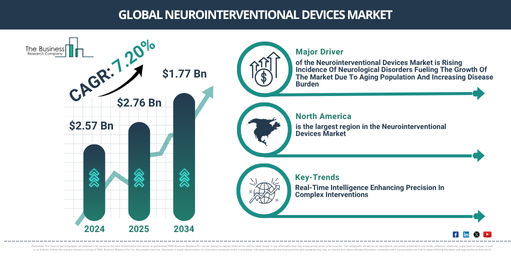
The neurointerventional devices market size has shown substantial growth in recent years. This market is set to expand from $2.76 billion in 2025 to $2.97 billion in 2026, demonstrating a compound annual growth rate (CAGR) of 7.6%. The expansion observed historically can be attributed to the rising incidence of stroke and aneurysm, ongoing improvements in catheter and stent design, an increase in neurology specialist training programs, the wider adoption of minimally invasive procedures, and the expansion of neurovascular departments in hospitals.
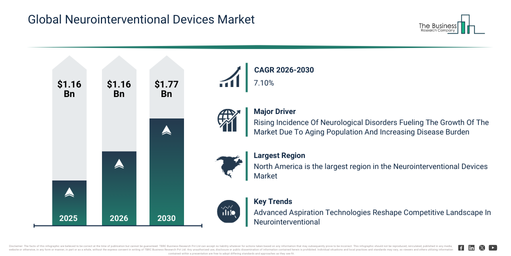
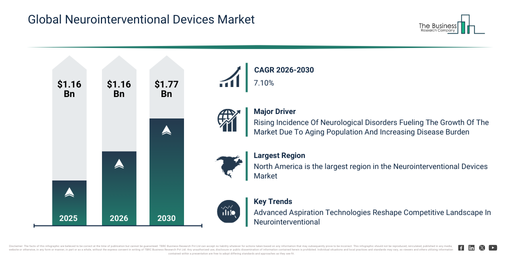
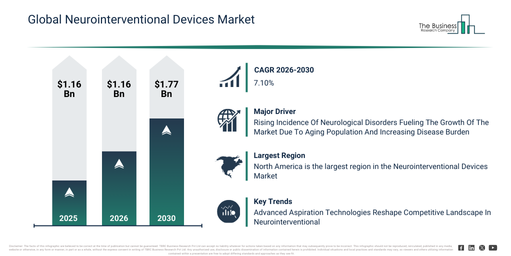
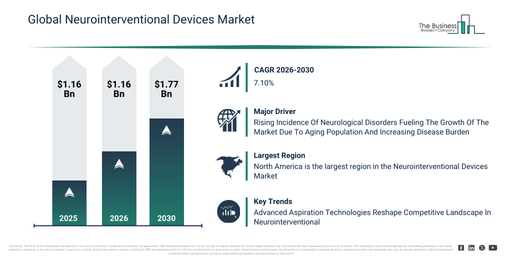
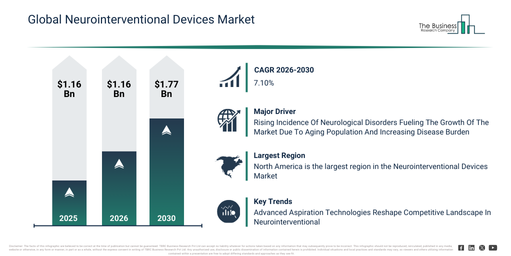
The neurointerventional devices market is projected to experience substantial expansion in the coming years. By 2030, this market is anticipated to reach a valuation of $3.91 billion, demonstrating a compound annual growth rate (CAGR) of 7.1%. Key factors driving this growth during the forecast period include the expanding aging population, increased funding for neurovascular research, the proliferation of comprehensive stroke centers, the necessity for quicker reperfusion results, and rising healthcare spending in developing nations. Significant trends expected during this period involve the advancement of image-guided neurointervention, a move towards less invasive stroke treatments, greater uptake of flow diversion technologies, increased need for devices that rapidly retrieve clots, and the wider availability of neurointerventional procedures in emerging markets.
Get A Free Sample Report With In-Depth Market Insights:
Neurointerventional Devices Market Development Factors: What’s Supporting Demand?
The increasing occurrence of neurological disorders is anticipated to stimulate the expansion of the neurointerventional devices market going forward. A neurological disorder refers to any condition impacting the brain, spinal cord, or nerves, thereby disrupting their normal functioning. The escalation in neurological disorders is primarily driven by an aging global population, as advancing age heightens the risk of neurodegenerative conditions due to the natural decline in brain function and cellular repair mechanisms. Neurointerventional devices aid in managing neurological disorders by enabling minimally invasive procedures for the diagnosis and treatment of conditions such as brain aneurysms, strokes, and vascular malformations, consequently reducing risk and recovery time and improving patient outcomes. For instance, in April 2024, according to a report by the Alzheimer’s Association, a US-based nonprofit voluntary health organization, in 2022, 6.5 million Americans aged 65 and older were diagnosed with Alzheimer’s dementia, a number projected to increase to 6.9 million in 2024. Therefore, the rising incidence of neurological disorders is fueling the growth of the neurointerventional devices market.
Neurointerventional Devices Market Breakdown By Product Type And Application
The neurointerventional devices market covered in this report is segmented –
1) By Product: Embolic Coils, Carotid Stents, Intracranial Stents, Neurovascular Thrombectomy, Embolic Protection Device, Flow Diverters Device, Intrasaccular Device, Other Products
2) By Indication: Brain Aneurysm, Stroke, Other Indications
3) By Technique: Neurothrombectomy Procedure, Cerebral Angiography, Stenting, Coiling Procedures, Flow Disruption
4) By End User: Hospitals, Ambulatory Surgical Centers, Specialty Clinics, Research Institutes
Subsegments:
1) By Embolic Coils: Bare Platinum Coils, Coated Or Modified Coils, Complex-Shaped Coils, Detachable Coils
2) By Carotid Stents: Open-Cell Stents, Closed-Cell Stents, Hybrid-Cell Stents, Drug-Eluting Stents
3) By Intracranial Stents: Self-Expanding Stents, Balloon-Expandable Stents, Drug-Eluting Stents
4) By Neurovascular Thrombectomy Devices: Stent Retrievers, Aspiration Catheters, Combined Thrombectomy Systems
5) By Embolic Protection Devices: Distal Filters, Proximal Occlusion Devices, Distal Occlusion Devices
6) By Flow Diverters Devices: Braided Flow Diverters, Dual-Layer Flow Diverters, Coated Flow Diverters
7) By Intrasaccular Devices: Woven Mesh Implants, Expandable Mesh Baskets, Flow Disrupting Implants
8) By Other Products: Microcatheters, Guidewires, Balloon Catheters, Distal Access Catheters
Neurointerventional Devices Market Transformation Trends: What Innovations Are Driving Change?
Leading companies within the neurointerventional devices market are focusing on developing advanced solutions, such as large-bore aspiration reperfusion catheters equipped with sophisticated delivery aids. These aspiration reperfusion catheters are elongated, flexible devices featuring a large lumen, specifically engineered to deliver powerful distal vacuum aspiration directly to the clot site. Unlike conventional stent-retriever techniques, they emphasize direct aspiration, sometimes in conjunction with adjunctive devices, to clear occlusions with fewer device passes, reduced device complexity at the clot interface, and potentially a more efficient procedure workflow. For instance, in May 2024, Penumbra Inc., a US-based medical device company, introduced RED 43, RED 72 with SENDit Technology, and RED 78, a new line of neurovascular reperfusion catheters launched in Europe, expanding the company’s aspiration-based thrombectomy portfolio. The RED devices are constructed with multi-layer catheter shafts, incorporating PTFE liners and hybrid stainless steel/nitinol coils, along with precision polymer distal tips, to balance lumen size with distal trackability. They operate by advancing the catheter to or near the thrombus and applying aspiration through Penumbra’s ENGINE aspiration source to extract the clot. Distinctive features include engineered transition zones and REDglide technology for enhanced deliverability through tortuous vessels, alongside a diverse selection of lumen sizes.
Neurointerventional Devices Market Competitive Landscape: Who Leads The Industry?
Major companies operating in the neurointerventional devices market are Medtronic plc, Stryker Corporation, Johnson And Johnson, Abbott Laboratories, Boston Scientific Corporation, Terumo Corporation, Kaneka Corporation, Cook Medical LLC, Merit Medical Systems Inc., MicroPort Scientific Corporation, Penumbra Inc., Asahi Intecc Co Ltd, MicroVention Inc, Phenox GmbH, Balt Group SAS, Balton Sp z o o, Zylox Tonbridge Medical Technology Co Ltd, Veiva Scientific Co Ltd, InspireMD Inc, Rapid Medical Ltd, Wallaby Medical, Cerus Endovascular Ltd
View The Full Neurointerventional Devices Market Report:
Neurointerventional Devices Market Geographic Landscape: Which Region Leads Industry Growth?
North America was the largest region in the neurointerventional market in 2025. The regions covered in the neurointerventional devices market report are Asia-Pacific, South East Asia, Western Europe, Eastern Europe, North America, South America, Middle East, Africa.
Reach Out To Our Team:
The Business Research Company: https://www.thebusinessresearchcompany.com/
Americas: +1 310-496-7795
Asia: +44 7882 955267 & +91 8897263534
Europe: +44 7882 955267
Email us at: marketing@tbrc.info
Follow us on:
LinkedIn: https://in.linkedin.com/company/the-business-research-company
YouTube: https://www.youtube.com/channel/UC24_fI0rV8cR5DxlCpgmyFQ
Global Market Model: https://www.thebusinessresearchcompany.com/global-market-model