Featuring market attractiveness scoring, total addressable market sizing, company benchmarking matrices, interactive Excel dashboards, deeper supply chain intelligence, emerging startup tracking, and granular product-level insights, The Business Research Company’s 2026 market reports are built to deliver research that is both more actionable and more strategically valuable.
Operating-Room Instrument Sterile Robot Market Forecast: What Value Will The Market Reach By 2030?
The market size for operating-room instrument sterile robots has experienced rapid expansion recently. This market is projected to expand from $1.92 billion in 2025 to $2.18 billion in 2026, demonstrating a compound annual growth rate (CAGR) of 13.7%. Historically, this growth can be attributed to several factors including an increase in hospital-acquired infection rates, the wider adoption of robotic surgery, continuous technological advancements in sterilization, a heightened demand for procedural efficiency, and the overall expansion of healthcare robotics.
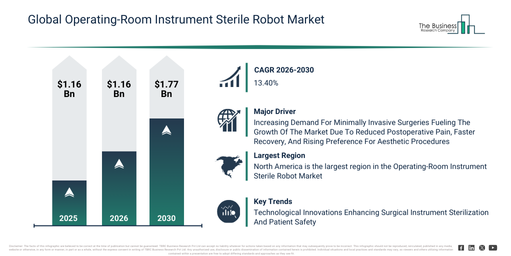
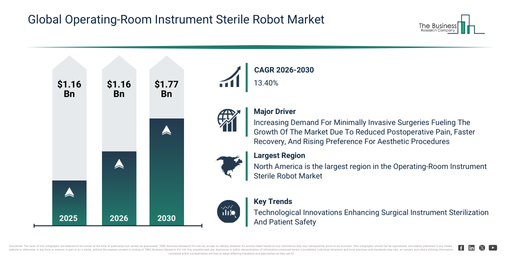
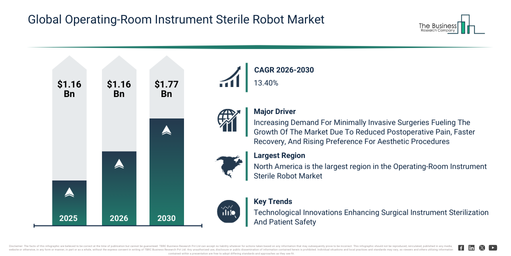
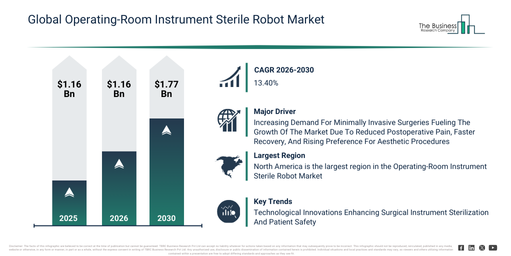
The operating-room instrument sterile robot market is poised for significant expansion over the coming years. This market is projected to reach $3.61 billion by 2030, exhibiting a compound annual growth rate (CAGR) of 13.4%. Key drivers for this anticipated growth during the forecast period include the integration with smart hospital ecosystems, AI-driven instrument tracking, an increase in ambulatory surgical centers, sophisticated chemical sterilization techniques, and more cost-effective robotic systems. Prominent trends expected in the forecast period encompass automated sterilization workflows, the adoption of UV-C and hydrogen peroxide sterilization, mobile sterile instrument robots, seamless integration with hospital IT systems, and hybrid semi-automated sterilization approaches.
Get A Free Sample Report With In-Depth Market Insights:
Operating-Room Instrument Sterile Robot Market Development Factors: What’s Supporting Demand?
The increasing demand for minimally invasive surgeries is anticipated to fuel the expansion of the operating-room instrument sterile robot market going forward. Minimally invasive surgeries are defined as surgical procedures carried out through small incisions utilizing specialized instruments and methods to lessen tissue harm and promote faster patient recovery. The heightened interest in minimally invasive surgeries stems from benefits like reduced postoperative pain, as smaller incisions minimize tissue damage and enhance patient comfort. Operating room sterile instrument robots contribute to meeting the demand for minimally invasive surgeries by ensuring consistently sterilized instruments, lowering infection risks, and facilitating the high precision required for such intricate procedures. For instance, in June 2024, according to the American Society of Plastic Surgeons, a US-based professional organization, minimally invasive procedures experienced a 7% growth in 2023, surpassing traditional surgical procedures by 2%. Consequently, the increasing demand for minimally invasive surgeries is driving the growth of the operating-room instrument sterile robot market.
Operating-Room Instrument Sterile Robot Market Segments: Where Is Growth Concentrated?
The operating-room instrument sterile robot market covered in this report is segmented –
1) By Product Type: Fully Automated Instrument Handling Robots, Semi-Automated Instrument Handling Robots, Hybrid Instrument Management Robots
2) By Sterility Maintenance Technology: UV-C Assisted Instrument Sterility Robots, Chemical-Based Local Instrument Sterility Robots, Enclosed Sterile Compartment Robots, Touchless Handling and Containment Robots
3) By Mobility Type: Mobile Operating-Room Instrument Robots, Fixed or Ceiling-Mounted Instrument Robots
4) By Application: General Surgery Operating Rooms, Orthopedic Surgery Operating Rooms, Cardiovascular Surgery Operating Rooms, Neurosurgery Operating Rooms, Minimally Invasive Surgery Operating Rooms
5) By End-User: Public Hospitals, Private Hospitals, Specialty Surgical Centers, Ambulatory Surgical Centers
Subsegments:
1) By Fully Automated Instrument Handling Robots: Autonomous Instrument Delivery Robots, Autonomous Instrument Retrieval Robots, Robotic Instrument Sorting and Organization Systems, Enclosed Sterile Instrument Transport Robots, AI-Guided Instrument Selection and Handover Robots
2) By Semi-Automated Instrument Handling Robots: Staff-Assisted Robotic Instrument Handling Systems, Robotic Instrument Positioning and Holding Devices, Partially Autonomous Instrument Transfer Robots, Touchless Instrument Pass-Through Robots, Human-in-the-Loop Instrument Management Robots
3) By Hybrid Instrument Management Robots: Instrument Handling Robots with Integrated Local Sterility Modules, Mobile-Fixed Hybrid Instrument Management Robots, Multi-Function Instrument Handling and Tracking Robots, Instrument Handling Robots Integrated with OR Workflow Systems, Sterile Instrument Logistics and Inventory Hybrid Robots
Operating-Room Instrument Sterile Robot Market Transformation Trends: What Innovations Are Driving Change?
Major companies within the operating-room instrument sterile robot market are concentrating on creating novel methodologies, such as whole-room pulsed UV germicidal sterilization. Their aim is to supply hospitals with sophisticated solutions that elevate surgical instrument sterilization, mitigate infection dangers, and enhance overall patient safety and operational effectiveness. Whole-room pulsed UV germicidal sterilization functions as a disinfection technique, employing high-intensity, broad-spectrum ultraviolet light pulses to eradicate microorganisms from surfaces throughout unoccupied spaces. As an illustration, in February 2023, Xenex Disinfection Services Inc., a US-based entity specializing in advanced ultraviolet (UV) light technology, unveiled the LightStrike+ whole-room pulsed UV germicidal sterilization system. This inventive apparatus is engineered to achieve rapid and efficient microbial reduction on non-porous, non-critical medical device surfaces within vacant operating rooms and clinical environments. It incorporates sophisticated safety features, biocompatibility evaluations, and software management to guarantee reliable sterilization, lessen the potential for hospital-acquired infections, and supplement current manual cleaning and disinfection procedures.
Operating-Room Instrument Sterile Robot Market Key Participants And Competitive Landscape
Major companies operating in the operating-room instrument sterile robot market are Intuitive Surgical Inc., Stryker Corporation, Johnson and Johnson, Medtronic plc, Zimmer Biomet Holdings Inc., Smith and Nephew plc, Asensus Surgical Inc., CMR Surgical Ltd., Medrobotics Corporation, Titan Medical Inc., Avateramedical GmbH, Medicaroid Corporation, Rob Surgical Systems S L, Moon Surgical SAS, SS Innovations International Inc., Virtuoso Surgical Inc., Vicarious Surgical Inc., Noah Medical Corporation, EndoQuest Robotics Inc., Medical Microinstruments SpA
View The Full Operating-Room Instrument Sterile Robot Market Report:
Operating-Room Instrument Sterile Robot Market Geographic Analysis: Where Is Demand Rising Fastest?
North America was the largest region in the operating-room instrument sterile robot market in 2025. Asia-Pacific is expected to be the fastest-growing region in the forecast period. The regions covered in the operating-room instrument sterile robot market report are Asia-Pacific, South East Asia, Western Europe, Eastern Europe, North America, South America, Middle East, Africa.
Reach Out To Our Team:
The Business Research Company: https://www.thebusinessresearchcompany.com/
Americas: +1 310-496-7795
Asia: +44 7882 955267 & +91 8897263534
Europe: +44 7882 955267
Email us at: marketing@tbrc.info
Follow us on:
LinkedIn: https://in.linkedin.com/company/the-business-research-company
YouTube: https://www.youtube.com/channel/UC24_fI0rV8cR5DxlCpgmyFQ
Global Market Model: https://www.thebusinessresearchcompany.com/global-market-model