Built to provide research that’s more actionable and strategically valuable, The Business Research Company’s 2026 market reports include market attractiveness analysis, total addressable market sizing, company benchmarking matrices, interactive Excel dashboards, broader supply chain intelligence, emerging startup tracking, and in-depth product insights.
Penile Cancer Market Value Growth And Long-Term Outlook
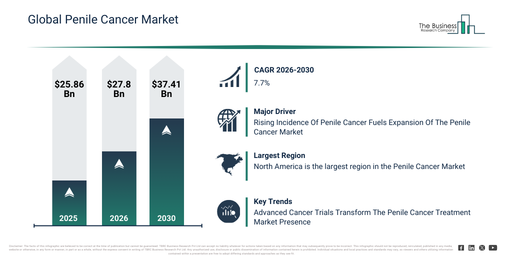
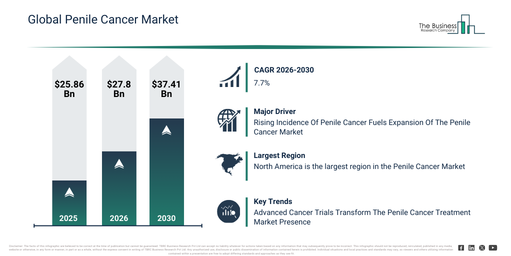
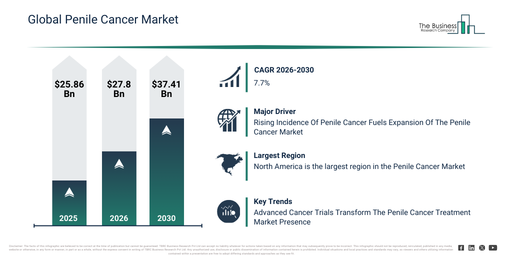
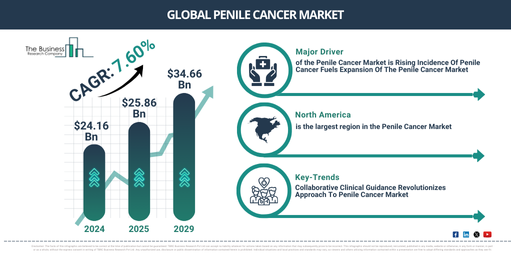
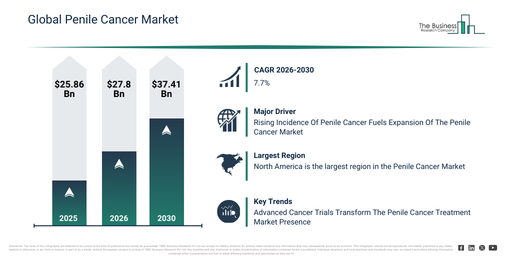
The penile cancer market has experienced significant growth in recent years. It is projected to expand from $25.86 billion in 2025 to $27.8 billion in 2026, demonstrating a compound annual growth rate (CAGR) of 7.5%. This historical growth can be attributed to factors such as limited awareness and screening, delayed diagnosis, a reliance on conventional surgery and chemotherapy, insufficient specialized treatment centers, and fragmented patient data.
The penile cancer market is projected to experience substantial expansion in the coming years, with its size anticipated to reach $37.41 billion by 2030, exhibiting a compound annual growth rate (CAGR) of 7.7%. This growth over the forecast period is primarily fueled by the increasing adoption of immunotherapy and biological treatments, the expanding use of personalized medicine approaches, the broader implementation of early detection programs, the surge in telemedicine and remote monitoring services, and increased investment in penile cancer research and awareness initiatives. Prominent trends expected during this period include the rising application of artificial intelligence for early diagnosis and risk assessment, the growing acceptance of genomics-based targeted therapies, the integration of cloud computing and big data for patient management, the deployment of IoT-enabled devices for monitoring treatment outcomes, and the implementation of smart manufacturing techniques in the production of biological therapies.
Get A Free Sample Report With In-Depth Market Insights:
Penile Cancer Market Demand Drivers: What’s Powering Industry Growth?
The escalating occurrence of penile cancer is set to propel the growth of the penile cancer market in the foreseeable future. Penile cancer involves the formation of malignant cells within the tissues of the penis. An uptick in the incidence of this cancer can potentially lead to an increased demand for diagnostic, surgical, and supportive care services, thereby influencing the penile cancer market. Consequently, the rising incidence of penile cancer is a key driver for the expansion of the penile cancer market. The surge in the geriatric population is anticipated to fuel the expansion of the penile cancer market moving forward. The geriatric population refers to individuals classified as elderly or older adults. Penile cancer predominantly affects older men, with its incidence increasing with advancing age. It has been treated using surgery, radiation therapy, and targeted therapy. An increase in the geriatric population heightens the probability of penile infection. Therefore, the growth in the geriatric population is significantly driving the growth of the penile cancer market.
Penile Cancer Market Segmentation: How Does The Market Break Down By Category?
The penile cancer market covered in this report is segmented –
1) By Type: Squamous Cell Cancer Of Penis, Aden Carcinoma Of Penis, Melanoma Of The Penis, Basal Cell Cancer Of Penis, Sarcoma Of Penis
2) By Type Of Therapy: Radiation Therapy, Chemotherapy, Biological Therapy, Surgery
3) By Diagnostic Test: Biopsy, Ultrasound, Imaging Tests
4) By Application: Hospital, Clinics, Other Applications
Subsegments:
1) By Squamous Cell Cancer Of Penis: Invasive Squamous Cell Carcinoma, Non-Invasive Squamous Cell Carcinoma
2) By Adenocarcinoma Of Penis: Penile Adenocarcinoma, Mucinous Adenocarcinoma, Non-Mucinous Adenocarcinoma
3) By Melanoma Of The Penis: Superficial Spreading Melanoma, Nodular Melanoma, Acral Lentiginous Melanoma
4) By Basal Cell Cancer Of Penis: Nodular Basal Cell Carcinoma, Superficial Basal Cell Carcinoma, Morpheaform Basal Cell Carcinoma
5) By Sarcoma Of Penis: Kaposi’s Sarcoma, Rhabdomyosarcoma
Penile Cancer Market Innovation Trends Shaping Future Development
Major companies operating in the penile cancer market are increasingly directing their efforts towards innovative solutions, including advanced cancer trials, to address unmet medical needs and enhance treatment outcomes. Advanced cancer trials involve the evaluation of new treatments, therapies, or medications on patients with late-stage cancer to determine their safety and effectiveness.
Penile Cancer Market Competitive Overview And Top Companies
Major companies operating in the penile cancer market are Pfizer Inc., Merck & Co. Inc., Bayer AG, Bristol-Myers Squibb Company, AstraZeneca PLC, Takeda Pharmaceutical Company Limited, Eli Lilly and Co Ltd., Amgen Inc., Astellas Pharma Inc., Daiichi Sankyo Company Limited, Eisai Co. Ltd., Novartis AG, F Hoffmann-La Roche Ltd, Johnson & Johnson, AbbVie Inc., GlaxoSmithKline plc, BeiGene Ltd., Iovance Biotherapeutics Inc, Lisata Therapeutics Inc, Halozyme Therapeutics Inc, Sotio Biotech, Sanofi S A, Genmab A S, Otsuka Pharmaceutical Co Ltd, Adaptimmune Therapeutics plc, Apceth Biopharma GmbH & Co KG
View The Full Penile Cancer Market Report:
Penile Cancer Market Largest Region: Which Geography Holds The Biggest Share?
North America was the largest region in the penile cancer market in 2025. Asia-Pacific is expected to be the fastest-growing region in the forecast period. The regions covered in the penile cancer market report are Asia-Pacific, South East Asia, Western Europe, Eastern Europe, North America, South America, Middle East, Africa.
Reach Out To Our Team:
The Business Research Company: https://www.thebusinessresearchcompany.com/
Americas: +1 310-496-7795
Asia: +44 7882 955267 & +91 8897263534
Europe: +44 7882 955267
Email us at: marketing@tbrc.info
Follow us on:
LinkedIn: https://in.linkedin.com/company/the-business-research-company
YouTube: https://www.youtube.com/channel/UC24_fI0rV8cR5DxlCpgmyFQ
Global Market Model: https://www.thebusinessresearchcompany.com/global-market-model