Built to provide research that’s more actionable and strategically valuable, The Business Research Company’s 2026 market reports include market attractiveness analysis, total addressable market sizing, company benchmarking matrices, interactive Excel dashboards, broader supply chain intelligence, emerging startup tracking, and in-depth product insights.
Postpartum Depression Market Value Growth And Long-Term Outlook
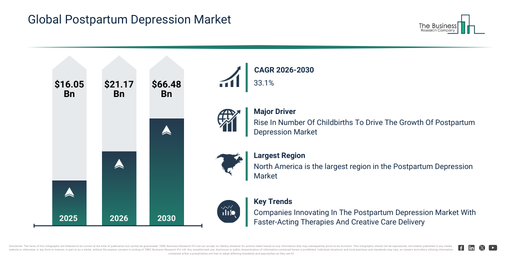
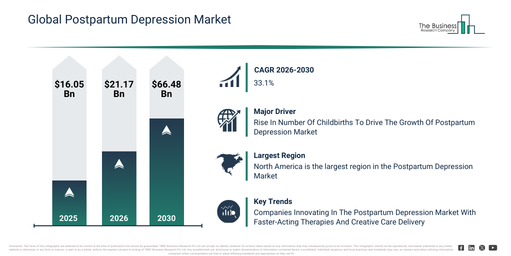
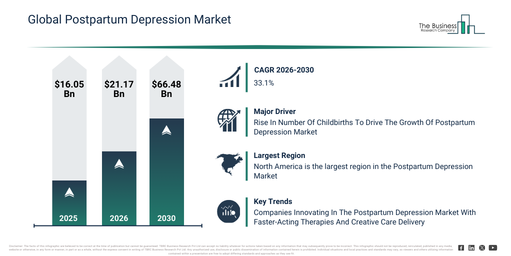
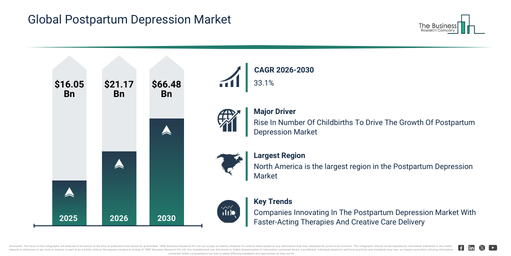
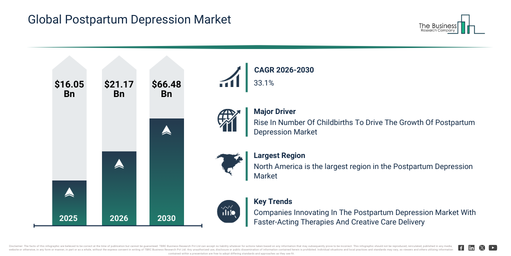
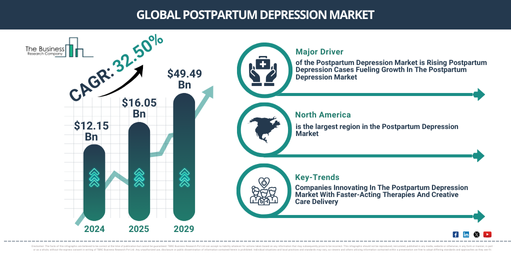
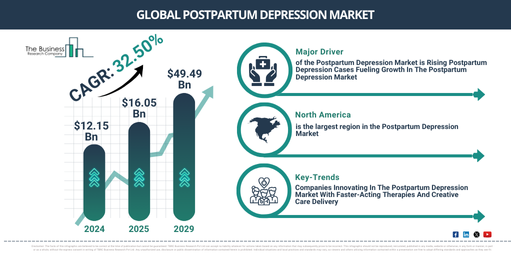
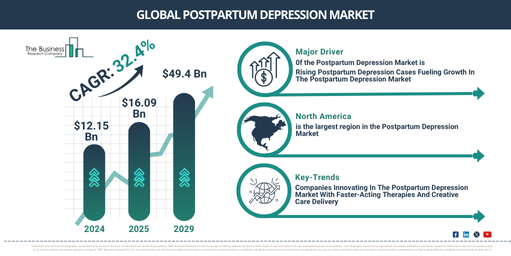
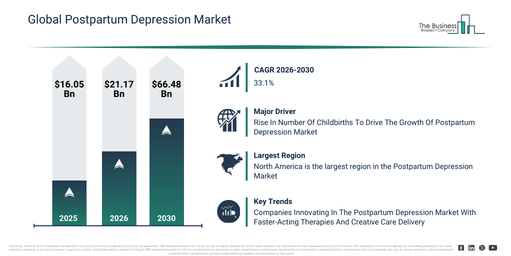
The market for postpartum depression has seen rapid expansion in recent times. Projections indicate it will expand from $16.05 billion in 2025 to reach $21.17 billion by 2026, demonstrating a compound annual growth rate (CAGR) of 31.9%. Historically, this growth can be ascribed to several factors, including a heightened awareness of maternal mental health conditions, insufficient early detection methods, diagnostic gaps within postpartum care environments, a continued dependence on conventional counseling techniques, and the expansion of hospital-based maternal care provisions.
The postpartum depression market size is projected to experience substantial growth in the upcoming years, expanding to $66.48 billion by 2030, demonstrating a compound annual growth rate (CAGR) of 33.1%. This anticipated growth during the forecast period is fueled by factors such as the increasing adoption of digital screening tools, a rising emphasis on preventive maternal healthcare, the expansion of tele-mental health services, growing investment in women’s mental health programs, and the increasing integration of mental health into obstetric care. Prominent trends observed during this period include heightened awareness and screening for postpartum mental health, the growing acceptance of digital mental health platforms, a rising focus on early diagnosis and intervention, the expansion of community-based support programs, and enhanced integration of mental health services in maternal care.
Get A Free Sample Report With In-Depth Market Insights:
Postpartum Depression Market Opportunity Drivers: What’s Unlocking New Revenue Potential?
The increasing number of childbirths is anticipated to drive the expansion of the postpartum depression market. Childbirth refers to the process where a baby is born from the mother’s uterus, typically through the vaginal canal. This rise in childbirths is a key factor for the postpartum depression market because postpartum depression (PPD) is a common mental health condition that can affect women after giving birth. PPD can cause a range of symptoms, including sadness, anxiety, fatigue, and difficulty bonding with the baby.
Postpartum Depression Market Segment Analysis Spotlighting Growth Areas
The postpartum depression market covered in this report is segmented –
1) By Types: Postpartum Blues, Postpartum Anxiety, Postpartum Obsessive Compulsive Disorder, Postpartum Panic Disorder, Postpartum Post-Traumatic Stress Disorder, Postpartum Psychosis, Other Types
2) By Treatment: Psychotherapy, Medication, Supplements, Other Treatments
3) By Route of Administration: Oral, Parenteral, Other Route Of Administration
4) By Distribution Channel: Hospital Pharmacy, Retail Pharmacy, Online Pharmacy, Other Distribution Channels
5) By End-Users: Hospitals, Specialty Clinics, Homecare, Other End-Users
Subsegments:
1) By Postpartum Blues: Mild Emotional Disturbances, Short-term Mood Swings
2) By Postpartum Anxiety: Generalized Anxiety Disorder (GAD), Panic Attacks
3) By Postpartum Obsessive Compulsive Disorder: Intrusive Thoughts, Compulsive Behaviors
4) By Postpartum Panic Disorder: Sudden Panic Attacks, Physical Symptoms
5) By Postpartum Post-Traumatic Stress Disorder (PTSD): Trauma Response To Childbirth, Flashbacks And Anxiety
6) By Postpartum Psychosis: Hallucinations, Severe Mood Swings
7) By Other Types: Mixed Mood Disorders, Comorbid Conditions With Postpartum
Postpartum Depression Market Innovation Trends: What Developments Are Reshaping The Industry?
Leading companies in the postpartum depression market are focusing on novel product innovations, including regulatory advancements aimed at enhancing the development and potential approval process for zuranolone in major depressive disorder and postpartum depression. A regulatory milestone signifies a crucial event in a drug or medical product’s lifecycle, indicating progress within the approval or compliance framework set by governmental authorities.
Postpartum Depression Market Leading Companies: Who Holds The Strongest Market Presence?
Major companies operating in the postpartum depression market are Pfizer Inc., Johnson & Johnson, Merck & Co., AbbVie Inc., Novartis AG, Sanofi SA, Bristol Myers Squibb Co., AstraZeneca plc, GlaxoSmithKline LLC, Takeda Pharmaceutical Company, Eli Lilly and Company, Viatris Inc., Teva Pharmaceutical Industries Ltd., Biogen Inc., Sun Pharmaceutical Industries Ltd., Lupin Pharmaceuticals, Mallinckrodt Pharmaceuticals plc, Sage Therapeutics Inc., Otsuka Pharmaceutical Co. Ltd., Lundbeck A S, Janssen Pharmaceuticals, Aurobindo Pharma Ltd.
View The Full Postpartum Depression Market Report:
Postpartum Depression Market Top Region: Where Does Most Revenue Come From?
North America was the largest region in the postpartum depression market in 2025. The regions covered in the postpartum depression market report are Asia-Pacific, South East Asia, Western Europe, Eastern Europe, North America, South America, Middle East, Africa.
Reach Out To Our Team:
The Business Research Company: https://www.thebusinessresearchcompany.com/
Americas: +1 310-496-7795
Asia: +44 7882 955267 & +91 8897263534
Europe: +44 7882 955267
Email us at: marketing@tbrc.info
Follow us on:
LinkedIn: https://in.linkedin.com/company/the-business-research-company
YouTube: https://www.youtube.com/channel/UC24_fI0rV8cR5DxlCpgmyFQ
Global Market Model: https://www.thebusinessresearchcompany.com/global-market-model