Featuring market attractiveness scoring, total addressable market sizing, company benchmarking matrices, interactive Excel dashboards, deeper supply chain intelligence, emerging startup tracking, and granular product-level insights, The Business Research Company’s 2026 market reports are built to deliver research that is both more actionable and more strategically valuable.
Robotic Knee Replacement Market Growth Analysis: How Will Revenue Trend Over The Forecast Period?
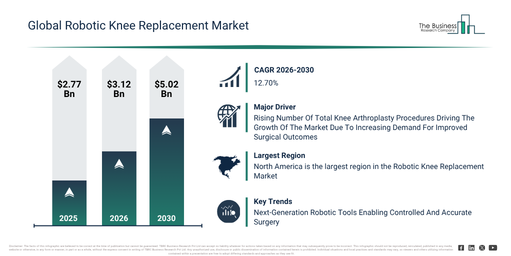
The robotic knee replacement market has demonstrated rapid expansion in recent years. It is expected to grow from $2.77 billion in 2025 to $3.12 billion in 2026, at a compound annual growth rate (CAGR) of 12.4%. This historical growth can be linked to the increasing prevalence of osteoarthritis and joint disorders, the global increase in the aging population, a rising demand for advanced orthopedic surgical procedures, the expansion of healthcare infrastructure and specialty orthopedic centers, and advancements in robotic-assisted surgical technologies.
The robotic knee replacement market is anticipated to experience substantial expansion in the coming years. Its valuation is projected to reach $5.02 billion by 2030, growing at a compound annual growth rate (CAGR) of 12.7%. This growth over the forecast period is fueled by the increasing integration of AI-powered surgical planning systems, rising investments in robotic orthopedic surgery platforms, the growing adoption of personalized and precision-based implant solutions, the expansion of outpatient robotic surgery centers, and an increasing demand for enhanced surgical accuracy and reduced hospital stay durations. Prominent trends for the forecast period include a greater embrace of minimally invasive robotic knee replacement procedures, an escalating demand for patient-specific implant alignment and surgical planning, a rising preference for faster recovery and fewer post-operative complications, the broadening use of real-time intraoperative guidance systems in orthopedic surgeries, and an increasing focus on precision-based knee arthroplasty procedures for improved implant longevity.
Get A Free Sample Report With In-Depth Market Insights:
Robotic Knee Replacement Market Demand Drivers Opening New Revenue Streams
The projected rise in total knee arthroplasty (TKA) procedures is anticipated to fuel the expansion of the robotic knee replacement market in the future. TKA involves a surgical operation where an impaired or diseased knee joint is substituted with an artificial implant to restore functionality and alleviate discomfort, frequently carried out on individuals suffering from advanced osteoarthritis or other degenerative joint issues. The volume of TKA operations is climbing, driven by the increasing incidence of osteoarthritis and a heightened desire for better mobility and enhanced quality of life among older patients. Robotic knee replacement systems contribute to greater surgical accuracy, facilitate superior implant positioning, and lead to improved patient results, thus complementing the growing number of procedures. For example, as reported by the National Institutes of Health, a US-based government medical research agency, in November 2025, the overall yearly use of primary total knee arthroplasty (TKA) procedures in the United States is predicted to see substantial growth, rising by 110% by 2025, 182% by 2030, and 401% by 2040, indicating robust long-term growth in demand. Consequently, the rising count of total knee arthroplasty procedures is propelling the expansion of the robotic knee replacement market.
Robotic Knee Replacement Market Segment Analysis Spotlighting Growth Areas
The robotic knee replacement market covered in this report is segmented –
1) By Technology Or Guidance Type: Image Guided, Computed Tomography Guided, Fluoroscopy Guided, Magnetic Resonance Imaging Guided, Manual Setup
2) By Type: Autonomous Robotic Surgery Platforms, Haptic Feedback Guidance Systems, Artificial Intelligence Enhanced Robotic Assistants
3) By Procedure Type: Total Knee Replacement, Partial Knee Replacement
4) By Application: Total Knee Arthroplasty, Partial Knee Replacement, Pre-Operative Surgical Planning, Alignment Optimization
Subsegments:
1) By Image Guided: Computer Assisted Navigation Systems, Real Time Imaging Guidance Systems, Three Dimensional Visualization Systems, Preoperative Planning Integration Systems, Intraoperative Feedback Systems
2) By Computed Tomography Guided: Preoperative Computed Tomography Planning Systems, Intraoperative Computed Tomography Navigation Systems, Three Dimensional Bone Mapping Systems, Computed Tomography Based Alignment Systems, Patient Specific Instrumentation Systems
3) By Fluoroscopy Guided: Real Time Fluoroscopy Imaging Systems, C Arm Based Navigation Systems, Dynamic Alignment Monitoring Systems, Intraoperative Position Verification Systems, Radiation Optimized Guidance Systems
4) By Magnetic Resonance Imaging Guided: Magnetic Resonance Imaging Based Planning Systems, Soft Tissue Visualization Guidance Systems, Three Dimensional Anatomical Mapping Systems, Radiation Free Navigation Systems, Advanced Imaging Integration Systems
5) By Manual Setup: Conventional Mechanical Alignment Techniques, Standard Surgical Instrumentation Systems, Manual Jig Based Positioning Systems, Surgeon Guided Alignment Methods, Traditional Implant Placement Techniques
Robotic Knee Replacement Market Trends Powering Strategic Industry Growth
Leading companies in the robotic knee replacement market are concentrating on creating advanced robotic surgical systems, including handheld robotic power systems, to improve surgical accuracy and workflow efficiency. Handheld robotic power systems are portable, surgeon-controlled devices that integrate powered surgical instruments with robotic guidance, sensors, and real-time feedback to heighten precision and control during procedures like bone cutting or implant placement. For example, in February 2026, Stryker, a US-based medical technology company, unveiled the Mako RPS (Robotic Power System) for Total Knee. This handheld robotic platform provides intuitive intraoperative planning, robotically enabled saw guidance that reacts to the surgeon’s hand motion, and compatibility with the Triathlon Total Knee System, helping ensure consistent joint alignment while retaining familiar surgical workflow. While these technologies demand investment in training and integration, they enhance procedural precision, support predictable outcomes, and bolster surgeon confidence in robotic knee replacement procedures.
Robotic Knee Replacement Market Company Landscape And Competitive Strategy
Major companies operating in the robotic knee replacement market are Johnson & Johnson, Stryker Corporation, Smith & Nephew plc, Zimmer Biomet Holdings Inc., Penn Medicine, Intuitive Surgical Inc., Meril Life Sciences Pvt. Ltd., Renishaw plc, Medacta International SA, MicroPort Scientific Corporation, Corin Group plc, ConforMIS Inc., SUM Ultimate Medicare, THINK Surgical Inc., Curexo Inc., OMNIlife Science Inc., Monogram Technologies Inc., Kinomatic Ltd., Just Medical Inc., Orthokey Italia S. r. l.
View The Full Robotic Knee Replacement Market Report:
Robotic Knee Replacement Market Largest Region: Which Geography Holds The Highest Market Share?
North America was the largest region in the robotic knee replacement market in 2025. Asia-Pacific is expected to be the fastest-growing region in the forecast period. The regions covered in the robotic knee replacement market report are Asia-Pacific, South East Asia, Western Europe, Eastern Europe, North America, South America, Middle East and Africa.
Reach Out To Our Team:
The Business Research Company: https://www.thebusinessresearchcompany.com/
Americas: +1 310-496-7795
Asia: +44 7882 955267 & +91 8897263534
Europe: +44 7882 955267
Email us at: marketing@tbrc.info
Follow us on:
LinkedIn: https://in.linkedin.com/company/the-business-research-company
YouTube: https://www.youtube.com/channel/UC24_fI0rV8cR5DxlCpgmyFQ
Global Market Model: https://www.thebusinessresearchcompany.com/global-market-model