Tag: Scaffold Free 3D Cell Culture

  • Scaffold Free 3D Cell Culture Market Expected To Reach $1.49 Billion By 2030 As Growth Accelerates At 11.9% CAGR

    Scaffold Free 3D Cell Culture Market Expected To Reach $1.49 Billion By 2030 As Growth Accelerates At 11.9% CAGR

    Delivering more actionable and strategically valuable research, The Business Research Company’s 2026 market reports feature market attractiveness analysis, total addressable market evaluation, company benchmarking matrices, interactive Excel dashboards, expanded supply chain intelligence, emerging startup coverage, and detailed product insights.

    Scaffold Free 3D Cell Culture Market Growth Potential: How Will Market Size Change Through 2030?

    The market for scaffold-free 3D cell culture is experiencing a significant upward trajectory, projected to expand from $0.85 billion in 2025 to $0.95 billion in 2026, demonstrating a robust compound annual growth rate of 12.2%. This expansion during the historical period is underpinned by key factors including innovations in cellular biology studies, the recognized shortcomings of traditional 2D cell culture methodologies, a surge in pharmaceutical research and development initiatives, the increasing integration of 3D culturing approaches, and a notable increase in stem cell investigations.

    The market for scaffold-free 3D cell culture is poised for considerable expansion, projected to reach $1.49 billion by 2030, exhibiting a compound annual growth rate of 11.9%. This anticipated growth trajectory is fueled by several key factors, including a heightened need for drug screening models that offer greater predictive accuracy, escalating financial commitments to regenerative medicine research, the wider implementation of organ-on-chip technologies, a sustained emphasis on minimizing animal experimentation, and the increasing incorporation of artificial intelligence in analyzing cellular data. During this forecast period, prominent developments are expected to include a greater uptake of organoid and spheroid culture methodologies, a more widespread utilization of scaffold-free platforms within the drug discovery process, the expanding integration of microfluidic systems for cell cultivation, advancements in personalized medicine research, and an intensified focus on developing in vitro models that more closely mimic physiological conditions.

    Download A Free Sample Report For Comprehensive Market Insights:

    https://www.thebusinessresearchcompany.com/sample.aspx?id=30382&type=smp

    Scaffold Free 3D Cell Culture Market Growth Drivers And Industry Catalysts

    The advancement of personalized medicine is anticipated to be a key catalyst for the expansion of the scaffold-free 3D cell culture market. This approach to healthcare customizes medical interventions and decisions by considering a patient’s unique genetic makeup, environmental exposures, and lifestyle choices. Progress in fields such as genomics, biotechnology, and advanced data analysis fuels the expansion of personalized medicine, paving the way for more accurate, impactful, and individualized patient care. Scaffold-free 3D cell culture techniques play a crucial role in this domain by facilitating the development of patient-specific tissue models that are instrumental in precise drug screening and the formulation of bespoke therapeutic plans. A notable illustration of this trend is the February 2024 report from the Personalized Medicine Coalition, a non-profit entity in the United States, which highlighted the Food and Drug Administration’s approval of 16 novel personalized treatments for individuals with rare diseases in 2023, a considerable surge compared to the six approvals recorded in 2022. Consequently, the expansion of personalized medicine directly influences and stimulates the growth trajectory of the scaffold-free 3D cell culture market.

    Scaffold Free 3D Cell Culture Market Segment Performance And Strategic Opportunities

    The scaffold free 3d cell culture market covered in this report is segmented –

    1) By Product Type: 3D Cell Culture Platforms, 3D Bioprinting Products, 3D Cell Culture Kits, Microfluidic Devices

    2) By Cellular Components: Stem Cells, Adherent Cell Cultures, Suspension Cell Cultures, Immune Cells

    3) By Technique: Hanging Drop Method, Magnetic Levitation, Microfluidics

    4) By Application: Drug Discovery, Regenerative Medicine, Tissue Engineering, Oncology Research, Stem Cell Research

    5) By End-User: Academic Research Institutions, Pharmaceutical And Biotechnology Companies, Contract Research Organizations (CROs), Clinics And Hospitals

    Subsegments:

    1) By 3D Cell Culture Platforms: Hanging Drop Plates, Low-Adhesion Microplates, Ultra-Low Attachment (ULA) Plates And Flasks, Spheroid Culture Dishes, Spinner Flasks And Bioreactors, Suspension Culture Systems

    2) By 3D Bioprinting Products: Bioprinters, Bioinks, Printheads And Nozzles, Printing Software, Consumables And Accessories

    3) By 3D Cell Culture Kits: Spheroid Formation Kits, Organoid Culture Kits, Co-Culture Kits, Tumor Model Kits, Stem Cell Differentiation Kits, Assay-Ready 3D Cell Culture Kits

    4) By Microfluidic Devices: Organ-On-A-Chip Systems, Lab-On-A-Chip Platforms, Microchamber Arrays, Perfusion-Based Microfluidic Devices, Droplet-Based Microfluidic Systems, Gradient Generating Microfluidic Devices

    #Scaffold Free 3D Cell Culture Market Trends Influencing Long-Term Demand

    Advancements in scaffold-free 3D cell culture technology are a primary area of strategic development for key players in the market, with a particular emphasis on features like transparent flask bases for straightforward spheroid observation and assessment, precisely engineered microcavities to guarantee uniform spheroid development, and high-volume formats designed to accelerate drug discovery and cancer investigations. A transparent flask bottom facilitates uncomplicated observation and imaging of cellular structures or spheroids. As an illustration, in February of 2024, Corning Incorporated, an American enterprise renowned for its expertise in specialty glass, ceramics, and life science products, unveiled the Corning Elplasia 12K flask, an addition to its collection of 3D cell culture solutions; this novel flask is engineered to facilitate extensive spheroid generation, empowering scientists to cultivate approximately 12,000 consistent spheroids within a single flask, thereby offering enhanced uniformity in spheroid dimensions, superior experimental repeatability, and substantially increased output compared to conventional 96-well spheroid plates, and it is adaptable for use with the diverse array of tumor, healthy, and primary cell populations frequently employed in 3D cell culture research, proving especially valuable for tasks such as drug testing, cancer research, and the creation of cutting-edge treatments, thereby meeting the escalating need for dependable and scalable 3D cell models.

    Scaffold Free 3D Cell Culture Market Key Players: Which Companies Shape Industry Competition?

    Major companies operating in the scaffold free 3d cell culture market are Thermo Fisher Scientific Inc., Merck KGaA, Corning Incorporated, Lonza Group AG, Sartorius AG, Hamilton Company, CELLINK AB, Creative Bioarray Inc., InSphero AG, Creative Biolabs Inc., Mimetas B.V., REPROCELL Inc., Synthecon Incorporated, Advanced Solutions Life Sciences LLC, Cherry Biotech SAS, celVivo ApS, Elveflow, Guangzhou Jet Bio-Filtration Co. Ltd., Organovo Holdings Inc., Alfa Cytology Co. Ltd.

    Access The Complete Scaffold Free 3D Cell Culture Market Report:

    https://www.thebusinessresearchcompany.com/report/global-scaffold-free-3d-cell-culture-market-report

    Scaffold Free 3D Cell Culture Market Geographic Distribution And Regional Opportunities

    North Americawas the largest region in the scaffold free 3D cell culture market in 2025. Asia-Pacificis expected to be the fastest-growing region in the forecast period. The regions covered in the scaffold free 3d cell culture market report are Asia-Pacific, South East Asia, Western Europe, Eastern Europe, North America, South America, Middle East, Africa.

    Get in touch with us:

    The Business Research Company: https://www.thebusinessresearchcompany.com/

    Americas: +1 310-496-7795

    Asia: +44 7882 955267 & +91 8897263534

    Europe: +44 7882 955267

    Email us at: marketing@tbrc.info

    Follow us on:

    LinkedIn: https://in.linkedin.com/company/the-business-research-company

    YouTube: https://www.youtube.com/channel/UC24_fI0rV8cR5DxlCpgmyFQ

    Global Market Model: https://www.thebusinessresearchcompany.com/global-market-model

  • Scaffold-free 3D cell culture market analysis covering drivers and outlook

    Scaffold-free 3D cell culture market analysis covering drivers and outlook

    The Business Research Company’s 2026 market reports feature enhanced tools like market attractiveness analysis, TAM assessment, and company scoring matrices, along with interactive dashboards, deeper supply chain insights, and startup coverage strengthening the depth, usability, and strategic value of insights.

    What Expansion In Market Value Is Forecasted For The Scaffold Free 3D Cell Culture Market Between 2026 And 2030?

    The scaffold free 3d cell culture market size has seen rapid growth in recent years. It is anticipated to increase from $0.85 billion in 2025 to $0.95 billion in 2026, at a compound annual growth rate (CAGR) of 12.2%. This historical growth can be attributed to advancements in cell biology research, the increasing limitations of 2D cell culture models, the expansion of pharmaceutical R&D activities, a rising adoption of 3D culture techniques, and growth in stem cell research.

    The scaffold free 3d cell culture market is projected for significant expansion in the coming years. This market is anticipated to reach $1.49 billion by 2030, exhibiting a compound annual growth rate (CAGR) of 11.9%. This projected growth stems from factors such as increasing demand for predictive drug screening models, rising investments in regenerative medicine research, the expansion of organ-on-chip technologies, a growing emphasis on minimizing animal testing, and the integration of AI into cell analysis. Key trends during this period are expected to encompass the increasing adoption of organoid and spheroid models, a rising application of scaffold-free platforms in drug discovery, the growing integration of microfluidic cell culture systems, the broadening of personalized medicine research applications, and an enhanced focus on physiologically relevant in vitro models.

    Access Your Free Sample Report For In-Depth Market Analysis:

    https://www.thebusinessresearchcompany.com/sample.aspx?id=30382&type=smp

    What Significant Factors Are Influencing The Scaffold Free 3D Cell Culture Market Expansion?

    The scaffold free 3D cell culture market is anticipated to expand due to the increasing adoption of personalized medicine. This medical strategy involves customizing treatments and health interventions according to a person’s unique genetic makeup, environmental influences, and lifestyle choices. Its expansion is fueled by progress in genomics, biotechnology, and data analytics, which facilitate more accurate, potent, and customized therapeutic approaches. In personalized medicine, scaffold-free 3D cell culture is utilized to develop patient-specific tissue models, allowing for precise drug screening and customized treatment plans. For example, the Personalized Medicine Coalition, a US-based non-profit organization, stated in February 2024 that the FDA had approved 16 new personalized treatments for individuals with rare diseases in 2023, marking a substantial rise from the six approvals in 2022. Consequently, the expansion of personalized medicine is fueling the growth of the scaffold free 3D cell culture market.

    Which Segments Define The Scaffold Free 3D Cell Culture Market Segment Structure?

    The scaffold free 3d cell culture market covered in this report is segmented –

    1) By Product Type: 3D Cell Culture Platforms, 3D Bioprinting Products, 3D Cell Culture Kits, Microfluidic Devices

    2) By Cellular Components: Stem Cells, Adherent Cell Cultures, Suspension Cell Cultures, Immune Cells

    3) By Technique: Hanging Drop Method, Magnetic Levitation, Microfluidics

    4) By Application: Drug Discovery, Regenerative Medicine, Tissue Engineering, Oncology Research, Stem Cell Research

    5) By End-User: Academic Research Institutions, Pharmaceutical And Biotechnology Companies, Contract Research Organizations (CROs), Clinics And Hospitals

    Subsegments:

    1) By 3D Cell Culture Platforms: Hanging Drop Plates, Low-Adhesion Microplates, Ultra-Low Attachment (ULA) Plates And Flasks, Spheroid Culture Dishes, Spinner Flasks And Bioreactors, Suspension Culture Systems

    2) By 3D Bioprinting Products: Bioprinters, Bioinks, Printheads And Nozzles, Printing Software, Consumables And Accessories

    3) By 3D Cell Culture Kits: Spheroid Formation Kits, Organoid Culture Kits, Co-Culture Kits, Tumor Model Kits, Stem Cell Differentiation Kits, Assay-Ready 3D Cell Culture Kits

    4) By Microfluidic Devices: Organ-On-A-Chip Systems, Lab-On-A-Chip Platforms, Microchamber Arrays, Perfusion-Based Microfluidic Devices, Droplet-Based Microfluidic Systems, Gradient Generating Microfluidic Devices

    What Trends Are Affecting The Direction Of The Scaffold Free 3D Cell Culture Market?

    Major companies operating within the scaffold free 3D cell culture market are concentrating on innovations in 3D cell culture. These advancements include features such as optically clear flask bottoms to facilitate easy visualization and monitoring of spheroids, uniform microcavity designs for consistent spheroid formation, and high-throughput formats aimed at increasing efficiency in drug discovery and cancer research. An optically clear flask bottom is a transparent base designed to allow straightforward monitoring and imaging of cells or spheroids. For example, in February 2024, Corning Incorporated, a US-based company known for specialty glass, ceramics, and life sciences products, introduced the Corning Elplasia 12K flask as part of its 3D cell culture portfolio. This innovative flask is specifically engineered to support large-scale spheroid formation, enabling researchers to produce roughly 12,000 uniform spheroids per flask. Compared to traditional 96-well spheroid plates, it delivers greater consistency in spheroid size, improved reproducibility, and significantly higher yields. The flask is compatible with a wide array of tumor, normal, and primary cell types frequently used in 3D cell culture studies. It is particularly beneficial for applications in drug screening, cancer research, and the development of advanced therapies, addressing the expanding demand for scalable and reliable 3D cell models.

    Who Are The Established Players Within The Scaffold Free 3D Cell Culture Market?

    Major companies operating in the scaffold free 3d cell culture market are Thermo Fisher Scientific Inc., Merck KGaA, Corning Incorporated, Lonza Group AG, Sartorius AG, Hamilton Company, CELLINK AB, Creative Bioarray Inc., InSphero AG, Creative Biolabs Inc., Mimetas B.V., REPROCELL Inc., Synthecon Incorporated, Advanced Solutions Life Sciences LLC, Cherry Biotech SAS, celVivo ApS, Elveflow, Guangzhou Jet Bio-Filtration Co. Ltd., Organovo Holdings Inc., Alfa Cytology Co. Ltd.

    Get The Full Scaffold Free 3D Cell Culture Market Report:

    https://www.thebusinessresearchcompany.com/report/global-scaffold-free-3d-cell-culture-market-report

    Which Region Represents The Largest Share Of The Scaffold Free 3D Cell Culture Market?

    North America was the largest region in the scaffold free 3D cell culture market in 2025. Asia-Pacific is expected to be the fastest-growing region in the forecast period. The regions covered in the scaffold free 3d cell culture market report are Asia-Pacific, South East Asia, Western Europe, Eastern Europe, North America, South America, Middle East, Africa.

    Request A Customized Scaffold Free 3D Cell Culture Market Report For Competitive Insights:

    https://www.thebusinessresearchcompany.com/report/global-scaffold-free-3d-cell-culture-market-report

    Browse Through More Reports Similar to the Global Scaffold Free 3D Cell Culture Market 2026, By The Business Research Company

    3D Cell Culture Technologies Market Report 2026

    https://www.thebusinessresearchcompany.com/report/3d-cell-culture-technologies-global-market-report

    Cell Cultures Market Report

    https://www.thebusinessresearchcompany.com/report/cell-cultures-global-market-report

    Cell Culture Media Market Report

    https://www.thebusinessresearchcompany.com/report/cell-culture-media-global-market-report

    Get in touch with us:

    The Business Research Company: https://www.thebusinessresearchcompany.com/

    Americas +1 310-496-7795

    Asia +44 7882 955267 & +91 8897263534

    Europe +44 7882 955267

    Email us at info@tbrc.info

    Follow us on:

    LinkedIn: https://in.linkedin.com/company/the-business-research-company

    YouTube: https://www.youtube.com/channel/UC24_fI0rV8cR5DxlCpgmyFQ

    Global Market Model: https://www.thebusinessresearchcompany.com/global-market-model

  • Global Scaffold Free 3D Cell Culture Market Expected to Reach $1.49 Billion by 2030 with 11.9% CAGR

    Global Scaffold Free 3D Cell Culture Market Expected to Reach $1.49 Billion by 2030 with 11.9% CAGR

    The Business Research Company’s 2026 market reports include new capabilities such as market attractiveness scoring and analysis, total addressable market analysis, company scoring matrix, interactive excel data dashboard, improved supply chain analysis, upcoming startups in the market, and overview of key products, aimed at improving the depth, usability, and strategic value of the insights delivered.

    How Is The Market Size Of The Scaffold Free 3D Cell Culture Market Expected To Change Between 2026 And 2030?

    The scaffold free 3d cell culture market has experienced substantial growth recently. It is projected to expand from $0.85 billion in 2025 to $0.95 billion in 2026, progressing at a compound annual growth rate (CAGR) of 12.2%. This historical growth can be attributed to advancements in cell biology research, the increasing limitations of 2D cell culture models, the expansion of pharmaceutical R&D activities, the rising adoption of 3D culture techniques, and the growth in stem cell research.

    The scaffold free 3d cell culture market size is projected to experience substantial growth over the next few years, with an anticipated increase to $1.49 billion by 2030, exhibiting a compound annual growth rate (CAGR) of 11.9%. This expansion during the forecast period is primarily driven by escalating demand for predictive drug screening models, greater investments in regenerative medicine research, the widening adoption of organ-on-chip technologies, an increasing emphasis on reducing animal testing, and the integration of AI in cell analysis. Significant trends for the forecast period include the rising adoption of organoid and spheroid models, the expanding application of scaffold-free platforms in drug discovery, the growing integration of microfluidic cell culture systems, the broadening of personalized medicine research applications, and an enhanced focus on physiologically relevant in vitro models.

    Download the Free Sample Report to Explore Key Market Insights:

    https://www.thebusinessresearchcompany.com/sample.aspx?id=30382&type=smp

    What Drivers Are Expected To Influence The Scaffold Free 3D Cell Culture Market During The Forecast Period?

    The expansion of personalized medicine is projected to stimulate the progress of the scaffold free 3D cell culture market moving forward. Personalized medicine constitutes a healthcare methodology that customizes treatments and health-related decisions based on individual genetic, environmental, and lifestyle elements. This advancement in personalized medicine is propelled by innovations in genomics, biotechnology, and data analytics, thereby enabling more precise, effective, and tailored treatments. Scaffold-free 3D cell culture finds application in personalized medicine for developing patient-specific tissue models, which facilitate accurate drug testing and bespoke therapeutic strategies. For instance, in February 2024, the Personalized Medicine Coalition, a US-based non-profit organization, reported that in 2023, the FDA sanctioned 16 new personalized treatments for patients with rare diseases, representing a notable increase from the six approved in 2022. Thus, the burgeoning personalized medicine sector is a key driver for the scaffold free 3D cell culture market’s growth.

    How Is The Scaffold Free 3D Cell Culture Market Structured Across Different Segments?

    The scaffold free 3d cell culture market covered in this report is segmented –

    1) By Product Type: 3D Cell Culture Platforms, 3D Bioprinting Products, 3D Cell Culture Kits, Microfluidic Devices

    2) By Cellular Components: Stem Cells, Adherent Cell Cultures, Suspension Cell Cultures, Immune Cells

    3) By Technique: Hanging Drop Method, Magnetic Levitation, Microfluidics

    4) By Application: Drug Discovery, Regenerative Medicine, Tissue Engineering, Oncology Research, Stem Cell Research

    5) By End-User: Academic Research Institutions, Pharmaceutical And Biotechnology Companies, Contract Research Organizations (CROs), Clinics And Hospitals

    Subsegments:

    1) By 3D Cell Culture Platforms: Hanging Drop Plates, Low-Adhesion Microplates, Ultra-Low Attachment (ULA) Plates And Flasks, Spheroid Culture Dishes, Spinner Flasks And Bioreactors, Suspension Culture Systems

    2) By 3D Bioprinting Products: Bioprinters, Bioinks, Printheads And Nozzles, Printing Software, Consumables And Accessories

    3) By 3D Cell Culture Kits: Spheroid Formation Kits, Organoid Culture Kits, Co-Culture Kits, Tumor Model Kits, Stem Cell Differentiation Kits, Assay-Ready 3D Cell Culture Kits

    4) By Microfluidic Devices: Organ-On-A-Chip Systems, Lab-On-A-Chip Platforms, Microchamber Arrays, Perfusion-Based Microfluidic Devices, Droplet-Based Microfluidic Systems, Gradient Generating Microfluidic Devices

    How Are Trends Transforming The Scaffold Free 3D Cell Culture Market Landscape?

    Leading companies in the scaffold free 3D cell culture market are prioritizing innovation within 3D cell culture, incorporating features such as optically clear flask bottoms for effortless spheroid visualization and observation, consistent microcavity designs to ensure uniform spheroid formation, and high-throughput configurations to enhance efficiency in drug discovery and cancer research. An optically clear flask bottom is a transparent base that facilitates easy monitoring and imaging of cells or spheroids. For example, in February 2024, Corning Incorporated, a US-based company specializing in specialty glass, ceramics, and life sciences products, introduced the Corning Elplasia 12K flask as part of its 3D cell culture portfolio. This innovative flask is specifically engineered to support large-scale spheroid formation, enabling researchers to produce approximately 12,000 uniform spheroids per flask. Compared to traditional 96-well spheroid plates, it offers superior consistency in spheroid size, improved reproducibility, and significantly higher yields. The flask is compatible with a wide array of tumor, normal, and primary cell types commonly utilized in 3D cell culture studies. It proves particularly valuable for applications in drug screening, cancer research, and the development of advanced therapies, thereby addressing the rising demand for scalable and reliable 3D cell models.

    Which Major Players Dominate The Scaffold Free 3D Cell Culture Market?

    Major companies operating in the scaffold free 3d cell culture market are Thermo Fisher Scientific Inc., Merck KGaA, Corning Incorporated, Lonza Group AG, Sartorius AG, Hamilton Company, CELLINK AB, Creative Bioarray Inc., InSphero AG, Creative Biolabs Inc., Mimetas B.V., REPROCELL Inc., Synthecon Incorporated, Advanced Solutions Life Sciences LLC, Cherry Biotech SAS, celVivo ApS, Elveflow, Guangzhou Jet Bio-Filtration Co. Ltd., Organovo Holdings Inc., Alfa Cytology Co. Ltd.

    Read the full scaffold free 3d cell culture market report here:

    https://www.thebusinessresearchcompany.com/report/global-scaffold-free-3d-cell-culture-market-report

    Which Region Is Forecast To Lead The Scaffold Free 3D Cell Culture Market In Terms Of Market Size?

    North America was the largest region in the scaffold free 3D cell culture market in 2025. Asia-Pacific is expected to be the fastest-growing region in the forecast period. The regions covered in the scaffold free 3d cell culture market report are Asia-Pacific, South East Asia, Western Europe, Eastern Europe, North America, South America, Middle East, Africa.

    Request A Tailored Scaffold Free 3D Cell Culture Market Research Report For Competitive Advantage:

    https://www.thebusinessresearchcompany.com/customise?id=30382&type=smp

    Browse Through More Reports Similar to the Global Scaffold Free 3D Cell Culture Market 2026, By The Business Research Company

    3D Cell Culture Technologies Global Market Report

    https://www.thebusinessresearchcompany.com/report/3d-cell-culture-technologies-global-market-report

    Cell Cultures Global Market Report

    https://www.thebusinessresearchcompany.com/report/cell-cultures-global-market-report

    Cell Culture Media Global Market Report

    https://www.thebusinessresearchcompany.com/report/cell-culture-media-global-market-report

    Get in touch with us:

    The Business Research Company: https://www.thebusinessresearchcompany.com/

    Americas +1 310-496-7795

    Asia +44 7882 955267 & +91 8897263534

    Europe +44 7882 955267

    Email us at info@tbrc.info

    Follow us on:

    LinkedIn: https://in.linkedin.com/company/the-business-research-company

    YouTube: https://www.youtube.com/channel/UC24_fI0rV8cR5DxlCpgmyFQ

    Global Market Model: https://www.thebusinessresearchcompany.com/global-market-model
  • Scaffold Free 3D Cell Culture Market Forecast 2026–2035: Data Trends and Industry Insights

    Scaffold Free 3D Cell Culture Market Forecast 2026–2035: Data Trends and Industry Insights

    Uncover key drivers, emerging technologies, and competitive movements shaping the scaffold free 3d cell culture market from 2026–2035 with trusted insights from The Business Research Company

    What was the valuation of the Scaffold Free 3D Cell Culture Market in 2026, and what figure is it projected to hit by 2030?

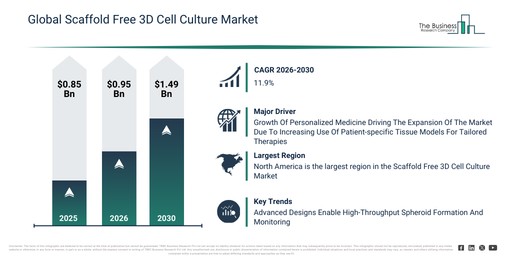
    The scaffold free 3d cell culture market has witnessed rapid expansion in recent years. This market is anticipated to expand from $0.85 billion in 2025 to $0.95 billion in 2026, at a compound annual growth rate (CAGR) of 12.2%. Historically, this growth can be ascribed to progress in cell biology research, the increasing constraints observed with 2D cell culture models, an uptick in pharmaceutical R&D initiatives, a rise in the acceptance of 3D culture methods, and advancements in stem cell research.

    The scaffold free 3d cell culture market is projected to experience substantial expansion over the upcoming years. This market is predicted to reach $1.49 billion by 2030, exhibiting a compound annual growth rate (CAGR) of 11.9%. Several factors will drive this growth during the forecast period, including the escalating demand for predictive drug screening models, increasing investments in regenerative medicine research, the broadening adoption of organ-on-chip technologies, a heightened emphasis on minimizing animal testing, and the incorporation of artificial intelligence in cell analysis. Key trends anticipated during this time frame involve the increasing adoption of organoid and spheroid models, a surge in the application of scaffold-free platforms for drug discovery, the expanding integration of microfluidic cell culture systems, the broadening of personalized medicine research applications, and an intensified focus on creating physiologically relevant in vitro models.

    Access Your Free Sample Report for In-Depth Market Insights:

    https://www.thebusinessresearchcompany.com/sample.aspx?id=30382&type=smp

    Which Drivers Are Affecting Market Participation In The Scaffold Free 3D Cell Culture Market?

    The expanding field of personalized medicine is anticipated to fuel the expansion of the scaffold free 3D cell culture market going forward. This medical strategy involves customizing treatments and healthcare choices according to a person’s unique genetic makeup, environmental influences, and lifestyle habits. Its development is propelled by progress in genomics, biotechnology, and data analytics, facilitating more exact, potent, and tailored therapies. Within personalized medicine, scaffold-free 3D cell culture is employed to construct patient-specific tissue models, allowing for precise drug screening and customized treatment plans. As an illustration, in February 2024, the Personalized Medicine Coalition, a US-based non-profit group, disclosed that in 2023, the FDA gave its approval to 16 novel personalized treatments for individuals with rare diseases, marking a substantial rise from the six authorized in 2022. Consequently, the advancement of personalized medicine is stimulating the expansion of the scaffold free 3D cell culture market.

    What Segment Classifications Make Up The Scaffold Free 3D Cell Culture Market?

    The scaffold free 3d cell culture market covered in this report is segmented –

    1) By Product Type: 3D Cell Culture Platforms, 3D Bioprinting Products, 3D Cell Culture Kits, Microfluidic Devices

    2) By Cellular Components: Stem Cells, Adherent Cell Cultures, Suspension Cell Cultures, Immune Cells

    3) By Technique: Hanging Drop Method, Magnetic Levitation, Microfluidics

    4) By Application: Drug Discovery, Regenerative Medicine, Tissue Engineering, Oncology Research, Stem Cell Research

    5) By End-User: Academic Research Institutions, Pharmaceutical And Biotechnology Companies, Contract Research Organizations (CROs), Clinics And Hospitals

    Subsegments:

    1) By 3D Cell Culture Platforms: Hanging Drop Plates, Low-Adhesion Microplates, Ultra-Low Attachment (ULA) Plates And Flasks, Spheroid Culture Dishes, Spinner Flasks And Bioreactors, Suspension Culture Systems

    2) By 3D Bioprinting Products: Bioprinters, Bioinks, Printheads And Nozzles, Printing Software, Consumables And Accessories

    3) By 3D Cell Culture Kits: Spheroid Formation Kits, Organoid Culture Kits, Co-Culture Kits, Tumor Model Kits, Stem Cell Differentiation Kits, Assay-Ready 3D Cell Culture Kits

    4) By Microfluidic Devices: Organ-On-A-Chip Systems, Lab-On-A-Chip Platforms, Microchamber Arrays, Perfusion-Based Microfluidic Devices, Droplet-Based Microfluidic Systems, Gradient Generating Microfluidic Devices

    Which Competitive Trends Are Impacting The Structure Of The Scaffold Free 3D Cell Culture Market?

    Major companies operating in the scaffold free 3D cell culture market are focusing on advancements in 3D cell culture, such as transparent flask bottoms to allow easy spheroid visualization and monitoring, standardized microcavity designs for consistent spheroid formation, and high-throughput formats to enhance efficiency in drug discovery and cancer research. An optically clear flask bottom is a translucent base that enables straightforward monitoring and imaging of cells or spheroids. For instance, in February 2024, Corning Incorporated, a US-based company specializing in specialty glass, ceramics, and life sciences products, introduced the Corning Elplasia 12K flask as part of its 3D cell culture portfolio. This innovative flask is specifically engineered to support large-scale spheroid formation, allowing researchers to produce approximately 12,000 uniform spheroids per flask. Compared to traditional 96-well spheroid plates, it offers greater consistency in spheroid size, improved reproducibility, and significantly higher yields. The flask is compatible with a wide array of tumor, normal, and primary cell types commonly utilized in 3D cell culture studies. It is particularly beneficial for applications in drug screening, cancer research, and the development of advanced therapies, addressing the rising demand for scalable and reliable 3D cell models.

    Which Leading Companies Dominate The Scaffold Free 3D Cell Culture Market Share?

    Major companies operating in the scaffold free 3d cell culture market are Thermo Fisher Scientific Inc., Merck KGaA, Corning Incorporated, Lonza Group AG, Sartorius AG, Hamilton Company, CELLINK AB, Creative Bioarray Inc., InSphero AG, Creative Biolabs Inc., Mimetas B.V., REPROCELL Inc., Synthecon Incorporated, Advanced Solutions Life Sciences LLC, Cherry Biotech SAS, celVivo ApS, Elveflow, Guangzhou Jet Bio-Filtration Co. Ltd., Organovo Holdings Inc., Alfa Cytology Co. Ltd.

    Access The Complete Report For Deeper Market Insights:

    https://www.thebusinessresearchcompany.com/report/global-scaffold-free-3d-cell-culture-market-report

    How Does The Scaffold Free 3D Cell Culture Market Perform Across Major Global Regions?

    North America was the largest region in the scaffold free 3D cell culture market in 2025. Asia-Pacific is expected to be the fastest-growing region in the forecast period. The regions covered in the scaffold free 3d cell culture market report are Asia-Pacific, South East Asia, Western Europe, Eastern Europe, North America, South America, Middle East, Africa.

    Request Your Customized Scaffold Free 3D Cell Culture Market Research Report for Competitive Advantage:

    https://www.thebusinessresearchcompany.com/customise?id=30382&type=smp

    Browse Through More Reports Similar to the Global Scaffold Free 3D Cell Culture Market 2026, By The Business Research Company

    Cell Culture Media Market Report 2026

    https://www.thebusinessresearchcompany.com/report/cell-culture-media-global-market-report

    3D Cell Culture Technologies Market Report 2026

    https://www.thebusinessresearchcompany.com/report/3d-cell-culture-technologies-global-market-report

    Cell Cultures Market Report 2026

    https://www.thebusinessresearchcompany.com/report/cell-cultures-global-market-report

    Get in touch with us:

    The Business Research Company: https://www.thebusinessresearchcompany.com/

    Americas +1 310-496-7795

    Asia +44 7882 955267 & +91 8897263534

    Europe +44 7882 955267

    Email us at info@tbrc.info

    Follow us on:

    LinkedIn: https://in.linkedin.com/company/the-business-research-company

    YouTube: https://www.youtube.com/channel/UC24_fI0rV8cR5DxlCpgmyFQ

    Global Market Model: https://www.thebusinessresearchcompany.com/global-market-model