Save up to 30% on The Business Research Company’s comprehensive market research reports for a limited time only!
What is the Expected Growth Rate of the Spatial omics Market from 2024 to 2033?
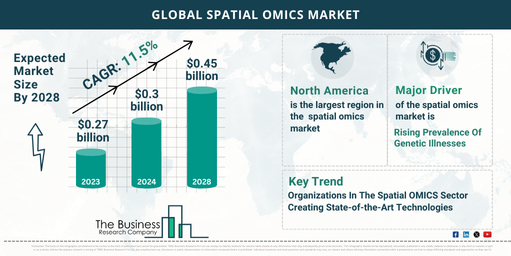
The spatial omics market has expanded rapidly, expected to grow from $0.27 billion in 2023 to $0.3 billion in 2024 with a CAGR of 11.3%. Growth is driven by rising genetic disorders, increasing cancer prevalence, demand for personalized medicine, and the adoption of spatial genomics and proteomics.
The spatial omics market is projected to grow to $0.46 billion by 2028 at a CAGR of 11.5%. Growth is attributed to increased research and development activities, financing for OMICS research, and new approaches for cancer biomarker discovery. Trends include strategic collaborations, advanced technologies integration, and product innovations.
Claim Your Free Sample of the Global Spatial omics Market Report Today!
https://www.thebusinessresearchcompany.com/sample.aspx?id=15927&type=smp
What Key Factors Are Fueling the Growth of the Spatial omics Market?
The spatial omics market is anticipated to grow due to the rising incidence of genetic diseases, which are linked to DNA abnormalities inherited from one or both parents. This increase is influenced by heightened awareness, advancements in diagnostic methods, lifestyle changes, and environmental factors. Spatial omics technologies provide crucial insights into genetic illnesses by mapping molecular and genetic features within tissues. For example, the WHO noted in February 2023 that congenital diseases cause approximately 240,000 infant deaths globally within 28 days of birth each year. Additionally, the CDC reported that about 6,000 babies are born with Down syndrome annually in the U.S. Therefore, the rising prevalence of genetic diseases is driving the spatial omics market.
What Are the Major Segments of the Spatial omics Market?
1) By Product: Instruments, Consumables, Software
2) By Sample Type: Formalin-Fixed Paraffin-Embedded (FFPE), Fresh Frozen
3) By Workflow: Sample Preparation, Instrumental Analysis, Data Analysis
4) By Technology: Spatial Transcriptomics, Spatial Genomics, Spatial Proteomics
5) By End-Use: Academic And Translational Research Institutes, Pharmaceutical And Biotechnology Companies
What New Trends Are Transforming the Spatial omics Market?
Major players in the spatial omics market are developing new platforms to enhance their market position. For instance, in March 2021, Rebus Biosystems Inc. launched the Rebus Esper spatial omics platform, utilizing Synthetic Aperture Optics technology for high-throughput analysis of cellular features.
Order Now for Fast Delivery of Your Spatial omics Market Report!
https://www.thebusinessresearchcompany.com/report/spatial-omics-global-market-report
Which Regions Are Driving Growth in the Spatial omics Market?
North America was the largest region in the Spatial OMICS market in 2023. Asia-Pacific is expected to be the fastest-growing region in the forecast period. The regions covered in the spatial omics market report are Asia-Pacific, Western Europe, Eastern Europe, North America, South America, Middle East and Africa.
The Spatial omics Global Market Report 2024 offers a comprehensive overview of the audio equipment market, covering historical data from 2010 to 2021 and providing a ten-year forecast from 2023 to 2032. This report examines the size of the spatial omics market, its market share, and analyzes key competitors along with their market positions.
The Table Of Content For The Spatial omics Market Include
1. Spatial omics Market Executive Summary
2. Spatial omics Market Segments
3. Spatial omics Market Size And Template Market Growth Rate
4. Key Spatial omics Market Trends
5. Major Spatial omics Market Drivers
……
25. Key Mergers And Acquisitions In The Spatial omics Market
26. Top Spatial omics Companies
27. Spatial omics Market Opportunities And Strategies
28. Spatial omics Market, Conclusions And Recommendations
29. Appendix
Discover Related Reports by The Business Research Company:
Geospatial Imagery Analytics Global Market Report 2024
https://www.thebusinessresearchcompany.com/report/geospatial-imagery-analytics-global-market-report
Geospatial Analytics Global Market Report 2024
https://www.thebusinessresearchcompany.com/report/geospatial-analytics-global-market-report
Geospatial Solutions Global Market Report 2024
https://www.thebusinessresearchcompany.com/report/geospatial-solutions-global-market-report
Learn More About The Business Research Company
The Business Research Company has published over 15000+ reports in 27 industries, spanning 60+ geographies. The reports draw on 1,500,000 datasets, extensive secondary research, and exclusive insights from interviews with industry leaders.
Contact us at:
The Business Research Company: https://www.thebusinessresearchcompany.com/
Americas +1 3156230293
Asia +44 2071930708
Europe +44 2071930708
Email us at info@tbrc.info
Follow us on:
LinkedIn: https://in.linkedin.com/company/the-business-research-company
YouTube: https://www.youtube.com/channel/UC24_fI0rV8cR5DxlCpgmyFQ
Global Market Model: https://www.thebusinessresearchcompany.com/global-market-model
Found this article helpful? Share it on: