Backed by market attractiveness analysis, total addressable market sizing, company benchmarking matrices, interactive Excel dashboards, wider supply chain intelligence, emerging startup coverage, and detailed product-level insights, The Business Research Company’s 2026 market reports are designed to offer research that is more actionable and strategically valuable than ever.
Thalassemia Drugs Market Revenue Outlook: What CAGR Lies Ahead Through 2030?
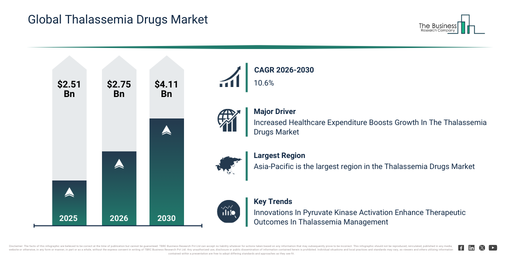
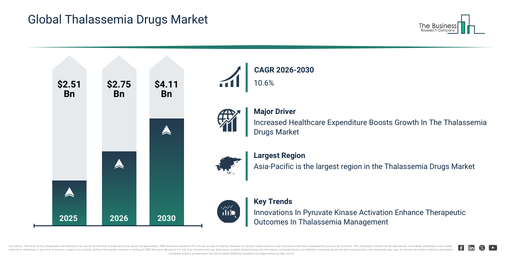
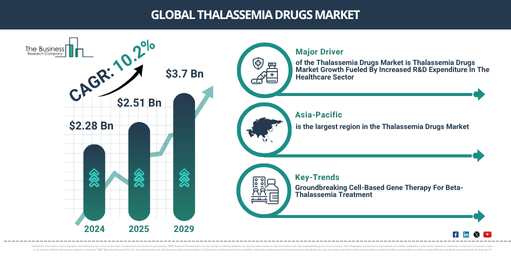
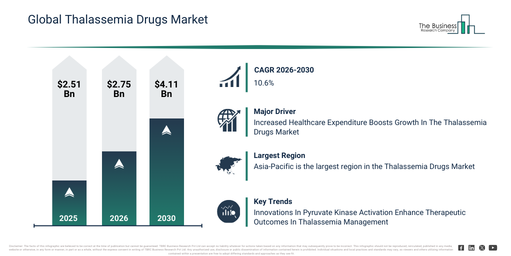
The thalassemia drugs market size has shown significant growth in recent years. Its value is expected to increase from $2.51 billion in 2025 to $2.75 billion in 2026, at a compound annual growth rate (CAGR) of 9.9%. This historical expansion can be attributed to several factors, including the high prevalence of inherited blood disorders, the reliance on regular blood transfusions, the limited availability of curative treatment options, growing awareness of genetic diseases, and government support for rare disease management.
The thalassemia drugs market size is anticipated to undergo significant growth in the coming years. It is projected to expand to $4.11 billion in 2030, achieving a compound annual growth rate (CAGR) of 10.6%. This expansion during the forecast period is driven by advancements in gene therapy technologies, increasing healthcare expenditure within emerging economies, the growing embrace of personalized medicine, the broader deployment of digital healthcare platforms, and enhanced diagnosis and screening initiatives. Key trends expected over this period include the rising adoption of gene therapy for beta thalassemia, an intensified focus on iron chelation optimization, the enlargement of long-term disease management therapies, an increase in the use of combination drug regimens, and improved access to treatment facilitated by online pharmacies.
Get A Free Sample Report With In-Depth Market Insights:
Thalassemia Drugs Market Growth Momentum: What Factors Are Shaping Demand?
The expansion of healthcare spending is anticipated to fuel the thalassemia drug market. Healthcare encompasses the structured delivery of medical services, treatments, preventative care, and the management of health concerns for individuals or groups. Enhanced healthcare expenditure often results in better clinical infrastructure, including specialized centers prepared to manage thalassemia cases. This development, consequently, facilitates the delivery of thalassemia drugs and associated therapies. For instance, in May 2023, a report from the Office for National Statistics, a UK-based government department, indicated that between 2022 and 2023, healthcare spending in the UK rose by 5.6% compared to a 0.9% growth in 2022. The UK healthcare expenditure was approximately $317.63 billion (£292 billion) in 2023. Thus, heightened healthcare spending is poised to stimulate the growth of the thalassemia drug market.
Thalassemia Drugs Market Segment Outlook: Which Categories Are Growing Fastest?
The thalassemia drugs market covered in this report is segmented –
1) By Type: Alpha Thalassemia Drugs, Beta Thalassemia Drugs
2) By Treatment Type: Iron Chelation Therapy, Other Treatments
3) By Distribution Channel: Hospital Pharmacies, Drug Stores And Retail Pharmacies
Subsegments:
1) By Alpha Thalassemia Drugs: Hydroxyurea, Luspatercept, Blood Transfusion Agents, Iron Chelators
2) By Beta Thalassemia Drugs: Hydroxyurea, Luspatercept, Gene Therapy Products, Blood Transfusion Agents, Iron Chelators
Thalassemia Drugs Market Trends Redefining Industry Growth
Major companies operating in the thalassemia drugs market are concentrating on developing advanced therapies, such as pyruvate kinase activation, to enhance red blood cell function, reduce transfusion dependence, and improve patient quality of life. Pyruvate kinase activation refers to a mechanism that boosts energy production in red blood cells, stabilizing defective hemoglobin and minimizing hemolysis. For instance, in August 2025, Agios Pharmaceuticals, a US-based company, launched PYRUKYND, an oral therapy featuring pyruvate kinase activation for both transfusion-dependent and non-transfusion-dependent alpha- and beta-thalassemia. Designed to decrease the frequency of blood transfusions and improve overall anemia management, PYRUKYND enhances oxygen binding to defective hemoglobin, reduces red blood cell deformation, and supports patient well-being. The therapy is also undergoing regulatory evaluation for broader thalassemia treatment, with risk evaluation strategies integrated into its development to ensure safety and efficacy.
Thalassemia Drugs Market Leading Companies And Competitive Benchmarking
Major companies operating in the thalassemia drugs market are Novartis AG, Bristol Myers Squibb Company, Bluebird Bio Inc, CRISPR Therapeutics AG, Acceleron Pharma Inc, Vertex Pharmaceuticals Inc, Pfizer Inc, Sanofi SA, Takeda Pharmaceutical Company Limited, Teva Pharmaceutical Industries Ltd, Cipla Ltd, Apotex Inc, Alvogen Inc, Ionis Pharmaceuticals Inc, Editas Medicine Inc, Agios Pharmaceuticals Inc, Alnylam Pharmaceuticals Inc, Gamida Cell Ltd, Amgen Inc, Roche Holding AG, AstraZeneca plc, Johnson and Johnson
View The Full Thalassemia Drugs Market Report:
Thalassemia Drugs Market Top Region By Revenue And Market Share
Asia-Pacific was the largest region in the thalassemia drugs market in 2025. The regions covered in the thalassemia drugs market report are Asia-Pacific, South East Asia, Western Europe, Eastern Europe, North America, South America, Middle East, Africa.
Reach Out To Our Team:
The Business Research Company: https://www.thebusinessresearchcompany.com/
Americas: +1 310-496-7795
Asia: +44 7882 955267 & +91 8897263534
Europe: +44 7882 955267
Email us at: marketing@tbrc.info
Follow us on:
LinkedIn: https://in.linkedin.com/company/the-business-research-company
YouTube: https://www.youtube.com/channel/UC24_fI0rV8cR5DxlCpgmyFQ
Global Market Model: https://www.thebusinessresearchcompany.com/global-market-model