Enhanced with market attractiveness analysis, total addressable market evaluation, company benchmarking matrices, interactive Excel dashboards, expanded supply chain intelligence, emerging startup coverage, and detailed product insights, The Business Research Company’s 2026 market reports deliver more actionable and strategically valuable research.
The tissue fixation devices market has demonstrated notable growth recently, driven by advancements in medical procedures and rising healthcare demands. This sector is expected to continue expanding as innovations and increasing surgical needs shape its future trajectory. Let’s explore the market size, key growth factors, product categories, competitive landscape, and regional outlook to better understand its development.
Market Size and Growth Prospects of the Tissue Fixation Devices Market
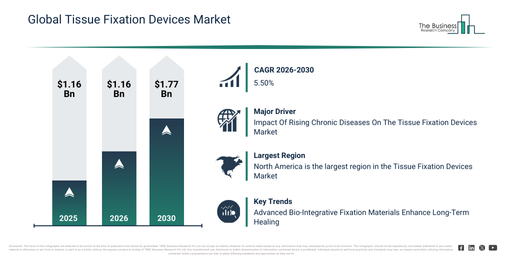
The tissue fixation devices market has experienced strong expansion in recent years, with revenues projected to increase from $16.58 billion in 2025 to $17.53 billion in 2026, reflecting a compound annual growth rate (CAGR) of 5.8%. This historical growth has been largely fueled by the rising number of orthopedic surgeries, trauma incidents, sports-related injuries, technological improvements in implants, and enhanced hospital surgical capacities. Looking ahead, the market is expected to sustain robust growth, reaching $21.68 billion by 2030 at a CAGR of 5.5%. The anticipated expansion is driven by broader adoption of bioabsorbable materials, growth in minimally invasive procedures, increased demand in sports medicine, reconstructive surgery needs, and an aging population. Key emerging trends include a rise in demand for bioabsorbable fixation devices, a surge in orthopedic and sports injury cases, growing utilization in minimally invasive surgeries, innovative fixation materials, and the expansion of trauma and reconstructive surgical procedures.
Download A Free Sample Report For Comprehensive Market Insights:
https://www.thebusinessresearchcompany.com/sample.aspx?id=20665&type=smp
Factors Contributing to Growth in the Tissue Fixation Devices Market
The rising number of chronic diseases worldwide is a major factor fueling the tissue fixation devices market. Chronic conditions such as diabetes, heart disease, and arthritis, which develop gradually and require ongoing management, are becoming more common due to unhealthy lifestyle factors like poor diet, sedentary behavior, and smoking. These diseases often necessitate medical interventions that rely on tissue fixation devices for effective repair and stabilization of bones and soft tissues. By improving patient outcomes through reducing re-injury risk and supporting faster recovery, these devices play a crucial role in chronic disease management.
A Real-World Example of Chronic Disease Impact on Market Demand
For instance, in June 2024, the UK’s National Health Service reported that 3,615,330 people registered with general practitioners were diagnosed with non-diabetic hyperglycemia (pre-diabetes) in 2023, marking an 18% rise from 3,065,825 cases in 2022. This increase in chronic conditions highlights the growing need for tissue fixation devices, as they are essential in treating complications and injuries related to such diseases, thereby driving market growth.
Access The Complete Tissue Fixation Devices Market Report:
https://www.thebusinessresearchcompany.com/report/tissue-fixation-devices-global-market-report
Product Types and Application Areas of the Tissue Fixation Devices Market
This market is segmented based on product types, applications, and end users. Product categories include sutures and suture anchors, interference screws, plates and pins, buttons, arrows, darts, and other types such as staples, spikes, and wires. Applications cover routine histology, immunohistochemistry, in situ hybridization, electron microscopy, and molecular diagnostics. End users range across hospitals, diagnostic laboratories, research institutes, biomedical companies, and forensic laboratories. Further segmentation breaks down sutures and anchors into absorbable and non-absorbable types, interference screws into bioabsorbable and metallic versions, plates and pins similarly divided, and buttons, arrows, and darts categorized by bioabsorbable and metallic materials.
Innovations Shaping the Tissue Fixation Devices Market Competition
Leading companies in the tissue fixation devices market are focusing on developing cutting-edge products such as bio-integrative fixation materials that promote natural healing and reduce complications associated with traditional metal implants. These innovative materials gradually integrate with bone and tissue, supporting regeneration without the permanence of metal. For example, in June 2025, OSSIO, a US-based orthopedic device manufacturer, launched the OSSIOFiber 2.5 mm Suture Anchor. This product features a unique metal-free mineral fiber matrix offering 55% greater pull-out strength compared to leading bio-composite anchors. It maintains standard surgical workflows with familiar instrumentation and comes in both unloaded and pre-loaded configurations to suit surgeon preferences. The fully bio-integrative design targets applications across various extremities, combining strong mechanical performance with biocompatibility and resorbability.
Key Players Defining the Tissue Fixation Devices Market Landscape
The market includes several prominent companies such as Medtronic plc, Stryker Corporation, Boston Scientific Corporation, B. Braun Group, Zimmer Biomet Holdings Inc., Smith & Nephew plc, Ethicon Inc., Cook Medical Incorporated, Arthrex Inc., Integra LifeSciences Holdings Corporation, In2Bones Global Inc., Conmed Corporation, Wright Medical Group N.V., Orthofix Medical Inc., LimaCorporate S.p.A., Exactech Inc., RTI Surgical Holdings Inc., Medartis AG, Aap Implantate AG, and Promedics Orthopaedic Ltd. These firms are actively competing by investing in product innovation and expanding their market reach.
Geographical Overview and Regional Market Insights
In 2025, North America dominated the tissue fixation devices market, holding the largest share. However, other regions such as Asia-Pacific, South East Asia, Western Europe, Eastern Europe, South America, the Middle East, and Africa are also covered in market analyses, each presenting different growth opportunities and challenges. The Asia-Pacific region, in particular, is expected to exhibit significant growth potential driven by increasing healthcare infrastructure development and rising incidence of orthopedic and trauma cases.
Get in touch with us:
The Business Research Company: https://www.thebusinessresearchcompany.com/
Americas: +1 310-496-7795
Asia: +44 7882 955267 & +91 8897263534
Europe: +44 7882 955267
Email us at: marketing@tbrc.info
Follow us on:
LinkedIn: https://in.linkedin.com/company/the-business-research-company
YouTube: https://www.youtube.com/channel/UC24_fI0rV8cR5DxlCpgmyFQ
Global Market Model: https://www.thebusinessresearchcompany.com/global-market-model