Built to provide research that’s more actionable and strategically valuable, The Business Research Company’s 2026 market reports include market attractiveness analysis, total addressable market sizing, company benchmarking matrices, interactive Excel dashboards, broader supply chain intelligence, emerging startup tracking, and in-depth product insights.
Viral Vector Manufacturing Market Size, Value And Growth Trajectory Through 2030
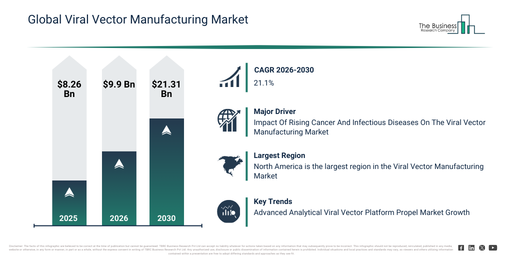
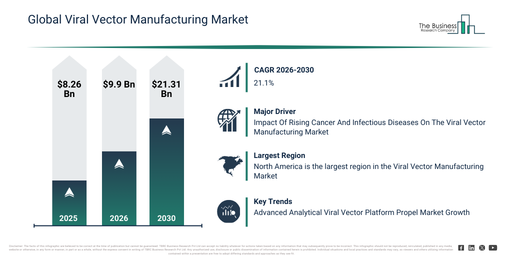
The viral vector manufacturing market has seen significant expansion in its size over recent years. This market is projected to expand from $8.26 billion in 2025 to $9.9 billion in 2026, demonstrating a compound annual growth rate (CAGR) of 19.9%. Historically, factors contributing to this growth include limited manufacturing capacity, elevated production costs, a reliance on conventional gene delivery techniques, existing regulatory barriers, and fragmented supply chains.
The viral vector manufacturing market size is poised for significant expansion in the coming years. It is projected to reach $21.31 billion in 2030, exhibiting a compound annual growth rate (CAGR) of 21.1%. The upward trend during this forecast period can be attributed to the rising demand for gene and cell therapies, continuous advancements in viral vector technology, increased investments in R&D, the expansion of contract manufacturing organizations, and the growing adoption of personalized medicine. Prominent trends expected in this period include ongoing innovation in gene therapy, enhanced optimization of viral vector safety, the development of scalable manufacturing processes, improved regulatory compliance, and sophisticated upstream and downstream processing methods.
Get A Free Sample Report With In-Depth Market Insights:
Viral Vector Manufacturing Market Demand Drivers Opening New Revenue Streams
The projected expansion of the viral vector manufacturing market is significantly influenced by the rising incidence of cancer and infectious diseases. An infectious disease is defined as an ailment resulting from a virus or its harmful substances, transmissible to a vulnerable host through contact with an afflicted individual, animal, or object. Cancer encompasses various medical conditions originating in any body organ or tissue, characterized by the uncontrolled proliferation of abnormal cells that breach normal limits to infiltrate adjacent organs and metastasize to distant sites. Viral vectors are employed to generate tumor antigens—proteins found on tumor cells—thereby stimulating the body’s immune system to combat cancer. Furthermore, viral vectors have been utilized as vaccines against a range of infectious illnesses in both pre-clinical and clinical investigations. For example, data from July 2024, provided by the Australian Institute of Health and Welfare, an Australia-based government agency, indicates that in Australia, cancer diagnoses grew from 160,570 in 2022 to 164,694 in 2023, demonstrating a significant increase within the year. This upward trajectory underscores the increasing prevalence of cancer nationally. Moreover, as per information released in August 2024 by the UK Health Security Agency, a UK-based executive agency, England recorded 368 measles cases in 2023, a nearly sevenfold increase compared to the 53 cases reported in 2022, with the West Midlands contributing 44% and London 33% of these cases. Consequently, the escalating occurrence of cancer and infectious diseases is propelling the expansion of the viral vector manufacturing market.
Viral Vector Manufacturing Market Segment Landscape: Which Areas Lead Development?
The viral vector manufacturing market covered in this report is segmented –
1) By Type: Adenoviral Vectors, Adeno-Associated Viral Vectors, Lentiviral Vectors, Retroviral Vectors, Other Types
2) By Disease: Cancer, Genetic Disorders, Infectious Diseases, Other Diseases
3) By Workflow: Upstream Processing, Downstream Processing
4) By Application: Gene And Cell Therapy Development, Vaccine Development, Biopharmaceutical And Pharmaceutical Discovery, Biomedical Research
5) By End-User: Research Organizations, Biotech And Pharmaceutical Companies, Other End Users
Subsegments:
1) By Adenoviral Vectors: Serotype 5, Serotype 2, Serotype 26
2) By Adeno-Associated Viral Vectors: AAV2, AAV5, AAV8, AAV9, Others
3) By Lentiviral Vectors: HIV-1-Based Lentiviral Vectors, SIV-Based Lentiviral Vectors, Others
4) By Retroviral Vectors: Moloney Murine Leukemia Virus (MoMLV), Gammaretroviral Vectors, Others
5) By Other Types: Sendai Viral Vectors, Vesicular Stomatitis Virus (VSV)-Based Vectors, Measles Virus Vectors, Others
Viral Vector Manufacturing Market Trends Powering Strategic Industry Growth
Major companies operating in the viral vector manufacturing market are focusing on developing advanced products, such as viral vector platforms specifically designed for viral vector production and manufacturing. Viral vector platforms are comprehensive systems tailored to efficiently produce and process viral vectors for applications such as gene therapy and vaccine development. For instance, in May 2023, AGC Biologics, a US-based global biopharmaceutical contract development and manufacturing organization (CDMO), launched the BravoAAV and ProntoLVV platforms, which were designed to offer flexible and accelerated vector development and manufacturing for cell and gene therapy programs. These platforms, aimed at flexible and accelerated vector development and manufacturing in cell and gene therapy programs, guarantee GMP product delivery within nine months, supported by a global regulatory and supply network and in-house plasmid DNA services. Through custom processes, templated material approaches, and prequalified analytical methods, these platforms are significant contributors to the viral vector manufacturing market’s projected growth, reaching $5.5 billion by 2035, by addressing the increasing demand for efficient development and delivery of life-changing gene therapies and vaccines.
Viral Vector Manufacturing Market Industry Leaders And Competitive Landscape
Major companies operating in the viral vector manufacturing market are Sanofi S.A., Merck Group, FUJIFILM Holdings Corporation, Lonza Group, Catalent Inc., AGC Biologics, Ultragenyx Pharmaceutical Inc., Novasep Holding SAS, Aldevron LLC, Oxford Biomedica plc, LakePharma Inc., Voyager Therapeutics Inc., Mustang Bio Inc., Regenxbio Inc., VGXI Inc., BioNTech IMFS GmbH, FinVector Oy, Vigene Biosciences Inc., Univercells Technologies, Sirion-Biotech GmbH, Cevec Pharmaceuticals GmbH, Batavia Biosciences BV
View The Full Viral Vector Manufacturing Market Report:
Viral Vector Manufacturing Market Geographic Analysis: Where Is Demand Rising Fastest?
North America was the largest region in the viral vector manufacturing market in 2025. Asia-Pacific is expected to be the fastest-growing region in the forecast period. The regions covered in the viral vector manufacturing market report are Asia-Pacific, South East Asia, Western Europe, Eastern Europe, North America, South America, Middle East, Africa.
Reach Out To Our Team:
The Business Research Company: https://www.thebusinessresearchcompany.com/
Americas: +1 310-496-7795
Asia: +44 7882 955267 & +91 8897263534
Europe: +44 7882 955267
Email us at: marketing@tbrc.info
Follow us on:
LinkedIn: https://in.linkedin.com/company/the-business-research-company
YouTube: https://www.youtube.com/channel/UC24_fI0rV8cR5DxlCpgmyFQ
Global Market Model: https://www.thebusinessresearchcompany.com/global-market-model