Built to provide research that’s more actionable and strategically valuable, The Business Research Company’s 2026 market reports include market attractiveness analysis, total addressable market sizing, company benchmarking matrices, interactive Excel dashboards, broader supply chain intelligence, emerging startup tracking, and in-depth product insights.
Vascular Sealant Market Growth Analysis: How Will Revenue Trend Over The Forecast Period?
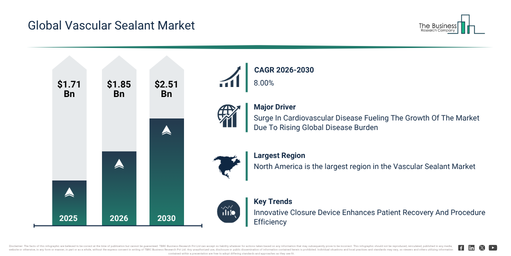
The vascular sealant market has shown robust growth recently. It is anticipated to expand from $1.71 billion in 2025 to $1.85 billion in 2026, achieving a compound annual growth rate (CAGR) of 7.8%. This historic market expansion is primarily attributed to an escalating number of surgical procedures, the increasing prevalence of cardiovascular diseases, ongoing advancements in surgical technologies, a rising demand for effective hemostasis solutions, and the general expansion of healthcare infrastructure.
The vascular sealant market size is projected to experience substantial expansion over the upcoming years. This market is anticipated to reach $2.51 billion by 2030, demonstrating a compound annual growth rate (CAGR) of 8.0%. Factors contributing to this growth during the forecast period include the expanding use of minimally invasive surgical procedures, an escalating need for sophisticated biomaterials, increased capital allocation towards surgical advancements, the proliferation of outpatient surgical facilities, and a heightened emphasis on ensuring patient safety and expedited recuperation. Significant trends expected during the forecast period encompass a greater uptake of advanced hemostatic agents in surgical operations, a heightened inclination towards minimally invasive surgical sealants, an increasing requirement for vascular sealants that are both rapid-acting and highly potent, the creation of sealant materials that are bioresorbable and biocompatible, and the broader application of multi-purpose sealants across various surgical domains.
Get A Free Sample Report With In-Depth Market Insights:
Vascular Sealant Market Development Factors: What’s Supporting Demand?
The expanding incidence of cardiovascular disease is anticipated to drive the future expansion of the vascular sealant market. Cardiovascular disease encompasses various conditions impacting the heart and blood vessels, such as ischemic heart disease and stroke. The rise in these diseases stems from an aging and expanding global population, coupled with greater exposure to risk factors like obesity, diabetes, high blood pressure, unhealthy dietary habits, lack of physical activity, and smoking; these factors collectively increase the risk of developing heart and blood vessel ailments. Vascular sealants play a role in managing cardiovascular disease by facilitating efficient bleeding control, aiding in vascular repair, and minimizing complications during surgical interventions. As an illustration, the Scottish Health Survey 2024, conducted by the Scottish Government, a Scotland-based governmental body, indicated that 16% of adults stated they lived with some form of cardiovascular disease (CVD), with the rate increasing from 4% for individuals aged 16–24 to 42% for adults aged 75 and over. Consequently, the increasing occurrence of cardiovascular disease is fueling the expansion of the vascular sealant market.
Vascular Sealant Market Segment Landscape And Growth Outlook
The vascular sealant market covered in this report is segmented –
1) By Product Type: Fibrin Sealants, Collagen Based Sealants, Synthetic Sealants, Other Product Types
2) By Material Type: Natural Biological Materials, Synthetic Polymeric Materials, Semi Synthetic Materials
3) By Form Factor: Liquid, Patch, Spray Or Foam, Pre Filled Applicator Kits
4) By Application: Cardiovascular Surgery, General Surgery, Neurosurgery, Orthopedic Surgery, Other Applications
5) By End User: Hospitals, Ambulatory Surgical Centers, Specialty Clinics, Other End Users
Subsegments:
1) By Fibrin Sealants: Human Plasma Derived Sealants, Bovine Plasma Derived Sealants, Recombinant Fibrin Sealants, Combination Fibrin Sealants
2) By Collagen Based Sealants: Bovine Collagen Sealants, Porcine Collagen Sealants, Equine Collagen Sealants, Crosslinked Collagen Sealants
3) By Synthetic Sealants: Polyethylene Glycol Sealants, Cyanoacrylate Sealants, Albumin Based Sealants, Gelatin Based Sealants
4) By Other Product Types: Combination Sealants, Hydrogel Sealants, Polysaccharide Based Sealants, Enzymatic Sealants
Vascular Sealant Market Transformation Trends: What Innovations Are Driving Change?
Leading companies in the vascular sealant market are increasingly focusing on utilizing innovative technologies like grip technology to achieve quicker hemostasis and improved patient recovery. Grip technology, a system rooted in hydrophilic polymers, establishes a secure and flexible seal at the vascular access site. This contributes to rapid hemostasis, minimizes the risk of bleeding complications, shortens patient recovery time, and facilitates earlier ambulation and discharge, all while presenting a minimally invasive alternative to traditional manual compression methods. For example, in July 2024, Cordis Corporation, a US-based medical device firm, secured U.S. Food and Drug Administration (FDA) approval for the Mynx Control Venous VCD. This innovative device integrates Grip Technology, which is based on hydrophilic, bioinert polyethylene glycol. The Mynx Control Venous VCD delivers effective closure for midbore venous puncture sites, including those employed in electrophysiology procedures, and demonstrated 100% procedural and device success in clinical trials. Its key benefits include a significantly reduced time to hemostasis (2.1 minutes versus 11.4 minutes for manual compression), faster ambulation, and earlier eligibility for discharge, thereby enhancing both patient experience and the operational efficiency of healthcare facilities.
Vascular Sealant Market Competitive Overview And Top Companies
Major companies operating in the vascular sealant market are Johnson & Johnson, Pfizer Inc., Medtronic plc, Stryker Corporation, Becton Dickinson and Company, Baxter International Inc., B. Braun Melsungen AG, Grifols S. A., Terumo Corporation, Teleflex Incorporated, Integra LifeSciences Holdings Corporation, CSL Behring LLC, Advanced Medical Solutions Group plc, SkinStitch Inc., Tricol Biomedical Inc., Cellphire Therapeutics Inc., Artivion Inc., GluStitch Inc., CuraMedical B. V., Endomedix Inc.
View The Full Vascular Sealant Market Report:
Vascular Sealant Market Leading Geography: Which Region Contributes The Most Revenue?
North America was the largest region in the vascular sealant market in 2025. Asia-Pacific is expected to be the fastest-growing region in the forecast period. The regions covered in the vascular sealant market report are Asia-Pacific, South East Asia, Western Europe, Eastern Europe, North America, South America, Middle East and Africa.
Reach Out To Our Team:
The Business Research Company: https://www.thebusinessresearchcompany.com/
Americas: +1 310-496-7795
Asia: +44 7882 955267 & +91 8897263534
Europe: +44 7882 955267
Email us at: marketing@tbrc.info
Follow us on:
LinkedIn: https://in.linkedin.com/company/the-business-research-company
YouTube: https://www.youtube.com/channel/UC24_fI0rV8cR5DxlCpgmyFQ
Global Market Model: https://www.thebusinessresearchcompany.com/global-market-model