Through market attractiveness analysis, total addressable market evaluation, company benchmarking matrices, interactive Excel dashboards, expanded supply chain intelligence, emerging startup coverage, and detailed product insights, The Business Research Company’s 2026 market reports provide more actionable and strategically valuable research.
The field of third-generation sequencing technology has witnessed remarkable progress recently, driven by advances in genomics and growing demand for more precise genetic analysis. As this technology evolves, it is set to play a critical role in transforming research, clinical diagnostics, and personalized medicine. Let’s explore the current market size, growth drivers, key industry players, and emerging trends shaping this vital sector.
Market Size and Projected Growth of the Third-Generation Sequencing Technology Market
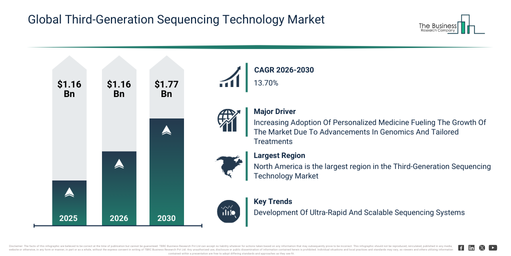
The third-generation sequencing technology market has expanded significantly, with its value increasing from $14 billion in 2025 to $15.96 billion in 2026, representing a compound annual growth rate (CAGR) of 14.0%. This growth reflects investments in genomics research, challenges faced by short-read sequencing methods, wider acceptance in academic research, a surge in rare disease investigations, and ongoing technological innovations. Looking ahead, the market is anticipated to accelerate further, reaching $26.71 billion by 2030, growing at a CAGR of 13.7%. Contributing factors for this forecast include the broadening scope of precision medicine, adoption of clinical diagnostics, decreasing sequencing costs, integration of AI analytics, and large-scale population genomics projects. Key trends expected to influence the market during this period encompass advancements in long-read sequencing, real-time DNA analysis, clinical genomics implementation, single-molecule sequencing, and development of portable sequencing devices.
Download A Free Sample Report For Comprehensive Market Insights:
https://www.thebusinessresearchcompany.com/sample.aspx?id=28340&type=smp
Personalized Medicine as a Catalyst for Market Expansion
One of the most significant forces propelling the third-generation sequencing technology market is the rising embrace of personalized medicine. This approach tailors medical treatments and preventive strategies based on an individual’s unique genetic profile, lifestyle, and environmental factors. The growth in personalized medicine is closely tied to breakthroughs in genomics that allow for the precise identification of genetic variants and the formulation of customized therapies. Third-generation sequencing technology supports this by providing long-read, highly accurate genomic data, making it possible to detect genetic differences more comprehensively and to design more effective treatments.
The impact of personalized medicine on market growth is underscored by recent developments. For example, in February 2024, the Personalized Medicine Coalition reported that the U.S. Food and Drug Administration (FDA) approved 26 new personalized medicines in 2023, a marked increase from the 12 approved in 2022. This surge highlights the accelerating acceptance and integration of tailored medical solutions, which in turn drives demand for advanced sequencing technologies.
Access The Complete Third-Generation Sequencing Technology Market Report:
Breakdown of Revenue-Generating Segments within the Third-Generation Sequencing Technology Market
The market for third-generation sequencing technology is categorized across several dimensions. By technology type, the main segments include Single-Molecule Real-Time Sequencing (SMRT) and Nanopore Sequencing. Workflow stages include sample preparation, sequencing, data analysis, data interpretation, and data storage and management. Application-wise, the market spans genomics, transcriptomics, epigenomics, metagenomics, personalized medicine, and synthetic biology. End-users range from academic institutions and clinical laboratories to pharmaceutical and biotechnology companies, research organizations, and government and nonprofit entities.
Within technology subsegments, SMRT sequencing is further divided into Zero-Mode Waveguides (ZMWs), Circular Consensus Sequencing (CCS), and High-Fidelity (HiFi) reads. Nanopore sequencing includes portable nanopore sequencers, benchtop nanopore sequencers, and high-throughput nanopore platforms, reflecting the diversity of devices adapted to various research and clinical needs.
Industry Trends Transforming Demand in the Third-Generation Sequencing Technology Market
Leading firms in the third-generation sequencing space are focusing efforts on creating cutting-edge platforms that deliver ultra-rapid and scalable sequencing solutions. These innovations aim to enhance research productivity, improve clinical relevance, and reduce both turnaround times and costs. Ultra-rapid and scalable sequencing systems facilitate high-throughput, real-time genomic analysis with exceptional speed and accuracy, enabling comprehensive genomic profiling across diverse applications.
A case in point is Roche Holding AG, which in February 2025 introduced its Sequencing by Expansion (SBX) technology. This fully integrated next-generation sequencing system incorporates a patented biochemical process that converts DNA or RNA sequences into measurable surrogate polymers called Xpandomers. The SBX platform offers highly accurate single-molecule nanopore sequencing combined with automated data analysis, providing whole-genome sequencing results in hours instead of days, and requiring minimal manual input.
Prominent Players and Strategic Positioning in the Third-Generation Sequencing Technology Market
The competitive landscape of this market includes several key organizations such as Oxford Nanopore Technologies, Pacific Biosciences, Quantapore, Ultima Genomics, BGI Genomics, MGI Tech, Complete Genomics, Stratos Genomics, VisiGen Biotechnologies, Helicos Biosciences, Genia Technologies, Electronic Bio Sciences, Quantum Biosystems, Base4 Innovation, Nabsys, Chronix Biomedical, Roche, Nanopore Diagnostics, GenapSys, and SomaLogic. These companies are actively innovating and expanding their product portfolios to maintain leadership in this rapidly evolving domain.
Geographical Leader in the Third-Generation Sequencing Technology Market
In 2025, North America held the dominant share of the third-generation sequencing technology market. The industry analysis encompasses a broad geographic scope, including Asia-Pacific, South East Asia, Western Europe, Eastern Europe, South America, the Middle East, and Africa, providing a comprehensive view of global market dynamics and growth opportunities.
Get in touch with us:
The Business Research Company: https://www.thebusinessresearchcompany.com/
Americas: +1 310-496-7795
Asia: +44 7882 955267 & +91 8897263534
Europe: +44 7882 955267
Email us at: marketing@tbrc.info
Follow us on:
LinkedIn: https://in.linkedin.com/company/the-business-research-company
YouTube: https://www.youtube.com/channel/UC24_fI0rV8cR5DxlCpgmyFQ
Global Market Model: https://www.thebusinessresearchcompany.com/global-market-model