Delivering more actionable and strategically valuable research, The Business Research Company’s 2026 market reports feature market attractiveness analysis, total addressable market evaluation, company benchmarking matrices, interactive Excel dashboards, expanded supply chain intelligence, emerging startup coverage, and detailed product insights.
Thymoglobulin Market Value Expansion And Long-Term Growth Outlook
Growth during the historic period was driven by a higher volume of organ transplantation surgeries, wider adoption of antibody-based immunosuppression, the global expansion of transplant centers, an increasing incidence of end-stage renal disease, and enhancements in biologic drug formulation.
The expansion expected during the forecast period is driven by higher funding for transplant immunology studies, a growing need for customized immunosuppressive approaches, the development of biologics production facilities, a stronger emphasis on minimizing chronic rejection risks, and wider integration into bone marrow transplant procedures. Key developments shaping this period involve the growing application of polyclonal antibody treatments, greater utilization of immunosuppressive induction regimens, an intensified effort to improve graft longevity, the scale-up of sophisticated biologic manufacturing technologies, and more thorough assessment of immune response results.
Download A Free Sample Report For Comprehensive Market Insights:
Thymoglobulin Market Opportunity Drivers: What Is Creating New Revenue Potential?
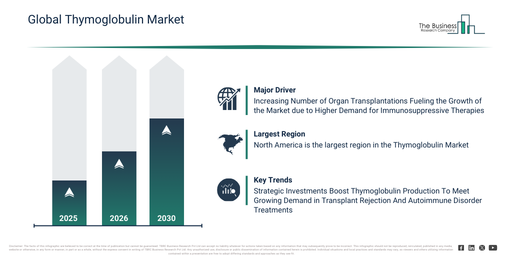
The anticipated growth of the Thymoglobulin market is being driven by a rising volume of organ transplant procedures. Organ transplantation involves surgically replacing a damaged or failing organ with a healthy one sourced from a donor. This increase in transplant operations is fueled by progress in surgical methods, enhanced organ availability, and a higher incidence of end-stage organ diseases. As an immunosuppressive agent, Thymoglobulin works by regulating immune responses to prevent and manage organ rejection in transplant recipients. For example, data from the Organ Procurement and Transplantation Network (OPTN), a US-based national membership organization, revealed that in 2023, a total of 46,632 organ transplants were carried out using both living and deceased donors, representing an 8.7% rise from 2022. Consequently, the growing number of organ transplantations is fueling expansion in the Thymoglobulin market.
The Thymoglobulin market is set to expand due to a rising incidence of autoimmune disorders. These disorders occur when the immune system erroneously attacks the body’s own tissues, viewing them as threats. This upward trend in autoimmune conditions is linked to genetic susceptibility, environmental triggers, shifts in lifestyle, enhanced diagnostic capabilities, an aging demographic, the hygiene hypothesis, hormonal effects, and the application of immunosuppressive drugs. Thymoglobulin aids in controlling autoimmune disorders by depleting T-cells that target bodily tissues, thereby modulating immune activity and lessening inflammation. As an illustration, in February 2024, Arthritis Australia, a non-profit organization based in Australia, projected that by 2025, an estimated 212,136 males and 362,137 females will have rheumatoid arthritis (RA), with these figures climbing to roughly 280,040 males and 479,828 females by 2040. Thus, the growing prevalence of autoimmune disorder cases is propelling the Thymoglobulin market forward.
Thymoglobulin Market Categorization By Product Type And Application
The thymoglobulin market covered in this report is segmented –
1) By Indication: Renal Transplantation, Bone Marrow Transplantation
2) By Distribution Channel: Hospital Pharmacies, Retail Pharmacies, Online Pharmacies
3) By End User: Adult, Geriatric
Thymoglobulin Market Innovation Trends Driving Future Development
A notable development in the thymoglobulin market is the use of strategic investments to improve treatment options for transplant rejection and autoimmune conditions. These investments are made to achieve long-term goals, including gaining a competitive edge or increasing market share. For example, in November 2024, Sanofi S.A., a pharmaceutical company based in France, invested $40.17 million (€40 million) to expand its biomanufacturing operations. This funding is intended to boost production of Thymoglobulin at the Lyon Gerland facility, the drug’s only manufacturing site. By scaling up its production capacity, Sanofi seeks to enhance the availability of Thymoglobulin, meeting the rising global demand for therapies addressing transplant rejection and autoimmune disorders.
Thymoglobulin Market Company Landscape And Strategic Competition
Major companies operating in the thymoglobulin market are Sanofi S.A.
Access The Complete Thymoglobulin Market Report:
Thymoglobulin Market Global Footprint: Which Region Holds Market Leadership?
North America was the largest region in the thymoglobulin market in 2025. The regions covered in the thymoglobulin market report are Asia-Pacific, Western Europe, Eastern Europe, North America, South America, Middle East, Africa.
Get in touch with us:
The Business Research Company: https://www.thebusinessresearchcompany.com/?utm_source=BlogsPR&utm_medium=Paid&utm_campaign=home_page_test
Americas: +1 310-496-7795
Asia: +44 7882 955267 & +91 8897263534
Europe: +44 7882 955267
Email us at: marketing@tbrc.info
Follow us on:
LinkedIn: https://in.linkedin.com/company/the-business-research-company
YouTube: https://www.youtube.com/channel/UC24_fI0rV8cR5DxlCpgmyFQ
Global Market Model: https://www.thebusinessresearchcompany.com/global-market-model