
Worker Heat Stress Monitoring Wearable Market Outlook From 2026 To 2030: Key Growth Factors And Future Opportunities
Featuring market attractiveness scoring, total addressable market sizing, company benchmarking matrices, interactive Excel dashboards, deeper supply chain intelligence, emerging startup tracking, and granular product-level insights, The Business Research Company’s 2026 market reports are built to deliver research that is both more actionable and more strategically valuable.
Worker Heat Stress Monitoring Wearable Market Forecast: What Value Will The Market Reach By 2030?
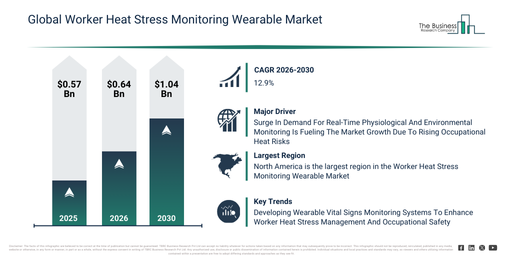
The worker heat stress monitoring wearable market has experienced substantial expansion in recent years. It is projected to increase from $0.57 billion in 2025 to $0.64 billion in 2026, at a compound annual growth rate (CAGR) of 13.1%. This growth in the historic period is attributable to several factors, including heightened workplace safety awareness, a rise in heat-related illnesses among workers, increased industrial adoption of wearable safety devices, more rigorous regulations for occupational safety compliance, an escalation in outdoor construction and industrial activities, a stronger focus on real-time worker health monitoring, greater utilization of IoT-enabled safety solutions, an increased understanding of productivity losses resulting from heat stress, a wider integration of wearable sensors in workforce safety, and an expanding sense of employer responsibility for worker well-being.
The worker heat stress monitoring wearable market is poised for significant expansion over the next few years, with its size projected to reach $1.04 billion by 2030, exhibiting a compound annual growth rate (CAGR) of 12.9%. This anticipated growth is driven by several factors, including the increasing adoption of industrial wearables, a heightened focus on preventing heat stress, growing investment in worker safety technologies, and the rising demand for real-time biometric monitoring. Further contributing elements are the ongoing digitalization of workplaces, a preference for connected safety systems, expanded deployment in high-risk industries, greater awareness of occupational hazards, the spread of industrial automation, and more stringent regulatory enforcement. Prominent trends throughout this period involve advancements in multi-parameter heat stress detection, progress in low-power sensor technologies, the evolution of flexible industrial wearables, and innovations in AI-driven predictive analytics. Additionally, key developments include novel cloud-based monitoring platforms, improved biometric heat risk assessment, integration with IoT safety networks, incorporation into workforce management systems, the inclusion of GPS-based worker tracking, and enhancements in the design of rugged wearable devices.
Get A Free Sample Report With In-Depth Market Insights:
Worker Heat Stress Monitoring Wearable Market Growth Momentum: What Factors Are Shaping Demand?
The increasing need for real-time physiological and environmental tracking is expected to drive the growth of the worker heat stress monitoring wearable market in the coming years. Real-time physiological and environmental monitoring involves continuous tracking of key health indicators like body temperature and heart rate, along with ambient conditions such as heat and humidity, to identify heat stress before severe symptoms develop. The demand for real-time physiological and environmental monitoring is rising due to increasing global temperatures, which are exposing more workers to hazardous heat, and traditional safety measures are unable to detect early physiological signs of heat stress. Worker heat stress monitoring wearables support real-time physiological and environmental monitoring by offering continuous tracking that alerts workers and employers to dangerous conditions, thereby improving workplace safety. For instance, in September 2025, KTCSafety Limited, an Ireland-based occupational health and safety research organization, reported that one in three European Union workers face climate-related risks including extreme heat, severe weather, and poor air quality, with 31% of workers concerned about health and safety from environmental conditions, 33% exposed to at least one risk factor, 20% to extreme heat, 19% to poor air quality, and over 10% to intense sun exposure. Therefore, the expanding requirement for real-time physiological and environmental monitoring is fueling the growth of the worker heat stress monitoring wearable market.
Worker Heat Stress Monitoring Wearable Market Segment Analysis Spotlighting Growth Areas
The worker heat stress monitoring wearable market covered in this report is segmented –
1) By Product Type: Smart Bands, Smart Patches, Smart Clothing, Others Product Type
2) By Sensor Type: Temperature Sensors, Heart Rate Sensors, Sweat Sensors, Others Sensor Type
3) By Connectivity: Bluetooth, Wi-Fi, Cellular, Others Connectivity
4) By Application: Industrial, Construction, Mining, Oil And Gas, Agriculture, Others Application
5) By End-User: Individual Workers, Enterprises
Subsegments:
1) By Smart Bands: Fitness Tracking Bands, Health Monitoring Bands, Sleep Tracking Bands, Hydration Monitoring Bands, Heart-Rate And ECG Bands, Sports Performance Bands, Medical-Grade Wearable Bands, Stress And Wellness Tracking Bands, Temperature Monitoring Bands
2) By Smart Patches: Vital-Sign Monitoring Patches, Electrolyte And Hydration Monitoring Patches, Glucose Monitoring Patches, Cardiac Monitoring Patches, Temperature Sensing Patches, Drug-Delivery Smart Patches, Pain Management Patches, Sweat Analysis Patches, Remote Patient Monitoring Patches
3) By Smart Clothing: Sensor-Integrated Shirts, Sensor-Integrated Vests, Cooling-Enabled Smart Garments, PPE-Integrated Smart Clothing
4) By Others Product Type: Smart Rings, Smart Footwear, Smart Helmets, Smart Gloves, Smart Eyewear, Smart Belts, Smart Jewelry, Smart Headbands
Worker Heat Stress Monitoring Wearable Market Trends Redefining Industry Growth
Leading firms in the worker heat stress monitoring wearable market are concentrating on creating sophisticated systems, including wearable medical-grade vital signs monitors, for ongoing measurement of core body temperature and additional physiological data, aiding occupational heat stress evaluation. These wearable vital signs monitoring technologies allow for real-time capture of various health indicators, evaluating thermal strain and facilitating early interventions in hazardous work settings. An example is Sempulse Corporation, a US-based medical technology firm, which introduced its FDA-cleared Sempulse Halo Vital Signs Monitoring System in May 2024. This compact, non-invasive medical-grade wearable continuously monitors core body temperature, pulse rate, respiratory rate, oxygen saturation (SpO2), and skin temperature, linking with mobile and cloud applications to offer real-time oversight in professional and other non-clinical contexts. The introduction of this system marks a notable progression, as it integrates multi-parameter vital sign tracking with practical insights, thereby connecting continuous physiological surveillance with improved worker safety and health management.
Worker Heat Stress Monitoring Wearable Market Competitive Overview And Top Companies
Major companies operating in the worker heat stress monitoring wearable market are Honeywell International Inc., Fujitsu Limited, PCE Instruments Ltd., Epicore Biosystems Inc., greenTEG AG, LSI LASTEM S.r.l., Equivital Inc., MakuSafe Corp., Corvex Connected Worker Inc., Modjoul Inc., Bodytrak Ltd., Soter Analytics, PHARE Technologies, SlateSafety, Hexoskin, Sato Keiryoki Mfg. Co. Ltd., Kenzen Health Care, TokenMe, Rootfit
View The Full Worker Heat Stress Monitoring Wearable Market Report:
Worker Heat Stress Monitoring Wearable Market Leading Geography: Which Region Contributes The Most Revenue?
North America was the largest region in the worker heat stress monitoring wearable market in 2025. Asia-Pacific is expected to be the fastest-growing region in the forecast period. The regions covered in the worker heat stress monitoring wearable market report are Asia-Pacific, South East Asia, Western Europe, Eastern Europe, North America, South America, Middle East, Africa.
Reach Out To Our Team:
The Business Research Company: https://www.thebusinessresearchcompany.com/
Americas: +1 310-496-7795
Asia: +44 7882 955267 & +91 8897263534
Europe: +44 7882 955267
Email us at: marketing@tbrc.info
Follow us on:
LinkedIn: https://in.linkedin.com/company/the-business-research-company
YouTube: https://www.youtube.com/channel/UC24_fI0rV8cR5DxlCpgmyFQ
Global Market Model: https://www.thebusinessresearchcompany.com/global-market-model