Blog

  • Insights Into The Slip Disc Market’s Growth Potential 2024-2033

    Insights Into The Slip Disc Market’s Growth Potential 2024-2033

    The Business Research Company’s global market reports are now updated with the latest market sizing information for the year 2024 and forecasted to 2033

    The slip disc market size has shown strong growth recently, projected to grow from $7.99 billion in 2023 to $8.53 billion in 2024 at a compound annual growth rate (CAGR) of 6.7%. Factors contributing to this growth during the historical period include the increasing elderly population, heightened awareness of spinal health, a rise in sedentary lifestyles and poor posture, the development and popularity of minimally invasive surgical options, and the expansion of health insurance coverage. The slip disc market size is expected to continue its strong growth trajectory, reaching $11.12 billion in 2028 at a CAGR of 6.8%. The anticipated growth in the forecast period can be attributed to improvements in healthcare infrastructure, ongoing research and development, enhanced availability and effectiveness of physical therapy and rehabilitation services, a rising focus on managing chronic pain, and a growing preference for non-surgical and less invasive treatment options. Key trends for the forecast period include advancements in imaging technologies, innovations in medical devices and surgical techniques, the adoption of robotic-assisted spine surgery, artificial disc replacement, and the implementation of telemedicine and digital health solutions.

    The increase in spinal cord injuries is expected to propel the growth of the slip disc market going forward. Spinal cord injuries are characterized by damage to the spinal cord that leads to a loss of function, such as mobility or sensation, often resulting in conditions like slipped discs. The rise in spinal cord injuries can be linked to a higher incidence of motor vehicle accidents, sports-related injuries, and falls. As more individuals experience spinal cord injuries, the demand for treatments and interventions for slipped discs increases. For example, in March 2024, according to the National Center for Biotechnology Information, a US-based government agency, approximately 17,000 new spinal cord injury cases are reported annually in the United States, with around 282,000 individuals currently living with spinal cord injuries. Furthermore, in May 2023, an article published by the National Center for Biotechnology Information noted that low back pain (LBP) affected 619 million people worldwide in 2020, with projections indicating this number could rise to 843 million by 2050. Consequently, the increase in spinal cord injuries is propelling the growth of the slip disc market.

    Get A Free Sample On The Slip Disc Market Report:

    https://www.thebusinessresearchcompany.com/sample.aspx?id=18735&type=smp

    What Are The Key Trends That Influence Slip Disc Market Share Analysis?

    Major companies in the slip disc market are focused on developing innovative products, such as biologic patches, to advance treatment options and improve patient outcomes. A biologic patch is a regenerative tissue scaffold designed to promote the healing and repair of damaged intervertebral discs using biological materials and growth factors. For instance, in November 2023, researchers at the Perelman School of Medicine at the University of Pennsylvania and the CMC VA Medical Center (CMCVAMC) developed a novel biologic patch called Tension-activated repair patches (TARPs) that could revolutionize the treatment of herniated discs in the spine. These patches aim to offer a more effective disc repair solution than current techniques by utilizing an individual’s natural movements, assisting in re-cushioning the vertebrae, restoring tension in the damaged discs, and filling in the gaps left by herniations. This dual approach seeks to halt further disc deterioration and alleviate disc pain.

    Which Market Players Are Driving Growth In The Slip Disc Market?

    Major companies operating in the slip disc market are Medacta International SA, Hitachi Ltd., General Electric Company, Pfizer Inc., GlaxoSmithKline plc, Medtronic plc, Siemens Healthcare Private Limited, Koninklijke Philips N.V, Stryker Corporation, Teva Pharmaceutical Industries Ltd., DePuy Synthes Companies, Zimmer Biomet Holdings Inc., Smith & Nephew plc, NuVasive Inc., Canon Medical Systems Corporation, Globus Medical Inc., Orthofix Medical Inc., Accuray Incorporated, Corin Group, Precision Spine Care, BioSpine Institute, Vertebral Technologies Inc., Captiva Spine Inc.

    How Is The Global Slip Disc Market Segmented?

    The slip disc market covered in this report is segmented –

    1) By Type: Thoracic Herniated Discs, Lumbar Herniated Disc, Cervical Herniated Discs
    2) By Diagnosis: Physical Examination, Nerve Conduction Test, Imaging Tests
    3) By Medications: Therapy, Surgery
    4) By Application: Hospital Use, Clinic Use, Household, Other Applications

    Read The Full Slip Disc Market Report Here

    https://www.thebusinessresearchcompany.com/report/slip-disc-global-market-report

    The Slip Disc Global Market Report 2024 provides an overview of the slip discmarket for the time series: historic years (2010 – 2021) and ten years forecast (2023 – 2032). The slip disc market forecast analyzes slip disc market size, slip disc market share, leading competitor and their market positions.

    The Table Of Content For The Slip Disc Market Include

    1. Slip Disc Market Executive Summary
    2. Slip Disc Market Segments
    3. Slip Disc Market Size And Template Market Growth Rate
    4.  Key Slip Disc Market Trends
    5. Major Slip Disc Market Drivers
    ……
    25. Key Mergers And Acquisitions In The Slip Disc Market
    26. Top Slip Disc Companies
    27. Slip Disc Market Opportunities And Strategies
    28. Slip Disc Market, Conclusions And Recommendations
    29. Appendix

    Explore Similar Reports From The Business Research Company:

    Opto Semiconductors Global Market Report 2024

    https://www.thebusinessresearchcompany.com/report/opto-semiconductors-global-market-report

    High-Reliability Semiconductors Global Market Report 2024

    https://www.thebusinessresearchcompany.com/report/high-reliability-semiconductors-global-market-report

    Semiconductor Etch Equipment Global Market Report 2024

    https://www.thebusinessresearchcompany.com/report/semiconductor-etch-equipment-global-market-report

    Learn More About The Business Research Company

    The Business Research Company has published over 15000+ reports in 27 industries, spanning 60+ geographies. The reports draw on 1,500,000 datasets, extensive secondary research, and exclusive insights from interviews with industry leaders.

    Contact us at:The Business Research Company: https://www.thebusinessresearchcompany.com/

    Americas +1 3156230293

    Asia +44 2071930708

    Europe +44 2071930708

    Email us at info@tbrc.info

    Follow us on:

    LinkedIn: https://in.linkedin.com/company/the-business-research-company

    YouTube: https://www.youtube.com/channel/UC24_fI0rV8cR5DxlCpgmyFQ

    Global Market Model: https://www.thebusinessresearchcompany.com/global-market-model

    Found this article helpful? Share it on:
  • Responsible-Artificial Intelligence Bias Audit Platform Market Growth Forecast: Market Size, Key Trends And Emerging Opportunities Through 2030

    Responsible-Artificial Intelligence Bias Audit Platform Market Growth Forecast: Market Size, Key Trends And Emerging Opportunities Through 2030

    Built to provide research that’s more actionable and strategically valuable, The Business Research Company’s 2026 market reports include market attractiveness analysis, total addressable market sizing, company benchmarking matrices, interactive Excel dashboards, broader supply chain intelligence, emerging startup tracking, and in-depth product insights.

    Responsible-Artificial Intelligence Bias Audit Platform Market Size Outlook: How Quickly Will Revenue Expand Through 2030?

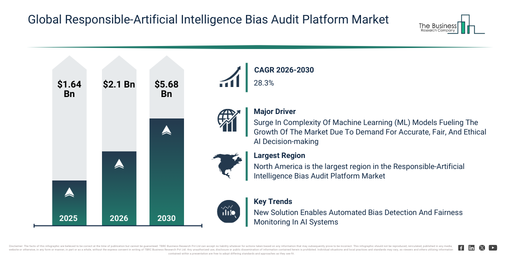
    The market size for responsible-artificial intelligence bias audit platforms has experienced significant expansion in recent years. This market is projected to expand from $1.64 billion in 2025 to reach $2.1 billion by 2026, exhibiting a compound annual growth rate (CAGR) of 28.0%. Historically, this growth has been fueled by factors such as the swift uptake of AI in critical decision-making applications, heightened public examination of algorithmic bias, the introduction of initial regulatory frameworks for ethical AI, notable AI bias occurrences, and the development of enterprise analytics and automation.

    The responsible-artificial intelligence bias audit platform market size is set to experience significant expansion in the coming years. It is expected to reach $5.68 billion in 2030, exhibiting a compound annual growth rate (CAGR) of 28.3%. This projected growth throughout the forecast period can be attributed to more stringent AI governance and regulatory enforcement, the widespread deployment of generative AI and Large Language Models, an increasing corporate focus on reliable AI, expanded AI utilization in public sector decision-making, and the need for real-time bias detection and mitigation. Prominent trends anticipated in this period include the broadening of continuous AI model monitoring and lifecycle audits, a heightened demand for regulatory-compliant automation in reporting, the greater adoption of explainability and transparency dashboards, the emergence of independent and third-party AI bias audit services, and the integration of bias mitigation tools into MLOps and DevOps workflows.

    Get A Free Sample Report With In-Depth Market Insights:

    https://thebusinessresearchcompany.com/sample_request?id=63861860&type=smp&name=Responsible-Artificial%20Intelligence%20Bias%20Audit%20Platform%20Market%20Report%202026&utm_source=Blogs&utm_medium=Paid&utm_campaign=Oct_PR

    Responsible-Artificial Intelligence Bias Audit Platform Market Expansion Drivers: What’s Shaping Future Growth?

    The future expansion of the responsible AI bias audit platform market is anticipated due to the rising intricacy of machine learning (ML) models. These ML models are defined as algorithms capable of learning data patterns to generate predictions or make decisions without direct programming. This escalating complexity in ML models stems from the demand for improved accuracy and enhanced functionalities, as advanced architectures handle vast datasets, operate on a larger scale, and facilitate more crucial decision-making scenarios. With the increase in model complexity and deployment scale, the task of identifying and addressing unintended biases grows more difficult, thereby boosting the demand for responsible AI bias audit platforms, which are instrumental in detecting, evaluating, and reducing bias while ensuring equitable, transparent, and ethical decision-making within AI-powered applications. As an illustration, a 2024 survey of US business leaders conducted by Gartner, a US-based advisory firm, revealed that a substantial majority of organizations are transforming to align with AI-driven market shifts, intensifying the requirement for governance, transparency, and risk-management tools. Ultimately, the rising complexity of machine learning models is a key factor fueling the demand for the responsible AI bias audit platform market.

    Responsible-Artificial Intelligence Bias Audit Platform Market Segment Performance And Emerging Opportunities

    The responsible-artificial intelligence bias audit platform market covered in this report is segmented –

    1) By Component: Software; Services

    2) By Deployment Mode: Cloud; On-Premises

    3) By Enterprise Size: Small And Medium Enterprises; Large Enterprises

    4) By Application: Fairness And Bias Monitoring; Explainability And Interpretability Tools (XAI); Risk And Compliance Management; Generative AI (GenAI) Or Large Language Model (LLM) Auditing

    5) By End User: Banking, Financial Services, And Insurance; Healthcare; Retail And E-Commerce; Government; Information Technology And Telecommunications; Other End Users

    Subsegments:

    1) By Software: Bias Detection And Assessment Software; Fairness Monitoring And Reporting Software; Model Explainability And Transparency Software; Compliance And Risk Management Software; Artificial Intelligence Governance Dashboard Software; Audit Trail And Documentation Software

    2) By Services: Consulting And Advisory Services; Implementation And Integration Services; Training And Education Services; Managed Audit And Monitoring Services; Compliance Support And Regulatory Services; Maintenance And Technical Support Services

    Responsible-Artificial Intelligence Bias Audit Platform Market Strategic Trends: What Defines The Next Growth Phase?

    Leading companies within the responsible artificial intelligence (AI) bias audit platform market are concentrating on developing innovative offerings, such as artificial intelligence bias detection and audit platforms, to address the growing demand for embedding responsible artificial intelligence platforms into the AI lifecycle management framework. These platforms are engineered to identify, assess, and alleviate bias within AI models by scrutinizing training data, model predictions, and decision-making processes, thereby ensuring fairness, transparency, and conformity with ethical artificial intelligence standards, unlike traditional manual audits which are lengthy and prone to human error. Illustratively, in May 2025, AMS, a US-based talent solutions and HR technology company, launched AMS Responsible artificial intelligence, a comprehensive responsible-artificial intelligence audit and diagnostics service created in partnership with Holistic AI. This solution combines automated bias detection algorithms with expert audit methodologies to evaluate the performance of AI systems across various demographic groups, expose fairness concerns, and generate actionable insights for mitigation and regulatory compliance. Its capabilities encompass diagnostic bias scoring, visual fairness dashboards, and risk assessment reports aligned with evolving AI regulations, coupled with recommendations to reduce discriminatory outcomes.

    Responsible-Artificial Intelligence Bias Audit Platform Market Competitive Landscape: Which Companies Lead The Industry?

    Major companies operating in the responsible-artificial intelligence bias audit platform market are Accenture plc, International Business Machines Corporation, Oracle Corporation, Automatic Data Processing Inc., DataRobot, H2O.AI Inc., ZestFinance Inc, Snorkel AI Inc., Arize AI Inc., Fiddler Labs Inc., Arthur AI Inc., Trustwise Inc., Botpress Inc., Omdena Inc., Redivis Inc., Allganize Inc., Fairly AI Inc., Holistic AI Inc., Monitaur Inc., Comet ML Inc.

    View The Full Responsible-Artificial Intelligence Bias Audit Platform Market Report:

    https://thebusinessresearchcompany.com/report/responsible-artificial-intelligence-bias-audit-platform-market-report?utm_source=Blogs&utm_medium=Paid&utm_campaign=Oct_PR

    Responsible-Artificial Intelligence Bias Audit Platform Market Regional Outlook: Where Is Opportunity Concentrated?

    North America was the largest region in the responsible artificial intelligence (AI) bias audit platform market in 2025. Asia-Pacific is expected to be the fastest-growing region in the forecast period. The regions covered in the responsible-artificial intelligence bias audit platform market report are Asia-Pacific, South East Asia, Western Europe, Eastern Europe, North America, South America, Middle East, Africa.

    Reach Out To Our Team:

    The Business Research Company: https://www.thebusinessresearchcompany.com/

    Americas: +1 310-496-7795

    Asia: +44 7882 955267 & +91 8897263534

    Europe: +44 7882 955267

    Email us at: marketing@tbrc.info

    Follow us on:

    LinkedIn: https://in.linkedin.com/company/the-business-research-company

    YouTube: https://www.youtube.com/channel/UC24_fI0rV8cR5DxlCpgmyFQ

    Global Market Model: https://www.thebusinessresearchcompany.com/global-market-model

  • Responsible Artificial Intelligence Governance Councils For Banks Market CAGR Forecast Through 2030: Key Trends Shaping Industry Expansion

    Responsible Artificial Intelligence Governance Councils For Banks Market CAGR Forecast Through 2030: Key Trends Shaping Industry Expansion

    Backed by market attractiveness analysis, total addressable market sizing, company benchmarking matrices, interactive Excel dashboards, wider supply chain intelligence, emerging startup coverage, and detailed product-level insights, The Business Research Company’s 2026 market reports are designed to offer research that is more actionable and strategically valuable than ever.

    Responsible Artificial Intelligence Training Market Size, Value And Growth Trajectory Through 2030

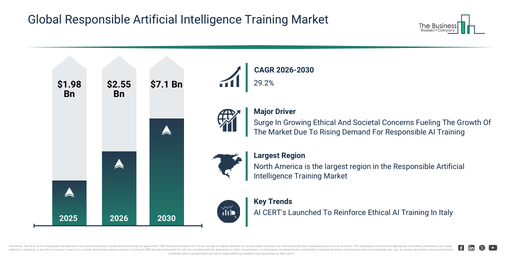
    The market size for responsible artificial intelligence training has experienced substantial growth in recent years. It is projected to increase from $1.98 billion in 2025 to $2.55 billion in 2026, exhibiting a compound annual growth rate (CAGR) of 28.9%. This historical expansion can be attributed to several factors including enterprise AI rollout programs, early AI misuse cases, compliance training expansion, data privacy education needs, and a corporate risk training culture.

    The responsible artificial intelligence training market is projected to undergo significant expansion over the next few years, with its size expected to grow to $7.1 billion by 2030, demonstrating a compound annual growth rate (CAGR) of 29.2%. This projected increase is largely due to factors such as mandatory AI literacy policies, the rising demand for workforce AI governance skills, regulated AI deployment practices, the proliferation of enterprise ethics programs, and the need for continuous AI audit readiness. Prominent trends emerging in this period encompass enterprise responsible AI certification programs, role-based AI ethics training, simulation-based AI risk learning, interactive AI compliance workshops, and continuous AI governance learning modules.

    Get A Free Sample Report With In-Depth Market Insights:

    https://thebusinessresearchcompany.com/sample_request?id=91833079&type=smp&name=Responsible%20Artificial%20Intelligence%20Training%20Market%20Report%202026&utm_source=Blogs&utm_medium=Paid&utm_campaign=Oct_PR

    Responsible Artificial Intelligence Training Market Development Factors: What’s Supporting Demand?

    Mounting ethical and societal apprehensions regarding artificial intelligence (AI) are anticipated to drive the expansion of the responsible artificial intelligence (AI) training market in the foreseeable future. These concerns pertain to heightened examination from the public, regulators, and stakeholders regarding AI systems’ impact on fairness, accountability, privacy, human rights, and overall societal results. Such worries are escalating as organizations increasingly utilize AI in critical decision-making contexts, frequently failing to adequately address inherent biases, gaps in accountability, or extensive social repercussions, which results in diminished trust and potential damage to reputation. Responsible artificial intelligence training offers a solution by developing the workforce’s capacity to design, implement, and manage AI systems in accordance with ethical principles, regulatory mandates, and frameworks for responsible usage. As an illustration, according to The Alan Turing Institute, a UK-based national research institute for data science and AI, approximately 72% of the UK public in November 2023 indicated that laws and regulation would enhance their comfort with AI, a rise from 62% in 2022. Consequently, the expanding ethical and societal concerns are propelling the development of the responsible artificial intelligence training market.

    Responsible Artificial Intelligence Training Market Segment Landscape And Growth Outlook

    The responsible artificial intelligence training market covered in this report is segmented –

    1) By Component: Software; Services; Platforms

    2) By Deployment Model And Ownership: On-Premises Responsible Artificial Intelligence (AI) Training; Cloud-Based Responsible Artificial Intelligence (AI) Training; Hybrid Responsible Artificial Intelligence (AI) Training

    3) By Training Type: Online; In-Person; Hybrid

    4) By Organization Size: Large Enterprises; Small And Medium Enterprises (SMEs)

    5) By End-User Vertical And Application: Healthcare And Life Sciences; Banking, Financial Services And Insurance (BFSI); Retail And E-Commerce; Telecommunications And Information Technology (IT); Government And Public Sector; Automotive And Transportation; Education And Research

    Subsegments:

    1) By Software: Curriculum Development Software; Assessment And Evaluation Software; Content Management Software; Analytics And Reporting Software

    2) By Services: Consulting Services; Implementation Services; Support And Maintenance Services; Custom Training Services

    3) By Platforms: Learning Management Systems; Virtual Classrooms; Simulation Environments; Collaborative Platforms

    Responsible Artificial Intelligence Training Market Transformation Trends: What Innovations Are Driving Change?

    Major companies operating in the responsible artificial intelligence (AI) training market are increasingly focusing on ethics-driven training and certification frameworks. Their aim is to build workforce capabilities in fairness, accountability, and transparent AI governance, thereby gaining a competitive advantage. Ethical AI training and certification frameworks are structured programs designed to equip professionals with the skills required to design, deploy, and govern AI systems in line with responsible-use principles and regulatory expectations. For instance, in December 2025, AI CERTs, a US-based professional AI training and certification provider, announced a strategic partnership with ENIA to expand ethical AI training and certification across Italy through ENIA Academy. The collaboration integrates AI CERTs professional training programs aligned with ISO/IEC 17024:2012, broadening access to internationally recognized responsible AI learning pathways. This initiative strengthens both technical and managerial competencies in responsible AI governance and human-centered AI adoption, demonstrating how leading providers are differentiating themselves through standardized, scalable, and market-ready responsible AI training solutions.

    Responsible Artificial Intelligence Training Market Competitive Landscape: Who Leads The Industry?

    Major companies operating in the responsible artificial intelligence training market are Deloitte Touche Tohmatsu Limited, Accenture plc, PricewaterhouseCoopers International Limited, Carnegie Mellon University, Udemy, Inc., Coursera, Inc., Information Systems Audit and Control Association (ISACA), Responsible Artificial Intelligence Institute, Artificial Intelligence Ethics and Compliance Institute, World Artificial Intelligence Institute, All Tech Is Human, Inc., Advetfly Solutions LLP, Diligent Institute, Fisher Phillips LLP, Skills4Good Artificial Intelligence Academy, Industry Artificial Intelligence Consortium, Ethical Artificial Intelligence Training Organization, Artificial Intelligence Competence and Certification Institute, Edstellar Solutions Private Limited

    View The Full Responsible Artificial Intelligence Training Market Report:

    https://thebusinessresearchcompany.com/report/responsible-artificial-intelligence-training-market-report?utm_source=Blogs&utm_medium=Paid&utm_campaign=Oct_PR

    Responsible Artificial Intelligence Training Market Geographic Landscape: Which Region Leads Industry Growth?

    North America was the largest region in the responsible artificial intelligence training market in 2025. Asia-Pacific is expected to be the fastest-growing region in the forecast period. The regions covered in the responsible artificial intelligence training market report are Asia-Pacific, South East Asia, Western Europe, Eastern Europe, North America, South America, Middle East, Africa.

    Reach Out To Our Team:

    The Business Research Company: https://www.thebusinessresearchcompany.com/

    Americas: +1 310-496-7795

    Asia: +44 7882 955267 & +91 8897263534

    Europe: +44 7882 955267

    Email us at: marketing@tbrc.info

    Follow us on:

    LinkedIn: https://in.linkedin.com/company/the-business-research-company

    YouTube: https://www.youtube.com/channel/UC24_fI0rV8cR5DxlCpgmyFQ

    Global Market Model: https://www.thebusinessresearchcompany.com/global-market-model

  • Responsible Artificial Intelligence Governance Councils For Banks Market To Witness 23.2% CAGR Growth Through 2030: Key Industry Drivers

    Responsible Artificial Intelligence Governance Councils For Banks Market To Witness 23.2% CAGR Growth Through 2030: Key Industry Drivers

    Featuring market attractiveness scoring, total addressable market sizing, company benchmarking matrices, interactive Excel dashboards, deeper supply chain intelligence, emerging startup tracking, and granular product-level insights, The Business Research Company’s 2026 market reports are built to deliver research that is both more actionable and more strategically valuable.

    Responsible Artificial Intelligence Governance Councils For Banks Market CAGR Outlook And Future Development

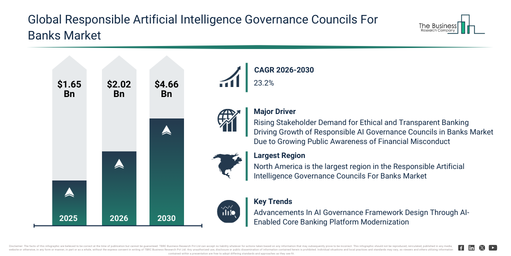
    The market size for responsible artificial intelligence governance councils for banks has experienced substantial growth in recent years. It is anticipated to expand from $1.65 billion in 2025 to $2.02 billion in 2026, achieving a compound annual growth rate (CAGR) of 23.0%. The growth observed in the past can be ascribed to factors such as the increasing use of AI in banking, regulations pertaining to model risk, governance frameworks driven by compliance, the enlargement of internal audit scopes, and controls over algorithmic decisions.

    The market for responsible artificial intelligence governance councils for banks is projected to experience substantial expansion in the coming years. This market is anticipated to reach a valuation of $4.66 billion by 2030, demonstrating a compound annual growth rate (CAGR) of 23.2%. This expansion throughout the forecast period is primarily driven by factors such as compulsory AI governance regulations, model assessments mandated by regulators, the necessity for AI explainability, organizational AI policy directives, and the persistent need for AI oversight. Significant developments expected during this timeframe encompass the establishment of bank-specific AI oversight committees, official AI risk assessment boards, initiatives for AI policy and ethics frameworks, integrated model governance dashboards, and inter-departmental AI audit mechanisms.

    Get A Free Sample Report With In-Depth Market Insights:

    https://thebusinessresearchcompany.com/sample_request?id=94763324&type=smp&name=Responsible%20Artificial%20Intelligence%20Governance%20Councils%20For%20Banks%20Market%20Report%202026&utm_source=Blogs&utm_medium=Paid&utm_campaign=Oct_PR

    Responsible Artificial Intelligence Governance Councils For Banks Market Industry Drivers: What’s Behind The Revenue Growth?

    The growing requirement for ethical and transparent banking practices is anticipated to stimulate the expansion of the responsible artificial intelligence (AI) governance councils for banks market. These practices involve the policies, behaviors, and operational standards through which banks operate with fairness, honesty, accountability, and transparency. The increasing demand for such practices is fueled by intensified regulatory scrutiny, greater consumer awareness and expectations, past financial misconduct and crises, and the necessity for banks to cultivate trust, accountability, and long-term sustainability in a highly competitive and regulated financial sector. Responsible AI governance councils aid in implementing these ethical and transparent banking practices by establishing explicit principles, oversight mechanisms, and accountability for the design, deployment, and usage of AI systems throughout the bank. As an illustration, PricewaterhouseCoopers (PwC), a UK-based audit, tax, and consulting firm network, reported that in May 2025, about 95% of business executives felt organizations bear a responsibility to build trust, which is an increase from 92% in 2023. Thus, the escalating focus on ethical and transparent banking practices is driving the growth of the responsible artificial intelligence (AI) governance councils for banks market.

    Responsible Artificial Intelligence Governance Councils For Banks Market Breakdown By Product Type And Application

    The responsible artificial intelligence governance councils for banks market covered in this report is segmented –

    1) By Component: Software; Services; Platforms

    2) By Deployment Mode: On Premises; Cloud

    3) By Council Type: Internal Councils; External Advisory Councils; Hybrid Councils

    4) By Bank Type: Retail Banks; Commercial Banks; Investment Banks; Central Banks; Other Bank Types

    5) By Application: Risk Management; Compliance; Ethical Artificial Intelligence Implementation; Model Validation; Data Privacy; Other Applications

    Subsegments:

    1) By Software: Governance Policy Management Software; Risk And Compliance Monitoring Software; Artificial Intelligence Model Oversight Software; Audit Trail And Documentation Software; Ethics Review And Decision Support Software; Regulatory Reporting And Disclosure Software

    2) By Services: Governance Advisory And Consulting Services; Regulatory Compliance Support Services; Artificial Intelligence Risk Assessment Services; Ethics Review And Oversight Services; Training And Capacity Building Services; Managed Governance Services

    3) By Platforms: Integrated Artificial Intelligence Governance Platforms; Enterprise Risk And Governance Management Platforms; Cross Functional Collaboration Platforms; Audit And Compliance Management Platforms; Artificial Intelligence Lifecycle Management Platforms

    #Responsible Artificial Intelligence Governance Councils For Banks Market Growth Trends: What’s Shaping The Future Outlook?

    Leading companies in the responsible artificial intelligence (AI) governance councils for banks market are prioritizing the creation of centralized AI governance frameworks, including enterprise-wide AI governance councils. This focus aims to strengthen control, transparency, and auditability over AI deployments, improve compliance with regulations, and enable the secure expansion of AI-driven banking use cases. Enterprise AI governance councils are defined as cross-functional oversight bodies that unite stakeholders from risk, compliance, legal, technology, and business units to establish policies, approve AI use cases, monitor model fairness and explainability, and ensure responsible AI adoption throughout banking operations. As an illustration, in July 2025, HSBC, a UK-based banking and financial services organization, established an enterprise AI governance council to oversee the ethical deployment of artificial intelligence across its worldwide banking activities. This council is responsible for setting ethical AI standards, sanctioning high-risk AI applications, monitoring adherence to regulatory requirements, and ensuring transparency and accountability across AI systems used in areas such as credit decisioning, fraud detection, and customer engagement. This strategy empowers HSBC to scale AI adoption securely while maintaining robust governance and regulatory oversight.

    Responsible Artificial Intelligence Governance Councils For Banks Market Company Landscape And Competitive Strategy

    Major companies operating in the responsible artificial intelligence governance councils for banks market are International Business Machines Corporation (IBM), ServiceNow Inc., Booz Allen Hamilton Holding Corporation, OneTrust LLC, Baringa Partners LLP, Quantexa Limited, LogicGate Inc., Fiddler Labs Inc., Arthur AI Inc., Centraleyes Ltd., Credo AI Corp., Guardrails AI Inc., Ethos AI Inc., Monitaur Inc., Holistic AI Ltd., FairNow, RevAIsor, Prompt Security, Deeploy, Amazon Web Services Inc. (AWS), Fair Isaac Corporation (FICO)

    View The Full Responsible Artificial Intelligence Governance Councils For Banks Market Report:

    https://thebusinessresearchcompany.com/report/responsible-artificial-intelligence-governance-councils-for-banks-market-report?utm_source=Blogs&utm_medium=Paid&utm_campaign=Oct_PR

    Responsible Artificial Intelligence Governance Councils For Banks Market Largest Region: Which Geography Holds The Biggest Share?

    North America was the largest region in the responsible artificial intelligence (AI) governance councils for banks market in 2025. Asia-Pacific is expected to be the fastest-growing region in the forecast period. The regions covered in the responsible artificial intelligence governance councils for banks market report are Asia-Pacific, South East Asia, Western Europe, Eastern Europe, North America, South America, Middle East, Africa.

    Reach Out To Our Team:

    The Business Research Company: https://www.thebusinessresearchcompany.com/

    Americas: +1 310-496-7795

    Asia: +44 7882 955267 & +91 8897263534

    Europe: +44 7882 955267

    Email us at: marketing@tbrc.info

    Follow us on:

    LinkedIn: https://in.linkedin.com/company/the-business-research-company

    YouTube: https://www.youtube.com/channel/UC24_fI0rV8cR5DxlCpgmyFQ

    Global Market Model: https://www.thebusinessresearchcompany.com/global-market-model

  • Responsible Artificial Intelligence (AI) Reporting Packs Market Projected For Strong Expansion Through 2030: Key Trends And Future Outlook

    Responsible Artificial Intelligence (AI) Reporting Packs Market Projected For Strong Expansion Through 2030: Key Trends And Future Outlook

    Built to provide research that’s more actionable and strategically valuable, The Business Research Company’s 2026 market reports include market attractiveness analysis, total addressable market sizing, company benchmarking matrices, interactive Excel dashboards, broader supply chain intelligence, emerging startup tracking, and in-depth product insights.

    Responsible Artificial Intelligence (AI) Reporting Packs Market Set To Climb From $2.13 Billion In 2026 To $6 Billion By 2030

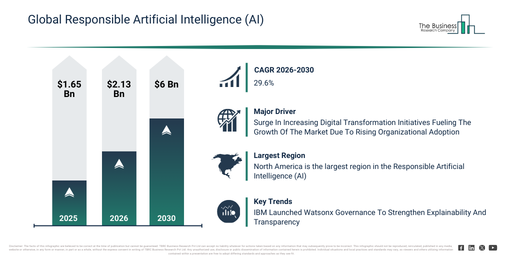
    The market for responsible artificial intelligence (AI) reporting packs has experienced substantial growth in recent years. Its value is set to increase from $1.65 billion in 2025 to $2.13 billion in 2026, achieving a compound annual growth rate (CAGR) of 29.3%. This historical expansion can be linked to a rise in enterprise AI governance programs, growing regulatory reporting demands, an increase in internal model review boards, the development of compliance reporting software, and the early adoption of AI risk dashboards.

    The market for responsible artificial intelligence (AI) reporting packs is projected to experience substantial growth over the coming years. This market is set to reach $6 billion by 2030, exhibiting a compound annual growth rate (CAGR) of 29.6%. This anticipated expansion during the forecast period stems from factors such as increasing regulatory requirements for AI disclosure, heightened AI oversight at the board level, an increase in AI governance budgets, a growing need for cross-border AI reporting, and greater integration of automated compliance dashboards. Key trends expected throughout this period encompass the wider utilization of standardized AI reporting dashboards, a surge in the adoption of automated governance reporting packs, the enhancement of modules for reporting bias and risk metrics, closer integration with existing enterprise risk systems, and an increased call for executive-level AI oversight reports.

    Get A Free Sample Report With In-Depth Market Insights:

    https://thebusinessresearchcompany.com/sample_request?id=69871156&type=smp&name=Responsible%20Artificial%20Intelligence%20%28AI%29%20Reporting%20Packs%20Market%20Report%202026&utm_source=Blogs&utm_medium=Paid&utm_campaign=Oct_PR

    Responsible Artificial Intelligence (AI) Reporting Packs Market Growth Factors: What’s Supporting Expansion?

    The increasing adoption of digital transformation initiatives is anticipated to propel the growth of the responsible artificial intelligence (AI) reporting packs market going forward. Digital transformation refers to the integration of digital technologies across organizational functions to enhance efficiency, improve customer experiences, and enable data-driven decision-making. These initiatives are accelerating as organizations increasingly adopt AI and automation to enhance operational performance and maintain competitiveness. Responsible artificial intelligence (AI) reporting packs support digital transformation initiatives by enabling transparent monitoring of AI systems, tracking ethical and regulatory compliance, and delivering actionable insights that assist organizations in aligning AI deployments with internal governance and risk-management frameworks. For instance, in 2024, according to the Deloitte Center for Integrated Research, a US-based member firm, organizations with average revenues of $13.4 billion witnessed their digital budgets increase from 7.5% of revenue in 2024 to 13.7% in 2025, reflecting a growing organizational focus on digital initiatives. Therefore, the expansion of digital transformation initiatives is driving the growth of the responsible artificial intelligence (AI) reporting packs market.

    Responsible Artificial Intelligence (AI) Reporting Packs Market Segment Analysis And Revenue Potential

    The responsible artificial intelligence (AI) reporting packs market covered in this report is segmented –

    1) By Component: Software; Services

    2) By Deployment Mode: On Premises; Cloud

    3) By Enterprise Size: Small And Medium Enterprises; Large Enterprises

    4) By Application: Risk Management; Compliance; Model Monitoring; Transparency And Explainability; Audit And Reporting; Other Applications

    5) By End User Industry: Banking, Financial Services And Insurance; Healthcare And Life Sciences; Government And Public Sector; Retail And E Commerce; Information Technology And Telecommunications; Automotive And Transportation; Other End User Industries

    Subsegments:

    1) By Software: Governance Platforms; Documentation Tools; Monitoring Dashboards; Analytics Modules; Reporting Solutions

    2) By Services: Consulting Services; Compliance Assessment; Model Auditing; Training And Support; Managed Services

    Responsible Artificial Intelligence (AI) Reporting Packs Market Industry Trends: What’s Reshaping Demand?

    Leading firms within the responsible artificial intelligence (AI) reporting packs market are concentrating on embedding explainability and transparency into their designs, frequently within wider AI governance platforms, through the utilization of explainable AI frameworks to secure a competitive edge. These frameworks facilitate the interpretability of machine learning (ML) and large language model (LLM) outputs for relevant parties by illustrating the progression from inputs to outputs, thus aiding in audit processes and record-keeping. As an illustration, in November 2023, the US-based technology firm IBM introduced watsonx.governance. IBM watsonx.governance serves as an AI governance solution, assisting businesses and governments in managing, overseeing, and documenting both generative AI (LLMs) and conventional ML models, thereby facilitating the generation of audit-ready Responsible-AI reports. This platform enhances clarity by logging model inputs, outputs, and the underlying decision logic, akin to a nutritional label for AI, which in turn boosts the comprehensibility and trustworthiness of these systems. It monitors aspects like fairness, bias, drift, and new metrics specific to LLMs, which allows for risk reduction alongside the production of standardized documents and reports. The system offers governance and reporting capabilities across models sourced from IBM, open-source communities, and external providers, all unified within a single framework.

    Responsible Artificial Intelligence (AI) Reporting Packs Market Key Players Shaping Industry Direction

    Major companies operating in the responsible artificial intelligence (AI) reporting packs market are Microsoft Corporation, Google LLC, Amazon Web Services Inc., International Business Machines Corporation (IBM), Cloudera Inc., DataRobot Inc., Dataiku Inc., SAS Institute Inc., H2O.AI Inc., Domino Data Lab Inc., Arize AI Inc., Qomplx Inc., Zetaris Pty Ltd, Fiddler AI Inc., Arthur AI Inc., Aporia Technologies Ltd., Truera Inc., Credo AI Inc., Holistic AI Limited, Superwise AI Ltd., Seldon Technologies Ltd., Monitaur Inc., Fairly AI Inc., Open Ethics Limited, ValidMind Inc.

    View The Full Responsible Artificial Intelligence (AI) Reporting Packs Market Report:

    https://thebusinessresearchcompany.com/report/responsible-artificial-intelligence-ai-reporting-packs-market-report?utm_source=Blogs&utm_medium=Paid&utm_campaign=Oct_PR

    Responsible Artificial Intelligence (AI) Reporting Packs Market Regional Analysis: Which Geography Leads On Revenue?

    North America was the largest region in the responsible Artificial Intelligence (AI) reporting packs market in 2025. Asia-Pacific is expected to be the fastest-growing region in the forecast period. The regions covered in the responsible artificial intelligence (AI) reporting packs market report are Asia-Pacific, South East Asia, Western Europe, Eastern Europe, North America, South America, Middle East, Africa.

    Reach Out To Our Team:

    The Business Research Company: https://www.thebusinessresearchcompany.com/

    Americas: +1 310-496-7795

    Asia: +44 7882 955267 & +91 8897263534

    Europe: +44 7882 955267

    Email us at: marketing@tbrc.info

    Follow us on:

    LinkedIn: https://in.linkedin.com/company/the-business-research-company

    YouTube: https://www.youtube.com/channel/UC24_fI0rV8cR5DxlCpgmyFQ

    Global Market Model: https://www.thebusinessresearchcompany.com/global-market-model

  • Responsible Artificial Intelligence (AI) Documentation Tools Market Outlook 2026–2030: Growth Trends, Market Dynamics And Emerging Opportunities

    Responsible Artificial Intelligence (AI) Documentation Tools Market Outlook 2026–2030: Growth Trends, Market Dynamics And Emerging Opportunities

    Backed by market attractiveness analysis, total addressable market sizing, company benchmarking matrices, interactive Excel dashboards, wider supply chain intelligence, emerging startup coverage, and detailed product-level insights, The Business Research Company’s 2026 market reports are designed to offer research that is more actionable and strategically valuable than ever.

    Responsible Artificial Intelligence (AI) Documentation Tools Market Forecast: Value Set To Climb From $2.44 Billion To $6.39 Billion

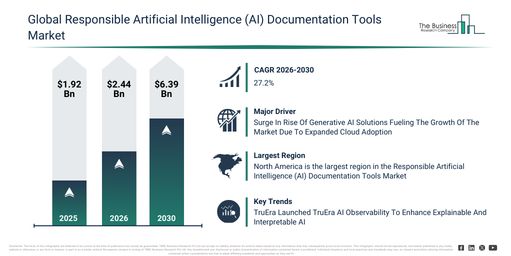
    The market for responsible artificial intelligence (AI) documentation tools has experienced rapid expansion over recent years. Its value is anticipated to increase from $1.92 billion in 2025 to $2.44 billion in 2026, demonstrating a compound annual growth rate (CAGR) of 27.0%. This historical growth can be attributed to several factors, including the increasing adoption of AI by enterprises, greater regulatory oversight of AI models, a rise in incidents involving model risk, the broadening of enterprise governance initiatives, and the initial deployment of AI audit frameworks.

    The market for responsible artificial intelligence (AI) documentation tools is projected to experience significant expansion in the coming years. This market is anticipated to reach a valuation of $6.39 billion by 2030, exhibiting a compound annual growth rate (CAGR) of 27.2%. This anticipated growth during the forecast period stems from factors such as the proliferation of mandatory AI governance regulations, an increase in corporate compliance spending, the expansion of regulated AI deployments, a rise in third-party AI audits, and a greater need for transparent AI systems. Key trends foreseen over this period involve the increasing uptake of model documentation platforms, the wider application of automated model card generation tools, the broadening of AI compliance workflow systems, the augmented deployment of audit trail and traceability instruments, and a heightened requirement for explainability reporting solutions.

    Get A Free Sample Report With In-Depth Market Insights:

    https://thebusinessresearchcompany.com/sample_request?id=53417169&type=smp&name=Responsible%20Artificial%20Intelligence%20%28AI%29%20Documentation%20Tools%20Market%20Report%202026&utm_source=Blogs&utm_medium=Paid&utm_campaign=Oct_PR

    Responsible Artificial Intelligence (AI) Documentation Tools Market Demand Drivers: What’s Powering Industry Growth?

    The emergence of generative AI solutions is projected to fuel expansion in the responsible artificial intelligence (AI) documentation tools market. These solutions encompass AI systems like large language models (LLMs) and other generative models that produce content, code, images, or decisions based on learned patterns, frequently operating in cloud-based and enterprise settings. Demand for generative AI solutions is escalating rapidly as organizations deploy them across business functions to enhance productivity, automation, and decision-making. This swift growth in generative AI adoption consequently amplifies the need for responsible AI documentation tools, compelling organizations to systematically record model behavior, training data lineage, decision logic, risk assessments, and usage controls. For instance, in April 2025, according to Search Engine Journal, a US-based online publication focused on SEO, search marketing, PPC, content strategy, and digital marketing trends, the share of organizations employing generative AI in at least one business function increased significantly, from 33% in 2023 to 71% in 2024, underscoring the rapid scale of generative AI deployment. Therefore, the increase in generative AI solutions is expected to propel the growth of the responsible artificial intelligence (AI) documentation tools market.

    Responsible Artificial Intelligence (AI) Documentation Tools Market Segmentation And Category Overview

    The responsible artificial intelligence (AI) documentation tools market covered in this report is segmented –

    1) By Component: Software; Services

    2) By Deployment Mode: Cloud; On Premises

    3) By Organization Size: Large Enterprises; Small And Medium Enterprises

    4) By Application: Model Development; Model Monitoring; Compliance Management; Risk Assessment; Other Applications

    5) By End User: Banking, Financial Services, And Insurance; Healthcare; Information Technology And Telecommunications; Retail; Government; Other End Users

    Subsegments:

    1) By Software: Documentation Platforms; Model Logging Tools; Compliance Management Tools; Audit Trail Solutions; Explainability And Transparency Tools

    2) By Services: Model Auditing Services; Risk Assessment Services; Compliance Consulting Services; Monitoring And Maintenance Services; Training And Support Services

    Responsible Artificial Intelligence (AI) Documentation Tools Market Innovation Trends: What Developments Are Reshaping The Industry?

    Leading companies in the responsible artificial intelligence (AI) documentation tools market are concentrating on integrating explainable and interpretable AI solutions, including full-lifecycle AI observability platforms, to achieve a competitive edge through robust model transparency, documentation, and governance across both development and production stages. These full-lifecycle AI observability platforms integrate explainability, monitoring, testing, and root cause analysis, thereby assisting organizations in evaluating, documenting, and enhancing AI model quality, alongside mitigating risks such as bias or failures. For example, in September 2023, TruEra, a US-based AI observability and quality platform provider, introduced TruEra AI Observability, a comprehensive AI monitoring solution designed to allow organizations to test, debug, and monitor both generative AI (LLM apps) and traditional ML models within a unified platform. This solution aims to improve AI quality and performance while lessening risks like hallucinations, bias, toxicity, and unreliable outputs. The platform supports the evaluation and tracking of LLM applications during their development as well as in live production use. Offered as a SaaS solution (with private cloud deployment options), it empowers teams to maintain reliable, high-performing AI systems across their entire AI portfolio.

    Responsible Artificial Intelligence (AI) Documentation Tools Market Competitive Analysis Of Leading Industry Participants

    Major companies operating in the responsible artificial intelligence (AI) documentation tools market are Microsoft Corporation, Google LLC, Amazon Web Services Inc., International Business Machines Corporation, Cloudera Inc., DataRobot Inc., Dataiku Inc., SAS Institute Inc., H2O.AI Inc., Domino Data Lab Inc., Arize AI Inc., Qomplx Inc., Zetaris Pty Ltd, Fiddler AI Inc., Arthur AI Inc., Aporia Technologies Ltd., TruEra Inc., Credo AI Inc., Holistic AI Ltd., Superwise Ltd., Seldon Technologies Ltd., Monitaur Inc., Fairly AI Inc., Open Ethics Ltd., ValidMind Inc.

    View The Full Responsible Artificial Intelligence (AI) Documentation Tools Market Report:

    https://thebusinessresearchcompany.com/report/responsible-artificial-intelligence-ai-documentation-tools-market-report?utm_source=Blogs&utm_medium=Paid&utm_campaign=Oct_PR

    Responsible Artificial Intelligence (AI) Documentation Tools Market Geographic Spread And Regional Opportunities

    North America was the largest region in the responsible Artificial Intelligence (AI) documentation tools market in 2025. Asia-Pacific is expected to be the fastest-growing region in the forecast period. The regions covered in the responsible artificial intelligence (AI) documentation tools market report are Asia-Pacific, South East Asia, Western Europe, Eastern Europe, North America, South America, Middle East, Africa.

    Reach Out To Our Team:

    The Business Research Company: https://www.thebusinessresearchcompany.com/

    Americas: +1 310-496-7795

    Asia: +44 7882 955267 & +91 8897263534

    Europe: +44 7882 955267

    Email us at: marketing@tbrc.info

    Follow us on:

    LinkedIn: https://in.linkedin.com/company/the-business-research-company

    YouTube: https://www.youtube.com/channel/UC24_fI0rV8cR5DxlCpgmyFQ

    Global Market Model: https://www.thebusinessresearchcompany.com/global-market-model

  • Responsible Artificial Intelligence Market Growth Outlook From $2.72 Billion In 2026 To $10.15 Billion By 2030

    Responsible Artificial Intelligence Market Growth Outlook From $2.72 Billion In 2026 To $10.15 Billion By 2030

    Featuring market attractiveness scoring, total addressable market sizing, company benchmarking matrices, interactive Excel dashboards, deeper supply chain intelligence, emerging startup tracking, and granular product-level insights, The Business Research Company’s 2026 market reports are built to deliver research that is both more actionable and more strategically valuable.

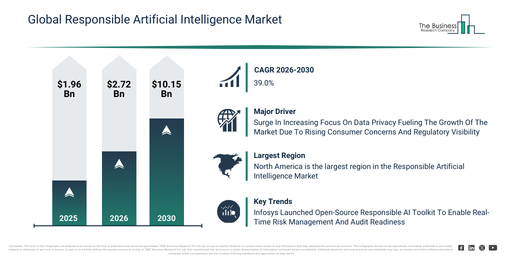
    Responsible Artificial Intelligence Market Revenue Growth On Track For A 39% CAGR Through 2030

    The responsible artificial intelligence market has experienced significant expansion in recent years. Its value is projected to increase from $1.96 billion in 2025 to $2.72 billion in 2026, at a compound annual growth rate (CAGR) of 38.8%. This historical growth can be attributed to several factors, including the rising adoption of AI within enterprises, initial incidents involving AI bias, increased regulatory scrutiny applied to algorithms, the enforcement of data privacy regulations, and the expansion of model validation practices.

    The responsible artificial intelligence market size is anticipated to undergo significant expansion over the forthcoming years. It is projected to attain a value of $10.15 billion by 2030, exhibiting a compound annual growth rate (CAGR) of 39.0%. This forecasted increase can be linked to several factors, including the widening scope of AI regulations, the implementation of enterprise AI audits, the rising need for automated model monitoring, the adoption of risk-based AI governance, and the demands for cross-border AI compliance. Prominent trends throughout this period involve enterprise AI governance platforms, tools for bias detection and mitigation, explainable AI monitoring systems, frameworks for model risk management, and software designed for AI compliance automation.

    Get A Free Sample Report With In-Depth Market Insights:

    https://thebusinessresearchcompany.com/sample_request?id=40350523&type=smp&name=Responsible%20Artificial%20Intelligence%20Market%20Report%202026&utm_source=Blogs&utm_medium=Paid&utm_campaign=Oct_PR

    Responsible Artificial Intelligence Market Growth Drivers: What’s Behind The Acceleration?

    A heightened emphasis on data privacy is anticipated to fuel the expansion of the responsible artificial intelligence (AI) market in the coming years. Data privacy pertains to the power individuals have over the collection, utilization, sharing, and management of their personal data by various entities. Rising consumer consciousness and apprehension regarding the inappropriate use of personal data by digital and AI-powered services are compelling companies to implement technologies guaranteeing ethical data practices, clarity, and adherence to regulations. Responsible artificial intelligence facilitates data privacy by allowing organizations to develop, implement, and oversee AI systems incorporating privacy-by-design principles, strategies for data minimization, and strong governance structures that meet user needs and legal obligations. For example, in December 2024, Deloitte, an UK-based professional services network, indicated that 48% of organizations encountered at least one security incident during the preceding year, an increase from 34% in 2023, thereby emphasizing growing weaknesses within digital infrastructures. Consequently, a greater focus on data privacy is projected to stimulate the growth of the responsible artificial intelligence market.

    Responsible Artificial Intelligence Market Segment Outlook: Which Categories Are Growing Fastest?

    The responsible artificial intelligence market covered in this report is segmented –

    1) By Component: Software; Hardware; Services

    2) By Deployment Model And Ownership: On-Premises Deployment; Cloud-Based Deployment; Hybrid Deployment

    3) By Functionality: Governance Risk And Compliance (GRC); Explainability And Transparency (XAI); Bias Detection And Mitigation; Artificial Intelligence (AI) Security And Safety; Privacy-Preserving Artificial Intelligence (AI)

    4) By Enterprise Size: Small And Medium Enterprises (SMEs); Large Enterprises

    5) By End-User: Banking, Financial Services And Insurance (BFSI); Healthcare; Retail And E-Commerce; Government; Manufacturing; Information Technology (IT) And Telecommunications; Other End-Users

    Subsegments:

    1) By Software: Bias Detection And Mitigation Software; Explainability And Transparency Tools; Model Governance And Lifecycle Management Software; Risk Assessment And Impact Analysis Software; Compliance And Regulatory Reporting Software; Audit And Traceability Platforms

    2) By Hardware: Secure Computing Hardware; On Device Monitoring Hardware; Edge Processing Units; Trusted Execution Environment Hardware; Secure Data Storage Hardware

    3) By Services: Software-As-A-Service (SaaS); Platform-As-A-Service (PaaS); Consulting And Professional Services

    Responsible Artificial Intelligence Market Trends: What’s Defining The Industry’s Next Phase?

    Leading companies in the responsible artificial intelligence (AI) market are increasingly developing innovative offerings, such as open-source responsible AI governance and audit toolkits, to enhance their competitive standing. These toolkits typically incorporate automated ethical oversight, explainability components, and risk-mitigation safeguards to facilitate the secure development, implementation, and supervision of AI systems. For instance, in February 2025, Infosys, an India-based IT and consulting company, introduced its Open-Source Responsible AI Toolkit. This toolkit furnishes enterprises with a customizable array of defensive AI guardrails, designed to aid in the safe and ethical construction and deployment of AI systems. It supports the identification and reduction of risks like privacy breaches, security attacks, sensitive data leakage, biased outputs, harmful content, hallucinations, deepfakes, and copyright concerns. Additionally, the toolkit boosts transparency by providing explainability features that offer insight into the factors behind a model’s generated responses. As an open-source solution, it empowers organizations to adopt, expand, and collaboratively improve responsible AI capabilities across various use cases.

    Responsible Artificial Intelligence Market Leading Companies And Competitive Benchmarking

    Major companies operating in the responsible artificial intelligence market are Apple Inc., Microsoft Corporation, Meta Platforms Inc., Amazon Web Services Inc., Deloitte Touche Tohmatsu Limited, Accenture plc, International Business Machines Corporation, Cisco Systems Inc., PricewaterhouseCoopers International Limited, Ernst & Young Global Limited, Capgemini SE, OpenAI Inc., The Boston Consulting Group Inc., Snowflake Inc., Databricks Inc., Fair Isaac Corporation, Anthropic PBC, QlikTech International AB, Dataiku Inc., Google LLC, Credo AI Inc., Aporia Technologies Ltd., Holistic AI Ltd., Fairly AI Inc.

    View The Full Responsible Artificial Intelligence Market Report:

    https://thebusinessresearchcompany.com/report/responsible-artificial-intelligence-market-report?utm_source=Blogs&utm_medium=Paid&utm_campaign=Oct_PR

    Responsible Artificial Intelligence Market Top Region By Revenue And Market Share

    North America was the largest region in the responsible artificial intelligence (AI) market in 2025. Asia-Pacific is expected to be the fastest-growing region in the forecast period. The regions covered in the responsible artificial intelligence market report are Asia-Pacific, South East Asia, Western Europe, Eastern Europe, North America, South America, Middle East, Africa.

    Reach Out To Our Team:

    The Business Research Company: https://www.thebusinessresearchcompany.com/

    Americas: +1 310-496-7795

    Asia: +44 7882 955267 & +91 8897263534

    Europe: +44 7882 955267

    Email us at: marketing@tbrc.info

    Follow us on:

    LinkedIn: https://in.linkedin.com/company/the-business-research-company

    YouTube: https://www.youtube.com/channel/UC24_fI0rV8cR5DxlCpgmyFQ

    Global Market Model: https://www.thebusinessresearchcompany.com/global-market-model

  • Relief And Aid Transportation Logistics Market Forecast 2026: Market Size, Competitive Landscape And Growth Drivers

    Relief And Aid Transportation Logistics Market Forecast 2026: Market Size, Competitive Landscape And Growth Drivers

    Featuring market attractiveness scoring, total addressable market sizing, company benchmarking matrices, interactive Excel dashboards, deeper supply chain intelligence, emerging startup tracking, and granular product-level insights, The Business Research Company’s 2026 market reports are built to deliver research that is both more actionable and more strategically valuable.

    Relief And Aid Transportation Logistics Market Size And Revenue Outlook Through 2030

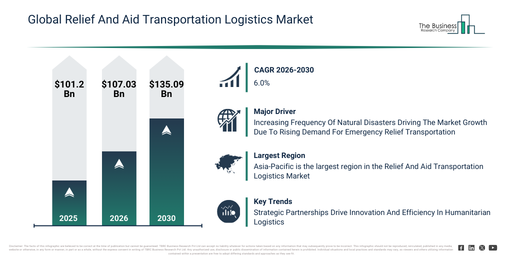
    The relief and aid transportation logistics market size has experienced strong growth in recent years. It is forecast to expand from $101.2 billion in 2025 to $107.03 billion in 2026, achieving a compound annual growth rate (CAGR) of 5.8%. Historically, this expansion can be attributed to factors like an increase in natural disasters, the growth of global humanitarian missions, the expansion of NGO relief programs, rising conflict-driven displacement, and higher demand for emergency supplies.

    The relief and aid transportation logistics market size is projected to experience robust expansion over the coming years. This sector is forecast to reach $135.09 billion in 2030, demonstrating a compound annual growth rate (CAGR) of 6.0%. This anticipated growth during the forecast period is primarily driven by factors such as the increase in climate-related disasters, the broadening of global relief funding, a rise in cross-border aid initiatives, significant investment in robust logistics infrastructure, and the growing demand for medical aid transport. Key developments anticipated in this period include the establishment of multimodal emergency logistics networks, enhanced rapid response transport coordination, the expansion of humanitarian cold chain capabilities, the creation of pre-positioned relief inventory hubs, and comprehensive integrated disaster supply planning.

    Get A Free Sample Report With In-Depth Market Insights:

    https://thebusinessresearchcompany.com/sample_request?id=33294&type=smp&name=Relief%20And%20Aid%20Transportation%20Logistics%20Market%20Report%202026&utm_source=Blogs&utm_medium=Paid&utm_campaign=Oct_PR

    Relief And Aid Transportation Logistics Market Growth Backed By Core Demand Fundamentals

    The anticipated surge in natural disaster occurrences is projected to stimulate the expansion of the relief and aid transportation logistics market in upcoming years. Such disasters are defined as catastrophic events originating from Earth’s natural processes, encompassing earthquakes, floods, hurricanes, and wildfires. The regularity and severity of these events are escalating, primarily due to climate change, which contributes to more extreme weather patterns through rising global temperatures, sea levels, and altered rainfall. As disasters become more common, the necessity for efficient relief and aid transportation logistics intensifies, as these services are vital for enabling the timely and coordinated delivery of essential supplies, emergency personnel, and support to affected communities. For example, the National Oceanic and Atmospheric Administration (NOAA) reported that the United States experienced 28 weather and climate disasters, each costing $1 billion or more, in 2023, an increase from 18 such events in 2022, thereby underscoring the growing scope of disaster response requirements. Hence, the increasing frequency of natural disasters represents a pivotal factor propelling the growth of the relief and aid transportation logistics market.

    Relief And Aid Transportation Logistics Market Segment Analysis: What Are The Core Market Categories?

    The relief and aid transportation logistics market covered in this report is segmented –

    1) By Relief Type: Medical Supplies; Shelter And Housing; Clothing And Personal Items; Emergency Equipment; Food And Water

    2) By Mode Of Transport: Air Transportation; Sea Transportation; Land Transportation

    3) By Service Providers: Government Agencies; Non Governmental Organizations; Private Contractors; Military Forces

    4) By Service Type: Transportation; Warehousing And Storage; Inventory Management; Last Mile Delivery

    5) By Distribution Channels: Direct Distribution; Through Relief Organizations; Public Private Partnerships

    Subsegments:

    1) By Medical Supplies: Emergency Medicines; Vaccines And Immunization Kits; First Aid Supplies; Medical Diagnostic Tools; Medical Treatment Equipment

    2) By Shelter And Housing: Temporary Shelter Tents; Emergency Housing Units; Shelter Repair Materials; Transitional Housing Solutions; Camp Infrastructure Support

    3) By Clothing And Personal Items: Adult Clothing Sets; Infant And Child Clothing; Footwear And Outerwear; Personal Hygiene Kits; Thermal Blankets And Bedding

    4) By Emergency Equipment: Search And Rescue Tools; Communication And Signaling Gear; Power Generation Equipment; Water Purification Systems; Protective And Safety Equipment

    5) By Food And Water: Ready To Eat Meal Packs; Nutritious Food Aid Packages; Clean Drinking Water Supplies; Food And Nutrition Supplements; Water Storage And Transportation Containers

    Relief And Aid Transportation Logistics Market Growth Trends Reshaping The Competitive Landscape

    Leading firms active within the relief and aid transportation logistics market are progressively forming strategic partnerships to create novel and streamlined solutions for humanitarian logistics. These collaborative alliances facilitate expansion in this sector by integrating specialized operational knowledge, pooling logistical assets, and jointly developing sophisticated supply chain frameworks to bolster worldwide humanitarian aid initiatives. A notable example is the partnership in May 2023 between the United Nations Children’s Fund (UNICEF), a US-based specialized agency, and Flexport, a US-based technology platform. They collaborated to deliver global humanitarian relief by streamlining the movement and allocation of critical provisions, including food, medical materials, and emergency aid, to children and families impacted by crises globally. This joint effort intends to utilize their collective logistical knowledge, improve operational effectiveness, and expedite the provision of vital supplies to at-risk communities in remote areas.

    Relief And Aid Transportation Logistics Market Top Companies Driving Competitive Growth

    Major companies operating in the relief and aid transportation logistics market are United Parcel Service Inc., DHL Group, FedEx Corporation, Maersk A/S, CMA CGM Group, Kuehne + Nagel International AG, DB Schenker, DSV A/S, C.H. Robinson Worldwide Inc., Nippon Express Co. Ltd., Geodis, Expeditors International of Washington Inc., Yusen Logistics Co. Ltd., Kintetsu World Express Inc. (KWE), Hellmann Worldwide Logistics SE & Co. KG, Agility Public Warehousing Company K.S.C.P., Blue Water Shipping A/S, Scan Global Logistics A/S, Move One Inc., Express Freight Management Inc.

    View The Full Relief And Aid Transportation Logistics Market Report:

    https://thebusinessresearchcompany.com/report/relief-and-aid-transportation-logistics-market-report?utm_source=Blogs&utm_medium=Paid&utm_campaign=Oct_PR

    Relief And Aid Transportation Logistics Market Global Footprint: Which Region Leads The Market?

    Asia-Pacific was the largest region in the relief and aid transportation logistics market in 2025 and is expected to be the fastest-growing region in the forecast period. The regions covered in the relief and aid transportation logistics market report are Asia-Pacific, South East Asia, Western Europe, Eastern Europe, North America, South America, Middle East, Africa.

    Reach Out To Our Team:

    The Business Research Company: https://www.thebusinessresearchcompany.com/

    Americas: +1 310-496-7795

    Asia: +44 7882 955267 & +91 8897263534

    Europe: +44 7882 955267

    Email us at: marketing@tbrc.info

    Follow us on:

    LinkedIn: https://in.linkedin.com/company/the-business-research-company

    YouTube: https://www.youtube.com/channel/UC24_fI0rV8cR5DxlCpgmyFQ

    Global Market Model: https://www.thebusinessresearchcompany.com/global-market-model

  • Release Testing For Gene Therapy Market Size In 2026: Regional Growth, Key Segments And Future Outlook

    Release Testing For Gene Therapy Market Size In 2026: Regional Growth, Key Segments And Future Outlook

    Built to provide research that’s more actionable and strategically valuable, The Business Research Company’s 2026 market reports include market attractiveness analysis, total addressable market sizing, company benchmarking matrices, interactive Excel dashboards, broader supply chain intelligence, emerging startup tracking, and in-depth product insights.

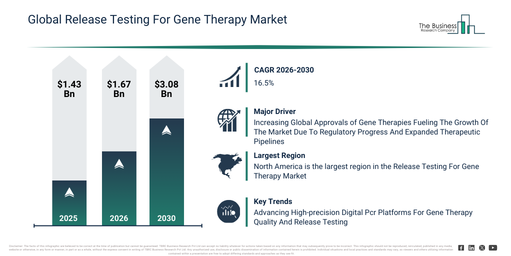
    Release Testing For Gene Therapy Market Growth From $1.67 Billion In 2026 To $3.08 Billion By 2030 At A CAGR Of 16.5%

    The market size for release testing in gene therapy has seen substantial growth in recent years. It is projected to expand from $1.43 billion in 2025 to $1.67 billion in 2026, demonstrating a compound annual growth rate (CAGR) of 16.3%. The expansion observed in past periods is attributable to an increase in gene therapy trials, strict regulatory quality standards, enhanced viral vector production, the proliferation of biologics testing laboratories, and a rise in advanced therapy approvals.

    The market for release testing in gene therapy is projected to experience swift expansion over the coming years. This market is anticipated to reach a value of $3.08 billion by 2030, exhibiting a compound annual growth rate (CAGR) of 16.5%. Key drivers for this growth during the projected timeframe include the proliferation of commercial gene therapies, an escalating need for rapid release testing, the widening scope of contract testing services, heightened regulatory scrutiny, and the integration of automated qc platforms. Significant trends anticipated within this forecast period encompass high sensitivity potency assays, swift sterility testing platforms, automated batch release analytics, comprehensive multi parameter quality control panels, and sophisticated vector identity testing.

    Get A Free Sample Report With In-Depth Market Insights:

    https://thebusinessresearchcompany.com/sample_request?id=33293&type=smp&name=Release%20Testing%20For%20Gene%20Therapy%20Market%20Report%202026&utm_source=Blogs&utm_medium=Paid&utm_campaign=Oct_PR

    Release Testing For Gene Therapy Market Growth Catalysts And Demand Drivers

    The anticipated expansion of global approvals for gene therapies is projected to fuel the growth of the release testing for gene therapy market in the future. Gene therapies are therapeutic approaches that entail introducing, extracting, or altering genetic material in a patient’s cells to manage or avert illnesses. This increase in worldwide gene therapy approvals is underpinned by greater regulatory acceptance, scientific progress, and a growing need for novel treatments for genetic conditions that were previously unmanageable. Release testing for gene therapy constitutes a mandatory regulatory step, guaranteeing product quality and patient well-being via evaluations of potency, purity, identity, and safety before a batch is cleared. As an illustration, the National Center for Biotechnology Information, a U.S.-based governmental research resource, reported in November 2023 that over 100 gene, cell, and ribonucleic acid (RNA) therapies had received global approval by early 2023, with an additional over 3,700 therapies currently in clinical and preclinical stages of development. Consequently, the rising volume of global gene therapy approvals is poised to contribute significantly to the expansion of the release testing for gene therapy market.

    Release Testing For Gene Therapy Market Segment Breakdown: Which Categories Lead On Revenue?

    The release testing for gene therapy market covered in this report is segmented –

    1) By Test Type: Potency Testing; Purity Testing; Identity Testing; Safety Testing; Sterility Testing; Other Test Types

    2) By Product Type: Assay Kits; Reagents; Instruments; Services

    3) By Therapy Type: In Vivo Gene Therapy; Ex Vivo Gene Therapy

    4) By Application: Clinical Diagnostics; Research; Quality Control; Process Development; Other Applications

    5) By End-User: Pharmaceutical and Biotechnology Companies; Academic and Research Institutes; Contract Research Organizations; Other End-Users

    Subsegments:

    1) By Potency Testing: Functional Activity Assays; Gene Expression Level Measurement; Biological Activity Evaluation; Dose Response Assessment

    2) By Purity Testing: Residual Host Cell Protein Analysis; Residual Deoxyribonucleic Acid Quantification; Process Related Impurity Testing; Product Related Impurity Assessment

    3) By Identity Testing: Genetic Sequence Confirmation; Vector Identity Verification; Transgene Identity Analysis; Cell Line Authentication

    4) By Safety Testing: Adventitious Agent Testing; Replication Competent Virus Detection; Endotoxin Level Evaluation; Toxicity Assessment

    5) By Sterility Testing: Bacterial Contamination Testing; Fungal Contamination Testing; Mycoplasma Detection; Environmental Monitoring Validation

    6) By Other Test Types: Stability Testing; Packaging Integrity Testing; Shelf Life Determination; Transport and Storage Condition Testing

    Release Testing For Gene Therapy Market Trends Shaping Long-Term Demand

    Leading companies in the release testing for gene therapy market are concentrating on developing inventive solutions, such as digital PCR-based analytical testing platforms. This initiative addresses the increasing demand for highly accurate, sensitive, and standardized methodologies essential for guaranteeing product safety, potency, and regulatory adherence for complex gene therapy products. Digital polymerase chain reaction (PCR)-based analytical testing platforms are sophisticated molecular systems that precisely quantify deoxyribonucleic acid (DNA) or ribonucleic acid (RNA) by separating samples into thousands of individual reactions, thereby enabling highly sensitive and absolute measurement of nucleic acid targets. For instance, in April 2025, QIAGEN N.V., a Germany-based supplier of molecular diagnostics and life science tools, expanded its QIAcuity digital PCR portfolio with new lentivirus solutions crafted to enhance quality control in cell and gene therapy manufacturing. These additions support viral vector genome titration, vector copy number determination, and replication-competent lentivirus detection, facilitating high-precision analytics for process development, batch release, and regulatory compliance. The platform offers absolute quantification across singleplex and multiplex applications, strong repeatability, and specialized kits for critical gene therapy vectors, delivering more reliable and reproducible results than many conventional testing approaches.

    Release Testing For Gene Therapy Market Leading Players And Competitive Positioning

    Major companies operating in the release testing for gene therapy market are Thermo Fisher Scientific Inc., Boehringer Ingelheim BioXcellence GmbH, Fujifilm Diosynth Biotechnologies Inc., AGC Biologics Inc., SGS SA, Lonza Group AG, Eurofins Scientific SE, WuXi AppTec Co. Ltd., Charles River Laboratories International Inc., Sartorius AG, Samsung Biologics Co. Ltd., Bio-Rad Laboratories Inc., Pace Analytical Services LLC, KBI Biopharma Inc., BioAgilytix Labs LLC, Viralgen Vector S.L., GenScript ProBio LLC, KCAS Bioanalytical Services, Creative Biolabs LLC, Cellipont Bioservices Inc.

    View The Full Release Testing For Gene Therapy Market Report:

    https://thebusinessresearchcompany.com/report/release-testing-for-gene-therapy-market-report?utm_source=Blogs&utm_medium=Paid&utm_campaign=Oct_PR

    Release Testing For Gene Therapy Market Regional Split: Which Areas Are Fueling Growth?

    North America was the largest region in the release testing for gene therapy in 2025. Asia-Pacific is expected to be the fastest-growing region in the forecast period. The regions covered in the release testing for gene therapy market report are Asia-Pacific, South East Asia, Western Europe, Eastern Europe, North America, South America, Middle East, Africa.

    Reach Out To Our Team:

    The Business Research Company: https://www.thebusinessresearchcompany.com/

    Americas: +1 310-496-7795

    Asia: +44 7882 955267 & +91 8897263534

    Europe: +44 7882 955267

    Email us at: marketing@tbrc.info

    Follow us on:

    LinkedIn: https://in.linkedin.com/company/the-business-research-company

    YouTube: https://www.youtube.com/channel/UC24_fI0rV8cR5DxlCpgmyFQ

    Global Market Model: https://www.thebusinessresearchcompany.com/global-market-model

  • Regenerative Grid Simulator Market Analysis: $0.88 Billion Market Size In 2026 And Future Growth Prospects

    Regenerative Grid Simulator Market Analysis: $0.88 Billion Market Size In 2026 And Future Growth Prospects

    Featuring market attractiveness scoring, total addressable market sizing, company benchmarking matrices, interactive Excel dashboards, deeper supply chain intelligence, emerging startup tracking, and granular product-level insights, The Business Research Company’s 2026 market reports are built to deliver research that is both more actionable and more strategically valuable.

    Regenerative Grid Simulator Market Growth Potential: How Will Market Size Shift Through 2030?

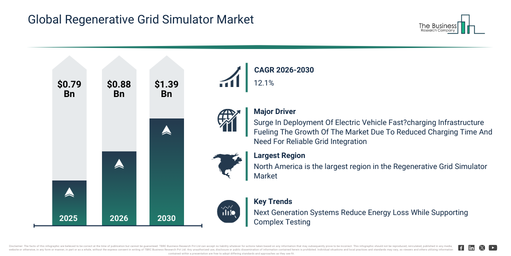
    The market for regenerative grid simulators has experienced significant growth in recent years. It is anticipated to expand from $0.79 billion in 2025 to $0.88 billion in 2026, achieving a compound annual growth rate (CAGR) of 11.8%. Key drivers for this historical growth include the rise in renewable energy installations, the broadening scope of power electronics testing, more stringent grid compliance requirements, an uptick in inverter validation needs, and the pursuit of energy-efficient test systems.

    The regenerative grid simulator market is anticipated to experience substantial expansion over the next few years. It is forecast to achieve a valuation of $1.39 billion by 2030, exhibiting a compound annual growth rate (CAGR) of 12.1%. This expansion throughout the forecast period is driven by factors such as the rise in EV charger testing, the development of smart grid projects, increasing demand for energy storage validation, stricter grid interconnection standards, and the integration of regenerative test platforms. Significant trends identified for this period include bidirectional energy recovery testing systems, high-efficiency grid emulation platforms, renewable integration validation setups, modular regenerative power test benches, and real-time grid code compliance testing.

    Get A Free Sample Report With In-Depth Market Insights:

    https://thebusinessresearchcompany.com/sample_request?id=83996518&type=smp&name=Regenerative%20Grid%20Simulator%20Market%20Report%202026&utm_source=Blogs&utm_medium=Paid&utm_campaign=Oct_PR

    Regenerative Grid Simulator Market Growth Momentum: What Factors Are Shaping Demand?

    The expansion of electric vehicle fast-charging infrastructure is anticipated to fuel the growth of the regenerative grid simulator market. This infrastructure comprises high-speed charging networks designed for rapid recharging of EV batteries, facilitating extended travel and minimizing vehicle downtime. The push for more EV fast-charging is largely due to the advantage of shorter charging periods, enabling EV owners to quickly power up and resume their travels without significant delays. Regenerative grid simulator systems are crucial for this deployment, offering precise testing and validation of grid-connected charging equipment under varying grid conditions, which ensures both dependability and adherence to standards as these charging networks expand. For example, as reported by the International Energy Agency, a France-based intergovernmental organization, in May 2025, the number of EV fast chargers increased from 1.2 million in 2023 to 1.6 million in 2024, marking a 33 % rise, with ultra-fast chargers experiencing over 50 % growth. Consequently, the rising implementation of electric vehicle fast-charging infrastructure is stimulating the regenerative grid simulator market’s expansion.

    Regenerative Grid Simulator Market Segment Trends And Revenue Contributors

    The regenerative grid simulator market covered in this report is segmented –

    1) By Component: Hardware; Software; Services

    2) By Product Type: Single-Phase; Three-Phase

    3) By Power Range: Low Power; Medium Power; High Power

    4) By Application: Automotive; Energy; Consumer Electronics; Industrial; Other Applications

    5) By End-User: Utilities; Research and Development; Laboratories; Other End-Users

    Subsegments:

    1) By Hardware: Power Electronic Modules; High Performance Processors; Control and Interface Panels; Measurement and Sensing Devices; Energy Storage Units

    2) By Software: Grid Modeling Platforms; Simulation and Analysis Tools; Real Time Monitoring Systems; Control Algorithm Applications; Data Visualization and Reporting Tools

    3) By Services: System Integration Services; Installation and Commissioning Services; Training and Education Services; Maintenance and Support Services; Consulting and Advisory Services

    Regenerative Grid Simulator Market Trends Redefining Industry Growth

    Leading companies within the regenerative grid simulator market are primarily dedicated to advancing regenerative grid simulation platforms. Their aim is to enhance testing precision, minimize energy consumption, and enable accurate replication of grid environments for grid-tied devices. These regenerative grid simulation platforms are defined as systems capable of both supplying and absorbing electrical power, while also emulating variations in voltage, frequency, harmonics, and transients. This functionality allows engineers to validate renewable energy inverters, EV chargers, and smart grid technologies under controlled yet authentic conditions. For example, in May 2024, Pacific Power Source, a US-based provider of industrial power test solutions, launched the GSZ Regenerative Grid Simulator with PHIL. This particular system is engineered to precisely imitate real-world grid conditions and simultaneously return over 90% of the energy it uses back to the grid, leading to a significant reduction in energy losses. It also supports dual voltage ranges and offers programmable control for AC, DC, and hybrid outputs, making it highly versatile. The integrated real-time hardware-in-the-loop (HIL) interface further enables advanced simulation of complex power scenarios. Ultimately, the simulator boosts laboratory efficiency, aids comprehensive compliance testing, and reduces operational costs through its energy-efficient performance.

    Regenerative Grid Simulator Market Competitive Landscape: Which Companies Lead The Industry?

    Major companies operating in the regenerative grid simulator market are Hitachi Energy Ltd., AMETEK Programmable Power Inc., Keysight Technologies Inc., Meidensha Corp., Chroma ATE Inc., Ainuo Instrument Co. Ltd., ITECH Electronic Co. Ltd., AD Equipment, ACA Tmetrix Inc., Pacific Power Source Inc., PPST Solutions Inc., Spitzenberger & Spies GmbH, Höcherl & Hackl Power Electronics, Cinergia Power Solutions, Preen Inc., Intepro Systems, Caltest Instruments Ltd., ActionPower Inc., Zenone Elettronica Srl, and Typhoon HIL Inc.

    View The Full Regenerative Grid Simulator Market Report:

    https://thebusinessresearchcompany.com/report/regenerative-grid-simulator-market-report?utm_source=Blogs&utm_medium=Paid&utm_campaign=Oct_PR

    Regenerative Grid Simulator Market Regional Breakdown: Where Is Demand Concentrated?

    North America was the largest region in the regenerative grid simulator market in 2025. Asia-Pacific is expected to be the fastest-growing region in the forecast period. The regions covered in the regenerative grid simulator market report are Asia-Pacific, South East Asia, Western Europe, Eastern Europe, North America, South America, Middle East, Africa.

    Reach Out To Our Team:

    The Business Research Company: https://www.thebusinessresearchcompany.com/

    Americas: +1 310-496-7795

    Asia: +44 7882 955267 & +91 8897263534

    Europe: +44 7882 955267

    Email us at: marketing@tbrc.info

    Follow us on:

    LinkedIn: https://in.linkedin.com/company/the-business-research-company

    YouTube: https://www.youtube.com/channel/UC24_fI0rV8cR5DxlCpgmyFQ

    Global Market Model: https://www.thebusinessresearchcompany.com/global-market-model

  • Rail Depot Electrification Market Size Growth: From $8.26 Billion In 2026 To $11.14 Billion By 2030

    Rail Depot Electrification Market Size Growth: From $8.26 Billion In 2026 To $11.14 Billion By 2030

    Built to provide research that’s more actionable and strategically valuable, The Business Research Company’s 2026 market reports include market attractiveness analysis, total addressable market sizing, company benchmarking matrices, interactive Excel dashboards, broader supply chain intelligence, emerging startup tracking, and in-depth product insights.

    Rail Depot Electrification Market Size, Value And Growth Trajectory Through 2030

    The rail depot electrification market has experienced significant growth in recent years. It is projected to expand from $7.68 billion in 2025 to $8.26 billion in 2026, demonstrating a compound annual growth rate (CAGR) of 7.5%. The market’s historical growth can be attributed to several factors including the expansion of urban rail networks, the development of metro systems, government-led rail modernization initiatives, increasing fuel cost pressures, and initial railway electrification projects.

    The market for rail depot electrification is projected to experience substantial expansion over the coming years. It will grow to $11.14 billion in 2030 at a compound annual growth rate (CAGR) of 7.8%. This anticipated growth during the forecast period is primarily driven by factors such as the increasing embrace of electric rail, more ambitious rail decarbonization objectives, the widening of high-speed rail networks, greater investment in public transportation, and increased financial backing for intelligent rail infrastructure. Key developments expected within this period encompass the upgrading of electric train depots, the growing deployment of intelligent traction substations, the proliferation of highly efficient overhead catenary systems, the rise of automated power solutions for depots, and the integration of modular electrification elements.

    Get A Free Sample Report With In-Depth Market Insights:

    https://thebusinessresearchcompany.com/sample_request?id=40592030&type=smp&name=Rail%20Depot%20Electrification%20Market%20Report%202026&utm_source=Blogs&utm_medium=Paid&utm_campaign=Oct_PR

    Rail Depot Electrification Market Growth Factors Behind Sustained Expansion

    Growing financial commitments to railway infrastructure are anticipated to fuel the expansion of the rail depot electrification market moving ahead. Railway infrastructure refers to the rising allocation of capital expenditures, project sanctions, and budgetary support by governments and public agencies for broadening, updating, and improving rail networks and facilities. These investments in railway infrastructure are on the rise, driven by government initiatives aimed at enhancing transportation efficiency, safety, and sustainability. Such investments aid rail depot electrification by financing the modernization of depots with electric power systems, charging infrastructure, and grid upgrades needed to support electric and hybrid rail fleets. For instance, in November 2025, according to the Office of Rail and Road (ORR), a UK-based government department, private sector investment in the rail industry reached USD 1.01 billion (£756 million) in 2024–2025, representing a 27% increase, equivalent to £161 million, compared with the previous year. Consequently, increasing investments in railway infrastructure are expected to drive the growth of the rail depot electrification market.

    Rail Depot Electrification Market Segment Outlook: Which Categories Are Growing Fastest?

    The rail depot electrification market covered in this report is segmented –

    1) By Component: Overhead Lines; Substations; Switchgear; Transformers; Cables; Other Components

    2) By Technology: Alternate Current Electrification; Direct Current Electrification; Hybrid Systems

    3) By Application: Passenger Rail; Freight Rail; Light Rail; Other Applications

    4) By End-User: Urban Transit Authorities; National Railways; Private Operators; Other End-Users

    Subsegments:

    1) By Overhead Lines: Simple Catenary Systems; Compound Catenary Systems; Rigid Overhead Systems; Flexible Suspension Systems

    2) By Substations: Traction Power Substations; Auxiliary Power Substations; Feeding Substations; Sectioning Substations

    3) By Switchgear: Air Insulated Switchgear; Gas Insulated Switchgear; Vacuum Switchgear; Hybrid Switchgear

    4) By Transformers: Traction Transformers; Auxiliary Transformers; Auto Transformers; Step Down Transformers

    5) By Cables: High Voltage Power Cables; Medium Voltage Power Cables; Control Cables; Signaling Cables

    6) By Other Components: Insulators; Circuit Breakers; Surge Arresters; Grounding Equipment

    Rail Depot Electrification Market Industry Trends Fueling Future Revenue Growth

    Leading companies in the rail depot electrification market are concentrating on developing innovative technologies, like sophisticated train charging infrastructure, to support the efficient operation of battery-electric and hybrid rail fleets. Advanced train charging infrastructure represents integrated, depot-based systems that incorporate medium-voltage grid connections, traction substations, energy storage, and managed power delivery for safely and efficiently recharging electric trains during stabling and turnaround. For instance, in August 2023, Alstom SA, a France-based manufacturer of transport systems, commenced a train charging facility project after securing a contract from Irish Rail. This charging facility facilitates rapid and dependable recharging of battery-electric trains, ensures smooth integration with the national electricity grid through an energy-storage-equipped traction substation, and enables rail operators to introduce battery-electric services prior to full route electrification, thereby enhancing operational flexibility and sustainability.

    Rail Depot Electrification Market Key Participants And Competitive Landscape

    Major companies operating in the rail depot electrification market are Hitachi Rail Limited, Schneider Electric SE, Mitsubishi Electric Corporation, CRRC Corporation Limited, ABB Ltd., Toshiba Infrastructure Systems & Solutions Corporation, Alstom SA, Balfour Beatty plc, Siemens Mobility GmbH, SNC-Lavalin Group Inc., STV Group Inc., Tesmec S.p.A., Pandrol SAS, Angelique International Limited, CAF Power & Automation S.L.U., Furrer+Frey AG, Utkarsh India Limited, Kiewit Corporation, NR Electric Co. Ltd., ENGIE Solutions SAS.

    View The Full Rail Depot Electrification Market Report:

    https://thebusinessresearchcompany.com/report/rail-depot-electrification-market-report?utm_source=Blogs&utm_medium=Paid&utm_campaign=Oct_PR

    Rail Depot Electrification Market Geographic Analysis: Where Is Demand Accelerating Fastest?

    Asia-Pacific was the largest region in the rail depot electrification market in 2025. Asia-Pacific is expected to be the fastest-growing region in the forecast period. The regions covered in the rail depot electrification market report are Asia-Pacific, South East Asia, Western Europe, Eastern Europe, North America, South America, Middle East, Africa.

    Reach Out To Our Team:

    The Business Research Company: https://www.thebusinessresearchcompany.com/

    Americas: +1 310-496-7795

    Asia: +44 7882 955267 & +91 8897263534

    Europe: +44 7882 955267

    Email us at: marketing@tbrc.info

    Follow us on:

    LinkedIn: https://in.linkedin.com/company/the-business-research-company

    YouTube: https://www.youtube.com/channel/UC24_fI0rV8cR5DxlCpgmyFQ

    Global Market Model: https://www.thebusinessresearchcompany.com/global-market-model