Month: March 2026

  • Global Coagulation Analyzer Market Analysis for 2026–2030 with Strategic Forecast Insights for Businesses

    Global Coagulation Analyzer Market Analysis for 2026–2030 with Strategic Forecast Insights for Businesses

    The Business Research Company’s 2026 market reports include new capabilities such as market attractiveness scoring and analysis, total addressable market analysis, company scoring matrix, interactive excel data dashboard, improved supply chain analysis, upcoming startups in the market, and overview of key products, aimed at improving the depth, usability, and strategic value of the insights delivered.

    What Market Valuation Is Forecasted For The Coagulation Analyzer Market By 2030 Starting From Its 2026 Size?

    The coagulation analyzer market has shown robust growth in recent years. It is projected to increase from $3.26 billion in 2025 to $3.53 billion in 2026, demonstrating a compound annual growth rate (CAGR) of 8.2%. The historical expansion can be linked to factors including the rising prevalence of cardiovascular disorders, advancements in anticoagulant therapy monitoring, the development of hospital diagnostic infrastructure, the adoption of standardized coagulation testing protocols, and an increase in surgical procedure volumes.

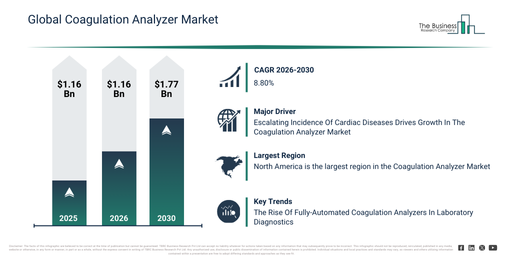
    The coagulation analyzer market is anticipated to experience robust expansion over the coming years. By 2030, this market is projected to reach $4.95 billion, exhibiting a compound annual growth rate (CAGR) of 8.8%. This anticipated growth is driven by several factors, including a surge in demand for swift coagulation diagnostics, the proliferation of decentralized testing facilities, heightened investments in sophisticated hematology analyzers, an increased emphasis on patient safety oversight, and the incorporation of intelligent diagnostics platforms. Key trends expected during this period involve the wider uptake of fully automated coagulation systems, a growing need for highly sensitive clotting assays, increasing incorporation of AI-assisted result interpretation, the expansion of point-of-care coagulation testing, and a greater emphasis on automating workflows.

    Download the Free Sample Report to Explore Key Market Insights:

    https://www.thebusinessresearchcompany.com/sample.aspx?id=11991&type=smp

    What Drivers Are Shaping The Future Growth Of The Coagulation Analyzer Market?

    The escalating incidence of cardiac ailments is projected to drive the expansion of the coagulation analyzer market moving forward. These conditions encompass a variety of disorders impacting both the heart and its associated blood vessels. Coagulation analyzers are essential for the management of cardiac diseases, evaluating blood clotting parameters, guiding anticoagulant therapies, and preventing complications, thereby contributing to effective treatment and care. For instance, in June 2024, data from the National Health Service, a UK-based government department, indicated that 3,615,330 individuals registered with a general practitioner (GP) were diagnosed with non-diabetic hyperglycemia or pre-diabetes (a condition characterized by elevated blood sugar levels, not severe enough to be classified as diabetes) in 2023. This figure marked an 18% increase from 3,065,825 cases reported in 2022. Thus, the growing prevalence of heart failure and other cardiovascular conditions is stimulating the demand for coagulation testing instruments.

    Which Segment Categories Define The Coagulation Analyzer Market?

    The coagulation analyzer market covered in this report is segmented –

    1) By Product Type: Semi-automated Coagulation Analyzer, Automated Coagulation Analyzer

    2) By Test Type: Prothrombin Time Testing, Fibrinogen Testing, Activated Partial Thromboplastin Time Testing, D-dimer Testing, Anti-factor Xa Testing, Other Tests

    3) By Technology Type: Optical Technology, Mechanical Technology, Other Technologies

    4) By End User: Hospitals And Clinics, Diagnostic Centers, Other End-Users

    Subsegments:

    1) By Semi-Automated Coagulation Analyzer: Benchtop Semi-Automated Analyzers, Portable Semi-Automated Analyzers

    2) By Automated Coagulation Analyzer: Fully Automated Analyzers, High-Throughput Analyzers, Point-Of-Care Automated Analyzers

    What Major Market Trends Are Driving Changes In The Coagulation Analyzer Market?

    Major companies operating in the coagulation analyzer market are engaged in developing technologically advanced products, such as fully-automated coagulation analyzers, to efficiently manage high test volumes with minimal human intervention. A fully automated coagulation analyzer serves as a laboratory device that conducts automated testing of blood clotting processes, thereby enabling precise and effective diagnosis of coagulation disorders without requiring manual input. For instance, in March 2024, Zybio Inc., a China-based provider specializing in in vitro diagnostic reagents and equipment, introduced the EXT 9800 fully-automated coagulation analyzer. The EXT 9800 Fully-Automated Coagulation Analyzer distinguishes itself as the first to utilize micro magnetic particle detection, facilitating visualized, multi-dimensional analysis of the coagulation process for improved accuracy and depth. It revolutionizes automated detection with its distributed structure, modular expandability, and high-throughput capabilities, presenting laboratories with a lightweight yet comprehensive solution. Furthermore, the analyzer incorporates a complete upgrade across its entire testing process, thereby establishing a new standard for innovation in coagulation testing.

    Who Are The Top Companies Competing In The Coagulation Analyzer Market?

    Major companies operating in the coagulation analyzer market are Siemens AG, F. Hoffmann-La Roche Ltd., Abbott Laboratories, Sysmex Corporation, Werfen S.A., Nihon Kohden Corporation, Diagnostica Stago SAS, ARKRAY Inc., Beckman Coulter Inc., Helena Laboratories Corporation, Maccura Biotechnology Co. Ltd., Beijing Succeeder Technology Inc., Trivitron Healthcare Pvt. Ltd., A&T Corporation, ACON Laboratories Inc., Genrui Biotech Inc., Teco Medical Instruments, Eurolyser Diagnostica GmbH, Meril Life Science Pvt. Ltd., Bioevopeak Co. Ltd.

    Read the full coagulation analyzer market report here:

    https://www.thebusinessresearchcompany.com/report/coagulation-analyzer-global-market-report

    Which Geographic Regions Are Influencing Demand In The Coagulation Analyzer Market?

    North America was the largest region in the coagulation analyzer market in 2025. Asia-Pacific is expected to be the fastest-growing region in the forecast period. The regions covered in the coagulation analyzer market report are Asia-Pacific, South East Asia, Western Europe, Eastern Europe, North America, South America, Middle East, Africa.

    Request A Tailored Coagulation Analyzer Market Research Report For Competitive Advantage:

    https://www.thebusinessresearchcompany.com/customise?id=11991&type=smp

    Browse Through More Reports Similar to the Global Coagulation Analyzer Market 2026, By The Business Research Company

    Capillary Blood Collection Devices Market Report 2026

    https://www.thebusinessresearchcompany.com/report/capillary-blood-collection-devices-global-market-report

    Skull Clamp Market Report 2026

    https://www.thebusinessresearchcompany.com/report/skull-clamp-global-market-report

    Thrombectomy Devices Market Report 2026

    https://www.thebusinessresearchcompany.com/report/thrombectomy-devices-global-market-report

    Get in touch with us:

    The Business Research Company: https://www.thebusinessresearchcompany.com/

    Americas +1 310-496-7795

    Asia +44 7882 955267 & +91 8897263534

    Europe +44 7882 955267

    Email us at info@tbrc.info

    Follow us on:

    LinkedIn: https://in.linkedin.com/company/the-business-research-company

    YouTube: https://www.youtube.com/channel/UC24_fI0rV8cR5DxlCpgmyFQ

    Global Market Model: https://www.thebusinessresearchcompany.com/global-market-model

  • Clot Management Devices Market Outlook 2026–2035 Driven by Key Growth Factors and Industry Projections

    Clot Management Devices Market Outlook 2026–2035 Driven by Key Growth Factors and Industry Projections

    The Business Research Company’s 2026 market reports include new capabilities such as market attractiveness scoring and analysis, total addressable market analysis, company scoring matrix, interactive excel data dashboard, improved supply chain analysis, upcoming startups in the market, and overview of key products, aimed at improving the depth, usability, and strategic value of the insights delivered.

    How Is The Market Size Of The Clot Management Devices Market Expected To Change Between 2026 And 2030?

    The market size for clot management devices has exhibited robust growth in recent years. Its value is anticipated to climb from $1.82 billion in 2025 to $1.93 billion in 2026, demonstrating a compound annual growth rate (CAGR) of 6.0%. The expansion witnessed in prior periods is attributable to the increasing incidence of deep vein thrombosis and pulmonary embolism, a rise in the prevalence of cardiovascular diseases, more frequent interventional radiology procedures, the expansion of hospital vascular care capabilities, and enhanced awareness of complications related to blood clots.

    The clot management devices market size is anticipated to experience substantial growth over the coming years. It is projected to expand to $2.37 billion by 2030, exhibiting a compound annual growth rate (CAGR) of 5.3%. The market’s expansion during the forecast period is driven by factors such as an aging population with elevated thrombotic risk, an increasing demand for minimally invasive vascular interventions, a heightened focus on the early diagnosis and treatment of clotting disorders, the expansion of advanced stroke and thrombosis centers, and the growing adoption of endovascular treatment approaches. Prominent trends throughout the forecast period include the increasing uptake of minimally invasive clot removal procedures, the rising utilization of mechanical and aspiration thrombectomy devices, a stronger emphasis on rapid intervention for acute thrombotic events, the broadening of catheter-based treatments for DVT and PE, and a growing preference for retrievable inferior vena cava filters.

    Download the Free Sample Report to Explore Key Market Insights:

    https://www.thebusinessresearchcompany.com/sample.aspx?id=15768&type=smp

    Which Economic Or Industry Drivers Are Impacting The Clot Management Devices Market?

    The growing requirement for hospitals is projected to fuel the expansion of the clot management device market in the coming years. Hospitals are dedicated healthcare establishments specifically designed to offer medical treatment, care, and services to individuals suffering from diverse illnesses, injuries, or medical conditions. The increase in hospitals can be attributed to multiple factors, such as an aging population, urbanization, improved healthcare access, overall population growth, and medical tourism. Clot management devices are critical components within the healthcare domain for addressing conditions like deep vein thrombosis, pulmonary embolism, and ischemic strokes, providing patients with effective and less invasive options that boost overall treatment results and enhance patient safety. For example, in May 2024, data from the American Health Care Association, a US-based nonprofit organization, indicated that the count of hospitals in the US had climbed to 6,120 from 5,129 in 2022. Consequently, the rising demand for hospitals is a significant driver behind the growth of the clot management device market.

    How Is The Clot Management Devices Market Structured Across Different Segments?

    The clot management devices market covered in this report is segmented –

    1) By Product Type: Neurovascular Embolectomy Devices, Embolectomy Balloon Catheters, Percutaneous Thrombectomy Devices, Catheter-Directed Thrombolysis (CDT) devices, Inferior vena cava filters (IVCF)

    2) By Percutaneous Thrombectomy Devices Type Outlook: Aspiration Thrombectomy Devices, Percutaneous Mechanical Thrombectomy Device

    3) By End User: Diagnostic centers, Hospitals

    Subsegments:

    1) By Neurovascular Embolectomy Devices: Aspiration Embolectomy Devices, Mechanical Embolectomy Devices, Embolectomy Balloon Catheters

    2) By Embolectomy Balloon Catheters: High-Pressure Balloon Catheters, Low-Pressure Balloon Catheters

    3) By Percutaneous Thrombectomy Devices: Rotational Thrombectomy Devices, Aspiration Thrombectomy Devices

    4) By Catheter-Directed Thrombolysis (CDT) Devices: Infusion Catheters, Guidewires For CDT

    5) By Inferior Vena Cava Filters (IVCF): Permanent IVC Filters, Retrievable IVC Filters

    Which Trends Are Shaping The Future Of The Clot Management Devices Market?

    Leading enterprises within the clot management device market are actively developing innovative technologies, such as computer-assisted vacuum thrombectomy (CAVT) systems, to provide customers with enhanced functionalities. Computer-assisted vacuum thrombectomy (CAVT) systems function as medical devices utilized for the treatment of blood clots, particularly in serious conditions like deep vein thrombosis (DVT) and pulmonary embolism (PE). As an illustration, in April 2024, Penumbra Inc., a medical company based in the US, unveiled the Lightning Flash 2.0. This product represents the latest in clot aspiration and vacuum thrombectomy (CAVT) technology, engineered for the rapid elimination of blood clots. The Lightning Flash 2.0 signifies a considerable progression in clot management devices, delivering improved performance and operational efficiency. This advanced apparatus incorporates state-of-the-art AI and sophisticated engineering to optimize patient outcomes across both acute and chronic care environments. It features sophisticated imaging and suction capabilities, enabling precise and effective clot removal to cater to the diverse requirements of various medical contexts.

    Which Major Players Dominate The Clot Management Devices Market?

    Major companies operating in the clot management devices market are Bayer AG, Abbott Laboratories, Medtronic plc, Boston Scientific Corporation, B. Braun Melsungen AG, Terumo Corporation, Acandis GmbH & Co KG, Cook Medical, Merit Medical Systems Inc., Penumbra Inc., MicroVention Inc., Inari Medical Inc., AngioDynamics Inc., Argon Medical Devices Inc., LeMaitre Vascular Inc., iVascular SLU, Straub Medical AG, Rapid Medical, C.R. Bard Inc., InspireMD Inc.

    Read the full clot management devices market report here:

    https://www.thebusinessresearchcompany.com/report/clot-management-devices-global-market-report

    What Are The Top-Performing Regions Within The Clot Management Devices Market?

    North America was the largest region in the clot management devices market in 2025. Asia-Pacific is expected to be the fastest-growing region in the forecast period. The regions covered in the clot management devices market report are Asia-Pacific, South East Asia, Western Europe, Eastern Europe, North America, South America, Middle East, Africa.

    Request A Tailored Clot Management Devices Market Research Report For Competitive Advantage:

    https://www.thebusinessresearchcompany.com/customise?id=15768&type=smp

    Browse Through More Reports Similar to the Global Clot Management Devices Market 2026, By The Business Research Company

    Internal Neuromodulation Devices Market Report 2026

    https://www.thebusinessresearchcompany.com/report/internal-neuromodulation-devices-global-market-report

    Neurostimulation Devices Market Report 2026

    https://www.thebusinessresearchcompany.com/report/neurostimulation-devices-global-market-report

    Neuromorphic Chips Market Report 2026

    https://www.thebusinessresearchcompany.com/report/neuromorphic-chips-global-market-report

    Get in touch with us:

    The Business Research Company: https://www.thebusinessresearchcompany.com/

    Americas +1 310-496-7795

    Asia +44 7882 955267 & +91 8897263534

    Europe +44 7882 955267

    Email us at info@tbrc.info

    Follow us on:

    LinkedIn: https://in.linkedin.com/company/the-business-research-company

    YouTube: https://www.youtube.com/channel/UC24_fI0rV8cR5DxlCpgmyFQ

    Global Market Model: https://www.thebusinessresearchcompany.com/global-market-model
  • Closed-Loop Neuromodulation Processor Market Developments and Growth Opportunities Across 2026–2030

    Closed-Loop Neuromodulation Processor Market Developments and Growth Opportunities Across 2026–2030

    The Business Research Company’s 2026 market reports include new capabilities such as market attractiveness scoring and analysis, total addressable market analysis, company scoring matrix, interactive excel data dashboard, improved supply chain analysis, upcoming startups in the market, and overview of key products, aimed at improving the depth, usability, and strategic value of the insights delivered.

    What Is The Market Size Of The Closed-Loop Neuromodulation Processor Market In 2026 And What Value Is Projected For 2030?

    The closed-loop neuromodulation processor market size has seen substantial growth in recent years. It is anticipated to expand from $2.52 billion in 2025 to $2.85 billion in 2026, demonstrating a compound annual growth rate (CAGR) of 13.2%. The historical expansion of this market can be linked to the increasing occurrence of neurological disorders, the demand for precise neuromodulation techniques, breakthroughs in implantable devices, the widespread adoption of DBS/SCS systems, and a rise in research funding for neurotechnology.

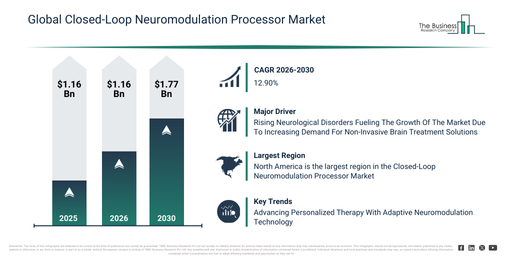
    The closed-loop neuromodulation processor market size is anticipated to experience substantial growth in the upcoming years. It is forecast to expand to $4.63 billion by 2030, achieving a compound annual growth rate (CAGR) of 12.9%. The drivers behind this growth during the forecast period include the advancement of AI-enabled adaptive processors, the increased availability of external wearable controllers, their integration with telemedicine, the expansion of home-based neuromodulation therapy, and rising adoption in emerging markets. Significant trends expected during this period encompass real-time neural feedback, adaptive stimulation algorithms, integration with wearable controllers, remote monitoring capabilities, and multimodal therapy optimization.

    Download the Free Sample Report to Explore Key Market Insights:

    https://www.thebusinessresearchcompany.com/sample.aspx?id=28175&type=smp

    What Major Drivers Are Influencing Demand In The Closed-Loop Neuromodulation Processor Market?

    The rising prevalence of neurological disorders is anticipated to drive the expansion of the closed-loop neuromodulation processor market moving forward. These conditions impair the nervous system, affecting the brain, spinal cord, or nerve function, which can lead to challenges with movement, thinking, or sensation. The increase in neurological disorders is attributed to a global aging population, elevating the occurrence of conditions such as Alzheimer’s and Parkinson’s disease. Closed-loop neuromodulation processors aid in managing these disorders by continuously monitoring brain activity and delivering targeted electrical stimulation in real time to regulate abnormal neural signals. For instance, according to the Institute for Health Metrics and Evaluation, a US-based research organization, neurological conditions impacted 43% of the global population in 2022, with projections suggesting this could double by 2050. Therefore, the growing incidence of neurological disorders is propelling the growth of the closed-loop neuromodulation processor market.

    What Are The Key Segments Of The Closed-Loop Neuromodulation Processor Market?

    The closed-loop neuromodulation processor market covered in this report is segmented –

    1) By Product Type: Implantable Processors, External Processors

    2) By Technology: Deep Brain Stimulation, Spinal Cord Stimulation, Vagus Nerve Stimulation, Other Technologies

    3) By Application: Chronic Pain Management, Epilepsy, Parkinson’s Disease, Depression, Other Applications

    4) By End-User: Hospitals, Specialty Clinics, Research Institutes, Other End Users

    Subsegments:

    1) By Implantable Processors: Deep Brain Stimulation (DBS) Processors, Spinal Cord Stimulation (SCS) Processors, Vagus Nerve Stimulation (VNS) Processors, Sacral Nerve Stimulation (SNS) Processors, Peripheral Nerve Stimulation (PNS) Processors

    2) By External Processors: Wearable Neuromodulation Controllers, Handheld Programming Devices, External Pulse Generators, Charging Systems And Power Management Units, Wireless Communication Interfaces

    What Key Trends Are Influencing The Development Of The Closed-Loop Neuromodulation Processor Market?

    Key companies operating in the closed-loop neuromodulation processor market are concentrating on integrating brain-computer interface (BCI) technology to enhance treatment accuracy, improve symptom management, and customize care for patients with neurological conditions. A brain-computer interface (BCI) is a system that allows direct interaction between the brain and an external device by identifying, interpreting, and converting neural signals into commands that can operate computers, prosthetics, or therapeutic systems. These are frequently incorporated into neuromodulation or rehabilitation devices, providing real-time oversight and adaptive treatment based on a patient’s brain activity. For instance, in February 2025, Medtronic plc, a US-based medical technology company, received United States Food and Drug Administration (FDA) approval for its BrainSense Adaptive Deep Brain Stimulation (aDBS) and BrainSense Electrode Identifier (EI), marking the largest commercial deployment of brain-computer interface technology. This particular closed-loop neuromodulation system continually observes a patient’s brain activity and automatically adjusts stimulation instantaneously, tailoring therapy for Parkinson’s disease. Clinical trials demonstrated superior symptom control, a reduction in motor fluctuations, and improved patient outcomes when compared to traditional continuous DBS.

    Who Are The Leading Companies Operating In The Closed-Loop Neuromodulation Processor Market?

    Major companies operating in the closed-loop neuromodulation processor market are Abbott Laboratories, Medtronic PLC, Boston Scientific Corporation, Beijing PINS Medical, CorTec, NeuroPace, Saluda Medical, NeuSpera Medical, Inbrain Neuroelectronics, Blackrock Neurotech, Great Lakes NeuroTechnologies, SensArs Neuroprosthetics, BioControl Medical, Precision Neuroscience, Motif Neurotech, Synergia Medical, BrainQ Technologies, Soterix Medical (partially relevant), Synergia Medical, Inbrain Neuroelectronics

    Read the full closed-loop neuromodulation processor market report here:

    https://www.thebusinessresearchcompany.com/report/closed-loop-neuromodulation-processor-global-market-report

    Which Region Shows The Strongest Potential For Future Growth In The Closed-Loop Neuromodulation Processor Market?

    North America was the largest region in the closed-loop neuromodulation processor market in 2025. Asia-Pacific is expected to be the fastest-growing region in the forecast period. The regions covered in the closed-loop neuromodulation processor market report are Asia-Pacific, South East Asia, Western Europe, Eastern Europe, North America, South America, Middle East, Africa.

    Request A Tailored Closed-Loop Neuromodulation Processor Market Research Report For Competitive Advantage:

    https://www.thebusinessresearchcompany.com/customise?id=28175&type=smp

    Browse Through More Reports Similar to the Global Closed-Loop Neuromodulation Processor Market 2026, By The Business Research Company

    Transfer Switch Market Report 2026

    https://www.thebusinessresearchcompany.com/report/transfer-switch-global-market-report

    Automotive Transfer Case Market Report 2026

    https://www.thebusinessresearchcompany.com/report/automotive-transfer-case-global-market-report

    Money Transfer Services Market Report 2026

    https://www.thebusinessresearchcompany.com/report/money-transfer-services-global-market-report

    Get in touch with us:

    The Business Research Company: https://www.thebusinessresearchcompany.com/

    Americas +1 310-496-7795

    Asia +44 7882 955267 & +91 8897263534

    Europe +44 7882 955267

    Email us at info@tbrc.info

    Follow us on:

    LinkedIn: https://in.linkedin.com/company/the-business-research-company

    YouTube: https://www.youtube.com/channel/UC24_fI0rV8cR5DxlCpgmyFQ

    Global Market Model: https://www.thebusinessresearchcompany.com/global-market-model

  • Global Closed System Transfer Devices Market Forecast 2026–2035 Presenting Long-Term Industry Expansion Insights

    Global Closed System Transfer Devices Market Forecast 2026–2035 Presenting Long-Term Industry Expansion Insights

    The Business Research Company’s 2026 market reports include new capabilities such as market attractiveness scoring and analysis, total addressable market analysis, company scoring matrix, interactive excel data dashboard, improved supply chain analysis, upcoming startups in the market, and overview of key products, aimed at improving the depth, usability, and strategic value of the insights delivered.

    What Will Be The Estimated Market Valuation Of The Closed System Transfer Devices Market By The End Of 2030?

    The market size for closed system transfer devices has experienced rapid expansion in recent years. It is anticipated to grow from $1.18 billion in 2025 to $1.35 billion in 2026, achieving a compound annual growth rate (CAGR) of 14.2%. The historical increase can be ascribed to several factors, including the rising application of hazardous drugs in oncology, greater recognition of occupational exposure risks, the implementation of safety guidelines for drug management, the broadening of hospital oncology services, and the increasing uptake of chemotherapy infusion therapies.

    The closed system transfer devices market is poised for substantial expansion in the coming years. It is forecast to grow to $2.18 billion in 2030, achieving a compound annual growth rate (CAGR) of 12.6%. This projected growth is driven by stricter regulatory enforcement for hazardous drug handling, rising cancer treatment volumes, an increasing focus on workplace safety compliance, the global expansion of oncology centers, and heightened investment in hospital pharmacy safety infrastructure. Key trends during this period include the rising adoption of closed drug handling systems in oncology, an intensified focus on healthcare worker safety and exposure reduction, a growing preference for needleless closed transfer systems, the expansion of CSTD usage across hospital pharmacies, and increasing standardization of hazardous drug handling protocols.

    Download the Free Sample Report to Explore Key Market Insights:

    https://www.thebusinessresearchcompany.com/sample.aspx?id=15767&type=smp

    Which Market Drivers Are Supporting The Expansion Of The Closed System Transfer Devices Market?

    The anticipated rise in cancer occurrences is projected to drive the expansion of the closed-system transfer devices market moving ahead. Cancer is defined as an illness marked by the unchecked multiplication of atypical cells, capable of invading adjacent tissues and migrating to other bodily regions via the circulatory and lymphatic systems. A surge in cancer incidents is attributed to multiple influences, including lifestyle choices, environmental contact, and a rise in infections. In cancer therapy, closed-system transfer devices serve as vital instruments, safeguarding both healthcare professionals and patients from hazards linked to managing and dispensing chemotherapy medications. Their application fosters a more secure healthcare setting and leads to improved treatment results for individuals afflicted with cancer. For example, data from February 2024 by the World Health Organization (WHO), a Switzerland-based intergovernmental organization, indicates that by 2050, cancer cases are predicted to surpass 35 million, marking a 77% surge from the 20 million cases estimated for 2022. This substantial escalation underscores the escalating global burden of cancer. Additionally, in January 2023, the National Center for Biotechnology Information, a US-based intergovernmental organization, reported 1,958,310 new cancer cases and a projected 609,820 cancer deaths in the United States for 2023. Consequently, the rising number of cancer incidents propels the closed system transfer devices market.

    Which Segment Classifications Shape The Closed System Transfer Devices Market?

    The closed system transfer devices market covered in this report is segmented –

    1) By Type: Needleless Systems, Membrane-To-Membrane Systems

    2) By Technology: Diaphragm-Based, Compartmentalized, Filtration

    3) By Closing Mechanism: Color-To-Color Alignment Systems, Push-To-Turn Systems, Click-To-Lock Systems, Luer-Lock Systems

    4) By End User: Hospitals And Clinics, Oncology Centers, Other End Users

    Subsegments:

    1) By Needleless Systems: Closed Vial Systems, Closed Syringe Systems, Transfer Device Adapters

    2) By Membrane-To-Membrane Systems: Membrane-To-Membrane Transfer Devices, Filtered Membrane Transfer Devices

    How Are Trends Impacting The Closed System Transfer Devices Market?

    Major companies engaged in the closed system transfer devices (CSTD) market are prioritizing the development of innovative syringe units. These advancements aim to improve safety, enhance user experience, minimize contamination risks, and meet rigorous regulatory standards in the healthcare industry. A syringe unit designed for full volume use signifies a syringe engineered to dispense or administer its complete liquid or medication content without requiring further mixing or dilution. For example, in October 2023, Equashield, a US-based medical device company, launched the EQUASHIELD Syringe Unit. This unit has obtained FDA clearance for full-volume use, thereby enabling safer and more efficient handling of hazardous drugs. Its inventive design prevents vapor from escaping and guards against plunger contamination, making it an economical option for compounding and administering medications.

    Which Companies Are Expanding Their Footprint In The Closed System Transfer Devices Market?

    Major companies operating in the closed system transfer devices market are Cardinal Health Inc., Becton Dickinson and Company, Baxter International Inc., B Braun Melsungen AG, Terumo Corporation, ICU Medical Inc., Amsino International Inc., JMS Co. Ltd., Vygon SA, Codan Medical GmbH, Equashield LLC, Hospira Inc., Nipro Corporation, Simplivia Healthcare Ltd., Practivet Inc., Corvida Medical Inc., Yukon Medical, Caragen Ltd., Insung Medical Co. Ltd., Aegis Medical Technologies, Epic Medical Pte Ltd., Smiths Medical

    Read the full closed system transfer devices market report here:

    https://www.thebusinessresearchcompany.com/report/closed-system-transfer-devices-global-market-report

    How Is The Closed System Transfer Devices Market Distributed Across Key Geographic Regions?

    North America was the largest region in the closed system transfer device market in 2025. Asia-Pacific is expected to be the fastest-growing region in the forecast period. The regions covered in the closed system transfer devices market report are Asia-Pacific, South East Asia, Western Europe, Eastern Europe, North America, South America, Middle East, Africa.

    Request A Tailored Closed System Transfer Devices Market Research Report For Competitive Advantage:

    https://www.thebusinessresearchcompany.com/customise?id=15767&type=smp

    Browse Through More Reports Similar to the Global Closed System Transfer Devices Market 2026, By The Business Research Company

    White Biotechnology Market Report 2026

    https://www.thebusinessresearchcompany.com/report/white-biotechnology-global-market-report

    Pet Cloning Market Report 2026

    https://www.thebusinessresearchcompany.com/report/pet-cloning-global-market-report

    Synthetic Biology Market Report 2026

    https://www.thebusinessresearchcompany.com/report/synthetic-biology-global-market-report

    Get in touch with us:

    The Business Research Company: https://www.thebusinessresearchcompany.com/

    Americas +1 310-496-7795

    Asia +44 7882 955267 & +91 8897263534

    Europe +44 7882 955267

    Email us at info@tbrc.info

    Follow us on:

    LinkedIn: https://in.linkedin.com/company/the-business-research-company

    YouTube: https://www.youtube.com/channel/UC24_fI0rV8cR5DxlCpgmyFQ

    Global Market Model: https://www.thebusinessresearchcompany.com/global-market-model

  • Cloning And Mutagenesis Market Outlook 2026–2030 Exploring New Business Opportunities

    Cloning And Mutagenesis Market Outlook 2026–2030 Exploring New Business Opportunities

    The Business Research Company’s 2026 market reports include new capabilities such as market attractiveness scoring and analysis, total addressable market analysis, company scoring matrix, interactive excel data dashboard, improved supply chain analysis, upcoming startups in the market, and overview of key products, aimed at improving the depth, usability, and strategic value of the insights delivered.

    What Market Size Growth Is Projected For The Cloning And Mutagenesis Market During The Forecast Period 2026–2030?

    The cloning and mutagenesis market has observed substantial growth over recent years. Its valuation is anticipated to rise from $3.54 billion in 2025 to $4.21 billion in 2026, driven by a compound annual growth rate (CAGR) of 19.1%. Historically, this expansion has been propelled by factors such as the increase in academic research funding, the advancement of recombinant protein research, the broader adoption of genetic engineering tools, the widespread availability of standardized molecular biology kits, and a rise in new biotech company ventures.

    The cloning and mutagenesis market is projected for rapid expansion over the coming years, with its size expected to reach $8.5 billion in 2030, driven by a compound annual growth rate (CAGR) of 19.2%. This anticipated growth during the forecast period is fueled by factors such as a heightened demand for gene function investigations, the broadening scope of synthetic biology applications, escalating investments directed towards therapeutic protein development, the wider embrace of automated laboratory platforms, and a sharper emphasis on precision genome editing. Key trends anticipated during this period encompass the increased uptake of high-fidelity cloning kits, a rise in the application of site-directed mutagenesis techniques, a surging demand for CRISPR-based editing instruments, the expansion of automated molecular biology workflows, and an intensified focus on ensuring both reproducibility and accuracy.

    Download the Free Sample Report to Explore Key Market Insights:

    https://www.thebusinessresearchcompany.com/sample.aspx?id=10541&type=smp

    What Underlying Factors Are Accelerating The Growth Of The Cloning And Mutagenesis Market?

    The growing demand for personalized medicine is anticipated to fuel the expansion of the cloning and mutagenesis market in the future. Personalized medicine represents an advanced healthcare strategy that customizes medical treatments and interventions based on the individual traits of each patient. Cloning And Mutagenesis play essential roles in personalized therapies, encompassing disease modeling, drug development, target identification, gene therapy, biomarker discovery, patient-specific cell therapies, pharmacogenomics, and genome editing. For example, in February 2024, data from the Personalized Medicine Coalition, a US-based non-profit organization, revealed that the FDA approved 16 new personalized therapies for patients with rare diseases in 2023, marking a significant increase from the 6 approvals recorded in 2022. Consequently, the rising need for personalized medicine is acting as a primary driver for the cloning and mutagenesis industry’s growth.

    What Market Segments Are Evaluated Within The Cloning And Mutagenesis Market?

    The cloning and mutagenesis market covered in this report is segmented –

    1) By Product: Cloning Kits, Mutagenesis Kits, Other Products

    2) By Technique: Blunt End Cloning, Topo PCR Cloning, Seamless Cloning, Site-Directed Mutagenesis, Other Techniques

    3) By End User: Academic and Research Institutes, Biotechnology Companies, Other End Users

    Subsegments:

    1) By Cloning Kits: Bacterial Cloning Kits, Yeast Cloning Kits, Viral Cloning Kits, Plasmid Cloning Kits

    2) By Mutagenesis Kits: Site-Directed Mutagenesis Kits, Random Mutagenesis Kits, Error-Prone PCR Kits, CRISPR Or Cas9 Mutagenesis Kits

    3) By Other Products: Enzymes, Vector Systems, Accessories

    What Industry Trends Are Redefining The Cloning And Mutagenesis Market?

    Leading companies in the cloning and mutagenesis markets are actively pursuing advanced techniques, such as PCR techniques, to gain a competitive advantage. Polymerase chain reaction (PCR) is a laboratory method in molecular biology for creating numerous copies of a specific DNA segment. As an illustration, in April 2023, Bio-Rad Laboratories, Inc., a US-based biotechnology firm, introduced the ID-Check Speciation Solution, a real-time PCR method designed for meat speciation. This solution allows for the identification of animal species in food, feed, and environmental samples, offering a reliable and quick way to verify raw material origins and enhance production line cleaning processes. It specifically targets mitochondrial DNA from various meat species, including bovine, chicken, duck, goat, horse, sheep, swine, and turkey, exhibiting exceptional sensitivity and the capacity to detect as low as 0.001% of the species DNA. The kit additionally includes a duplex detection system for improved accuracy and ease of use.

    Who Are The Top Market Participants Influencing The Cloning And Mutagenesis Market?

    Major companies operating in the cloning and mutagenesis market are Thermo Fisher Scientific Inc, Takara Bio Inc, Agilent Technologies Inc, New England Biolabs Inc, Merck KGaA, Promega Corporation, Bio-Rad Laboratories Inc, GenScript Biotech Corporation, Codex DNA Inc, Integrated DNA Technologies Inc, Bio-Techne Corporation, Sino Biological Inc, OriGene Technologies Inc, Bioneer Corporation, Lucigen Corporation, Inscripta Inc, Creative Biogene, Biomatik Corporation, TransGen Biotech Co Ltd, Jena Bioscience GmbH, EZBioscience, Synbio Technologies LLC

    Read the full cloning and mutagenesis market report here:

    https://www.thebusinessresearchcompany.com/report/cloning-and-mutagenesis-global-market-report

    Which Region Is Projected To Dominate The Cloning And Mutagenesis Market During The Forecast Period?

    North America was the largest region in the cloning and mutagenesis market in 2025. Asia-pacific is expected to be the fastest-growing region in the global cloning and mutagenesis market report during the forecast period. The regions covered in the cloning and mutagenesis market report are Asia-Pacific, South East Asia, Western Europe, Eastern Europe, North America, South America, Middle East, Africa.

    Request A Tailored Cloning And Mutagenesis Market Research Report For Competitive Advantage:

    https://www.thebusinessresearchcompany.com/customise?id=10541&type=smp

    Browse Through More Reports Similar to the Global Cloning And Mutagenesis Market 2026, By The Business Research Company

    Virtual Reality Vr In Medical Simulation Market Report 2026

    https://www.thebusinessresearchcompany.com/report/virtual-reality-vr-in-medical-simulation-global-market-report

    Wearable Medical Devices Market 2026

    https://www.thebusinessresearchcompany.com/report/wearable-medical-devices-market

    Virtual Reality Devices Market Report 2026

    https://www.thebusinessresearchcompany.com/report/virtual-reality-devices-global-market-report

    Get in touch with us:

    The Business Research Company: https://www.thebusinessresearchcompany.com/

    Americas +1 310-496-7795

    Asia +44 7882 955267 & +91 8897263534

    Europe +44 7882 955267

    Email us at info@tbrc.info

    Follow us on:

    LinkedIn: https://in.linkedin.com/company/the-business-research-company

    YouTube: https://www.youtube.com/channel/UC24_fI0rV8cR5DxlCpgmyFQ

    Global Market Model: https://www.thebusinessresearchcompany.com/global-market-model

  • Global Clinical Wearable Virtual Reality Market Report 2026–2035 Highlighting Expansion Outlook and Forecast Opportunities

    Global Clinical Wearable Virtual Reality Market Report 2026–2035 Highlighting Expansion Outlook and Forecast Opportunities

    The Business Research Company’s 2026 market reports include new capabilities such as market attractiveness scoring and analysis, total addressable market analysis, company scoring matrix, interactive excel data dashboard, improved supply chain analysis, upcoming startups in the market, and overview of key products, aimed at improving the depth, usability, and strategic value of the insights delivered.

    How Will The Market Size Of The Clinical Wearable Virtual Reality Market Evolve From 2026 To 2030?

    The market size for clinical wearable virtual reality has seen rapid expansion in recent years. This market is anticipated to grow from $1.74 billion in 2025 to $2.08 billion in 2026, exhibiting a compound annual growth rate (CAGR) of 19.2%. The historical increase can be attributed to the rising integration of VR in healthcare, the demand for engaging training solutions, technological progress in head-mounted displays (HMDs), increased funding for medical simulations, and the expansion of rehabilitation clinics.

    The market size for clinical wearable virtual reality is projected to experience substantial expansion over the coming years. This market is anticipated to reach $4.15 billion in 2030, exhibiting a compound annual growth rate (CAGR) of 18.9%. Factors contributing to this growth during the forecast period include the broader availability of telehealth VR solutions, their integration with AI-based diagnostics, the emergence of personalized VR therapy programs, increasing use in mental health services, and advancements in wireless and lightweight head-mounted displays. Key trends anticipated within the forecast period encompass patient-specific VR therapy, VR-based surgical training, solutions for rehabilitation and physiotherapy, the integration of telehealth with VR, and cognitive and mental health monitoring.

    Download the Free Sample Report to Explore Key Market Insights:

    https://www.thebusinessresearchcompany.com/sample.aspx?id=28172&type=smp

    Which Growth Drivers Are Contributing To The Progress Of The Clinical Wearable Virtual Reality Market?

    The increasing medical tourism is anticipated to advance the expansion of the clinical wearable virtual reality market moving forward. Medical tourism involves individuals journeying to different nations for medical, surgical, or dental care, frequently blending health services with travel and leisure. The surge in medical tourism stems from the accessibility of superior healthcare provisions at reduced expenses in international locations. Within medical tourism, clinical wearable virtual reality is employed to offer patients immersive experiences before and after treatment, encompassing virtual consultations, therapeutic sessions, and pain alleviation. For example, the National Institutes of Health (NIH), a US-based government medical research agency, stated in January 2025 that approximately 348,000 UK residents traveled abroad for medical tourism in 2022, a figure that climbed to 431,000 in 2023. Consequently, the expansion of medical tourism is projected to stimulate the growth of the clinical wearable virtual reality market.

    Which Segment Areas Are Covered In The Clinical Wearable Virtual Reality Market Analysis?

    The clinical wearable virtual reality market covered in this report is segmented –

    1) By Product Type: Head-Mounted Displays, Smart Glasses, Handheld Devices, Other Product Types

    2) By Application: Pain Management, Rehabilitation, Surgical Training, Patient Care Management, Other Applications

    3) By End-User: Hospitals, Clinics, Rehabilitation Centers, Other End-Users

    Subsegments:

    1) By Head-Mounted Displays: Tethered Head-Mounted Displays, Standalone Or Untethered Head-Mounted Displays

    2) By Smart Glasses: Optical See-Through Smart Glasses, Video See-Through Smart Glasses

    3) By Handheld Devices: Virtual Reality-Enabled Tablets, Virtual Reality-Enabled Smartphones With Headset Kits

    4) By Other Product Types: Haptic Feedback Gloves, Virtual Reality Treadmills And Motion Platforms, Full-Body Haptic Suits

    What Key Developments And Trends Are Impacting The Clinical Wearable Virtual Reality Market?

    Leading companies operating in the clinical wearable virtual reality market are prioritizing the development of advanced solutions, such as AI-driven immersive therapy systems, to boost treatment effectiveness, improve patient involvement, and facilitate remote monitoring. These AI-powered immersive therapy systems are characterized as VR-based wearable devices that offer interactive, adaptive exercises for clinical conditions, tracking patient progress continuously and automatically adjusting difficulty levels. For instance, in February 2025, NeuraSim, an India-based medical technology company, in collaboration with QWR Interactive, an India-based AI-powered healthcare VR company, launched the BeeVee, an AI-powered VR wearable specifically for treating amblyopia. The BeeVee delivers immersive, adaptive exercises to retrain vision, can be utilized both in clinics under professional supervision or at home, and supports continuous monitoring alongside personalized therapy adjustments, thereby improving treatment outcomes and patient compliance. It integrates real-time eye tracking to provide adaptive VR exercises that dynamically adjust according to patient performance. The device supports both clinic-based and home therapy models, allowing patients to continue treatment between visits while remaining under professional supervision.

    Which Global Companies Are Actively Competing In The Clinical Wearable Virtual Reality Market?

    Major companies operating in the clinical wearable virtual reality market are Heru Inc., Vection Technologies, MindMaze SA, XRHealth Inc., Ocutrx Vision Technologies Inc., Health Scholars Inc., AppliedVR, Limbix Inc., SimX Inc., MyndVR Inc., SentiAR Inc., CUREosity GmbH, SyncThink Inc., Virti, ORamaVR, Psious, PrecisionOS Technology Inc., Osso VR, HypnoVR, VerityXR, EON Reality Inc., Bioflight VR, WorldViz, TheraSim Inc., FundamentalVR, PsyTechVR, VirtaMed AG

    Read the full clinical wearable virtual reality market report here:

    https://www.thebusinessresearchcompany.com/report/clinical-wearable-virtual-reality-global-market-report

    What Are The Leading Geographic Regions In The Clinical Wearable Virtual Reality Market?

    North America was the largest region in the clinical wearable virtual reality market in 2025. Asia-Pacific is expected to be the fastest-growing region in the forecast period. The regions covered in the clinical wearable virtual reality market report are Asia-Pacific, South East Asia, Western Europe, Eastern Europe, North America, South America, Middle East, Africa.

    Request A Tailored Clinical Wearable Virtual Reality Market Research Report For Competitive Advantage:

    https://www.thebusinessresearchcompany.com/customise?id=28172&type=smp

    Browse Through More Reports Similar to the Global Clinical Wearable Virtual Reality Market 2026, By The Business Research Company

    Clinical Trial Supply And Logistics Market Report 2026

    https://www.thebusinessresearchcompany.com/report/clinical-trial-supply-and-logistics-global-market-report

    Clinical Trial Management Systems Market Report 2026

    https://www.thebusinessresearchcompany.com/report/clinical-trial-management-systems-global-market-report

    Clinical Trial Management System Market Report 2026

    https://www.thebusinessresearchcompany.com/report/clinical-trial-management-system-global-market-report

    Get in touch with us:

    The Business Research Company: https://www.thebusinessresearchcompany.com/

    Americas +1 310-496-7795

    Asia +44 7882 955267 & +91 8897263534

    Europe +44 7882 955267

    Email us at info@tbrc.info

    Follow us on:

    LinkedIn: https://in.linkedin.com/company/the-business-research-company

    YouTube: https://www.youtube.com/channel/UC24_fI0rV8cR5DxlCpgmyFQ

    Global Market Model: https://www.thebusinessresearchcompany.com/global-market-model

  • Clinical Trial Supplies Market Growth Prospects 2026–2030 with Innovation Trends and Competitive Landscape

    Clinical Trial Supplies Market Growth Prospects 2026–2030 with Innovation Trends and Competitive Landscape

    The Business Research Company’s 2026 market reports include new capabilities such as market attractiveness scoring and analysis, total addressable market analysis, company scoring matrix, interactive excel data dashboard, improved supply chain analysis, upcoming startups in the market, and overview of key products, aimed at improving the depth, usability, and strategic value of the insights delivered.

    What Is The Forecasted Market Value Of The Clinical Trial Supplies Market Across 2026–2030?

    The clinical trial supplies market size has experienced strong growth in recent years. It is anticipated to expand from $2.86 billion in 2025 to $3.1 billion in 2026, exhibiting a compound annual growth rate (CAGR) of 8.3%. The expansion observed in the historic period can be attributed to an increase in global clinical trial activity, the proliferation of multicenter trial designs, the rise of biologics and specialty drugs, a growing trend of outsourcing to CROs, and the improvement of cold-chain logistics infrastructure.

    The market for clinical trial supplies is projected to experience substantial expansion over the upcoming years. It will grow to **$4.33 billion in 2030 at a compound annual growth rate (CAGR) of 8.7%.** This anticipated growth during the projected period is driven by several factors, including the escalating intricacy of clinical trial protocols, the broadening of decentralized and virtual trial approaches, a heightened emphasis on patient-centric trial designs, increasing financial commitments to digital tools for trial management, and enhanced regulatory oversight across various geographical areas. Key developments expected during this forecast timeframe encompass the wider implementation of integrated supply chain platforms, a greater reliance on logistics solutions that maintain specific temperatures, an escalating need for comprehensive trial visibility from start to finish, the availability of more flexible packaging and labeling options, and a reinforced commitment to adherence and tracking capabilities.

    Download the Free Sample Report to Explore Key Market Insights:

    https://www.thebusinessresearchcompany.com/sample.aspx?id=12133&type=smp

    What Primary Drivers Are Shaping The Development Of The Clinical Trial Supplies Market?

    The expanding volume of registered clinical trials is anticipated to stimulate the future expansion of the clinical trial supplies market. These trials represent research endeavors involving human participants, aimed at assessing the safety and efficacy of novel medical treatments, interventions, or diagnostic procedures. Essential for successful clinical trials, clinical trial supplies—encompassing pharmaceuticals, medical devices, and other vital components—play a critical role in supporting the research process, guaranteeing precise data collection, and safeguarding patient well-being. As an illustration, data from ClinicalTrials.gov, an arm of the National Institutes of Health (NIH), a US-based governmental entity overseeing medical research, revealed that in May 2023, approximately 437,533 clinical trials were registered in 2023. This figure contrasts with 399,499 registered studies in 2022, spanning all 50 states of the United States and 221 countries. Consequently, the rising count of registered clinical trials is serving as a catalyst for the expansion of the clinical trial supplies market.

    What Segmentation Levels Are Considered In The Clinical Trial Supplies Market?

    The clinical trial supplies market covered in this report is segmented –

    1) By Services: Logistics And Distribution, Storage And Retention, Supply Chain Management, Packaging, Labeling, And Blinding, Comparator Sourcing

    2) By Clinical Phases: Phase I, Phase II, Phase III, Phase IV

    3) By Therapeutic Use: Oncology, Central Nervous System (CNS), Cardiovascular, Infectious Disease, Metabolic Disorders, Other Therapeutic Uses

    4) By End User: Pharmaceutical And Biotech companies, Contract Research Organization (CRO)

    Subsegments:

    1) By Logistics And Distribution: Transportation, Inventory Management, Temperature-Controlled Shipping, Customs Clearance

    2) By Storage And Retention: Short-term Storage, Long-term Storage, Controlled Environment Storage

    3) By Supply Chain Management: Planning And Forecasting, Supplier Management, Risk Management, Compliance Management

    4) By Packaging, Labeling, And Blinding: Primary Packaging, Secondary Packaging, Label Design And Printing, Blinding Techniques

    5) By Comparator Sourcing: Sourcing Of Reference Products, Quality Control And Assurance, Regulatory Compliance For Comparators

    What Trends Are Projected To Affect The Clinical Trial Supplies Market?

    Leading companies in the clinical trial supplies market are adopting innovative technologies to transform healthcare decision-making, drug development, and patient care. They achieve this by utilizing real-world data to generate evidence-based insights and secure their market position. For example, in April 2023, Komodo Health, a US-based healthcare technology company specializing in patient recruitment, site selection, and real-time data monitoring for clinical trials, launched MapEnhance. This platform is a network of specialty data partners integrated into a real-world evidence (RWE) technology platform. MapEnhance equips customers with a thorough and detailed real-world perspective on clinical events and patient populations, enabling unparalleled understanding. Its features include precision molecular diagnostics for various therapeutic areas, high-volume standard laboratory diagnostics for earlier disease detection, and electronic medical records that capture clinical encounters. Additionally, it provides inpatient and outpatient facility chargemasters for comprehensive cost and utilization insights across diverse hospital settings.

    Which Leading Firms Are Contributing To The Growth Of The Clinical Trial Supplies Market?

    Major companies operating in the clinical trial supplies market are Thermo Fisher Scientific Inc., IQVIA, Eurofins Scientific SE, Parexel International Corporation, ICON PLC, Catalent Inc., Intertek Group PLC, Recipharm AB, World Courier, Almac Group Ltd., Piramal Pharma Solutions, Clinigen Group PLC, Movianto GmbH, Marken Limited, PCI Pharma Services, Rubicon Research Private Limited, Bionical Ltd., Durbin PLC, SIRO Clinpharm Pvt. Ltd., Biocair International Ltd., Ancillare LP., Myonex, Klifo A/S, Alium Medical Limited, ADAllen Pharma, Sharp Services LLC

    Read the full clinical trial supplies market report here:

    https://www.thebusinessresearchcompany.com/report/clinical-trial-supplies-global-market-report

    How Does The Clinical Trial Supplies Market Perform Across Major Global Regions?

    North America was the largest region in the clinical trial supplies market in 2025. Asia-Pacific is expected to be the fastest-growing region in the forecast period. The regions covered in the clinical trial supplies market report are Asia-Pacific, South East Asia, Western Europe, Eastern Europe, North America, South America, Middle East, Africa.

    Request A Tailored Clinical Trial Supplies Market Research Report For Competitive Advantage:

    https://www.thebusinessresearchcompany.com/customise?id=12133&type=smp

    Browse Through More Reports Similar to the Global Clinical Trial Supplies Market 2026, By The Business Research Company

    Medical And Diagnostic Laboratory Services Market Report 2026

    https://www.thebusinessresearchcompany.com/report/medical-and-diagnostic-laboratory-services-global-market-report

    Medical And Diagnostic Laboratory Services Market Report 2026

    https://www.thebusinessresearchcompany.com/report/medical-and-diagnostic-laboratory-services-global-market-report

    Veterinary Reference Laboratory Market Report 2026

    https://www.thebusinessresearchcompany.com/report/veterinary-reference-laboratory-global-market-report

    Get in touch with us:

    The Business Research Company: https://www.thebusinessresearchcompany.com/

    Americas +1 310-496-7795

    Asia +44 7882 955267 & +91 8897263534

    Europe +44 7882 955267

    Email us at info@tbrc.info

    Follow us on:

    LinkedIn: https://in.linkedin.com/company/the-business-research-company

    YouTube: https://www.youtube.com/channel/UC24_fI0rV8cR5DxlCpgmyFQ

    Global Market Model: https://www.thebusinessresearchcompany.com/global-market-model
  • Clinical Reference Laboratory Market Forecast 2026–2035 Highlighting Market Data Patterns and Industry Insights

    Clinical Reference Laboratory Market Forecast 2026–2035 Highlighting Market Data Patterns and Industry Insights

    The Business Research Company’s 2026 market reports include new capabilities such as market attractiveness scoring and analysis, total addressable market analysis, company scoring matrix, interactive excel data dashboard, improved supply chain analysis, upcoming startups in the market, and overview of key products, aimed at improving the depth, usability, and strategic value of the insights delivered.

    What Market Size Increase Is Anticipated For The Clinical Reference Laboratory Market Over The 2026–2030 Period?

    The clinical reference laboratory market has shown robust expansion in recent years. It is projected to expand from $47 billion in 2025 to $50.24 billion in 2026, achieving a compound annual growth rate (CAGR) of 6.9%. Historically, the expansion can be linked to factors such as the prevalence of chronic diseases, the outsourcing of diagnostics by hospitals, the demand for infectious disease testing, requirements for regulatory compliance, and the consolidation of laboratories.

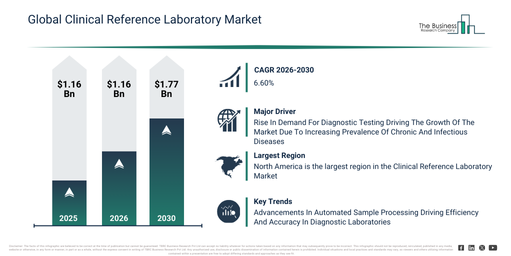
    The clinical reference laboratory market size is projected to experience substantial expansion over the upcoming years. This market is forecast to reach $64.93 billion in 2030, exhibiting a compound annual growth rate (CAGR) of 6.6%. The drivers behind this anticipated growth during the forecast period encompass the broadening of genomic testing, the integration of AI-based diagnostics, the advancement of personalized medicine, increasing healthcare digitization, and the rising need for population health screening. Key developments anticipated within this timeframe involve the proliferation of molecular diagnostics, the automation of laboratory procedures, an increase in high-complexity testing, a heightened call for swift diagnostic results, and the consolidation of diagnostic operations.

    Download the Free Sample Report to Explore Key Market Insights:

    https://www.thebusinessresearchcompany.com/sample.aspx?id=23340&type=smp

    Which Major Factors Are Driving The Expansion Of The Clinical Reference Laboratory Market?

    The expanding need for diagnostic evaluations is anticipated to drive the future expansion of the clinical reference laboratory market. Such testing involves examining biological specimens to identify, diagnose, and track illnesses, health conditions, or infections. The surge in diagnostic procedures stems from progress in medical technology, making these tests more readily available, precise, and effective. Clinical reference laboratories play a crucial role in diagnostic testing by delivering highly specialized and accurate analyses, employing cutting-edge technology and consistent protocols to guarantee dependable results beneficial for early disease identification, treatment formulation, and patient oversight across diverse medical disciplines. For example, data from April 2024, as reported by the National Health Service (NHS), a public healthcare system in the UK, indicated that 376,200 patients faced waits exceeding six weeks for a vital diagnostic test, marking an increase of 21,200 compared to the prior month. Consequently, the rising requirement for diagnostic examinations will stimulate the growth of the clinical reference laboratory market.

    How Is The Clinical Reference Laboratory Market Segmented Across Key Categories?

    The clinical reference laboratory market covered in this report is segmented –

    1) By Type: Clinical Chemistry, Genetics Testing, Microbiology And Cytology, Other Types

    2) By Technology: Traditional Laboratory Techniques, Digital Technologies, Automated Testing Platforms, Molecular Diagnostics

    3) By Application: Clinics, Hospitals, Independent Laboratory

    Subsegments:

    1) By Clinical Chemistry: Blood Gas Analysis, Enzyme Testing, Electrolyte Testing, Lipid Panel, Liver Function Testing, Renal Function Testing

    2) By Genetics Testing: Carrier Screening, Diagnostic Testing, Predictive And Presymptomatic Testing, Pharmacogenomics, Prenatal And Newborn Testing

    3) By Microbiology And Cytology: Bacterial Culture Testing, Fungal Culture Testing, Viral Testing, Parasitology Testing, Cytopathology

    4) By Other Types: Immunology Testing, Hematology Testing, Toxicology Testing, Endocrinology Testing

    Which Upcoming Trends Are Expected To Influence The Clinical Reference Laboratory Market?

    Leading companies active in the clinical reference laboratory market are concentrating on developing technologically advanced offerings, including automated sample processing platforms, to enhance their efficiency, accuracy, and scalability. Automated sample processing platforms are high-throughput laboratory systems that leverage robotics and sophisticated software to handle, prepare, and analyze biological samples with minimal human involvement, thus ensuring efficiency, accuracy, and standardization in diagnostic and research workflows. For instance, in January 2023, QIAGEN NV, a Germany-based provider of sample and assay technologies for molecular diagnostics, introduced the EZ2 Connect MDx platform to diagnostic laboratories. The EZ2 Connect MDx is an IVD platform specifically designed for automated sample processing, enabling laboratories to efficiently purify DNA and RNA from 24 samples in parallel in as little as 30 minutes. It integrates magnetic-bead technology for nucleic acid extraction from various sample types, such as blood plasma, serum, and stool. The platform employs prefilled and sealed reagent cartridges, integrated cameras for load checking, and UV decontamination to guarantee high process safety and minimize contamination risks. Additionally, it features onboard pipetting and heating, alongside automated piercing of sealed cartridges for seamless operation. The resulting analyte is compatible with multiple downstream technologies, including real-time PCR, digital PCR, and next-generation sequencing.

    Who Are The Dominant Players Shaping The Clinical Reference Laboratory Market Landscape?

    Major companies operating in the clinical reference laboratory market are Mayo Clinic Laboratories, Eurofins Scientific, Quest Diagnostics, Sonic Healthcare, Unilabs, ARUP Laboratories, Lancet Laboratories, NeoGenomics Laboratories, Ampath Laboratories, Clinical Reference Laboratory, Al Borg Medical Laboratories, Medsol Diagnostics, Medlabs Group, Cerba International, Lifebrain Group, CRL Diagnostics, Dr. Lal PathLabs, SRL Diagnostics, Synlab International, ACM Global Laboratories, Laboratory Corporation of America (Labcorp), KingMed Diagnostics

    Read the full clinical reference laboratory market report here:

    https://www.thebusinessresearchcompany.com/report/clinical-reference-laboratory-global-market-report

    Which Region Currently Holds The Largest Share Of The Clinical Reference Laboratory Market?

    North America was the largest region in the clinical reference laboratory market in 2025. Asia-Pacific is expected to be the fastest-growing region in the forecast period. The regions covered in the clinical reference laboratory market report are Asia-Pacific, South East Asia, Western Europe, Eastern Europe, North America, South America, Middle East, Africa.

    Request A Tailored Clinical Reference Laboratory Market Research Report For Competitive Advantage:

    https://www.thebusinessresearchcompany.com/customise?id=23340&type=smp

    Browse Through More Reports Similar to the Global Clinical Reference Laboratory Market 2026, By The Business Research Company

    Clinical Next Generation Sequencing Ngs Data Analysis Market Report 2026

    https://www.thebusinessresearchcompany.com/report/clinical-next-generation-sequencing-ngs-data-analysis-global-market-report

    Next Generation Sequencing Market 2026

    https://www.thebusinessresearchcompany.com/report/next-generation-sequencing-market

    Genomics In Cancer Care Market Report 2026

    https://www.thebusinessresearchcompany.com/report/genomics-in-cancer-care-global-market-report

    Get in touch with us:

    The Business Research Company: https://www.thebusinessresearchcompany.com/

    Americas +1 310-496-7795

    Asia +44 7882 955267 & +91 8897263534

    Europe +44 7882 955267

    Email us at info@tbrc.info

    Follow us on:

    LinkedIn: https://in.linkedin.com/company/the-business-research-company

    YouTube: https://www.youtube.com/channel/UC24_fI0rV8cR5DxlCpgmyFQ

    Global Market Model: https://www.thebusinessresearchcompany.com/global-market-model

  • Clinical Oncology Next Generation Sequencing Market Outlook 2026–2030 with Major Growth Drivers and Emerging Industry Trends

    Clinical Oncology Next Generation Sequencing Market Outlook 2026–2030 with Major Growth Drivers and Emerging Industry Trends

    The Business Research Company’s 2026 market reports include new capabilities such as market attractiveness scoring and analysis, total addressable market analysis, company scoring matrix, interactive excel data dashboard, improved supply chain analysis, upcoming startups in the market, and overview of key products, aimed at improving the depth, usability, and strategic value of the insights delivered.

    How Much Is The Clinical Oncology Next Generation Sequencing Market Expected To Grow In Terms Of Market Value Between 2026 And 2030?

    The clinical oncology next generation sequencing market size has expanded significantly in recent years. It is anticipated to increase from $0.58 billion in 2025 to $0.66 billion in 2026, exhibiting a compound annual growth rate (CAGR) of 13.3%. The market’s past growth can be attributed to the broadening of cancer genomics research, the greater availability of sequencing platforms, an increase in oncology clinical trials, the rising acceptance of molecular diagnostics, and the reduction in sequencing costs.

    The clinical oncology next generation sequencing market size is projected to expand significantly in the coming years, reaching $1.04 billion by 2030, exhibiting a compound annual growth rate (CAGR) of 12.1%. This expansion during the forecast period is primarily driven by factors such as the increasing demand for precision oncology, rising investments in genomic medicine, the expansion of hospital-based sequencing laboratories, the growing use of targeted cancer therapies, and continuous advancements in sequencing technologies. Furthermore, major trends anticipated within this period include a greater adoption of NGS-based oncology diagnostics, the rising use of companion diagnostic applications, growing integration of bioinformatics and data analytics, the expansion of personalized cancer treatment approaches, and an enhanced focus on rare mutation detection.

    Download the Free Sample Report to Explore Key Market Insights:

    https://www.thebusinessresearchcompany.com/sample.aspx?id=3344&type=smp

    What Key Drivers Are Influencing The Growth Of The Clinical Oncology Next Generation Sequencing Market?

    The increasing incidence of cancer is anticipated to stimulate the expansion of the clinical oncology next-generation sequencing market moving forward. Cancer refers to a group of illnesses characterized by the uncontrolled division and spread of abnormal cells throughout the body. The growing occurrence of cancer is primarily linked to an aging population, as the risk of cancer significantly elevates with age. NGS is employed to identify both new and rare mutations within cancer, offering a deeper insight into the molecular foundations of individual tumors. For example, in February 2024, the World Health Organization, a Switzerland-based public health agency of United Nations, projected over 35 million new cancer cases by 2050, which represents a 77% increase compared to the estimated 20 million cases reported in 2022. Thus, the escalating prevalence of cancer is a key factor driving the growth of the clinical oncology next-generation sequencing market.

    What Major Segment Divisions Exist Within The Clinical Oncology Next Generation Sequencing Market?

    The clinical oncology next generation sequencing market covered in this report is segmented –

    1) By Technology: Ion Semiconductor Sequencing, Pyro-Sequencing, Synthesis Sequencing, Real Time Sequencing, Ligation Sequencing, Reversible Dye Termination Sequencing, Nano-Pore Sequencing

    2) By Application: Screening, Companion Diagnostics, Other Diagnostics

    3) By End User: Hospital Laboratories, Clinical Research Organizations, Diagnostic Laboratories

    Subsegments:

    1) By Ion Semiconductor Sequencing: Ion Proton System, Ion PGM System, Ion S5 System, Other Ion Semiconductor Sequencing Technologies

    2) By Pyro-Sequencing: 454 Pyrosequencing, Other Pyro-Sequencing Technologies

    3) By Synthesis Sequencing: Illumina Sequencing Technology, SOLiD Sequencing Technology, Other Synthesis Sequencing Technologies

    4) By Real-Time Sequencing: PacBio RS II System, Sequel System, Other Real-Time Sequencing Technologies

    5) By Ligation Sequencing: Helicos Single Molecule Sequencing, Other Ligation Sequencing Technologies

    6) By Reversible Dye Termination Sequencing: Illumina HiSeq, Illumina NextSeq, Other Reversible Dye Termination Sequencing Technologies

    7) By Nano-Pore Sequencing: Oxford Nanopore Technologies (MinION, GridION, PromethION), Other Nano-Pore Sequencing Technologies

    How Are Trends Shaping The Direction Of The Clinical Oncology Next Generation Sequencing Market?

    Major companies operating in the clinical oncology next-generation sequencing (NGS) market are emphasizing technological advancements, such as incorporating software accelerators designed to significantly reduce the time and cost involved in second-level NGS analysis, thereby enabling laboratories to deliver results faster while minimizing computational resource requirements. These accelerator technologies support comprehensive genomic profiling and enhance the accessibility of high-throughput cancer panels for both large centralized laboratories and decentralized diagnostic settings. For example, in January 2024, QIAGEN Digital Insights, a Germany-based bioinformatics company, launched an upgraded version of its CLC Genomics Workbench Premium featuring LightSpeed technology, which now supports somatic cancer secondary analysis. The LightSpeed accelerator is capable of analyzing a 275-gene cancer panel at 3377× coverage in just 6 minutes, costing less than US$ 0.72 per test in standard cloud environments. LightSpeed is optimized to provide high speed, accuracy, reduced power consumption, and eliminates the need for new hardware or additional licenses beyond the existing CLC platform.

    Which Companies Are Leading Innovation In The Clinical Oncology Next Generation Sequencing Market?

    Major companies operating in the clinical oncology next generation sequencing market are Thermo Fisher Scientific, Oxford Nanopore Technologies Ltd., QIAGEN N.V., Myriad Genetics Inc., Illumina Inc., F. Hoffmann-La Roche Ltd., PerkinElmer Inc., Agilent Technologies Inc., Pacific Biosciences of California Inc., Caris Life Sciences, Paradigm Diagnostics, GATC Biotech AG, Macrogen Inc., DNASTAR Inc., Exosome Diagnostics Inc., Biomatters Ltd., Partek Inc., Foundation Medicine Inc., Becton Dickinson and Company (BD), Takara Bio Inc., Knome Inc., Genomatix Software GmbH, CLC bio, GnuBIO Inc., Bio-Rad Laboratories Inc., BGI Genomics Co. Ltd., Guardant Health Inc., Invitae Corporation, Natera Inc., NeoGenomics Laboratories Inc., Sysmex Corporation, Veracyte Inc., Zymo Research Corporation, ArcherDX Inc., Karius Inc., OncoDNA S.A., Personal Genome Diagnostics Inc., PierianDx Inc.

    Read the full clinical oncology next generation sequencing market report here:

    https://www.thebusinessresearchcompany.com/report/clinical-oncology-next-generation-sequencing-global-market-report

    Which Region Is Expected To Register The Fastest Growth In The Clinical Oncology Next Generation Sequencing Market?

    North America was the largest region in the clinical oncology next-generation sequencing market in 2025. Asia-Pacific was the second largest region in the clinical oncology next-generation sequencing market. The regions covered in the clinical oncology next generation sequencing market report are Asia-Pacific, South East Asia, Western Europe, Eastern Europe, North America, South America, Middle East, Africa.

    Request A Tailored Clinical Oncology Next Generation Sequencing Market Research Report For Competitive Advantage:

    https://www.thebusinessresearchcompany.com/customise?id=3344&type=smp

    Browse Through More Reports Similar to the Global Clinical Oncology Next Generation Sequencing Market 2026, By The Business Research Company

    Clinical Chemistry Market Report 2026

    https://www.thebusinessresearchcompany.com/report/clinical-chemistry-global-market-report

    Dental Diagnostic Imaging Devices And Equipment Market Report 2026

    https://www.thebusinessresearchcompany.com/report/dental-diagnostic-imaging-devices-and-equipment-global-market-report

    Biochemistry Analyzer Market Report 2026

    https://www.thebusinessresearchcompany.com/report/biochemistry-analyzer-global-market-report

    Get in touch with us:

    The Business Research Company: https://www.thebusinessresearchcompany.com/

    Americas +1 310-496-7795

    Asia +44 7882 955267 & +91 8897263534

    Europe +44 7882 955267

    Email us at info@tbrc.info

    Follow us on:

    LinkedIn: https://in.linkedin.com/company/the-business-research-company

    YouTube: https://www.youtube.com/channel/UC24_fI0rV8cR5DxlCpgmyFQ

    Global Market Model: https://www.thebusinessresearchcompany.com/global-market-model

  • One of the Major Drivers of the Clinical Chemistry Analyzers Market Is the Surge In Infectious And Chronic Disorders Is Anticipated To Fuel The Clinical Chemistry Analyzer Market Growth

    One of the Major Drivers of the Clinical Chemistry Analyzers Market Is the Surge In Infectious And Chronic Disorders Is Anticipated To Fuel The Clinical Chemistry Analyzer Market Growth

    The Business Research Company’s 2026 market reports include new capabilities such as market attractiveness scoring and analysis, total addressable market analysis, company scoring matrix, interactive excel data dashboard, improved supply chain analysis, upcoming startups in the market, and overview of key products, aimed at improving the depth, usability, and strategic value of the insights delivered.

    What Market Value Is Expected For The Clinical Chemistry Analyzers Market At The End Of The 2026–2030 Forecast Period?

    The clinical chemistry analyzers market size has shown robust expansion in recent years. This market is set to expand from $15.49 billion in 2025 to $16.63 billion in 2026, exhibiting a compound annual growth rate (CAGR) of 7.3%. The historic period’s growth can be attributed to factors like increased diagnostic testing volumes, an expanded hospital laboratory infrastructure, a rising prevalence of chronic diseases, greater adoption of automated laboratory equipment, and the availability of standardized reagents.

    The clinical chemistry analyzers market is projected to experience substantial expansion over the upcoming years. This market is anticipated to reach $22.64 billion by 2030, exhibiting a compound annual growth rate (CAGR) of 8.0%. This projected growth during the forecast period is primarily driven by factors such as the increasing need for quick diagnostic solutions, the expansion of decentralized testing approaches, growing investments in smart laboratory technologies, an intensified focus on personalized medicine, and the incorporation of advanced analytics into clinical diagnostics. Key trends identified for this period encompass the wider adoption of fully automated analyzers, the increasing integration of AI-based diagnostic assistance, a rising demand for high-throughput testing systems, the broadening scope of point-of-care chemistry testing, and an elevated emphasis on data connectivity alongside LIS integration.

    Download the Free Sample Report to Explore Key Market Insights:

    https://www.thebusinessresearchcompany.com/sample.aspx?id=12462&type=smp

    What Major Growth Drivers Are Shaping The Outlook Of The Clinical Chemistry Analyzers Market?

    The clinical chemistry analyzer market is anticipated to expand, driven by the increasing occurrence of infectious and chronic conditions. Infectious diseases are defined as illnesses resulting from pathogens, which are harmful agents entering the human body via food or from another individual. Chronic diseases typically persist for three months or more and can worsen over time. The growing prevalence of these infectious and chronic disorders is boosting the clinical chemistry analyzer market, as these devices are utilized to analyze specimen samples for disease diagnosis and management. For example, in September 2023, data from the UK Health Security Agency, a UK-based government agency, revealed a 7% rise in tuberculosis (TB) cases in England during the first half of 2023, with 2,408 notifications reported, compared to 2,251 during the corresponding period in 2022. This upward trend in infectious and chronic disorders consequently stimulates the clinical chemistry analyzer market.

    What Segment Types Make Up The Clinical Chemistry Analyzers Market?

    The clinical chemistry analyzers market covered in this report is segmented –

    1) By Product: Clinical Chemistry Analyzers, Clinical Chemistry Reagents, Other Products

    2) By Analyzer Technology: Semi-Automated Clinical Chemistry Analyzers, Fully Automated Clinical Chemistry Analyzers

    3) By Test Type: Basic Metabolic Panels, Electrolyte Panels, Liver Panels, Lipid Profiles, Renal Panels, Thyroid Function Panels, Specialty Chemical Tests

    4) By End-User: Hospitals, Academic Research Centers, Diagnostic Laboratories, Other End-Users

    Subsegments:

    1) By Clinical Chemistry Analyzers: Fully Automated Analyzers, Semi-Automated Analyzers, Benchtop Analyzers, Portable Analyzers

    2) By Clinical Chemistry Reagents: Enzymatic Reagents, Immunochemical Reagents, Colorimetric Reagents, Control And Calibration Reagents

    3) By Other Products: Quality Control Products, Calibration Standards, Sample Preparation Kits

    Which Market Trends Are Creating New Opportunities In The Clinical Chemistry Analyzers Market?

    Major entities operating in the clinical chemistry analyzers market are increasingly concentrating their efforts on the creation of compact testing systems. These compact testing systems generally refer to diagnostic or analytical solutions that are designed to be small, easily transportable, and efficient for performing various tests or assays. For instance, in July 2023, Siemens Healthineers, a Germany-based company providing healthcare solutions, announced the introduction of its ‘Atellica CI Analyzer’. This instrument is utilized for clinical chemistry testing and immunoassay. The Atellica CI Analyzer provides consistency in reagents, consumables, and intelligent software for both independent laboratories and satellite facilities within larger healthcare networks.

    Who Are The Key Players Driving Competition In The Clinical Chemistry Analyzers Market?

    Major companies operating in the clinical chemistry analyzers market are F. Hoffmann-La Roche AG, Abbott Laboratories, Siemens Healthineers AG, Thermo Fisher Scientific Inc., Mindray Medical International Limited, Sysmex Corporation, HORIBA Ltd., Nova Biomedical Corporation, Randox Laboratories Ltd., ELITechGroup, DiaSys Diagnostic Systems GmbH, SNIBE Co. Ltd., EKF Diagnostics Holdings plc, Awareness Technology Inc., Bio Systems Diagnostics Pvt. Ltd., Analyticon Biotechnologies AG, SFRI Medical Diagnostics, Shenzhen Rayto Life and Analytical Sciences Co. Ltd., Biobase Group, Jokoh Co. Ltd., Dirui Industrial Co. Ltd.

    Read the full clinical chemistry analyzers market report here:

    https://www.thebusinessresearchcompany.com/report/clinical-chemistry-analyzers-global-market-report

    Which Regions Are Projected To Dominate The Clinical Chemistry Analyzers Market In The Coming Years?

    North America was the largest region in the clinical chemistry analyzer market in 2025. The regions covered in the clinical chemistry analyzers market report are Asia-Pacific, South East Asia, Western Europe, Eastern Europe, North America, South America, Middle East, Africa.

    Request A Tailored Clinical Chemistry Analyzers Market Research Report For Competitive Advantage:

    https://www.thebusinessresearchcompany.com/customise?id=12462&type=smp

    Browse Through More Reports Similar to the Global Clinical Chemistry Analyzers Market 2026, By The Business Research Company

    Dental Practice Management Market Report 2026

    https://www.thebusinessresearchcompany.com/report/dental-practice-management-global-market-report

    Dental X Ray Equipment Market Report 2026

    https://www.thebusinessresearchcompany.com/report/dental-x-ray-equipment-global-market-report

    Dental Implants Market Report 2026

    https://www.thebusinessresearchcompany.com/report/dental-implants-global-market-report

    Get in touch with us:

    The Business Research Company: https://www.thebusinessresearchcompany.com/

    Americas +1 310-496-7795

    Asia +44 7882 955267 & +91 8897263534

    Europe +44 7882 955267

    Email us at info@tbrc.info

    Follow us on:

    LinkedIn: https://in.linkedin.com/company/the-business-research-company

    YouTube: https://www.youtube.com/channel/UC24_fI0rV8cR5DxlCpgmyFQ

    Global Market Model: https://www.thebusinessresearchcompany.com/global-market-model