Month: May 2026

  • Artificial Intelligence (AI)-Generated Personalized Bipolar Management Plan Market Outlook Assessing Future Opportunities And Growth Prospects

    Artificial Intelligence (AI)-Generated Personalized Bipolar Management Plan Market Outlook Assessing Future Opportunities And Growth Prospects

    The Business Research Company’s 2026 market reports feature enhanced tools like market attractiveness analysis, TAM assessment, and company scoring matrices, along with interactive dashboards, deeper supply chain insights, and startup coverage strengthening the depth, usability, and strategic value of insights.

    What Increase In Market Value Is Predicted For The Artificial Intelligence (AI)-Generated Personalized Bipolar Management Plan Market During The 2026–2030 Period?

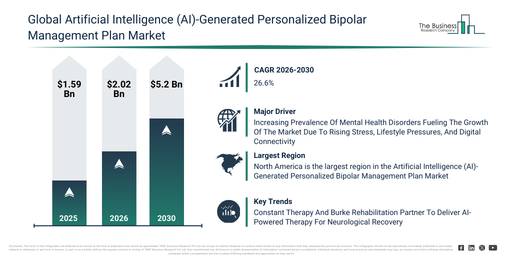
    The artificial intelligence (AI)-generated personalized bipolar management plan market size has experienced significant expansion recently. It is anticipated to increase from $1.59 billion in 2025 to $2.02 billion in 2026, achieving a compound annual growth rate (CAGR) of 26.9%. Historically, this growth can be attributed to factors such as increasing diagnosis rates of bipolar disorder, the growing embrace of digital mental health tools, the expansion of telepsychiatry services, the rising availability of patient health data, and enhancements in machine learning analytics.

    The market size for artificial intelligence (AI)-generated personalized bipolar management plans is set for significant expansion in the coming years, with projections indicating a rise to $5.2 billion by 2030, at a compound annual growth rate (CAGR) of 26.6%. This growth throughout the forecast period is largely due to the escalating demand for individualized mental healthcare, increased investments in AI-based clinical decision support systems, the expansion of remote mental health monitoring services, a greater emphasis on preventive psychiatry, and advancements in predictive healthcare analytics. Notable trends during this period are expected to include the rising adoption of AI-driven mood pattern analysis, the broader use of predictive relapse detection models, enhanced integration with electronic health records, the development of personalized therapy adjustment tools, and an increased focus on long-term mental health stability.

    Download A Free Sample Report For Comprehensive Market Insights:

    https://www.thebusinessresearchcompany.com/sample.aspx?id=28133&type=smp

    Which Significant Factors Are Encouraging Growth In The Artificial Intelligence (AI)-Generated Personalized Bipolar Management Plan Market?

    The expansion of the artificial intelligence (AI)-generated personalized bipolar management plan market is anticipated to be propelled by the growing occurrence of mental health disorders. These conditions are defined as ailments that substantially impact an individual’s emotions, thought processes, conduct, and overall psychological state. The escalation in mental health disorders stems from heightened stress prevalent in contemporary lifestyles, encompassing factors such as occupational demands, social disconnection, and continuous digital engagement. Artificial intelligence (AI)-generated personalized bipolar management plans assist in managing mental health disorders by providing customized treatment approaches, thus serving as an excellent solution for individualized patient care. These plans mitigate diagnostic ambiguity through ongoing monitoring and the delivery of foresightful data, thereby enhancing treatment efficacy and overall patient wellness. For instance, in May 2024, data from the American Psychiatric Association, a US-based non-profit organization, indicated that 43% of adults reported increased anxiety compared to the previous year, an uptick from 37% in 2023 and 32% in 2022. Consequently, the rising incidence of mental health disorders is a key impetus for the growth of the artificial intelligence (AI)-generated personalized bipolar management plan market.

    What Key Segment Areas Are Included In The Artificial Intelligence (AI)-Generated Personalized Bipolar Management Plan Market Assessment?

    The artificial intelligence (AI)-generated personalized bipolar management plan market covered in this report is segmented –

    1) By Component: Software, Services

    2) By Deployment Mode: Cloud-Based, On-Premises

    3) By Application: Clinical Management, Remote Monitoring, Patient Engagement, Decision Support, Other Applications

    4) By End-User: Hospitals And Clinics, Mental Health Centers, Homecare Settings, Other End Users

    Subsegments:

    1) By Software: Clinical Decision Support Systems (CDSS), Mobile And Web Applications, Artificial Intelligence (AI) Algorithms And Predictive Analytics Tools, Electronic Health Record (EHR) Integration Modules, Remote Monitoring Platforms

    2) By Services: Implementation And Integration Services, Training And Education Services, Consulting Services, Maintenance And Support Services, Data Management And Security Services

    Which Trends Are Influencing The Direction Of The Artificial Intelligence (AI)-Generated Personalized Bipolar Management Plan Market?

    Major companies within the artificial intelligence (AI)-generated personalized bipolar management plan market are concentrating on creating sophisticated solutions, such as AI-driven mental health platforms, designed to offer individualized treatment, track mood, anticipate relapses, and promote optimized care. Artificial intelligence (AI)-driven mental health platforms are digital tools that utilize AI to oversee mental health, customize treatment plans, forecast relapses, and aid clinical decisions. For instance, in May 2024, JD Health International Inc., a China-based healthcare company, unveiled the Small Universe for Chatting and Healing, an AI-driven mental health platform. This platform capitalizes on JD Health’s healthcare-specific large language model (LLM) to deliver empathetic, logical, and personalized interactions, facilitating continuous monitoring and management of bipolar symptoms. Furthermore, the platform furnishes multimodal diagnostic tools for professionals and a licensed sleep monitoring software for accurate assessments.

    Who Are The Key Market Participants In The Artificial Intelligence (AI)-Generated Personalized Bipolar Management Plan Market?

    Major companies operating in the artificial intelligence (AI)-generated personalized bipolar management plan market are JD Health International Inc., Cerebral Inc., Merative US L.P., Headspace Inc., Talkspace Inc., Quartet Health Inc., NUE Life Health P.A., Woebot Health Inc., Koa Health B.V., Mindstrong Health Inc., Altimate Health Inc., SilverCloud Health Limited, Pear Therapeutics Inc., Wysa Ltd., Youper Inc., Happify Health Inc., Ellipsis Health Inc., Flow Neuroscience AB, Earkick AG, Juli Health Inc.

    Access The Complete Artificial Intelligence (AI)-Generated Personalized Bipolar Management Plan Market Report:

    https://www.thebusinessresearchcompany.com/report/artificial-intelligence-ai-generated-personalized-bipolar-management-plan-global-market-report

    Which Region Is The Dominant Market In The Artificial Intelligence (AI)-Generated Personalized Bipolar Management Plan Market?

    North America was the largest region in the artificial intelligence (AI)-generated personalized bipolar management plan market in 2025. Asia-Pacific is expected to be the fastest-growing region in the forecast period. The regions covered in the artificial intelligence (AI)-generated personalized bipolar management plan market report are Asia-Pacific, South East Asia, Western Europe, Eastern Europe, North America, South America, Middle East, Africa.

    Access Artificial Intelligence (AI)-Generated Personalized Bipolar Management Plan Market Report for Deeper Competitive Insights

    https://www.thebusinessresearchcompany.com/customise?id=28133&type=smp

    Browse Through More Reports Similar to the Global Artificial Intelligence (AI)-Generated Personalized Bipolar Management Plan Market 2026, By The Business Research Company

    Artificial Intelligence Ai Based Personalization Global Market Report 2026

    https://www.thebusinessresearchcompany.com/report/artificial-intelligence-ai-based-personalization-global-market-report

    Ai Powered Personal Finance Management Global Market Report 2026

    https://www.thebusinessresearchcompany.com/report/ai-powered-personal-finance-management-global-market-report

    Artificial Intelligence Ai For Insurance Global Market Report 2026

    https://www.thebusinessresearchcompany.com/report/artificial-intelligence-ai-for-insurance-global-market-report

    Get in touch with us:

    The Business Research Company: https://www.thebusinessresearchcompany.com/

    Americas: +1 310-496-7795

    Asia: +44 7882 955267 & +91 8897263534

    Europe: +44 7882 955267

    Email us at: marketing@tbrc.info

    Follow us on:

    LinkedIn: https://in.linkedin.com/company/the-business-research-company

    YouTube: https://www.youtube.com/channel/UC24_fI0rV8cR5DxlCpgmyFQ

    Global Market Model: https://www.thebusinessresearchcompany.com/global-market-model

  • Artificial Intelligence (AI)-Generated Digital Health Coaching Avatar Market Industry Forecast Reflecting Growth To $6.54 Billion By 2030

    Artificial Intelligence (AI)-Generated Digital Health Coaching Avatar Market Industry Forecast Reflecting Growth To $6.54 Billion By 2030

    The Business Research Company’s 2026 market reports feature enhanced tools like market attractiveness analysis, TAM assessment, and company scoring matrices, along with interactive dashboards, deeper supply chain insights, and startup coverage strengthening the depth, usability, and strategic value of insights.

    How Will The Market Size Of The Artificial Intelligence (AI)-Generated Digital Health Coaching Avatar Market Progress Through 2030?

    The artificial intelligence (AI)-generated digital health coaching avatar market size has experienced rapid growth in recent years. This market is projected to expand from $1.71 billion in 2025 to reach $2.24 billion by 2026, demonstrating a compound annual growth rate (CAGR) of 31.0%. Historically, this expansion has been driven by factors such as increasing rates of digital health adoption, the broadening of mobile health platforms, a growing embrace of virtual health assistants, the rising prevalence of chronic diseases, and advancements in natural language processing models.

    The artificial intelligence (AI)-generated digital health coaching avatar market is anticipated to experience substantial growth over the coming years. This market is projected to reach $6.54 billion by 2030, exhibiting a compound annual growth rate (CAGR) of 30.7%. Factors contributing to this growth during the projected timeframe include the escalating demand for tailored preventive healthcare, increasing capital injections into AI-powered digital therapeutics, the broadening scope of remote patient interaction platforms, an intensified emphasis on mental well-being assistance, and breakthroughs in generative AI technologies. Key trends anticipated within this period encompass the greater uptake of conversational AI health interfaces, the expanding incorporation of emotional intelligence into avatars, the growing implementation of individualized behavioral coaching approaches, the wider integration of multimodal health data, and a heightened commitment to ongoing patient involvement.

    Download A Free Sample Report For Comprehensive Market Insights:

    https://www.thebusinessresearchcompany.com/sample.aspx?id=28132&type=smp

    What Core Drivers Are Transforming The Artificial Intelligence (AI)-Generated Digital Health Coaching Avatar Market?

    The escalating need for personalized healthcare is anticipated to drive the future expansion of the artificial intelligence (AI)-generated digital health coaching avatar market. Personalized healthcare denotes medical services precisely tailored to an individual’s distinct requirements, lifestyle, and health conditions. This surge in personalized healthcare is attributable to breakthroughs in data-driven insights, which allow medical professionals to understand each patient’s specific health needs and administer more potent and targeted treatments. Artificial intelligence (AI)-generated digital health coaching avatar assist personalized healthcare by delivering real-time, customized guidance and support grounded in an individual’s health data, habits, and objectives, thereby making care more effective and patient-centric. For instance, in February 2024, the Personalized Medicine Coalition, a US-based non-profit organization, reported that the Food and Drug Administration (FDA) approved 16 novel personalized therapies for patients with rare diseases in 2023, a considerable increase from six in 2022. Thus, the growing demand for personalized healthcare is fueling the development of the artificial intelligence (AI)-generated digital health coaching avatar market.

    How Is Segment Classification Applied In The Artificial Intelligence (AI)-Generated Digital Health Coaching Avatar Market?

    The artificial intelligence (AI)-generated digital health coaching avatar market covered in this report is segmented –

    1) By Component: Software, Hardware, Services

    2) By Deployment Mode: Cloud-Based, On-Premises

    3) By Application: Chronic Disease Management, Mental Health Support, Fitness And Wellness, Nutrition Guidance, Other Applications

    4) By End-User: Hospitals And Clinics, Fitness Centers, Homecare, Corporate Wellness Programs, Other End-Users

    Subsegments:

    1) By Software: Cloud Based Platforms, Mobile Applications, Web Based Interfaces, Embedded Systems

    2) By Hardware: Sensors And Wearable Devices, Smart Displays, Virtual Reality Devices, Voice And Speech Recognition Devices

    3) By Services: Implementation Services, Training And Education Services, Support And Maintenance Services, Consulting Services

    What Trends Are Driving Changes In The Artificial Intelligence (AI)-Generated Digital Health Coaching Avatar Market?

    Leading firms within the artificial intelligence (AI)-generated digital health coaching avatar market are concentrating on creating sophisticated offerings, including artificial intelligence (AI)-powered digital avatars, to provide tailored health advice. These AI-powered digital avatars serve as virtual constructs employing artificial intelligence to replicate human actions and engage smartly in digital settings. As an illustration, during January 2025, the US-based health technology firm, Assisted Intelligence Wellness Inc. (AI Wellness), unveiled the Ask My Avatar Challenge at CES 2025. This particular program showcased interactive digital avatars enabling clients to participate in live wellness coaching sessions. The avatars offered continuous 24/7 assistance, limitless educational resources, and worldwide reach through engaging platforms, with the objective of transforming health learning and involvement.

    Which Organizations Are Operating Within The Artificial Intelligence (AI)-Generated Digital Health Coaching Avatar Market?

    Major companies operating in the artificial intelligence (AI)-generated digital health coaching avatar market are Google LLC, OpenAI LLC, Cera CARE LIMITED, Tempus AI Inc., CoachHub, Ada Health GmbH, Touchkin Eservices Private Limited, Infermedica Sp. z o.o, Hippocratic AI Inc., Buoy Health Inc., Woebot Labs Inc., Zing Coach Inc., Virti Inc., Hey Coach Education Private Limited, Rocky Robots Ltd., XpertDox LLC, Assisted Intelligence Wellness Inc., Luka Inc., RAVATAR, GOLD Health.

    Access The Complete Artificial Intelligence (AI)-Generated Digital Health Coaching Avatar Market Report:

    https://www.thebusinessresearchcompany.com/report/artificial-intelligence-ai-generated-digital-health-coaching-avatar-global-market-report

    Which Area Represents The Largest Portion Of The Artificial Intelligence (AI)-Generated Digital Health Coaching Avatar Market?

    North America was the largest region in the artificial intelligence (AI)-generated digital health coaching avatar market in 2025. Asia-Pacific is expected to be the fastest-growing region in the forecast period. The regions covered in the artificial intelligence (AI)-generated digital health coaching avatar market report are Asia-Pacific, South East Asia, Western Europe, Eastern Europe, North America, South America, Middle East, Africa.

    Access Artificial Intelligence (AI)-Generated Digital Health Coaching Avatar Market Report for Deeper Competitive Insights

    https://www.thebusinessresearchcompany.com/customise?id=28132&type=smp

    Browse Through More Reports Similar to the Global Artificial Intelligence (AI)-Generated Digital Health Coaching Avatar Market 2026, By The Business Research Company

    Health Coaching Apps Global Market Report 2026

    https://www.thebusinessresearchcompany.com/report/health-coaching-apps-global-market-report

    Ai In Mental Health Global Market Report 2026

    https://www.thebusinessresearchcompany.com/report/ai-in-mental-health-global-market-report

    Generative Ai In Healthcare Global Market Report 2026

    https://www.thebusinessresearchcompany.com/report/generative-ai-in-healthcare-global-market-report

    Get in touch with us:

    The Business Research Company: https://www.thebusinessresearchcompany.com/

    Americas: +1 310-496-7795

    Asia: +44 7882 955267 & +91 8897263534

    Europe: +44 7882 955267

    Email us at: marketing@tbrc.info

    Follow us on:

    LinkedIn: https://in.linkedin.com/company/the-business-research-company

    YouTube: https://www.youtube.com/channel/UC24_fI0rV8cR5DxlCpgmyFQ

    Global Market Model: https://www.thebusinessresearchcompany.com/global-market-model

  • Artificial Intelligence (AI)-Enhanced Remote Patient Intravenous (IV) Monitoring Market Forecast Analysis Through 2030 With Insights On Industry Expansion

    Artificial Intelligence (AI)-Enhanced Remote Patient Intravenous (IV) Monitoring Market Forecast Analysis Through 2030 With Insights On Industry Expansion

    The Business Research Company’s 2026 market reports feature enhanced tools like market attractiveness analysis, TAM assessment, and company scoring matrices, along with interactive dashboards, deeper supply chain insights, and startup coverage strengthening the depth, usability, and strategic value of insights.

    What Is The Expected Market Size Of The Artificial Intelligence (AI)-Enhanced Remote Patient Intravenous (IV) Monitoring Market In 2026 And How Much Will It Reach By 2030?

    The artificial intelligence (AI)-enhanced remote patient intravenous (iv) monitoring market has experienced significant expansion in its size during recent years. This market is anticipated to expand from $1.69 billion in 2025 to $2.05 billion in 2026, achieving a compound annual growth rate (CAGR) of 21.6%. Historically, this growth can be attributed to factors such as the increasing utilization of intravenous therapies in clinical care, a rise in the incidence of infusion-related complications, the broadening of hospital patient monitoring systems, the growing embrace of smart infusion devices, and an intensified focus on medication safety protocols.

    The artificial intelligence (AI)-enhanced remote patient intravenous (iv) monitoring market is expected to experience substantial growth in the upcoming years. It is projected to reach $4.45 billion by 2030, demonstrating a compound annual growth rate (CAGR) of 21.3%. The expansion during this forecast period can be attributed to the increasing adoption of AI-enabled infusion monitoring, a rising demand for home-based iv therapy solutions, the broadening of predictive patient safety analytics, the growing integration of connected infusion systems, and an increasing focus on remote clinical monitoring. Prominent trends anticipated in the forecast period include the wider adoption of real-time iv flow analytics, the rising use of AI-based infusion error detection, the growing integration of smart infusion sensors, the expansion of remote iv therapy management, and an enhanced emphasis on patient safety and compliance.

    Download A Free Sample Report For Comprehensive Market Insights:

    https://www.thebusinessresearchcompany.com/sample.aspx?id=28921&type=smp

    Which Growth Factors Are Strengthening The Artificial Intelligence (AI)-Enhanced Remote Patient Intravenous (IV) Monitoring Market Landscape?

    The increasing adoption of telehealth services is anticipated to fuel the expansion of the Artificial Intelligence (AI)-Enhanced Remote Patient Intravenous (IV) Monitoring Market moving forward. Telehealth involves delivering healthcare through digital communication technologies for remote medical consultations, monitoring, and treatment. Its growth stems from regulatory adjustments and reimbursement structures put in place during the COVID-19 pandemic, which made virtual healthcare more accessible and financially viable for both healthcare providers and patients. AI-enhanced remote patient intravenous (IV) monitoring supports telehealth by allowing real-time, distant tracking of patients’ IV therapy, automatically identifying complications, offering actionable insights to healthcare professionals, and integrating smoothly with virtual care platforms. This ensures prompt interventions, enhanced patient safety, and more efficient management of treatments at home and in outpatient settings. For instance, in April 2023, FAIR Health Inc., a US-based non-profit organization, reported that in 2023, national telehealth utilization grew by 7.3%, increasing from 5.5% of medical claim lines in December 2022 to 5.9% in January 2023. Consequently, the proliferation of telehealth services is accelerating the development of the Artificial Intelligence (AI)-Enhanced Remote Patient Intravenous (IV) Monitoring Market.

    What Are The Core Segment Classifications In The Artificial Intelligence (AI)-Enhanced Remote Patient Intravenous (IV) Monitoring Market?

    The artificial intelligence (AI)-enhanced remote patient intravenous (iv) monitoring market covered in this report is segmented –

    1) By Component: Hardware, Software, Services

    2) By Deployment Mode: On-Premises, Cloud-Based

    3) By Application: Hospitals, Clinics, Homecare Settings, Ambulatory Surgical Centers, Other Applications

    4) By End-User: Healthcare Providers, Patients

    Subsegments:

    1) By Hardware: Patient Monitoring Devices, Sensors And Infusion Pumps, Communication Devices, Data Storage Systems

    2) By Software: Predictive Analytics Software, Clinical Decision Support Software, Remote Monitoring Software, Data Management Software

    3) By Services: Implementation And Integration Services, Maintenance And Support Services, Training And Education Services, Remote Monitoring Services

    Who Are The Businesses Driving Activity In The Artificial Intelligence (AI)-Enhanced Remote Patient Intravenous (IV) Monitoring Market?

    Major companies operating in the artificial intelligence (AI)-enhanced remote patient intravenous (iv) monitoring market are Medtronic plc, Siemens Healthineers AG, GE HealthCare Technologies Inc., Koninklijke Philips N.V., Baxter International Inc., B. Braun Melsungen AG, Terumo Corporation, Nipro Corporation, Epic Systems Corporation, ICU Medical Inc., InfuSystem Holdings Inc., AlayaCare Inc., Huma Therapeutics Ltd., Health Recovery Solutions Inc., Arcomed AG, VitalConnect Inc., Cloud DX Inc., Empatica S.r.l., AccuHealth Inc., Serum Tracker Inc.

    Access The Complete Artificial Intelligence (AI)-Enhanced Remote Patient Intravenous (IV) Monitoring Market Report:

    https://www.thebusinessresearchcompany.com/report/artificial-intelligence-ai-enhanced-remote-patient-intravenous-iv-monitoring-global-market-report

    Which Region Commands The Largest Share Of The Artificial Intelligence (AI)-Enhanced Remote Patient Intravenous (IV) Monitoring Market?

    North America was the largest region in the artificial intelligence (AI)-enhanced remote patient intravenous (IV) monitoring market in 2025. Asia-Pacific is expected to be the fastest-growing region in the forecast period. The regions covered in the artificial intelligence (AI)-enhanced remote patient intravenous (iv) monitoring market report are Asia-Pacific, South East Asia, Western Europe, Eastern Europe, North America, South America, Middle East, Africa.

    Access Artificial Intelligence (AI)-Enhanced Remote Patient Intravenous (IV) Monitoring Market Report for Deeper Competitive Insights

    https://www.thebusinessresearchcompany.com/customise?id=28921&type=smp

    Browse Through More Reports Similar to the Global Artificial Intelligence (AI)-Enhanced Remote Patient Intravenous (IV) Monitoring Market 2026, By The Business Research Company

    Ai In Medical Devices Global Market Report 2026

    https://www.thebusinessresearchcompany.com/report/ai-in-medical-devices-global-market-report

    Artificial Intelligence Or Machine Learning Ai Or Ml Medical Device Global Market Report 2026

    https://www.thebusinessresearchcompany.com/report/artificial-intelligence-or-machine-learning-ai-or-ml-medical-device-global-market-report

    Artificial Intelligence In Healthcare Global Market Report 2026

    https://www.thebusinessresearchcompany.com/report/artificial-intelligence-in-healthcare-global-market-report

    Get in touch with us:

    The Business Research Company: https://www.thebusinessresearchcompany.com/

    Americas: +1 310-496-7795

    Asia: +44 7882 955267 & +91 8897263534

    Europe: +44 7882 955267

    Email us at: marketing@tbrc.info

    Follow us on:

    LinkedIn: https://in.linkedin.com/company/the-business-research-company

    YouTube: https://www.youtube.com/channel/UC24_fI0rV8cR5DxlCpgmyFQ

    Global Market Model: https://www.thebusinessresearchcompany.com/global-market-model
  • Artificial Intelligence (AI)-Enhanced Remote Neonatal Monitoring Market Growth Outlook Indicating Expansion To $2.98 Billion By 2030

    Artificial Intelligence (AI)-Enhanced Remote Neonatal Monitoring Market Growth Outlook Indicating Expansion To $2.98 Billion By 2030

    The Business Research Company’s 2026 market reports feature enhanced tools like market attractiveness analysis, TAM assessment, and company scoring matrices, along with interactive dashboards, deeper supply chain insights, and startup coverage strengthening the depth, usability, and strategic value of insights.

    What Market Size Is Forecasted For The Artificial Intelligence (AI)-Enhanced Remote Neonatal Monitoring Market By 2030 Based On Its 2026 Value?

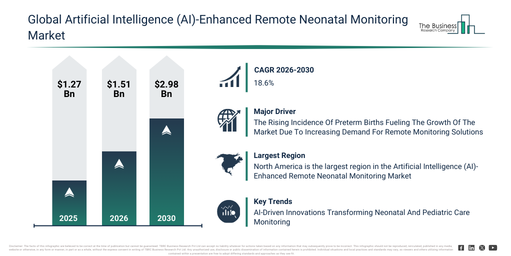
    The market size for artificial intelligence (AI)-enhanced remote neonatal monitoring has experienced swift expansion in recent years. It is projected to grow from $1.27 billion in 2025 to $1.51 billion in 2026, at a compound annual growth rate (CAGR) of 18.9%. This historical growth can be attributed to several factors, including increasing premature birth rates, the expansion of neonatal intensive care services, a rising adoption of remote patient monitoring technologies, a growing focus on early intervention in neonatal care, and advancements in neonatal sensor technologies.

    The artificial intelligence (AI)-enhanced remote neonatal monitoring market is poised for significant expansion in the coming years. This sector is projected to reach a valuation of $2.98 billion by 2030, exhibiting a compound annual growth rate (CAGR) of 18.6%. The anticipated growth during this period is driven by factors such as the increasing embrace of AI-powered neonatal monitoring, a growing need for home-based neonatal care options, the development of predictive health analytics, the broader integration of cloud-based monitoring systems, and a heightened focus on preventive neonatal healthcare. Prominent trends expected in the forecast timeframe include the rising adoption of continuous neonatal vital sign monitoring, increased utilization of AI-based early warning mechanisms, the expanding deployment of wearable sensors for neonates, the growth of remote neonatal care models, and an intensified focus on predictive neonatal analytics.

    Download A Free Sample Report For Comprehensive Market Insights:

    https://www.thebusinessresearchcompany.com/sample.aspx?id=28920&type=smp

    What Important Drivers Are Powering The Artificial Intelligence (AI)-Enhanced Remote Neonatal Monitoring Market Growth?

    An anticipated increase in preterm birth rates is projected to drive expansion within the artificial intelligence (AI)-enhanced remote neonatal monitoring market. Preterm birth, defined as the delivery of an infant prior to 37 completed weeks of gestation, frequently necessitates specialized medical attention because of underdeveloped organs and significantly impacts neonatal health. The occurrence of preterm births is escalating partly due to a trend of women having children later in life, a factor that heightens the likelihood of pregnancy complications and premature delivery. Artificial intelligence (AI)-enhanced remote neonatal monitoring systems assist in managing preterm births by continuously analyzing vital signs, thereby allowing for the early detection of complications, facilitating prompt interventions, and improving safety in post-discharge care. For example, a report released by the Centers for Disease Control and Prevention (CDC), a US-based nonprofit organization, in March 2025 indicated that the U.S. preterm birth rate climbed to 10.41% in 2023, representing a slight increase from 10.38% in 2022. Consequently, the growing frequency of preterm births is stimulating the expansion of the artificial intelligence (AI)-enhanced remote neonatal monitoring market.

    How Is The Artificial Intelligence (AI)-Enhanced Remote Neonatal Monitoring Market Structured Across Different Market Segments?

    The artificial intelligence (AI)-enhanced remote neonatal monitoring market covered in this report is segmented –

    1) By Component: Hardware, Software, Services

    2) By Monitoring Type: Vital Signs Monitoring, Respiratory Monitoring, Cardiac Monitoring, Other Monitoring Types

    3) By Deployment Mode: Cloud-Based, On-Premises

    4) By End User: Hospitals, Neonatal Intensive Care Units, Homecare Settings, Clinics, Other End Users

    Subsegments:

    1) By Hardware: Monitoring Devices, Wearable Sensors, Imaging Equipment, Communication Modules, Data Storage Units

    2) By Software: Analytics Platforms, Patient Management Systems, Predictive Algorithms, Visualization Tools, Alert And Notification Systems

    3) By Services: Remote Monitoring Support, Technical Maintenance, Training And Education, Consulting Services, Integration Services

    What Trends Are Influencing The Artificial Intelligence (AI)-Enhanced Remote Neonatal Monitoring Market Outlook?

    Leading firms within the artificial intelligence (AI)-enhanced remote neonatal monitoring market are prioritizing the creation of innovative solutions, such as AI-driven neonatal and pediatric care monitoring platforms, aiming to improve early identification of health complications, refine clinical decision-making, and facilitate constant, real-time tracking of newborns. These platforms leverage artificial intelligence to continuously monitor and scrutinize newborns’ and children’s health data, identify irregularities, and offer practical insights for prompt medical intervention. An illustration of this trend is seen in April 2025, when AngelEye Health, a US-based provider specializing in neonatal and pediatric family engagement technology, introduced AIVision. This significant advancement incorporates artificial intelligence (AI) and computer vision into neonatal intensive care units (NICUs) and pediatric units. This particular platform converts existing bedside cameras into smart clinical instruments, delivering proactive, data-informed insights to medical staff. Its principal functionalities encompass AI-driven motion analysis for identifying neuromotor risks early, synchronized video EEG, monitoring of respiratory status to spot initial signs of distress, AI-supported pain and sedation evaluation, and recording of crash/coding events for clinical training purposes.

    Which Firms Are Competing In The Artificial Intelligence (AI)-Enhanced Remote Neonatal Monitoring Market?

    Major companies operating in the artificial intelligence (AI)-enhanced remote neonatal monitoring market are Philips Healthcare, GE HealthCare Technologies Inc., Mount Sinai Health System Inc., Mindray Medical International Limited, Drägerwerk AG & Co. KGaA, Hill-Rom Company Inc., Masimo Corporation, Sheba Medical Center, Natus Medical Incorporated, Spacelabs Healthcare Inc., Aver Information Inc., Owlet Inc., Nanit Inc., AngelEye Health Inc., Raybaby Inc., Zoundream Inc., Sempulse Inc., Kriba Inc., Luscii B.V., Bloomlife Inc.

    Access The Complete Artificial Intelligence (AI)-Enhanced Remote Neonatal Monitoring Market Report:

    https://www.thebusinessresearchcompany.com/report/artificial-intelligence-ai-enhanced-remote-neonatal-monitoring-global-market-report

    Which Region Accounts For The Highest Share Of The Artificial Intelligence (AI)-Enhanced Remote Neonatal Monitoring Market?

    North America was the largest region in the artificial intelligence (AI)-enhanced remote neonatal monitoring market in 2025. Asia-Pacific is expected to be the fastest-growing region in the forecast period. The regions covered in the artificial intelligence (AI)-enhanced remote neonatal monitoring market report are Asia-Pacific, South East Asia, Western Europe, Eastern Europe, North America, South America, Middle East, Africa.

    Access Artificial Intelligence (AI)-Enhanced Remote Neonatal Monitoring Market Report for Deeper Competitive Insights

    https://www.thebusinessresearchcompany.com/customise?id=28920&type=smp

    Browse Through More Reports Similar to the Global Artificial Intelligence (AI)-Enhanced Remote Neonatal Monitoring Market 2026, By The Business Research Company

    Fetal And Neonatal Monitoring Devices Global Market Report 2026

    https://www.thebusinessresearchcompany.com/report/fetal-and-neonatal-monitoring-devices-global-market-report

    Baby Monitoring Devices Global Market Report 2026

    https://www.thebusinessresearchcompany.com/report/baby-monitoring-devices-global-market-report

    Fetal And Neonatal Monitoring Devices Global Market Report 2026

    https://www.thebusinessresearchcompany.com/report/fetal-and-neonatal-monitoring-devices-global-market-report

    Get in touch with us:

    The Business Research Company: https://www.thebusinessresearchcompany.com/

    Americas: +1 310-496-7795

    Asia: +44 7882 955267 & +91 8897263534

    Europe: +44 7882 955267

    Email us at: marketing@tbrc.info

    Follow us on:

    LinkedIn: https://in.linkedin.com/company/the-business-research-company

    YouTube: https://www.youtube.com/channel/UC24_fI0rV8cR5DxlCpgmyFQ

    Global Market Model: https://www.thebusinessresearchcompany.com/global-market-model

  • Global Artificial Intelligence (AI)-Enhanced Intensive Care Unit (ICU) Ventilation Weaning Market Anticipated To Grow To $4.56 Billion By 2030 At 23.1% CAGR

    Global Artificial Intelligence (AI)-Enhanced Intensive Care Unit (ICU) Ventilation Weaning Market Anticipated To Grow To $4.56 Billion By 2030 At 23.1% CAGR

    The Business Research Company’s 2026 market reports feature enhanced tools like market attractiveness analysis, TAM assessment, and company scoring matrices, along with interactive dashboards, deeper supply chain insights, and startup coverage strengthening the depth, usability, and strategic value of insights.

    How Is The Market Value Of The Artificial Intelligence (AI)-Enhanced Intensive Care Unit (ICU) Ventilation Weaning Market Projected To Expand During 2026–2030?

    The market size for artificial intelligence (AI)-enhanced intensive care unit (icu) ventilation weaning has witnessed substantial growth in recent years. This market is anticipated to expand from $1.61 billion in 2025 to $1.99 billion in 2026, at a compound annual growth rate (CAGR) of 23.3%. Historically, this expansion has been propelled by factors including the heightened adoption of mechanical ventilation in critical care, increasing volumes of icu patients, the escalating clinical complexity inherent in respiratory management, the proliferation of critical care monitoring technologies, and the broader integration of data-driven icu protocols.

    The artificial intelligence (AI)-enhanced intensive care unit (icu) ventilation weaning market is projected for rapid expansion, reaching $4.57 billion by 2030 with a compound annual growth rate (CAGR) of 23.1%. This anticipated growth is driven by factors such as the greater acceptance of AI-powered critical care solutions, an increased need for outcome-focused ICU management, the broadening of smart ventilator ecosystems, the rising incorporation of predictive analytics in intensive care settings, and a heightened emphasis on shortening ICU stays. Key trends during this period will involve the expanded application of predictive weaning algorithms, the growing integration of real-time ventilator data analysis, a wider embrace of AI-aided ICU decision support, the development of automated ventilation management, and an intensified effort to minimize ventilation duration.

    Download A Free Sample Report For Comprehensive Market Insights:

    https://www.thebusinessresearchcompany.com/sample.aspx?id=28916&type=smp

    Which Major Factors Are Contributing To The Development Of The Artificial Intelligence (AI)-Enhanced Intensive Care Unit (ICU) Ventilation Weaning Market?

    The market for artificial intelligence (AI)-enhanced intensive care unit (ICU) ventilation weaning is anticipated to grow due to the increasing incidence of respiratory diseases. These conditions, which impact the lungs and airways and hinder normal breathing and oxygen exchange, are becoming more common, particularly among aging populations in developed nations. Older individuals are more prone to chronic respiratory issues because of compromised immune systems and prolonged environmental exposure. AI-enhanced ventilation weaning systems play a crucial role in managing these diseases by continuously analyzing patient data, forecasting ideal weaning times, shortening the period of mechanical ventilation, lessening complications, and facilitating tailored, effective, and prompt clinical actions that enhance patient recovery. For example, data from June 2024 by the Australian Institute of Health and Welfare, an Australia-based government agency, revealed that in 2023, chronic obstructive pulmonary disease (COPD) constituted 3.6% of Australia’s total disease burden and represented 50% of the total burden from respiratory conditions. Consequently, the increasing occurrence of respiratory diseases is a significant factor propelling the artificial intelligence (AI)-enhanced intensive care unit (ICU) ventilation weaning market forward.

    Which Segment-Based Categories Are Covered In The Artificial Intelligence (AI)-Enhanced Intensive Care Unit (ICU) Ventilation Weaning Market?

    The artificial intelligence (AI)-enhanced intensive care unit (icu) ventilation weaning market covered in this report is segmented –

    1) By Component: Software, Hardware, Services

    2) By Deployment Mode: On-Premises, Cloud-Based

    3) By Application: Adult Intensive Care Unit (ICU), Pediatric Intensive Care Unit (ICU), Neonatal Intensive Care Unit (ICU)

    4) By End-User: Hospitals, Specialty Clinics, Other End-Users

    Subsegments:

    1) By Software: Ventilation Management Software, Predictive Weaning Algorithms, Patient Monitoring Software, Data Analytics And Visualization Software

    2) By Hardware: Ventilators, Sensors And Monitors, Computing Systems, Connectivity Devices

    3) By Services: Implementation And Integration Services, Training And Education Services, Maintenance And Support Services, Remote Monitoring Services

    Who Are The Major Companies Operating In The Artificial Intelligence (AI)-Enhanced Intensive Care Unit (ICU) Ventilation Weaning Market?

    Major companies operating in the artificial intelligence (AI)-enhanced intensive care unit (icu) ventilation weaning market are Medtronic plc, Koninklijke Philips N.V., GE HealthCare Technologies Inc., Drägerwerk AG & Co. KGaA, Getinge AB, Hamilton Medical AG, Hicuity Health Inc., Etiometry Inc., Clew Medical Ltd., Ambient Clinical Analytics Inc., ResMed Inc., Vyaire Medical, Inc., Mindray Medical International Limited, Zoll Medical Corporation, Baxter International Inc., Siemens Healthineers AG, Smiths Medical (ICU Medical, Inc.), Masimo Corporation, Aeonmed, Timpel S.A

    Access The Complete Artificial Intelligence (AI)-Enhanced Intensive Care Unit (ICU) Ventilation Weaning Market Report:

    https://www.thebusinessresearchcompany.com/report/artificial-intelligence-ai-enhanced-intensive-care-unit-icu-ventilation-weaning-global-market-report

    Which Region Is The Primary Market For The Artificial Intelligence (AI)-Enhanced Intensive Care Unit (ICU) Ventilation Weaning Market?

    North America was the largest region in the artificial intelligence (AI)-enhanced intensive care unit (ICU) ventilation weaning market in 2025. Asia-Pacific is expected to be the fastest-growing region in the forecast period. The regions covered in the artificial intelligence (AI)-enhanced intensive care unit (icu) ventilation weaning market report are Asia-Pacific, South East Asia, Western Europe, Eastern Europe, North America, South America, Middle East, Africa.

    Access Artificial Intelligence (AI)-Enhanced Intensive Care Unit (ICU) Ventilation Weaning Market Report for Deeper Competitive Insights

    https://www.thebusinessresearchcompany.com/customise?id=28916&type=smp

    Browse Through More Reports Similar to the Global Artificial Intelligence (AI)-Enhanced Intensive Care Unit (ICU) Ventilation Weaning Market 2026, By The Business Research Company

    Artificial Intelligence Ai In Operating Room Global Market Report 2026

    https://www.thebusinessresearchcompany.com/report/artificial-intelligence-ai-in-operating-room-global-market-report

    Ai In Medical Devices Global Market Report 2026

    https://www.thebusinessresearchcompany.com/report/ai-in-medical-devices-global-market-report

    Artificial Intelligence In Healthcare Global Market Report 2026

    https://www.thebusinessresearchcompany.com/report/artificial-intelligence-in-healthcare-global-market-report

    Get in touch with us:

    The Business Research Company: https://www.thebusinessresearchcompany.com/

    Americas: +1 310-496-7795

    Asia: +44 7882 955267 & +91 8897263534

    Europe: +44 7882 955267

    Email us at: marketing@tbrc.info

    Follow us on:

    LinkedIn: https://in.linkedin.com/company/the-business-research-company

    YouTube: https://www.youtube.com/channel/UC24_fI0rV8cR5DxlCpgmyFQ

    Global Market Model: https://www.thebusinessresearchcompany.com/global-market-model

  • Artificial Intelligence (AI)-Enhanced Diabetes Foot Ulcer Monitor Market Future Analysis Covering Industry Shifts And Growth Potential

    Artificial Intelligence (AI)-Enhanced Diabetes Foot Ulcer Monitor Market Future Analysis Covering Industry Shifts And Growth Potential

    The Business Research Company’s 2026 market reports feature enhanced tools like market attractiveness analysis, TAM assessment, and company scoring matrices, along with interactive dashboards, deeper supply chain insights, and startup coverage strengthening the depth, usability, and strategic value of insights.

    What Are The Forecasted Market Size Figures For The Artificial Intelligence (AI)-Enhanced Diabetes Foot Ulcer Monitor Market In 2026 And 2030?

    The artificial intelligence (AI)-enhanced diabetes foot ulcer monitor market has seen rapid growth in its size during recent years. This market is expected to expand from $1.71 billion in 2025 to $2.03 billion by 2026, registering a compound annual growth rate (CAGR) of 18.5%. The expansion witnessed in the historic period can be ascribed to the increasing worldwide prevalence of diabetes, the rising incidence of diabetic foot complications, the broadening availability of telehealth monitoring solutions, a growing clinical emphasis on preventive wound care, and enhancements in medical imaging technologies.

    The market for artificial intelligence (AI)-enhanced diabetes foot ulcer monitors is projected to experience swift expansion in the coming years. This market is anticipated to reach $3.96 billion by 2030, exhibiting a compound annual growth rate (CAGR) of 18.3%. Factors contributing to this growth during the forecast period include the greater embrace of AI-driven diagnostic instruments, an increasing need for monitoring solutions in home settings, the broadening scope of predictive healthcare analytics, the progressive integration of imaging and sensor technologies, and a heightened focus on preventive care for diabetes. Key developments expected in this period encompass the growing acceptance of AI-powered risk assessment for foot ulcers, the expanded application of computer vision in wound analysis, the wider implementation of intelligent wearable foot sensors, the broadening availability of home-based diabetic foot monitoring, and a reinforced emphasis on detecting ulcers at an early stage.

    Download A Free Sample Report For Comprehensive Market Insights:

    https://www.thebusinessresearchcompany.com/sample.aspx?id=28915&type=smp

    What Key Growth Drivers Are Influencing The Artificial Intelligence (AI)-Enhanced Diabetes Foot Ulcer Monitor Market?

    An anticipated increase in healthcare spending is projected to stimulate expansion within the artificial intelligence (AI)-enhanced diabetes foot ulcer monitor market in the future. This expenditure encompasses all financial outlays made by individuals, organizations, and governmental bodies for services and initiatives focused on preserving or enhancing health. The increase in healthcare spending stems from the rising occurrence of chronic illnesses, which in turn necessitates ongoing medical attention, prolonged therapeutic interventions, and extensive management provisions. Such spending enables healthcare facilities like hospitals and clinics to acquire AI-enhanced diabetes foot ulcer monitors, thereby facilitating more effective patient management and reducing protracted treatment costs. For example, reports from April 2025 by the UK’s government agency, the Office for National Statistics, indicated that public healthcare funding constitutes the majority of health expenditure in the UK, totaling $344 billion (£258 billion) in 2024, representing a 2.5% real-term increase compared to 2023. Consequently, the expansion of healthcare expenditure is a primary factor driving the development of the artificial intelligence (AI)-enhanced diabetes foot ulcer monitor market.

    What Are The Major Segment Categories Within The Artificial Intelligence (AI)-Enhanced Diabetes Foot Ulcer Monitor Market?

    The artificial intelligence (AI)-enhanced diabetes foot ulcer monitor market covered in this report is segmented –

    1) By Product Type: Wearable Devices, Non-Wearable Devices, Smart Sensors, Imaging Systems

    2) By Technology: Machine Learning, Deep Learning, Computer Vision, Other Technologies

    3) By Application: Hospitals And Clinics, Homecare, Ambulatory Surgical Centers, Research Institutes, Other Applications

    4) By End-User: Healthcare Providers, Patients, Research Organizations, Other End-Users

    Subsegments:

    1) By Wearable Devices: Smart Watches, Smart Boots, Smart Insoles, Smart Socks

    2) By Non-Wearable Devices: Digital Cameras, Mobile Scanners, Handheld Imaging Devices, Pressure Mapping Platforms

    3) By Smart Sensors: Temperature Sensors, Pressure Sensors, Moisture Sensors, Motion Sensors

    4) By Imaging Systems: Thermal Imaging Systems, Hyperspectral Imaging Systems, Optical Imaging Systems, Ultrasonic Imaging Systems

    What Trends Are Affecting The Artificial Intelligence (AI)-Enhanced Diabetes Foot Ulcer Monitor Market Dynamics?

    Companies operating in the artificial intelligence (AI)-enhanced diabetes foot ulcer monitor market are focusing on establishing financial provisions (funds) to facilitate scaling production, broadening market reach, and enhancing patient accessibility. These funds represent sums of money allocated or pooled for specific investments or expenditures. For example, in July 2024, IR-MED Inc., an Israel-based medical device developer, announced it had secured a grant of $500,000 to support its development of a device for the early detection of diabetic foot ulcers. This funding will enable IR-MED to advance the development and commercialization of its AI-enhanced DiaSafe device for diabetes foot ulcer monitoring in the second half of 2025, as part of a 13-month program. The DiaSafe device, building upon the PressureSafe platform set to launch in late 2024, integrates AI data analysis with infra-red sensing for the early detection of diabetic foot ulcers. This technology is capable of identifying conditions that are otherwise hidden or invisible to the naked eye, particularly in patients with darker skin tones. Additionally, the platform’s AI-powered decision support system evaluates bioinformation against condition-specific biomarker profiles to determine whether tissue is healthy or at risk.

    Which Companies Are Influencing The Artificial Intelligence (AI)-Enhanced Diabetes Foot Ulcer Monitor Market?

    Major companies operating in the artificial intelligence (AI)-enhanced diabetes foot ulcer monitor market are Net Health Systems Inc., Podimetrics Inc., Orpyx Medical Technologies Inc., Spectral AI Inc., Siren Care Inc., Calceus Health Pty Ltd., WoundVision LLC., Bluedrop Medical Inc., Moticon GmbH., eKare Inc., Sensoria Health Inc., Baliston Limited., Empo Health Inc., MolecuLight Inc., MIMOSA Diagnostics Inc., Thermology Health Ltd., IR-MED Inc., DiabSense Private Limited, HeloCare Inc., SmartDiabetes Tech Ltd.

    Access The Complete Artificial Intelligence (AI)-Enhanced Diabetes Foot Ulcer Monitor Market Report:

    https://www.thebusinessresearchcompany.com/report/artificial-intelligence-ai-enhanced-diabetes-foot-ulcer-monitor-global-market-report

    Which Geographic Region Represents The Largest Artificial Intelligence (AI)-Enhanced Diabetes Foot Ulcer Monitor Market Share?

    North America was the largest region in the artificial intelligence (AI)-enhanced diabetes foot ulcer monitor market in 2025. Asia-Pacific is expected to be the fastest-growing region in the forecast period. The regions covered in the artificial intelligence (AI)-enhanced diabetes foot ulcer monitor market report are Asia-Pacific, South East Asia, Western Europe, Eastern Europe, North America, South America, Middle East, Africa.

    Access Artificial Intelligence (AI)-Enhanced Diabetes Foot Ulcer Monitor Market Report for Deeper Competitive Insights

    https://www.thebusinessresearchcompany.com/customise?id=28915&type=smp

    Browse Through More Reports Similar to the Global Artificial Intelligence (AI)-Enhanced Diabetes Foot Ulcer Monitor Market 2026, By The Business Research Company

    Artificial Intelligence In Healthcare Diagnosis Global Market Report 2026

    https://www.thebusinessresearchcompany.com/report/artificial-intelligence-in-healthcare-diagnosis-global-market-report

    Ai In Medical Devices Global Market Report 2026

    https://www.thebusinessresearchcompany.com/report/ai-in-medical-devices-global-market-report

    Artificial Intelligence Or Machine Learning Ai Or Ml Medical Device Global Market Report 2026

    https://www.thebusinessresearchcompany.com/report/artificial-intelligence-or-machine-learning-ai-or-ml-medical-device-global-market-report

    Get in touch with us:

    The Business Research Company: https://www.thebusinessresearchcompany.com/

    Americas: +1 310-496-7795

    Asia: +44 7882 955267 & +91 8897263534

    Europe: +44 7882 955267

    Email us at: marketing@tbrc.info

    Follow us on:

    LinkedIn: https://in.linkedin.com/company/the-business-research-company

    YouTube: https://www.youtube.com/channel/UC24_fI0rV8cR5DxlCpgmyFQ

    Global Market Model: https://www.thebusinessresearchcompany.com/global-market-model

  • Artificial Intelligence (AI)-Enhanced Chronic Obstructive Sleep Apnea Coach Market Analysis Reflecting Expansion Trends And Industry Performance

    Artificial Intelligence (AI)-Enhanced Chronic Obstructive Sleep Apnea Coach Market Analysis Reflecting Expansion Trends And Industry Performance

    The Business Research Company’s 2026 market reports feature enhanced tools like market attractiveness analysis, TAM assessment, and company scoring matrices, along with interactive dashboards, deeper supply chain insights, and startup coverage strengthening the depth, usability, and strategic value of insights.

    How Much Larger Will The Artificial Intelligence (AI)-Enhanced Chronic Obstructive Sleep Apnea Coach Market Become By 2030 Compared To 2026?

    The artificial intelligence (AI)-enhanced chronic obstructive sleep apnea coach market size has experienced swift growth in recent years. This market is set to increase from $1.61 billion in 2025 to $1.92 billion in 2026, registering a compound annual growth rate (CAGR) of 19.5%. The expansion observed in prior periods stemmed from factors including the rising prevalence of sleep apnea and respiratory disorders, heightened awareness of sleep health management, the development of home-based sleep monitoring solutions, the broadening of digital health platforms, and a strengthened clinical emphasis on therapy compliance.

    The artificial intelligence (AI)-enhanced chronic obstructive sleep apnea coach market size is projected for substantial expansion over the coming years. Reaching a valuation of $3.88 billion by 2030, this market is anticipated to expand at a compound annual growth rate (CAGR) of 19.2%. This growth during the forecast period is propelled by factors such as the increasing adoption of AI-enabled chronic disease management tools, a rising demand for remote patient monitoring solutions, the expansion of personalized digital therapeutics, growing integration with connected medical devices, and an increasing healthcare shift toward preventive care models. Prominent developments expected throughout this period encompass increasing adoption of continuous sleep and respiratory monitoring, rising use of AI-driven therapy adherence coaching, growing integration of wearable sleep diagnostics, expansion of personalized sleep health platforms, and an enhanced focus on proactive disease management.

    Download A Free Sample Report For Comprehensive Market Insights:

    https://www.thebusinessresearchcompany.com/sample.aspx?id=28914&type=smp

    Which Core Factors Are Supporting The Expansion Of The Artificial Intelligence (AI)-Enhanced Chronic Obstructive Sleep Apnea Coach Market?

    The rising occurrence of sleep disorders is projected to fuel the expansion of the artificial intelligence (AI)-enhanced chronic obstructive sleep apnea coach market in the future. These conditions are health issues that disrupt normal sleep patterns, affecting both the quality of sleep, general well-being, and daily functioning. The escalation of sleep disorders primarily stems from elevated stress levels, with contemporary work demands, academic pressures, and extensive screen usage leading to increased anxiety and disturbed sleep cycles. An artificial intelligence (AI)-enhanced chronic obstructive sleep apnea coach addresses sleep disorders through the monitoring of breathing and sleep patterns, simultaneously providing individualized guidance and therapeutic assistance, which facilitates the prompt identification of issues and encourages improved sleep quality and overall health. For example, data from November 2023 by the National Health Service, a UK government health statistics body, indicated a slight increase in the percentage of young individuals aged 17 to 23 years reporting sleep issues three or more times weekly, reaching 64.9% from 64.0% in 2022. Consequently, the rising prevalence of sleep disorders is a key factor propelling the expansion of the artificial intelligence (AI)-enhanced chronic obstructive sleep apnea coach market.

    How Is The Artificial Intelligence (AI)-Enhanced Chronic Obstructive Sleep Apnea Coach Market Distributed Across Key Segments?

    The artificial intelligence (AI)-enhanced chronic obstructive sleep apnea coach market covered in this report is segmented –

    1) By Component: Software, Hardware, Services

    2) By Deployment Mode: Cloud-Based, On-Premises

    3) By Application: Home Care, Sleep Clinics, Hospitals, Research Institutes, Other Applications

    4) By End-User: Patients, Healthcare Providers, Sleep Specialists, Other End-Users

    Subsegments:

    1) By Software: Cloud-Based Platforms, Mobile Applications, Patient Monitoring Dashboards, Sleep Data Analytics Tools, Therapeutic Guidance Systems, Compliance Management Software

    2) By Hardware: Wearable Sleep Trackers, Respiratory Monitoring Devices, Pulse Oximeters, Smart Sleep Masks, Connected Airflow Sensors, Portable Sleep Diagnostic Units

    3) By Services: Remote Patient Monitoring Services, Sleep Coaching Programs, Data Integration And Management Services, Technical Support And Maintenance, Clinical Consultation Services, Training And Education Services

    Which Trends Are Influencing The Expansion Of The Artificial Intelligence (AI)-Enhanced Chronic Obstructive Sleep Apnea Coach Market?

    Major companies operating in the artificial intelligence (AI)-enhanced chronic obstructive sleep apnea coach market are concentrating on developing sophisticated products, such as positive airway pressure (PAP) devices, to deliver individualized therapy and facilitate remote monitoring through AI-driven insights. Positive airway pressure (PAP) devices function by providing a consistent or adaptable airflow via a mask to keep airways open during sleep, thereby preventing collapse in obstructive sleep apnea patients and enhancing breathing and sleep quality. For instance, in February 2024, ResMed Inc., a US-based medical device and digital health company, introduced its AirCurve 11 series bilevel devices. These devices offer two distinct levels of support, specifically higher pressure during inhalation and lower pressure during exhalation, which simplifies sleep apnea treatment for healthcare providers and aids patients in adhering to therapy. The AirCurve 11 devices are built upon the AirSense 11 platform and incorporate digital features like secure data transfer through cellular communication, automated software updates, and tools for patient engagement, such as the myAir app. This series includes models tailored for both obstructive and central sleep apnea, with the goal of improving comfort and compliance through personalized therapy support. The devices are presently available in the U.S., with a global rollout anticipated.

    Who Are The Companies Shaping The Artificial Intelligence (AI)-Enhanced Chronic Obstructive Sleep Apnea Coach Market Landscape?

    Major companies operating in the artificial intelligence (AI)-enhanced chronic obstructive sleep apnea coach market are Koninklijke Philips N.V., ResMed Inc., Sleep Number Corporation, Nihon Kohden Corporation, Fisher & Paykel Healthcare Corporation Limited, Verily Life Sciences LLC, Natus Medical Incorporated, SomnoMed Limited, BMC Medical Co.,Ltd., Eight Sleep,Inc., Sleepiz AG, Sleep.ai B.V. (SleepScore Labs), EnsoData,Inc., SovaSage,Inc., Somnics Inc., Sleep Doctor,LLC, Sommetrics,Inc., Nyxoah S.A., Neru Health Inc., Apnea-Tech Limited.

    Access The Complete Artificial Intelligence (AI)-Enhanced Chronic Obstructive Sleep Apnea Coach Market Report:

    https://www.thebusinessresearchcompany.com/report/artificial-intelligence-ai-enhanced-chronic-obstructive-sleep-apnea-coach-global-market-report

    Which Region Leads The Artificial Intelligence (AI)-Enhanced Chronic Obstructive Sleep Apnea Coach Market By Size?

    North America was the largest region in the artificial intelligence (AI)-enhanced chronic obstructive sleep apnea coach market in 2025. Asia-Pacific is expected to be the fastest-growing region in the forecast period. The regions covered in the artificial intelligence (AI)-enhanced chronic obstructive sleep apnea coach market report are Asia-Pacific, South East Asia, Western Europe, Eastern Europe, North America, South America, Middle East, Africa.

    Access Artificial Intelligence (AI)-Enhanced Chronic Obstructive Sleep Apnea Coach Market Report for Deeper Competitive Insights

    https://www.thebusinessresearchcompany.com/customise?id=28914&type=smp

    Browse Through More Reports Similar to the Global Artificial Intelligence (AI)-Enhanced Chronic Obstructive Sleep Apnea Coach Market 2026, By The Business Research Company

    Sleep Apnea Devices Global Market Report 2026

    https://www.thebusinessresearchcompany.com/report/sleep-apnea-devices-global-market-report

    Artificial Intelligence In Diabetes Management Global Market Report 2026

    https://www.thebusinessresearchcompany.com/report/artificial-intelligence-in-diabetes-management-global-market-report

    Wearable Ai Global Market Report 2026

    https://www.thebusinessresearchcompany.com/report/wearable-ai-global-market-report

    Get in touch with us:

    The Business Research Company: https://www.thebusinessresearchcompany.com/

    Americas: +1 310-496-7795

    Asia: +44 7882 955267 & +91 8897263534

    Europe: +44 7882 955267

    Email us at: marketing@tbrc.info

    Follow us on:

    LinkedIn: https://in.linkedin.com/company/the-business-research-company

    YouTube: https://www.youtube.com/channel/UC24_fI0rV8cR5DxlCpgmyFQ

    Global Market Model: https://www.thebusinessresearchcompany.com/global-market-model

  • Global Artificial Intelligence (AI)-Driven Virtual Nursing Assistants Market Revenue Expected To Reach $5.19 Billion By 2030

    Global Artificial Intelligence (AI)-Driven Virtual Nursing Assistants Market Revenue Expected To Reach $5.19 Billion By 2030

    The Business Research Company’s 2026 market reports feature enhanced tools like market attractiveness analysis, TAM assessment, and company scoring matrices, along with interactive dashboards, deeper supply chain insights, and startup coverage strengthening the depth, usability, and strategic value of insights.

    What Growth In Market Value Is Anticipated For The Artificial Intelligence (AI)-Driven Virtual Nursing Assistants Market Between 2026 And 2030?

    The market size for artificial intelligence (AI)-driven virtual nursing assistants has experienced rapid growth in recent years. This market is expected to expand from $1.76 billion in 2025 to $2.19 billion in 2026, achieving a compound annual growth rate (CAGR) of 24.4%. Key factors contributing to this historical growth include increasing healthcare staff shortages, the early adoption of telehealth services, a growing demand for patient self-management tools, the expansion of digital health platforms, and the availability of conversational AI technologies.

    The artificial intelligence (AI)-driven virtual nursing assistants market size is projected to experience substantial expansion in the coming years. By 2030, it is anticipated to reach $5.19 billion, exhibiting a compound annual growth rate (CAGR) of 24.1%. This projected growth is driven by factors such as greater investments in virtual care infrastructure, an increasing need for continuous patient support, the wider deployment of AI-assisted clinical workflows, a growing emphasis on delivering cost-efficient healthcare, and the rising adoption of remote patient monitoring solutions. Key developments anticipated during this period encompass the increased use of virtual nursing support tools, the growing deployment of AI-powered patient engagement platforms, the further integration of remote monitoring capabilities, the expansion of 24/7 digital care assistance, and a strengthened focus on automating care coordination.

    Download A Free Sample Report For Comprehensive Market Insights:

    https://www.thebusinessresearchcompany.com/sample.aspx?id=28131&type=smp

    What Are The Main Drivers Accelerating The Growth Of The Artificial Intelligence (AI)-Driven Virtual Nursing Assistants Market?

    The increasing need for remote patient monitoring is projected to fuel the expansion of the artificial intelligence (AI)-driven virtual nursing assistants market moving forward. Remote patient monitoring (RPM) involves utilizing digital technologies to gather patients’ health data from outside conventional healthcare environments and transmit it to providers for assessment and care management. The rising demand for remote patient monitoring stems from the heightened necessity for continuous, real-time healthcare oversight beyond traditional clinical settings. Artificial intelligence (AI)-driven virtual nursing assistants in remote patient monitoring assist in tracking patients’ health data in real time, delivering timely alerts, and supporting personalized care, while simultaneously easing the workload for healthcare staff. For instance, in August 2025, as per the US Department of Health and Human Services, a US-based government administration, nearly 1 million enrollees in 2024 received remote patient monitoring, indicating a 27% increase from 2023. Thus, the growing demand for remote patient monitoring is consequently driving the growth of the artificial intelligence (AI)-driven virtual nursing assistants market.

    How Does Segment Analysis Break Down The Artificial Intelligence (AI)-Driven Virtual Nursing Assistants Market Structure?

    The artificial intelligence (AI)-driven virtual nursing assistants market covered in this report is segmented –

    1) By Component: Software, Services

    2) By Technology: Automatic Speech Recognition(ASR), Text-To-Speech(TTS), Text-Based Interface, Natural Language Processing (NLP), Other Technologies

    3) By Deployment: Cloud Based, On-Premise, Hybrid

    4) By Application: Symptom Checking And Virtual Triage, Appointment Scheduling And Reminders, Medication Management, Medical Information Retrieval, Patient Engagement And Education, Clinical Decision Support, Administrative Support, Remote Monitoring

    5) By End User: Hospitals And Clinics, Patients, Healthcare Payers Pharmaceutical And Life Sciences Companies, Other End Users

    Subsegments:

    1) By Software: Clinical Decision Support, Patient Monitoring And Engagement, Workflow And Care Coordination, Medication Management, Predictive Analytics And Risk Assessment, Communication And Chat Interfaces

    2) By Services: Training And Education, Consulting And Advisory, Support And Maintenance, Managed Services, Data Management And Security, Implementation And Integration

    Which Trends Are Expected To Shape The Artificial Intelligence (AI)-Driven Virtual Nursing Assistants Market?

    Leading firms within the artificial intelligence (AI)-driven virtual nursing assistants market are innovating with new solutions, including LIDAR-based spatial intelligence systems. These systems facilitate continuous patient oversight, boost safety by proactively identifying dangers like falls or sudden health declines, and bolster virtual nursing frameworks. Specifically, Light detection and ranging (LIDAR) represents sophisticated remote sensing that employs laser light pulses to precisely gauge distances. As an illustration, Emory Healthcare, a US-based healthcare provider, rolled out a virtual nursing program in March 2025, leveraging AI-powered technology to improve patient services. This program integrates Light detection and ranging (LIDAR) technology within patient rooms to track movements and foresee falls up to 30 seconds ahead of time, issuing automated voice prompts to encourage patients to remain in bed. It empowers nurses in a central control center to remotely manage tasks such as admissions documentation, medication administration, patient instruction, and discharge procedures, thus allowing bedside nurses to dedicate more time to hands-on patient care. Furthermore, the system consistently analyzes patient data to pinpoint initial indicators of clinical worsening or emergencies, thereby facilitating prompt notifications to bedside care staff.

    Which Industry Players Are Present In The Artificial Intelligence (AI)-Driven Virtual Nursing Assistants Market?

    Major companies operating in the artificial intelligence (AI)-driven virtual nursing assistants market are Microsoft Corporation, HealthTap Inc., Artera Inc., Caregility LLC, Luma Health Inc., Infermedica Sp. z o.o., Memora Health Inc., Buoy Health Inc., Hyro AI Ltd., Care Angel Inc., Sensely Inc., Artisight Inc., K Health Inc., Mediktor International S.L., Corti ApS, AvaSure LLC, Care.AI Inc., Tap Health Inc., GetWellNetwork Inc., Biofourmis Inc.

    Access The Complete Artificial Intelligence (AI)-Driven Virtual Nursing Assistants Market Report:

    https://www.thebusinessresearchcompany.com/report/artificial-intelligence-ai-driven-virtual-nursing-assistants-global-market-report

    Which Region Has The Strongest Presence In The Artificial Intelligence (AI)-Driven Virtual Nursing Assistants Market?

    North America was the largest region in the artificial intelligence (AI)-driven virtual nursing assistants market in 2025. Asia-Pacific is expected to be the fastest-growing region in the forecast period. The regions covered in the artificial intelligence (AI)-driven virtual nursing assistants market report are Asia-Pacific, South East Asia, Western Europe, Eastern Europe, North America, South America, Middle East, Africa.

    Access Artificial Intelligence (AI)-Driven Virtual Nursing Assistants Market Report for Deeper Competitive Insights

    https://www.thebusinessresearchcompany.com/customise?id=28131&type=smp

    Browse Through More Reports Similar to the Global Artificial Intelligence (AI)-Driven Virtual Nursing Assistants Market 2026, By The Business Research Company

    Intelligent Virtual Assistant Global Market Report 2026

    https://www.thebusinessresearchcompany.com/report/intelligent-virtual-assistant-global-market-report

    Virtual Assistant Global Market Report 2026

    https://www.thebusinessresearchcompany.com/report/virtual-assistant-global-market-report

    Ai As A Service Global Market Report 2026

    https://www.thebusinessresearchcompany.com/report/ai-as-a-service-global-market-report

    Get in touch with us:

    The Business Research Company: https://www.thebusinessresearchcompany.com/

    Americas: +1 310-496-7795

    Asia: +44 7882 955267 & +91 8897263534

    Europe: +44 7882 955267

    Email us at: marketing@tbrc.info

    Follow us on:

    LinkedIn: https://in.linkedin.com/company/the-business-research-company

    YouTube: https://www.youtube.com/channel/UC24_fI0rV8cR5DxlCpgmyFQ

    Global Market Model: https://www.thebusinessresearchcompany.com/global-market-model

  • Artificial Intelligence (AI)-Driven Remote Cardiac Rehab Market Insights Exploring Expansion Opportunities Through 2030

    Artificial Intelligence (AI)-Driven Remote Cardiac Rehab Market Insights Exploring Expansion Opportunities Through 2030

    The Business Research Company’s 2026 market reports feature enhanced tools like market attractiveness analysis, TAM assessment, and company scoring matrices, along with interactive dashboards, deeper supply chain insights, and startup coverage strengthening the depth, usability, and strategic value of insights.

    What Is The Expected Market Value Outlook For The Artificial Intelligence (AI)-Driven Remote Cardiac Rehab Market Through 2030?

    The artificial intelligence (AI)-driven remote cardiac rehab market size has seen rapid expansion in recent years. This market is projected to expand from $1.4 billion in 2025 to $1.7 billion in 2026, exhibiting a compound annual growth rate (CAGR) of 21.4%. The growth observed in the historic period can be attributed to the expansion of cardiac rehabilitation programs, the rising prevalence of cardiovascular diseases, the increased adoption of telehealth services, the growth of wearable cardiac devices, and improved remote monitoring capabilities.

    The artificial intelligence (AI)-driven remote cardiac rehab market size is projected to experience substantial expansion in the coming years. This market is anticipated to reach $3.66 billion by 2030, exhibiting a compound annual growth rate (CAGR) of 21.1%. Several factors contribute to this growth during the forecast period, including augmented investments in AI-based cardiac care, a surging demand for home-based rehabilitation services, the broadening of cloud-based cardiac analytics platforms, an intensified focus on preventive cardiac health, and greater integration with digital health records. Key trends shaping the forecast period encompass a wider utilization of AI-driven cardiac monitoring algorithms, an increased adoption of wearable heart monitoring devices, an escalating demand for personalized rehabilitation programs, the proliferation of remote patient engagement tools, and a heightened emphasis on continuous outcome tracking.

    Download A Free Sample Report For Comprehensive Market Insights:

    https://www.thebusinessresearchcompany.com/sample.aspx?id=28913&type=smp

    Which Growth Drivers Are Expected To Support The Artificial Intelligence (AI)-Driven Remote Cardiac Rehab Market Forward?

    The increasing occurrence of cardiovascular diseases is anticipated to fuel the expansion of the artificial intelligence (AI)-driven remote cardiac rehab market in the future. These conditions encompass heart and blood vessel disorders, such as heart attack, stroke, and hypertension. A primary contributor to the rise in cardiovascular diseases is unhealthy lifestyle choices, leading to conditions like obesity, elevated blood pressure, and high cholesterol, which strain the heart and arteries. AI-powered remote cardiac rehabilitation assists patients with cardiovascular diseases by remotely monitoring their heart health, customizing exercise and medication regimens, and providing immediate feedback. This consequently enhances recovery, boosts adherence, and lowers hospital readmission rates. For instance, the National Institutes of Health, a US-based government agency, reported in August 2025 that between 2025 and 2050, the prevalence of cardiovascular conditions is expected to surge by 90%, mortality by 73%, and DALYs by 55%, with fatalities projected to increase from 20.5 million to 35.6 million. Hence, the growing incidence of cardiovascular diseases is propelling the expansion of the artificial intelligence (AI)-driven remote cardiac rehab market.

    What Segment Types Are Included In The Artificial Intelligence (AI)-Driven Remote Cardiac Rehab Market Analysis?

    The artificial intelligence (AI)-driven remote cardiac rehab market covered in this report is segmented –

    1) By Component: Software, Hardware, Services

    2) By Delivery Mode: Web-Based, App-Based, Telehealth Platforms

    3) By Deployment Mode: Cloud-Based, On-Premises

    4) By Application: Chronic Heart Failure, Post-Myocardial Infarction, Post-Cardiac Surgery, Hypertension Management, Other Applications

    5) By End-User: Hospitals And Clinics, Homecare Settings, Rehabilitation Centers, Other End-Users

    Subsegments:

    1) By Software: Remote Monitoring Software, Patient Engagement Software, Data Analytics Software

    2) By Hardware: Wearable Devices, Sensors And Monitors, Mobile Devices

    3) By Services: Telehealth Services, Consultation Services, Training And Support Services

    Which Trends Are Affecting The Artificial Intelligence (AI)-Driven Remote Cardiac Rehab Market Framework?

    Leading companies in the artificial intelligence (AI)-driven remote cardiac rehab market are focusing on creating novel solutions, such as sophisticated connected health platforms. These platforms are intended to facilitate ongoing remote surveillance, provide tailored rehabilitation programs, and enhance patient involvement to achieve superior cardiovascular results. An advanced connected health platform is a digital system that brings together wearable devices, sensors, mobile applications, and cloud-based analytics to remotely oversee patients’ health, deliver customized care, and enable instant communication between patients and healthcare professionals. For instance, in July 2025, OMRON Healthcare, a Japan-based healthcare company, collaborated with Tricog Health Services Pvt Limited, an India-based medtech company, to launch KeeboHealth. This initiative was designed to combat the cardiac crisis in India and further OMRON’s Going for Zero vision, which aims to eradicate cardiovascular events such as heart attacks and strokes. The platform enables real-time monitoring by combining OMRON’s home ECG and blood pressure devices with Tricog’s AI cardiac analysis, allowing for the early detection of heart conditions and prompt medical intervention. This system helps to reduce hospitalizations, improve adherence to therapy, and support personalized heart health management.

    Which Organizations Are Involved In The Artificial Intelligence (AI)-Driven Remote Cardiac Rehab Market?

    Major companies operating in the artificial intelligence (AI)-driven remote cardiac rehab market are Medtronic PLC, Philips Healthcare, Biofourmis Inc., Neurosoft Ltd., Cadence Health Solutions, Wellframe Inc., Amwell, Datos Health Ltd., VivaLNK Inc., Carda Health Inc., Heartbeat Health Inc., Cardihab Pty Ltd., Chanl Health Inc., HealthSnap Inc., Kento Health Inc., Lyfe by Lupin Digital Health, Movn Health Inc., RecoveryPlus Health, Wellinks Inc., CardioCare Fit.

    Access The Complete Artificial Intelligence (AI)-Driven Remote Cardiac Rehab Market Report:

    https://www.thebusinessresearchcompany.com/report/artificial-intelligence-ai-driven-remote-cardiac-rehab-global-market-report

    Which Region Stands As The Largest Contributor To The Artificial Intelligence (AI)-Driven Remote Cardiac Rehab Market?

    North America was the largest region in the artificial intelligence (AI)-driven remote cardiac rehab market in 2025. Asia-Pacific is expected to be the fastest-growing region in the forecast period. The regions covered in the artificial intelligence (AI)-driven remote cardiac rehab market report are Asia-Pacific, South East Asia, Western Europe, Eastern Europe, North America, South America, Middle East, Africa.

    Access Artificial Intelligence (AI)-Driven Remote Cardiac Rehab Market Report for Deeper Competitive Insights

    https://www.thebusinessresearchcompany.com/customise?id=28913&type=smp

    Browse Through More Reports Similar to the Global Artificial Intelligence (AI)-Driven Remote Cardiac Rehab Market 2026, By The Business Research Company

    Cardiac Ai Monitoring And Diagnostics Global Market Report 2026

    https://www.thebusinessresearchcompany.com/report/cardiac-ai-monitoring-and-diagnostics-global-market-report

    Artificial Intelligence Ai In Remote Patient Monitoring Global Market Report 2026

    https://www.thebusinessresearchcompany.com/report/artificial-intelligence-ai-in-remote-patient-monitoring-global-market-report

    Rehabilitation Robotics Global Market Report 2026

    https://www.thebusinessresearchcompany.com/report/rehabilitation-robotics-global-market-report

    Get in touch with us:

    The Business Research Company: https://www.thebusinessresearchcompany.com/

    Americas: +1 310-496-7795

    Asia: +44 7882 955267 & +91 8897263534

    Europe: +44 7882 955267

    Email us at: marketing@tbrc.info

    Follow us on:

    LinkedIn: https://in.linkedin.com/company/the-business-research-company

    YouTube: https://www.youtube.com/channel/UC24_fI0rV8cR5DxlCpgmyFQ

    Global Market Model: https://www.thebusinessresearchcompany.com/global-market-model

  • Artificial Intelligence (AI)-Driven Rare Disease Patient Finder Market Developments Influencing Industry Expansion Through 2030

    Artificial Intelligence (AI)-Driven Rare Disease Patient Finder Market Developments Influencing Industry Expansion Through 2030

    The Business Research Company’s 2026 market reports feature enhanced tools like market attractiveness analysis, TAM assessment, and company scoring matrices, along with interactive dashboards, deeper supply chain insights, and startup coverage strengthening the depth, usability, and strategic value of insights.

    How Will The Market Value Of The Artificial Intelligence (AI)-Driven Rare Disease Patient Finder Market Increase Between 2026 And 2030?

    Over recent years, the market size for the artificial intelligence (AI)-driven rare disease patient finder has expanded significantly. It is projected to increase from $1.62 billion in 2025 to $2.11 billion in 2026, with a compound annual growth rate (CAGR) of 29.9%. Factors contributing to this historical growth include the growing access to electronic health records, the nascent application of data analytics in clinical research, the proliferation of genomic databases, an elevated focus on orphan diseases, and the initial integration of AI into trial recruitment processes.

    The artificial intelligence (AI)-driven rare disease patient finder market size is projected to experience substantial growth in the coming years. It is anticipated to expand to $5.95 billion by 2030, achieving a compound annual growth rate (CAGR) of 29.6%. The expansion during this forecast period can be attributed to increased investments in precision medicine research, a rising demand for expedited clinical trial enrollment, the broadening scope of real-world evidence analytics, growing collaboration between healthcare and life sciences firms, and enhanced regulatory support for rare disease innovation. Major developments expected in the forecast period include the increasing adoption of AI-based patient identification algorithms, greater integration of multi-source health data, rising automation of clinical trial recruitment, the expansion of precision patient matching platforms, and an elevated focus on enabling rare disease research.

    Download A Free Sample Report For Comprehensive Market Insights:

    https://www.thebusinessresearchcompany.com/sample.aspx?id=28129&type=smp

    What Influential Factors Are Boosting The Artificial Intelligence (AI)-Driven Rare Disease Patient Finder Market Demand?

    The growing embrace of digital health and telemedicine is projected to stimulate the expansion of the artificial intelligence (AI)-driven rare disease patient finder market moving forward. Digital health refers to employing technology, software, and electronic tools to monitor, manage, and improve overall health and wellness. Telemedicine, on the other hand, involves delivering healthcare services remotely through telecommunications technology, such as video calls, mobile applications, and online platforms. This increasing acceptance of digital health and telemedicine is attributed to patients and providers seeking healthcare solutions that are convenient, time-efficient, and easily accessible. The artificial intelligence (AI)-driven rare disease patient finder supports digital health and telemedicine by precisely identifying patients, enabling remote monitoring, facilitating timely virtual consultations, and providing personalized care. For instance, in November 2025, the Organisation for Economic Co operation and Development, a France-based intergovernmental organization, reported that OECD countries have progressed in widening access to EHRs. In 2024, the average availability of online digital health services reached 82%, marking an increase from 79% in 2023 among countries with comparable data. Therefore, the increasing adoption of digital health and telemedicine is driving the growth of the artificial intelligence (AI)-driven rare disease patient finder market.

    Which Segment Divisions Form The Structure Of The Artificial Intelligence (AI)-Driven Rare Disease Patient Finder Market?

    The artificial intelligence (AI)-driven rare disease patient finder market covered in this report is segmented –

    1) By Component: Software, Services

    2) By Deployment Mode: Cloud-Based, On-Premises

    3) By Application: Hospitals, Clinics, Research Institutes, Pharmaceutical Companies, Other Applications

    4) By End-User: Healthcare Providers, Life Sciences Companies, Payers, Other End-Users

    Subsegments:

    1) By Software: Electronic Data Capture, Data Management Platform, Analytics And Reporting Tools, Patient Engagement Tools, Clinical Trial Management System

    2) By Services: Implementation And Integration, Training And Support, Data Hosting And Security, Consulting Services, Maintenance And Upgrades

    What Trends Are Influencing The Artificial Intelligence (AI)-Driven Rare Disease Patient Finder Market?

    Companies operating significantly within the AI-driven rare disease patient finder market are concentrating on developing technological advancements, such as precision patient recruitment solutions. This focus aims to improve the accuracy, speed, and efficiency of identifying suitable patients for rare disease clinical trials, while also reducing recruitment timelines and enhancing trial success rates. A precision patient recruitment solution represents a technology-driven method that employs advanced algorithms and real-world data to precisely identify and engage patients who fulfill specific clinical trial eligibility criteria. For instance, in April 2024, Citeline, a US-based company focused on business intelligence and data analytics, launched Citeline PatientMatch. This platform combines advanced algorithms with comprehensive real-world data, including lab results, biomarkers, and electronic medical records from over 400 hospitals and health systems, to assist sponsors and investigators in identifying eligible patients for clinical trials efficiently and promptly, streamlining enrollment, and supporting diverse and complex study protocols across various therapeutic areas.

    Who Are The Firms Contributing To The Artificial Intelligence (AI)-Driven Rare Disease Patient Finder Market Ecosystem?

    Major companies operating in the artificial intelligence (AI)-driven rare disease patient finder market are UnitedHealth Group Incorporated, Dassault Systèmes SE, GeneDx Holdings Corp., HealthVerity Inc., ConcertAI Inc., Komodo Health Inc., Unlearn.AI Inc., Antidote Technologies Inc., Healx Ltd., FDNA Inc., Saventic Health Sp. z o.o., Digital Pharma Lab SAS, AnnieGuard Ltd., Rapid Innovation Labs Inc., Sqilline EOOD, TrialX Inc., enGenome Srl, EveryCure Inc., ThinkGenetic Inc., RareSum Inc.

    Access The Complete Artificial Intelligence (AI)-Driven Rare Disease Patient Finder Market Report:

    https://www.thebusinessresearchcompany.com/report/artificial-intelligence-ai-driven-rare-disease-patient-finder-global-market-report

    What Is The Largest Regional Market In The Artificial Intelligence (AI)-Driven Rare Disease Patient Finder Market?

    North America was the largest region in the artificial intelligence (AI)-driven rare disease patient finder market in 2025. Asia-Pacific is expected to be the fastest-growing region in the forecast period. The regions covered in the artificial intelligence (AI)-driven rare disease patient finder market report are Asia-Pacific, South East Asia, Western Europe, Eastern Europe, North America, South America, Middle East, Africa.

    Access Artificial Intelligence (AI)-Driven Rare Disease Patient Finder Market Report for Deeper Competitive Insights

    https://www.thebusinessresearchcompany.com/customise?id=28129&type=smp

    Browse Through More Reports Similar to the Global Artificial Intelligence (AI)-Driven Rare Disease Patient Finder Market 2026, By The Business Research Company

    Ai In Medical Diagnostics Global Market Report 2026

    https://www.thebusinessresearchcompany.com/report/ai-in-medical-diagnostics-global-market-report

    Artificial Intelligence Ai In Clinical Trials Global Market Report 2026

    https://www.thebusinessresearchcompany.com/report/artificial-intelligence-ai-in-clinical-trials-global-market-report

    Artificial Intelligence In Cancer Diagnostics Global Market Report 2026

    https://www.thebusinessresearchcompany.com/report/artificial-intelligence-in-cancer-diagnostics-global-market-report

    Get in touch with us:

    The Business Research Company: https://www.thebusinessresearchcompany.com/

    Americas: +1 310-496-7795

    Asia: +44 7882 955267 & +91 8897263534

    Europe: +44 7882 955267

    Email us at: marketing@tbrc.info

    Follow us on:

    LinkedIn: https://in.linkedin.com/company/the-business-research-company

    YouTube: https://www.youtube.com/channel/UC24_fI0rV8cR5DxlCpgmyFQ

    Global Market Model: https://www.thebusinessresearchcompany.com/global-market-model