Month: October 2026

  • Sovereign Cloud For Financial Services Market Forecast 2026–2030: Market Size, Trends And Growth Opportunities

    Sovereign Cloud For Financial Services Market Forecast 2026–2030: Market Size, Trends And Growth Opportunities

    Backed by market attractiveness analysis, total addressable market sizing, company benchmarking matrices, interactive Excel dashboards, wider supply chain intelligence, emerging startup coverage, and detailed product-level insights, The Business Research Company’s 2026 market reports are designed to offer research that is more actionable and strategically valuable than ever.

    Sovereign Cloud For Financial Services Market Value Analysis: What Growth Lies Ahead Over The Forecast Period?

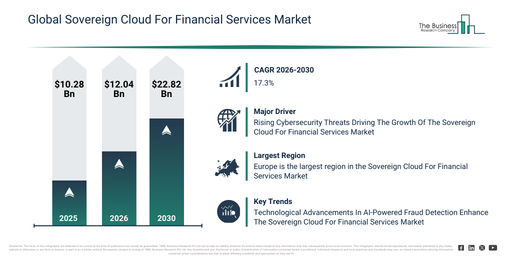
    The sovereign cloud for financial services market size has experienced rapid growth in recent years. Its value is projected to expand from $10.28 billion in 2025 to $12.04 billion in 2026, demonstrating a compound annual growth rate (CAGR) of 17.1%. The historical expansion of this market can be attributed to factors such as a rise in financial data regulations, an increase in cross-border data restrictions, a growth in cyber breach incidents, the expansion of digital banking platforms, and the early adoption of private cloud solutions within the BFSI sector.

    The sovereign cloud for financial services market size is projected for substantial expansion in the coming years. It will grow to $22.82 billion in 2030 at a compound annual growth rate (CAGR) of 17.3%. This projected growth is fueled by factors such as the tightening of national data residency laws, an escalating demand for compliant cloud migration, the expansion of digital payment infrastructure, an increase in regulatory audits within the finance sector, and greater investment in secure cloud stacks. Significant trends anticipated during this forecast period include the increasing adoption of regulated cloud environments, a rising need for in-country data hosting, the advancement of sovereign key management systems, the wider use of jurisdiction-locked cloud zones, and an elevated deployment of financial compliance cloud platforms.

    Get A Free Sample Report With In-Depth Market Insights:

    https://thebusinessresearchcompany.com/sample_request?id=59185996&type=smp&name=Sovereign%20Cloud%20For%20Financial%20Services%20Market%20Report%202026&utm_source=Blogs&utm_medium=Paid&utm_campaign=Oct_PR

    Sovereign Cloud For Financial Services Market Industry Drivers: What’s Behind The Revenue Growth?

    The increasing prevalence of cybersecurity threats is anticipated to fuel the expansion of the sovereign cloud for financial services market. Cybersecurity threats are defined as potential malicious acts or occurrences that exploit weaknesses in digital systems, networks, or data, leading to unauthorized entry, disruption, harm, or theft of information. This escalation in threats stems from the swift digitalization of banking activities and the emergence of ‘Shadow AI,’ which involves unauthorized artificial intelligence tools creating new vulnerabilities that conventional, non-sovereign cloud setups frequently struggle to protect. Sovereign cloud solutions assist financial institutions in confronting these issues by offering ‘security-by-design’ frameworks, encompassing localized encryption key management and physically isolated data areas. These features guarantee that vital financial records stay under domestic legal authority and are safeguarded from foreign legal interference. For example, in October 2025, the UK’s National Cyber Security Centre (NCSC), a UK government body, disclosed a substantial increase in nationally significant cyber incidents, with figures climbing from 89 in the year to August 2024 to 204 in the year to August 2025. Concurrently, the incidence of cyber breaches among major UK businesses stayed high at 74%. Consequently, the escalation in cybersecurity threats is stimulating the growth of the sovereign cloud for financial services market.

    Sovereign Cloud For Financial Services Market Segmentation And Category Overview

    The sovereign cloud for financial services market covered in this report is segmented –

    1) By Component: Software; Hardware; Services

    2) By Deployment Mode: Public Cloud; Private Cloud; Hybrid Cloud

    3) By Enterprise Size: Small And Medium Enterprises; Large Enterprises

    4) By Application: Core Banking; Risk And Compliance Management; Payment Processing; Data Storage And Management; Fraud Detection And Prevention; Other Applications

    5) By End-User: Banks; Insurance Companies; Investment Firms; Credit Unions; Other End-Users

    Subsegments:

    1) By Software: Data Residency Monitoring Software; Sovereign Compliance Management Platforms; Encryption And Key Management Software; Automated Regulatory Reporting Tools; Identity And Access Governance Software

    2) By Hardware: Localized Data Center Infrastructure; Sovereign Server And Storage Systems; Hardware Security Modules; Dedicated Network Security Appliances; Sovereign Graphics Processing Units

    3) By Services: Professional Consulting And Advisory Services; Sovereign Infrastructure Implementation Services; Managed Sovereignty And Security Services; Technical Training And Support Services; Sovereign Compliance Audit Services

    #Sovereign Cloud For Financial Services Market Growth Trends: What’s Shaping The Future Outlook?

    Leading companies active in the sovereign cloud for financial services market are concentrating on technological advancements, such as AI-powered fraud detection, to establish secure, compliant, and autonomous digital environments for regulated industries. AI-powered fraud detection refers to the integration of specialized machine learning models and generative AI agents into sovereign cloud architectures, aimed at identifying complex financial crimes like synthetic identity fraud and deepfake-driven phishing, while ensuring all sensitive transactional data remains within a specific national jurisdiction. For instance, in March 2025, Oracle, a U.S.-based technology company, introduced new agentic AI capabilities within its Oracle Investigation Hub Cloud Service to combat financial crime. These advanced AI agents automate labor-intensive investigations by adhering to predefined plans, gathering cross-silo evidence, and generating consistent, audit-ready narratives, which reduces human error and manual data collection. Through the adoption of these advanced AI-powered tools, companies like Oracle, Google, and Swift illustrate how sovereign-ready frameworks can transform global financial systems by enhancing regional trust and data security.

    Sovereign Cloud For Financial Services Market Competitive Landscape: Which Companies Lead The Industry?

    Major companies operating in the sovereign cloud for financial services market are Amazon Web Services (AWS), Microsoft Azure, Alibaba Cloud, T-Systems (Deutsche Telekom), Tencent Cloud, IBM Cloud, SUSE, Oracle Cloud, Google Cloud Platform (GCP), SAP SE, Salesforce Inc, Thales Group, Hewlett Packard Enterprise (HPE), Fujitsu, Infosys Limited, Capgemini SE, Atos SE, VMware, Orange Business Services, NTT Communications, Rackspace Technology, OVHcloud, ANS Group Sovereign Cloud, TierPoint, Aruba Cloud

    View The Full Sovereign Cloud For Financial Services Market Report:

    https://thebusinessresearchcompany.com/report/sovereign-cloud-for-financial-services-market-report?utm_source=Blogs&utm_medium=Paid&utm_campaign=Oct_PR

    Sovereign Cloud For Financial Services Market Regional Outlook: Where Is Opportunity Concentrated?

    Europe was the largest region in the sovereign cloud for financial services market in 2025. Asia-Pacific is expected to be the fastest-growing region in the forecast period. The regions covered in the sovereign cloud for financial services market report are Asia-Pacific, South East Asia, Western Europe, Eastern Europe, North America, South America, Middle East, Africa.

    Reach Out To Our Team:

    The Business Research Company: https://www.thebusinessresearchcompany.com/

    Americas: +1 310-496-7795

    Asia: +44 7882 955267 & +91 8897263534

    Europe: +44 7882 955267

    Email us at: marketing@tbrc.info

    Follow us on:

    LinkedIn: https://in.linkedin.com/company/the-business-research-company

    YouTube: https://www.youtube.com/channel/UC24_fI0rV8cR5DxlCpgmyFQ

    Global Market Model: https://www.thebusinessresearchcompany.com/global-market-model

  • Solid State Hydrogen Storage Materials Market Size Reaches $1.24 Billion In 2026: What Is Driving Growth?

    Solid State Hydrogen Storage Materials Market Size Reaches $1.24 Billion In 2026: What Is Driving Growth?

    Featuring market attractiveness scoring, total addressable market sizing, company benchmarking matrices, interactive Excel dashboards, deeper supply chain intelligence, emerging startup tracking, and granular product-level insights, The Business Research Company’s 2026 market reports are built to deliver research that is both more actionable and more strategically valuable.

    Solid State Hydrogen Storage Materials Market Size Forecast: How Big Could The Market Get By 2030?

    The solid state hydrogen storage materials market size has seen rapid expansion in recent years. It is projected to grow from $1.06 billion in 2025 to $1.24 billion in 2026, reflecting a compound annual growth rate (CAGR) of 16.1%. The growth witnessed in historical periods can be ascribed to hydrogen energy research programs, fuel cell development, material science advances, clean fuel initiatives, and pilot hydrogen storage projects.

    The solid state hydrogen storage materials market is projected to experience substantial expansion in the coming years, reaching a valuation of $2.26 billion by 2030, exhibiting a compound annual growth rate (CAGR) of 16.3%. This anticipated growth throughout the forecast period is driven by several factors, including the expansion of hydrogen mobility, increasing demand for long-duration energy storage, the development of green hydrogen infrastructure, funding for advanced material research and development, and the necessity for compact storage systems. Key developments expected within this period encompass innovations in metal hydride storage materials, the emergence of MOF-based hydrogen storage media, the utilization of high entropy alloy storage materials, advancements in low-temperature hydrogen absorption materials, and the creation of nanostructured porous storage solids.

    Get A Free Sample Report With In-Depth Market Insights:

    https://thebusinessresearchcompany.com/sample_request?id=11728712&type=smp&name=Solid%20State%20Hydrogen%20Storage%20Materials%20Market%20Report%202026&utm_source=Blogs&utm_medium=Paid&utm_campaign=Oct_PR

    Solid State Hydrogen Storage Materials Market Growth Factors: What’s Supporting Expansion?

    Growing investments in hydrogen infrastructure are anticipated to boost the solid state hydrogen storage materials market’s expansion. This investment encompasses allocating capital to systems for hydrogen production, storage, transport, and end-use, facilitating its widespread use as an energy carrier with low emissions. Such investment is increasing due to robust commitments from both government and private sectors towards achieving decarbonization and ensuring energy security. Consequently, the solid state hydrogen storage materials industry is experiencing higher demand, as the swift growth of hydrogen infrastructure prompts businesses to seek out safer, higher-density, and more efficient storage options for hydrogen. A notable example is found in 2024 data from the International Energy Agency (IEA), a France-based autonomous intergovernmental organization, which reported that capital expenditure on low-emissions hydrogen projects reached $4.3 billion in 2024, representing an 80% increase from 2023. Furthermore, based on recent final investment decisions, this spending is forecast to climb by over 80% in 2025, approaching $8 billion. Hence, the escalating investments in hydrogen infrastructure are fueling the expansion of the solid state hydrogen storage materials market.

    Solid State Hydrogen Storage Materials Market Segment Outlook: Which Categories Are Growing Fastest?

    The solid state hydrogen storage materials market covered in this report is segmented –

    1) By Material Type: Metal Hydrides; Chemical Hydrides; Complex Hydrides; Carbon Based Materials; Other Material Types

    2) By Storage Mechanism: Absorption; Adsorption

    3) By Operating Temperature: Low Temperature; Medium Temperature; High Temperature

    4) By Application: Automotive; Portable Power; Stationary Power; Aerospace; Other Applications

    Subsegments:

    1) By Metal Hydrides: Light Metal Hydrides; Transition Metal Hydrides; Intermetallic Hydrides; Rare Earth Metal Hydrides

    2) By Chemical Hydrides: Sodium Borohydride; Ammonia Borane; Lithium Aluminum Hydride; Potassium Hydride

    3) By Complex Hydrides: Alanates; Borohydrides; Amides; Imides

    4) By Carbon Based Materials: Activated Carbon; Carbon Nanotubes; Graphene; Carbon Nanofibers

    5) By Other Material Types: Metal Organic Frameworks; Covalent Organic Frameworks; Hybrid Composites; Porous Polymers

    Solid State Hydrogen Storage Materials Market Industry Trends: What’s Reshaping Demand?

    Leading companies in the solid state hydrogen storage material market are concentrating on developing innovative products, such as metal-organic framework (MOF)-based solid-state hydrogen storage materials. Their goal is to enhance hydrogen storage capacity, improve safety, and increase energy efficiency, thereby enabling compact and low-pressure hydrogen storage solutions for clean-energy and mobility applications. These MOF-based solid-state hydrogen storage materials are advanced porous crystalline structures that store hydrogen through physical adsorption on their ultra-high-surface-area internal structures. This approach yields a higher gravimetric storage density, improved reversibility, enhanced thermal stability, and safer low-pressure operation compared to conventional compressed or liquid hydrogen storage systems. For instance, in July 2024, H2MOF, a US-based advanced materials company, introduced a solid-state hydrogen storage material derived from Nobel-recognized metal-organic framework (MOF) technology. This newly launched material facilitates high-density hydrogen adsorption within its porous framework, providing a safer and lower-pressure alternative to traditional hydrogen tanks. It also offers improved storage efficiency, enhanced thermal stability, and better reversibility for repeated hydrogen charging and discharging cycles. The product is engineered to support decentralized renewable-energy storage, hydrogen mobility systems, and next-generation clean-energy infrastructure by delivering compact, lightweight, and scalable solid-state hydrogen storage solutions.

    Solid State Hydrogen Storage Materials Market Competitive Landscape: Who Leads The Industry?

    Major companies operating in the solid state hydrogen storage materials market are Mitsui Mining & Smelting Co. Ltd., Nippon Denko Co. Ltd., Ajax TOCCO Magnethermic Corp., Hydrogenious LOHC Technologies GmbH, American Elements Inc., GreenHy2 Limited, Alkali Metals Limited, Hydrexia Holding Limited, Harnyss LLC, Otto Chemie Pvt. Ltd., H2MOF Technology Limited, Jiangsu JITRI Advanced Energy Materials Research Institute Co. Ltd., Ergenics Corporation, Safe Hydrogen LLC, HYSTORSYS LLC, Plasma Kinetics LLC, GRZ Technologies Inc., H2Go Power Limited, Acme Process Systems Private Limited, and Methydor SRL.

    View The Full Solid State Hydrogen Storage Materials Market Report:

    https://thebusinessresearchcompany.com/report/solid-state-hydrogen-storage-materials-market-report?utm_source=Blogs&utm_medium=Paid&utm_campaign=Oct_PR

    Solid State Hydrogen Storage Materials Market Geographic Landscape: Which Region Leads Industry Growth?

    North America was the largest region in the solid state hydrogen storage materials market in 2025. Asia-Pacific is expected to be the fastest-growing region in the forecast period. The regions covered in the solid state hydrogen storage materials market report are Asia-Pacific, South East Asia, Western Europe, Eastern Europe, North America, South America, Middle East, Africa.

    Reach Out To Our Team:

    The Business Research Company: https://www.thebusinessresearchcompany.com/

    Americas: +1 310-496-7795

    Asia: +44 7882 955267 & +91 8897263534

    Europe: +44 7882 955267

    Email us at: marketing@tbrc.info

    Follow us on:

    LinkedIn: https://in.linkedin.com/company/the-business-research-company

    YouTube: https://www.youtube.com/channel/UC24_fI0rV8cR5DxlCpgmyFQ

    Global Market Model: https://www.thebusinessresearchcompany.com/global-market-model
  • Smart Grid Synchronization Market Size In 2026: Growth Outlook And Forecast Through 2030

    Smart Grid Synchronization Market Size In 2026: Growth Outlook And Forecast Through 2030

    Backed by market attractiveness analysis, total addressable market sizing, company benchmarking matrices, interactive Excel dashboards, wider supply chain intelligence, emerging startup coverage, and detailed product-level insights, The Business Research Company’s 2026 market reports are designed to offer research that is more actionable and strategically valuable than ever.

    Smart Grid Synchronization Market Growth Analysis: How Will Revenue Trend Over The Forecast Period?

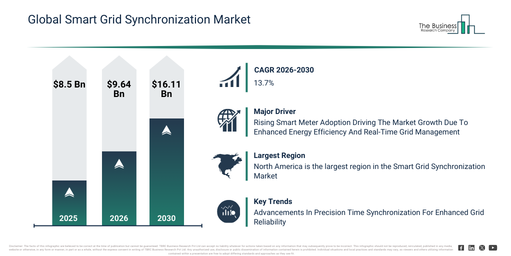
    The smart grid synchronization market has experienced significant expansion in recent times. Projections indicate its expansion from $8.5 billion in 2025 to $9.64 billion in 2026, demonstrating a compound annual growth rate (CAGR) of 13.4%. Historically, this growth stemmed from factors such as phasor measurement unit adoption, wide area monitoring systems, grid stability programs, transmission modernization, and initiatives focused on blackout prevention.

    The smart grid synchronization market is anticipated to experience substantial expansion in the forthcoming years. It is predicted to attain a size of $16.11 billion in 2030, driven by a compound annual growth rate (CAGR) of 13.7%. This projected growth stems from factors such as the management of renewable variability, increasing demand for microgrid synchronization, high penetration of distributed energy resources (DER), the necessity for real-time grid control, and the advancement of grid analytics. Prominent trends throughout this period encompass synchrophasor based grid coordination, the deployment of high precision time synchronization devices, dense PMU deployment networks, real-time phase angle monitoring, and automated grid frequency alignment.

    Get A Free Sample Report With In-Depth Market Insights:

    https://thebusinessresearchcompany.com/sample_request?id=33321&type=smp&name=Smart%20Grid%20Synchronization%20Market%20Report%202026&utm_source=Blogs&utm_medium=Paid&utm_campaign=Oct_PR

    Smart Grid Synchronization Market Growth Drivers: What’s Behind The Acceleration?

    The increasing integration of smart meters is anticipated to fuel expansion within the smart grid synchronization market. These electronic devices are designed to automatically measure and transmit real-time data on electricity, gas, or water consumption directly to utility providers, facilitating precise billing and effective energy management. Their growing prevalence stems from initiatives promoting energy efficiency, given that smart meters offer immediate usage insights, empowering consumers to cut down on consumption and enabling utilities to refine grid operations, thereby reducing expenses and ecological footprint. Crucially, Smart Grid Synchronization facilitates this by ensuring seamless communication between smart meters and the grid infrastructure, which in turn supports automated energy management systems, minimizes power interruptions, and enhances the efficiency of power distribution. As an illustration, figures from Gov.uk, a UK-based government body, indicate that in Q3 2025, major energy suppliers throughout Great Britain deployed a combined total of 680,000 smart and advanced meters, as reported in November 2025. Consequently, the expanding deployment of smart meters is a significant factor propelling the smart grid synchronization market’s growth.

    Smart Grid Synchronization Market Segments: Where Is Growth Concentrated?

    The smart grid synchronization market covered in this report is segmented –

    1) By Component: Hardware; Software; Services

    2) By Deployment: On-Premises; Cloud; Hybrid

    3) By Technology: Phasor Measurement Units; Synchrophasors; Digital Fault Recorders; Smart Meters; Other Technologies

    4) By Application: Transmission; Distribution; Generation; Other Applications

    5) By End-User: Utilities; Industrial; Commercial; Residential; Other End-Users

    Subsegments:

    1) By Hardware: Smart Meters; Sensors; Controllers; Communication Devices; Energy Storage Systems

    2) By Software: Grid Management Software; Data Analytics Platforms; Monitoring and Control Software; Predictive Maintenance Software; Energy Optimization Software

    3) By Services: Installation Services; Integration Services; Consulting Services; Maintenance Services; Training and Support Services

    Smart Grid Synchronization Market Trends: What’s Defining The Industry’s Next Phase?

    Leading companies in the smart grid synchronization market are prioritizing the development of inventive solutions, such as precision time synchronization technologies, to address the escalating need for improved grid reliability, interoperability, and resilient digital power infrastructure. Precision Time Synchronization technologies are defined as methods that accurately align clocks across devices or systems with microsecond or nanosecond precision, enabling coordinated operations within networks, industrial systems, and critical applications. For example, in December 2025, Siemens AG, a Germany-based industrial automation and power systems technology company, introduced the siprotec 5 precision time protocol (PTP) grandmaster clock (GMC), specifically designed to reinforce digital substations and critical grid infrastructure. The Siprotec 5 PTP GMC incorporates Precision Time Protocol (IEEE 1588v2) grandmaster capabilities alongside enhanced cybersecurity features, including strict separation of process bus and station bus networks and patent-pending seamless grandmaster changeover technology to maintain continuous synchronization without disruptive time jumps during clock transitions. This particular innovation facilitates resilient, fail-safe time coordination, which is vital for modern smart grids, enhances protection functions against disturbances, and strengthens overall grid reliability.

    Smart Grid Synchronization Market Key Players Shaping Industry Direction

    Major companies operating in the smart grid synchronization market are Siemens AG., Hitachi Energy Ltd., Cisco Systems Inc., Oracle Corporation, Schneider Electric SE, Honeywell International Inc., ABB Ltd., Eaton Corporation plc., Quanta Technology LLC, Prysmian Group, Emerson Electric Co., Fluence Energy Inc., Itron Inc., Schweitzer Engineering Laboratories Inc., Landis+Gyr Group AG., Bentley Systems Incorporated, Crompton Greaves, S&C Electric Company, Kamstrup A/S, ETAP, Toshiba Corporation, and General Electric Company.

    View The Full Smart Grid Synchronization Market Report:

    https://thebusinessresearchcompany.com/report/smart-grid-synchronization-market-report?utm_source=Blogs&utm_medium=Paid&utm_campaign=Oct_PR

    Smart Grid Synchronization Market Regional Analysis: Which Geography Leads On Revenue?

    North America was the largest region in the smart grid synchronization market in 2025. Asia-Pacific is expected to be the fastest-growing region in the forecast period. The regions covered in the smart grid synchronization market report are Asia-Pacific, South East Asia, Western Europe, Eastern Europe, North America, South America, Middle East, Africa.

    Reach Out To Our Team:

    The Business Research Company: https://www.thebusinessresearchcompany.com/

    Americas: +1 310-496-7795

    Asia: +44 7882 955267 & +91 8897263534

    Europe: +44 7882 955267

    Email us at: marketing@tbrc.info

    Follow us on:

    LinkedIn: https://in.linkedin.com/company/the-business-research-company

    YouTube: https://www.youtube.com/channel/UC24_fI0rV8cR5DxlCpgmyFQ

    Global Market Model: https://www.thebusinessresearchcompany.com/global-market-model
  • Smart Grid Network Management Market Trends Supporting 11.6% CAGR Growth Through 2030

    Smart Grid Network Management Market Trends Supporting 11.6% CAGR Growth Through 2030

    Featuring market attractiveness scoring, total addressable market sizing, company benchmarking matrices, interactive Excel dashboards, deeper supply chain intelligence, emerging startup tracking, and granular product-level insights, The Business Research Company’s 2026 market reports are built to deliver research that is both more actionable and more strategically valuable.

    Smart Grid Network Management Market Forecast: What Value Will The Market Reach By 2030?

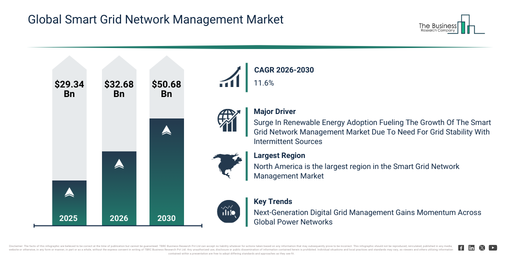
    The smart grid network management market has experienced substantial expansion in recent years. It is projected to increase from $29.34 billion in 2025 to $32.68 billion in 2026, exhibiting a compound annual growth rate (CAGR) of 11.4%. This historical growth can be ascribed to elements such as smart meter rollouts, grid automation programs, utility digitization initiatives, requirements for outage management, and the deployment of advanced metering infrastructure.

    The smart grid network management market is set to experience rapid expansion over the next few years. Its valuation is predicted to reach $50.68 billion in 2030, propelled by a compound annual growth rate (CAGR) of 11.6%. The expansion during the forecast period stems from factors such as the growth of distributed energy resources, the demand for grid edge intelligence, greater integration of renewable energy into the grid, increased cybersecurity investments within utilities, and the widespread adoption of real-time grid analytics. Prominent trends for this period include real-time grid data orchestration, AI-driven load balancing systems, secure grid communication platforms, cloud-based grid control centers, and integrated DER network management.

    Get A Free Sample Report With In-Depth Market Insights:

    https://thebusinessresearchcompany.com/sample_request?id=33320&type=smp&name=Smart%20Grid%20Network%20Management%20Market%20Report%202026&utm_source=Blogs&utm_medium=Paid&utm_campaign=Oct_PR

    Smart Grid Network Management Market Growth Factors Behind Sustained Expansion

    The increasing integration of renewable energy sources is projected to stimulate the growth of the smart grid network management market moving forward. Renewable energy sources refer to naturally replenishing resources such as solar, wind, hydropower, geothermal, and biomass, which generate electricity with minimal environmental impact. The heightened adoption of these sources is a result of global commitments to decarbonization and energy security, demonstrated by unprecedented capacity expansions. Smart grid network management supports the greater use of renewable energy sources by enabling real-time monitoring, forecasting, and balancing of their intermittent supply to uphold grid stability. For instance, in March 2024, according to the International Renewable Energy Agency (IRENA), a UAE-based intergovernmental agency, global renewable capacity in 2023 surged by a record 473 GW, a 13.9% increase over previous years, accounting for 86% of power additions, led by solar (346 GW) and wind (116 GW). Therefore, the expanding adoption of renewable energy sources is a key factor driving the growth of the smart grid network management market.

    Smart Grid Network Management Market Segment Analysis: What Are The Core Market Categories?

    The smart grid network management market covered in this report is segmented –

    1) By Component Type: Hardware; Software and Platforms; Services

    2) By Deployment Model: On-Premises; Cloud-Based

    3) By Solution Type: Network Management System; Data Management System; Advanced Metering Infrastructure; Security Management System

    4) By Application: Demand Response Management; Capacity Management; Asset Management; Distributed Energy Resource Management

    5) By End-User Type: Utilities; Industrial Enterprises; Commercial and Residential Customers; Government and Public Sector

    Subsegments:

    1) By Hardware: Smart Meters; Sensors and Internet of Things (IoT) Devices; Communication Gateways; Network Switches and Routers

    2) By Software and Platforms: Grid Management Platforms; Data Analytics and Visualization Software; Energy Management Software; Security and Cybersecurity Platforms

    3) By Services: Installation and Deployment Services; Monitoring and Maintenance Services; Consulting and Advisory Services; Training and Support Services

    Smart Grid Network Management Market Industry Trends Fueling Future Revenue Growth

    Leading companies operating within the smart grid network management market are focusing on creating innovative advancements, such as distributed energy management platforms, to enhance grid flexibility, resiliency, and net-zero integration. A distributed energy management platform functions as a centralized digital system that optimizes bidirectional energy flows and coordinates various distributed assets across the power network. For instance, in October 2024, Schneider Electric, a France-based energy management and automation company, announced improvements to its EcoStruxure Distributed Energy Resource Management System. This solution incorporates advanced analytics, artificial intelligence, and real-time grid visibility to manage distributed renewable assets with greater reliability and efficiency. Its deployment supports utilities in improving operational continuity, climate resilience, and data-driven decision-making across modern digital grids.

    Smart Grid Network Management Market Competitive Analysis Of Leading Industry Participants

    Major companies operating in the smart grid network management market are Siemens AG, Hitachi Energy, IBM Corporation, Cisco Systems Inc., Oracle Corporation, Schneider Electric SE, Mitsubishi Electric, Honeywell International Inc., GE Vernova (formerly GE Grid Solutions), ABB Ltd., Fujitsu Global, Eaton Corporation Plc, Emerson Electric, Itron Inc., Landis+Gyr, S&C Electric Company, Aclara Technologies (Hubbell), Kamstrup A/S, Stem Inc., Trilliant Holdings, Fluentgrid Limited, Tantalus Systems, Smarter Grid Solutions, Esyasoft Solutions

    View The Full Smart Grid Network Management Market Report:

    https://thebusinessresearchcompany.com/report/smart-grid-network-management-market-report?utm_source=Blogs&utm_medium=Paid&utm_campaign=Oct_PR

    Smart Grid Network Management Market Geographic Spread And Regional Opportunities

    North America was the largest region in the smart grid network management market in 2025. Asia-Pacific is expected to be the fastest-growing region in the forecast period. The regions covered in the smart grid network management market report are Asia-Pacific, South East Asia, Western Europe, Eastern Europe, North America, South America, Middle East, Africa.

    Reach Out To Our Team:

    The Business Research Company: https://www.thebusinessresearchcompany.com/

    Americas: +1 310-496-7795

    Asia: +44 7882 955267 & +91 8897263534

    Europe: +44 7882 955267

    Email us at: marketing@tbrc.info

    Follow us on:

    LinkedIn: https://in.linkedin.com/company/the-business-research-company

    YouTube: https://www.youtube.com/channel/UC24_fI0rV8cR5DxlCpgmyFQ

    Global Market Model: https://www.thebusinessresearchcompany.com/global-market-model
  • Smart Glasses Microdisplay Market Forecast Highlights A $5.48 Billion Opportunity For Industry Participants

    Smart Glasses Microdisplay Market Forecast Highlights A $5.48 Billion Opportunity For Industry Participants

    Built to provide research that’s more actionable and strategically valuable, The Business Research Company’s 2026 market reports include market attractiveness analysis, total addressable market sizing, company benchmarking matrices, interactive Excel dashboards, broader supply chain intelligence, emerging startup tracking, and in-depth product insights.

    Smart Glasses Microdisplay Market Size Outlook: How Quickly Will Revenue Expand Through 2030?

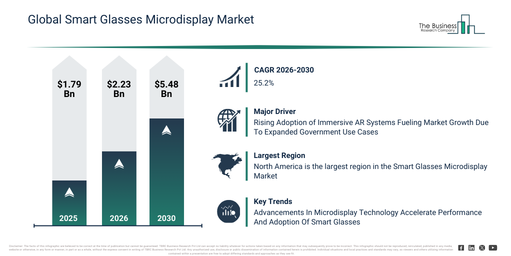
    The smart glasses microdisplay market has seen substantial growth in recent years. Its size is anticipated to expand from $1.79 billion in 2025 to $2.23 billion in 2026, achieving a compound annual growth rate (CAGR) of 24.9%. This historical growth can be attributed to several factors, including an increase in AR wearable devices, the initial introduction of smart glasses, the shrinking size of display components, the need for defense head-mounted displays, and enterprise wearable pilot programs.

    The smart glasses microdisplay market size is anticipated to undergo significant expansion in the upcoming years, reaching $5.48 billion by 2030 with a robust compound annual growth rate (CAGR) of 25.2%. This projected growth is attributable to various factors including the increased adoption of consumer AR glasses, the prevalence of enterprise field service wearables, advancements in microled commercialization, a rising demand for immersive interfaces, and innovations in lightweight optics. Key trends influencing the market during this forecast period involve ultra high brightness microdisplays, display engines with low power consumption, waveguide optimized microdisplay modules, smart glass displays incorporating microled technology, and the integration of compact optical engines.

    Get A Free Sample Report With In-Depth Market Insights:

    https://thebusinessresearchcompany.com/sample_request?id=43878093&type=smp&name=Smart%20Glasses%20Microdisplay%20Market%20Report%202026&utm_source=Blogs&utm_medium=Paid&utm_campaign=Oct_PR

    Smart Glasses Microdisplay Market Demand Drivers Opening New Revenue Streams

    Increased implementation of immersive AR systems is projected to fuel the expansion of the smart glasses microdisplay market in the future. These immersive AR technologies involve light, head-mounted devices which superimpose digital information onto the real world, allowing for hands-free viewing and engagement in various training and operational contexts. The uptake of immersive AR systems is rising, driven by their broader application in public sector training and operational processes, which aligns with the growing needs of the wider metaverse and wearable technology landscape. Smart-glasses microdisplays provide clear digital images right into the user’s field of vision, smoothly integrating virtual elements with the actual surroundings. Their excellent brightness and minimal latency facilitate precise object positioning, thereby boosting the realism and immersive quality of AR experiences. For example, data from August 2024, sourced from the United States Government Accountability Office (GAO), a US federal agency, indicated that 17 of 23 U.S. federal civilian agencies engaged in immersive technology activities (including AR and VR) during fiscal years 2022–2023. Furthermore, 16 agencies intend to broaden their usage until 2028, underscoring increasing governmental dependence on wearable AR systems for practical applications. Consequently, the increasing embrace of immersive AR technologies is propelling the growth of the smart glasses microdisplay market.

    Smart Glasses Microdisplay Market Segment Breakdown: Which Categories Lead On Revenue?

    The smart glasses microdisplay market covered in this report is segmented –

    1) By Display Technology: Organic Light-Emitting Diode (OLED); Liquid Crystal Display (LCD); Liquid Crystal On Silicon (LCoS); Digital Light Processing (DLP); Micro Light-Emitting Diode (MicroLED); Other Display Technologies

    2) By Application: Consumer Electronics; Healthcare; Industrial; Military And Defense; Sports And Fitness; Other Applications

    3) By Distribution Channel: Online; Offline

    4) By End-User: Enterprises; Individuals; Other End-Users

    Subsegments:

    1) By Organic Light-Emitting Diode (OLED): Active Matrix; Passive Matrix

    2) By Liquid Crystal Display (LCD): Twisted Nematic; In-Plane Switching; Advanced Fringe Field Switching

    3) By Liquid Crystal On Silicon (LCoS): Ferroelectric; Nematic

    4) By Digital Light Processing (DLP): Single Panel; Three Panel

    5) By Micro Light-Emitting Diode (MicroLED): Direct View; Quantum Dot Enhanced

    6) By Other Display Technologies: Laser Beam Scanning; Virtual Retinal Display; Electrowetting Display

    Smart Glasses Microdisplay Market Trends Powering Strategic Industry Growth

    Companies operating in the smart glasses microdisplay market are concentrating on developing sophisticated display solutions, such as ultra-low-power single-chip full-color microdisplay panels. This effort aims to enhance visual performance, decrease power consumption, and reduce both manufacturing complexity and costs. Ultra-low-power single-chip microdisplay panels represent integrated display technologies that consolidate the display array, driver circuitry, and memory into a single compact chip. This integration enables higher resolution and wider fields of view, while minimizing energy usage and simplifying system integration for smart glasses manufacturers. For instance, in December 2025, OmniVision, a US-based semiconductor and imaging technology company, introduced the OP03021 liquid crystal on silicon (LCOS) microdisplay panel, an industry-leading single-chip solution. This panel provides a resolution of 1632 × 1536 at a 90 Hz refresh rate within a compact 0.26-inch optical format. It integrates the display array, driver, and memory on a single die, supporting advanced smart glasses designs by improving image quality and field of view while lowering power consumption and overall component costs.

    Smart Glasses Microdisplay Market Leading Companies And Competitive Benchmarking

    Major companies operating in the smart glasses microdisplay market are Hon HAI Precision Industry Co. Ltd., Sony Group Corporation, LG Corporation, BOE Technology Group Co. Ltd., Texas Instruments Incorporated, Goertek Inc., Seiko Epson Corporation, Innolux Corporation, Samsung Display Co. Ltd., MicroOLED S.A., OMNIVISION Technologies Inc., Magic Leap Inc., Himax Technologies Inc., Jade Bird Display, SeeYA Technology Co. Ltd., Kopin Corporation, FRAMOS GmbH, MICLEDI Microdisplays B.V., RAONTECH Inc., MicroVision Inc., and Vuzix Corporation.

    View The Full Smart Glasses Microdisplay Market Report:

    https://thebusinessresearchcompany.com/report/smart-glasses-microdisplay-market-report?utm_source=Blogs&utm_medium=Paid&utm_campaign=Oct_PR

    Smart Glasses Microdisplay Market Top Region By Revenue And Market Share

    North America was the largest region in the smart glasses microdisplay market in 2025. Asia-Pacific is expected to be the fastest-growing region in the forecast period. The regions covered in the smart glasses microdisplay market report are Asia-Pacific, South East Asia, Western Europe, Eastern Europe, North America, South America, Middle East, Africa.

    Reach Out To Our Team:

    The Business Research Company: https://www.thebusinessresearchcompany.com/

    Americas: +1 310-496-7795

    Asia: +44 7882 955267 & +91 8897263534

    Europe: +44 7882 955267

    Email us at: marketing@tbrc.info

    Follow us on:

    LinkedIn: https://in.linkedin.com/company/the-business-research-company

    YouTube: https://www.youtube.com/channel/UC24_fI0rV8cR5DxlCpgmyFQ

    Global Market Model: https://www.thebusinessresearchcompany.com/global-market-model
  • Single-Modal Affective Computing Market Growth Outlook: Why Analysts Expect Continued Expansion

    Single-Modal Affective Computing Market Growth Outlook: Why Analysts Expect Continued Expansion

    Backed by market attractiveness analysis, total addressable market sizing, company benchmarking matrices, interactive Excel dashboards, wider supply chain intelligence, emerging startup coverage, and detailed product-level insights, The Business Research Company’s 2026 market reports are designed to offer research that is more actionable and strategically valuable than ever.

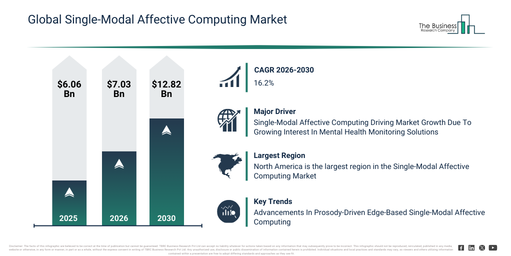
    Single-Modal Affective Computing Market Forecast: Value Set To Climb From $7.03 Billion To $12.82 Billion

    The single-modal affective computing market has seen substantial growth in recent years. It is anticipated to expand from $6.06 billion in 2025 to $7.03 billion in 2026, at a compound annual growth rate (CAGR) of 16.0%. The expansion observed in the past can be attributed to several factors, including the increase in human-computer interaction research, the rise of AI-based analytics, the broadening of digital customer experience tools, the greater adoption of voice assistants, and the demand for sentiment analysis.

    The single-modal affective computing market is projected for significant expansion in the coming years. Its valuation is anticipated to reach $12.82 billion by 2030, exhibiting a compound annual growth rate (CAGR) of 16.2%. This projected expansion stems from factors such as its application in mental health screening, increased presence in smart devices, growing deployment in customer service automation, the development of emotion-aware interfaces, and its incorporation into interactive media systems. Key developments expected during this timeframe encompass voice-based emotion recognition engines, software for analyzing facial expressions, platforms for detecting text sentiment, tools for real-time emotion monitoring, and edge-based affective AI processing.

    Get A Free Sample Report With In-Depth Market Insights:

    https://thebusinessresearchcompany.com/sample_request?id=97492452&type=smp&name=Single-Modal%20Affective%20Computing%20Market%20Report%202026&utm_source=Blogs&utm_medium=Paid&utm_campaign=Oct_PR

    Single-Modal Affective Computing Market Growth Momentum: What Factors Are Shaping Demand?

    The rising demand for mental health monitoring solutions is projected to fuel the expansion of the single-modal affective computing market moving forward. These solutions involve technologies and systems that observe psychological well-being by gathering and analyzing data, aiding in the early detection of mental health issues. The increasing prevalence of mental health monitoring solutions is driven by individuals seeking greater understanding and improved management of their mental well-being. Single-modal affective computing supports mental health monitoring solutions by enabling the identification of emotional states using a single data type for monitoring mental well-being, thereby assisting in mental health assessment and tracking. For instance, in January 2024, a survey published in the Journal of Medical Internet Research, a Canada-based peer-reviewed open-access journal, reported that patients with mental health conditions indicated using or being prepared to use digital self-monitoring tools in 2024, an increase compared to around 66% in 2023, demonstrating a clear surge in patient interest and acceptance as technology and provider adoption expanded. Thus, the growing interest in mental health monitoring solutions is driving the growth of the single-modal affective computing market.

    Single-Modal Affective Computing Market Segment Performance And Emerging Opportunities

    The single-modal affective computing market covered in this report is segmented –

    1) By Component: Hardware; Software

    2) By Technology: Facial Recognition; Voice Recognition; Gesture Recognition; Textual Emotion Analysis

    3) By Application: Healthcare; Education; Gaming; Automotive; Retail

    4) By End-User: Individual Consumers; Enterprises

    Subsegments:

    1) By Hardware: Cameras; Microphones; Physiological Sensors; Wearable Devices; Processing Units

    2) By Software: Emotion Recognition Software; Facial Expression Analysis Software; Speech And Voice Analysis Software; Text Sentiment Analysis Software; Data Analytics And Visualization Software

    Single-Modal Affective Computing Market Trends Redefining Industry Growth

    Major companies operating in the single-modal affective computing market are concentrating on innovations in wearable and edge-based devices for real-time emotion monitoring, specifically through methods like prosody-driven emotion recognition. This strategy is aimed at gaining competitive differentiation via low-latency inference, privacy-preserving deployment, and more natural human–AI interactions. Prosody-driven emotion recognition refers to the process of identifying and interpreting human emotional states by analyzing only vocal characteristics, rather than the spoken words themselves. For instance, in April 2023, Hume AI, a US-based company, introduced Hume’s Empathic Voice Interface (EVI) API. Hume’s Empathic Voice Interface (EVI) API provides a real-time, voice-only affective computing platform that facilitates emotionally intelligent conversations by analyzing users’ vocal prosody, encompassing tone, rhythm, and timbre. It leverages an empathic large language model (eLLM) to detect emotional cues and respond with contextually appropriate timing, language, and vocal expression. The API supports low-latency, bidirectional audio streaming, allowing for natural turn-taking and seamless interruption handling. By dynamically modulating its own speech characteristics, EVI produces responses that sound attentive, empathetic, and human-like.

    Single-Modal Affective Computing Market Leading Players And Competitive Positioning

    Major companies operating in the single-modal affective computing market are Cogito Health Analytics Ltd., Empatica Inc., Noldus Information Technology B.V., Hume AI Inc., Beyond Verbal Ltd., iMotions A/S, VoiceSense Ltd., Realeyes Limited, Sentiance NV, Paravision Inc., Aural Analytics Inc., NVISO AG, Eyeris Technologies Inc., Ellipsis Health Inc., Behavioural Signals Ltd., Sonde Health Inc., BioBeats Ltd., Emteq Labs Ltd., Emoshape Ltd., Wluper Ltd., Vocalis Health Ltd., CrowdEmotion Ltd., and AffectLab Ltd.

    View The Full Single-Modal Affective Computing Market Report:

    https://thebusinessresearchcompany.com/report/single-modal-affective-computing-market-report?utm_source=Blogs&utm_medium=Paid&utm_campaign=Oct_PR

    Single-Modal Affective Computing Market Regional Split: Which Areas Are Fueling Growth?

    North America was the largest region in the single-modal affective computing market in 2025. Asia-Pacific is expected to be the fastest-growing region in the forecast period. The regions covered in the single-modal affective computing market report are Asia-Pacific, South East Asia, Western Europe, Eastern Europe, North America, South America, Middle East, Africa.

    Reach Out To Our Team:

    The Business Research Company: https://www.thebusinessresearchcompany.com/

    Americas: +1 310-496-7795

    Asia: +44 7882 955267 & +91 8897263534

    Europe: +44 7882 955267

    Email us at: marketing@tbrc.info

    Follow us on:

    LinkedIn: https://in.linkedin.com/company/the-business-research-company

    YouTube: https://www.youtube.com/channel/UC24_fI0rV8cR5DxlCpgmyFQ

    Global Market Model: https://www.thebusinessresearchcompany.com/global-market-model
  • Single Use Plastic Market Forecast Insights: The Road To $62.71 Billion By 2030

    Single Use Plastic Market Forecast Insights: The Road To $62.71 Billion By 2030

    Featuring market attractiveness scoring, total addressable market sizing, company benchmarking matrices, interactive Excel dashboards, deeper supply chain intelligence, emerging startup tracking, and granular product-level insights, The Business Research Company’s 2026 market reports are built to deliver research that is both more actionable and more strategically valuable.

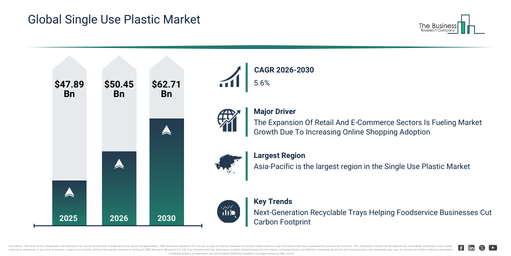
    Single Use Plastic Market Revenue Growth On Track For A 5.6% CAGR Through 2030

    The single use plastic market size has experienced significant growth in recent years. Its expansion is anticipated, moving from $47.89 billion in 2025 to $50.45 billion in 2026, at a compound annual growth rate (CAGR) of 5.3%. The historical period’s growth can be linked to the increased demand for convenience foods, the proliferation of takeaway culture, the availability of low-cost packaging, rapid urbanization, and a surge in retail packaged goods.

    The single use plastic market is projected to experience substantial expansion in the coming years. It is set to reach $62.71 billion in 2030, exhibiting a compound annual growth rate (CAGR) of 5.6%. This anticipated growth during the forecast period stems from factors such as a move towards recyclable disposable items, the expansion of food delivery services, an increasing need for sanitary packaging, the proliferation of e-commerce shipping, and advancements in bio-based plastics. Key developments expected during this period involve lightweight designs for disposable packaging, the creation of compostable plastic blends, plastic packaging integrated with smart labels, automated high-speed production of plastics, and packaging systems for traceable supply chains.

    Get A Free Sample Report With In-Depth Market Insights:

    https://thebusinessresearchcompany.com/sample_request?id=33314&type=smp&name=Single%20Use%20Plastic%20Market%20Report%202026&utm_source=Blogs&utm_medium=Paid&utm_campaign=Oct_PR

    Single Use Plastic Market Expansion Drivers: What’s Shaping Future Growth?

    The expansion of the retail and e-commerce sectors is projected to drive the growth of the single-use plastic market going forward. These sectors encompass industries that sell goods directly to consumers through physical stores and online platforms. Their growth is primarily fueled by increasing internet access, which allows more consumers to shop online and enables businesses to reach a wider audience via digital channels. Single-use plastics are widely adopted in the retail and e-commerce sectors because they provide lightweight, durable, and cost-effective packaging solutions that safeguard products during storage and transportation, improve logistics efficiency, prolong shelf life, and facilitate fast, safe, and convenient delivery to consumers. Even with increasing sustainability initiatives, the swift growth in e-commerce order volumes continues to stimulate demand for protective packaging materials, including single-use plastics. For instance, in February 2024, the United States Census Bureau, a US-based federal statistical agency, estimated total e-commerce sales at $1,118.7 billion in 2023, representing a 7.6% increase (±1.2%). Consequently, the expansion of the retail and e-commerce sectors, especially e-commerce-driven growth, is a key factor in the growth of the single-use plastic market.

    Single Use Plastic Market Segment Landscape And Growth Outlook

    The single use plastic market covered in this report is segmented –

    1) By Product Type: Bags And Sacks; Bottles; Containers; Straws And Stirrers; Packaging; Other Product Types

    2) By Material Type: Polyethylene (PE); Polypropylene (PP); Polyethylene Terephthalate (PET); Polystyrene (PS); Other Material Types

    3) By Application: Packaging; Beverage Containers; Food Service; Healthcare; Retail; Other Applications

    4) By End-User Industry: Food And Beverage; Retail And Consumer Goods; Healthcare; Manufacturing; Other End-Users

    Subsegments:

    1) By Bags And Sacks: Plastic Shopping Bags; Grocery Bags; Garbage Bags; Zip Lock Bags; Mailing Bags

    2) By Bottles: Water Bottles; Soft Drink Bottles; Juice Bottles; Milk Bottles; Other Beverage Bottles

    3) By Containers: Food Containers; Takeaway Containers; Storage Containers; Industrial Containers; Other Plastic Containers

    4) By Straws And Stirrers: Plastic Drinking Straws; Cocktail Stirrers; Coffee Stirrers; Juice Straws; Other Plastic Straws

    5) By Packaging: Plastic Films; Shrink Wraps; Pouches; Plastic Wraps; Other Packaging Materials

    6) By Other Product Types: Plastic Cutlery; Plastic Plates; Plastic Cups; Plastic Trays; Specialty Disposable Plastics

    Single Use Plastic Market Strategic Trends: What Defines The Next Growth Phase?

    Major companies operating in the single use plastic market are concentrating on developing innovative solutions, such as recyclable expanded polypropylene (EPP) packaging, to lessen environmental impact and comply with plastic bans. Recyclable expanded polypropylene (EPP) packaging is a lightweight, durable, and fully recyclable plastic material that aids in reducing single-use plastic waste, decreasing carbon footprint, and safely preserving food for delivery and storage. For instance, in May 2023, Seal Packaging, a UK-based packaging company, introduced Infinity TopSeal, an inventive recyclable tray solution for food service and delivery, constructed from expanded polypropylene (EPP) with a heat-sealable polypropylene film lid. This product is designed to be microwavable, lightweight, and entirely recyclable, while additionally offering tamper-evidence and assisting in the reduction of food waste through hygienic portioning and storage. This launch underscores the industry’s progression towards sustainable alternatives to conventional single-use plastics and aligns with upcoming EPS bans in the UK.

    Single Use Plastic Market Competitive Overview And Top Companies

    Major companies operating in the single use plastic market are Sinopec Group, ExxonMobil Corporation, TotalEnergies SE, BASF SE, Dow Inc., Saudi Basic Industries Corporation (SABIC), INEOS Group, Indorama Ventures Public Company Limited, Braskem S.A., Amcor plc, Graphic Packaging International LLC, Mondi Group, Sonoco Products Company, Silgan Holdings Inc., ALPLA Werke Alwin Lehner GmbH & Co. KG, Chevron Phillips Chemical Company LLC, Huhtamaki Oyj, Reynolds Consumer Products LLC, Dart Container Corporation, Novolex Holdings LLC, Borealis AG, Plastipak Holdings Inc., Winpak Ltd.

    View The Full Single Use Plastic Market Report:

    https://thebusinessresearchcompany.com/report/single-use-plastic-market-report?utm_source=Blogs&utm_medium=Paid&utm_campaign=Oct_PR

    Single Use Plastic Market Top Region: Where Does Most Revenue Come From?

    Asia-Pacific was the largest region in the single use plastic market in 2025, and is expected to be the fastest-growing region in the forecast period. The regions covered in the single use plastic market report are Asia-Pacific, South East Asia, Western Europe, Eastern Europe, North America, South America, Middle East, Africa.

    Reach Out To Our Team:

    The Business Research Company: https://www.thebusinessresearchcompany.com/

    Americas: +1 310-496-7795

    Asia: +44 7882 955267 & +91 8897263534

    Europe: +44 7882 955267

    Email us at: marketing@tbrc.info

    Follow us on:

    LinkedIn: https://in.linkedin.com/company/the-business-research-company

    YouTube: https://www.youtube.com/channel/UC24_fI0rV8cR5DxlCpgmyFQ

    Global Market Model: https://www.thebusinessresearchcompany.com/global-market-model
  • SEPP Interconnect Security Market Explained: What Is Fueling Growth To $3.75 Billion By 2030?

    SEPP Interconnect Security Market Explained: What Is Fueling Growth To $3.75 Billion By 2030?

    Built to provide research that’s more actionable and strategically valuable, The Business Research Company’s 2026 market reports include market attractiveness analysis, total addressable market sizing, company benchmarking matrices, interactive Excel dashboards, broader supply chain intelligence, emerging startup tracking, and in-depth product insights.

    SEPP Interconnect Security Market Value Growth And Long-Term Outlook

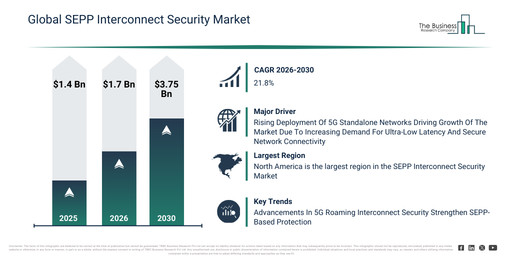
    The sepp interconnect security market has seen substantial expansion in recent years. This market is projected to expand from $1.4 billion in 2025 to $1.7 billion in 2026, exhibiting a compound annual growth rate (CAGR) of 21.6%. Historically, this growth has stemmed from increased mobile data traffic, the spread of LTE roaming networks, escalating inter operator signaling risks, documented telecom fraud incidents, and a rise in cross-border network links.

    The sepp interconnect security market size is projected to experience substantial expansion in the coming years. This market is anticipated to reach $3.75 billion in 2030, progressing at a compound annual growth rate (CAGR) of 21.8%. This expansion during the projection period stems from factors such as the global rollout of 5G standalone networks, an increase in data exchange between operators, more stringent telecom security regulations, growing complexity within edge networks, and a heightened need for secure roaming frameworks. Key trends anticipated for this forecast span 5G interconnect security gateways, encrypted roaming data exchange, policy-driven security solutions for inter-operator communication, real-time monitoring of interconnect threats, and software-defined edge security platforms.

    Get A Free Sample Report With In-Depth Market Insights:

    https://thebusinessresearchcompany.com/sample_request?id=22474746&type=smp&name=SEPP%20Interconnect%20Security%20Market%20Report%202026&utm_source=Blogs&utm_medium=Paid&utm_campaign=Oct_PR

    SEPP Interconnect Security Market Development Factors: What’s Supporting Demand?

    The increasing implementation of 5G standalone networks is anticipated to stimulate expansion within the security edge protection proxy (SEPP) interconnect security market in the future. Such a network represents a completely self-contained 5G architecture, leveraging a 5G core to provide comprehensive 5G services without dependence on current 4G infrastructure, thereby allowing for ultra-low latency, network slicing, and sophisticated 5G functionalities. The uptake of 5G standalone networks is on the rise, driven by increasing needs for ultra-low latency and cutting-edge applications, including autonomous systems, smart cities, and industrial automation. The security edge protection proxy (SEPP) interconnect security facilitates the rollout of 5G standalone networks through guaranteeing secure signaling, safeguarding data transfers across networks, and enabling reliable connectivity between operators. For example, in December 2024, data from the Office of Communications (Ofcom), the independent UK regulator for communications services, showed that UK telecom providers boosted their operational 5G standalone sites from approximately 2,000 in 2023 to around 3,300 in 2024. This indicates strong annual growth in the national deployment of standalone networks. Consequently, the expanding deployment of 5G standalone networks is fueling the growth of the security edge protection proxy (SEPP) interconnect security market.

    SEPP Interconnect Security Market Breakdown By Product Type And Application

    The sepp interconnect security market covered in this report is segmented –

    1) By Component: Software; Hardware; Services

    2) By Deployment Mode: On-Premises; Cloud

    3) By Organization Size: Small And Medium Enterprises; Large Enterprises

    4) By End-User: Telecom Operators; Enterprises; Managed Service Providers; Other End-Users

    Subsegments:

    1) By Software: Security Management Platforms; Identity And Access Management (IAM) Software; Network Monitoring And Analytics Tools; Threat Detection And Response Software; Policy Enforcement And Compliance Tools

    2) By Hardware: Secure Network Gateways; Authentication Devices; Encryption Appliances; Secure Communication Modules; Network Firewalls

    3) By Services: Installation And Integration Services; Managed Security Services; Monitoring And Incident Response Services; Consulting And Risk Assessment Services; Maintenance And Support Services

    SEPP Interconnect Security Market Transformation Trends: What Innovations Are Driving Change?

    Leading companies operating in the SEPP interconnect security market are prioritizing the development of advanced 5G roaming-based security updates to ensure secure, standards-compliant cross-network communication. These 5G roaming-based security updates are dynamic measures activated when users or devices access external 5G networks during roaming, ensuring data protection and network safety by continuously refreshing authentication, monitoring threats, and enforcing security policies across both home and visited networks. For instance, in March 2025, IPLOOK Technologies Co., Ltd., a Hong Kong-based telecom solutions provider, introduced an enhanced Security Edge Protection Proxy (SEPP) solution. This upgrade featured improved N32 interface performance, optimized TLS handshake processes for quicker cross-operator connections, dual routing strategies for complex roaming scenarios, and threat defense capabilities like intelligent topology hiding and anomaly detection, all consistent with 3GPP Release 17 standards to facilitate secure and efficient interconnect signaling in 5G roaming architectures. This product’s scalable design supports up to 200,000 transactions per second in clustered deployments and assists operators in reducing security operation costs while maintaining compliance across interfaces such as N8, N12, N14, N16, and N27.

    SEPP Interconnect Security Market Competitive Landscape: Which Companies Lead The Industry?

    Major companies operating in the sepp interconnect security market are Deutsche Telekom AG, Huawei Technologies Co Ltd, Cisco Systems Inc, Oracle Corporation, Ericsson AB, Nokia Corporation, ZTE Corporation, Palo Alto Networks Inc., Amdocs Limited, F5 Inc, Mavenir Systems Inc, Ribbon Communications Inc, Mobileum Inc, Belgacom International Carrier Services SA, iBASIS Inc, Enea AB, IPLOOK Network Co Ltd, teleSys Communications Inc, Cumucore Oy, BroadForward BV, TOMIA sro, and Nomios Group BV.

    View The Full SEPP Interconnect Security Market Report:

    https://thebusinessresearchcompany.com/report/sepp-interconnect-security-market-report?utm_source=Blogs&utm_medium=Paid&utm_campaign=Oct_PR

    SEPP Interconnect Security Market Regional Breakdown: Where Is Demand Concentrated?

    North America was the largest region in the security edge protection proxy (SEPP) interconnect security market in 2025. Asia-Pacific is expected to be the fastest-growing region in the forecast period. The regions covered in the sepp interconnect security market report are Asia-Pacific, South East Asia, Western Europe, Eastern Europe, North America, South America, Middle East, Africa.

    Reach Out To Our Team:

    The Business Research Company: https://www.thebusinessresearchcompany.com/

    Americas: +1 310-496-7795

    Asia: +44 7882 955267 & +91 8897263534

    Europe: +44 7882 955267

    Email us at: marketing@tbrc.info

    Follow us on:

    LinkedIn: https://in.linkedin.com/company/the-business-research-company

    YouTube: https://www.youtube.com/channel/UC24_fI0rV8cR5DxlCpgmyFQ

    Global Market Model: https://www.thebusinessresearchcompany.com/global-market-model
  • Self Healing Smart Grid Market Forecast To Reach $16.48 Billion By 2030: Key Trends Explained

    Self Healing Smart Grid Market Forecast To Reach $16.48 Billion By 2030: Key Trends Explained

    Backed by market attractiveness analysis, total addressable market sizing, company benchmarking matrices, interactive Excel dashboards, wider supply chain intelligence, emerging startup coverage, and detailed product-level insights, The Business Research Company’s 2026 market reports are designed to offer research that is more actionable and strategically valuable than ever.

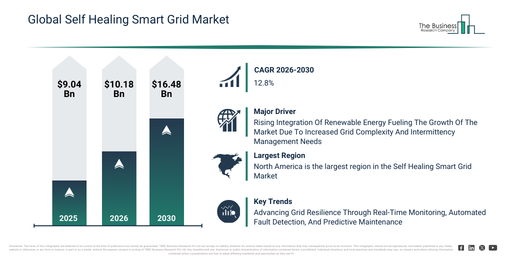
    Self Healing Smart Grid Market Poised To Hit $16.48 Billion By 2030 With A 12.8% CAGR

    The self healing smart grid market has seen rapid expansion in recent years. Its valuation is expected to rise from $9.04 billion in 2025 to $10.18 billion in 2026, exhibiting a compound annual growth rate (CAGR) of 12.6%. This historical growth can be attributed to an increase in grid outage incidents, the spread of smart meter programs, past grid modernization initiatives, growing electricity demand, and regulatory reliability standards.

    The self healing smart grid market is anticipated to experience swift expansion in the coming years. It is projected to reach $16.48 billion in 2030, growing at a compound annual growth rate (CAGR) of 12.8%. This growth over the forecast period is primarily driven by the increasing presence of distributed energy resources, rising integration of renewable energy into grids, enhanced investment in grid resilience, the expansion of digital substations, and growing utility automation budgets. Key trends expected during this period include automated fault isolation systems, advanced distribution automation deployment, predictive grid maintenance platforms, integrated outage management solutions, and real time grid monitoring networks.

    Get A Free Sample Report With In-Depth Market Insights:

    https://thebusinessresearchcompany.com/sample_request?id=33312&type=smp&name=Self%20Healing%20Smart%20Grid%20Market%20Report%202026&utm_source=Blogs&utm_medium=Paid&utm_campaign=Oct_PR

    Self Healing Smart Grid Market Industry Drivers: What’s Behind The Revenue Growth?

    The future expansion of the self-healing smart grid market is anticipated to be driven by the rising incorporation of renewable energy sources. These sources encompass naturally regenerating forms of energy such as solar, wind, hydro, biomass, and geothermal, which produce electricity and power without consuming finite resources. The prevalence of renewable energy is escalating, spurred by robust governmental policies and encouragement to mitigate carbon emissions and foster the uptake of clean energy. Self-healing smart grids facilitate renewable energy integration through dynamic load balancing, effective management of intermittent source variations, and optimized energy distribution to ensure stable power quality and operational efficiency. A notable example is provided by the International Energy Agency, a France-based intergovernmental organization, which reported in January 2024 that global renewable energy capacity additions saw a significant rise of 50% in 2023, totaling almost 510 gigawatts (GW), with solar PV accounting for approximately three-quarters of all new global installations. Consequently, the expanding incorporation of renewable energy sources is acting as a catalyst for the growth of the self-healing smart grid market.

    Self Healing Smart Grid Market Segment Analysis And Revenue Potential

    The self healing smart grid market covered in this report is segmented –

    1) By Component: Hardware; Software; Services

    2) By Deployment Model: On-Premises; Cloud-Based

    3) By Technology: Distributed Generation; Demand Response; Advanced Metering Infrastructure; Other Technologies

    4) By Application: Transmission; Distribution; Substation Automation; Other Applications

    5) By End-User: Utilities; Industrial; Commercial; Residential

    Subsegments:

    1) By Hardware: Smart Sensors; Automated Reclosers; Intelligent Electronic Devices; Fault Circuit Indicators; Smart Meters

    2) By Software: Advanced Distribution Management Systems; Outage Management Systems; Predictive Analytics Platforms; Fault Location, Isolation and Service Restoration Software; Grid Optimization Software

    3) By Services: System Integration and Deployment; Consulting Services; Support and Maintenance Services; Training and Education Services; Monitoring and Remote Management Services

    #Self Healing Smart Grid Market Growth Trends: What’s Shaping The Future Outlook?

    Major companies operating in the self-healing smart grid market are prioritizing the development of innovative solutions, such as digital grid management platforms, to boost grid reliability, enable instantaneous fault detection, support proactive maintenance, and improve automated recovery for more resilient and efficient power systems. A digital grid management platform is an intelligent software system that collects and analyzes data from the power grid to automate decision-making, optimize energy distribution, integrate renewable sources, and ensure uninterrupted, self-healing grid operations. For instance, in February 2024, Siemens AG, a Germany-based technology company, introduced Gridscale X to strengthen grid resilience by providing real-time monitoring, automated fault detection, and swift self-healing functionalities. This solution employs advanced artificial intelligence, machine learning, and real-time analytics to continuously observe grid conditions, anticipate potential faults, and automatically initiate corrective actions like reconfiguration and load balancing without human intervention. Its open and interoperable architecture supports seamless integration with distributed energy resources, digital substations, and third-party applications, allowing utilities to manage increasingly intricate, renewable-dominant grids.

    Self Healing Smart Grid Market Competitive Landscape: Who Leads The Industry?

    Major companies operating in the self healing smart grid market are Siemens AG, Hitachi Ltd., Lockheed Martin Corporation, Accenture plc, IBM Corporation, Cisco Systems Inc., General Electric Company, Oracle Corporation, Schneider Electric SE, Mitsubishi Electric Corporation, Honeywell International Inc., ABB Ltd., Eaton Corporation, Wipro Limited, Landis+Gyr Group AG, Schweitzer Engineering Laboratories Inc., Itron Inc., G&W Electric Company, C3 AI Inc., Utilidata Inc.

    View The Full Self Healing Smart Grid Market Report:

    https://thebusinessresearchcompany.com/report/self-healing-smart-grid-market-report?utm_source=Blogs&utm_medium=Paid&utm_campaign=Oct_PR

    Self Healing Smart Grid Market Geographic Landscape: Which Region Dominates Industry Growth?

    North America was the largest region in the self healing smart grid market in 2025. Asia-Pacific is expected to be the fastest-growing region in the forecast period. The regions covered in the self healing smart grid market report are Asia-Pacific, South East Asia, Western Europe, Eastern Europe, North America, South America, Middle East, Africa.

    Reach Out To Our Team:

    The Business Research Company: https://www.thebusinessresearchcompany.com/

    Americas: +1 310-496-7795

    Asia: +44 7882 955267 & +91 8897263534

    Europe: +44 7882 955267

    Email us at: marketing@tbrc.info

    Follow us on:

    LinkedIn: https://in.linkedin.com/company/the-business-research-company

    YouTube: https://www.youtube.com/channel/UC24_fI0rV8cR5DxlCpgmyFQ

    Global Market Model: https://www.thebusinessresearchcompany.com/global-market-model
  • Segmented Seal Rings Market Analysis: Understanding The Drivers Behind 5.5% CAGR Through 2030 Growth

    Segmented Seal Rings Market Analysis: Understanding The Drivers Behind 5.5% CAGR Through 2030 Growth

    Featuring market attractiveness scoring, total addressable market sizing, company benchmarking matrices, interactive Excel dashboards, deeper supply chain intelligence, emerging startup tracking, and granular product-level insights, The Business Research Company’s 2026 market reports are built to deliver research that is both more actionable and more strategically valuable.

    Segmented Seal Rings Market Size And Revenue Outlook Through 2030

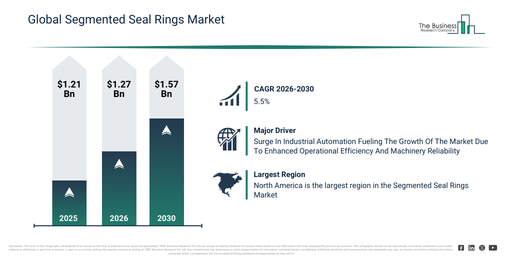
    The segmented seal rings market has experienced robust expansion in recent years. Its size is projected to increase from $1.21 billion in 2025 to $1.27 billion in 2026, demonstrating a compound annual growth rate (CAGR) of 5.2%. Historically, this expansion can be linked to factors such as increased turbine and compressor installations, the enlargement of oil and gas processing plants, a heightened need for rotating equipment reliability, past requirements for leakage reduction, and a greater deployment of high pressure pumps.

    The segmented seal rings market is projected to experience substantial expansion in the coming years. It is anticipated to reach $1.57 billion by 2030, demonstrating a compound annual growth rate (CAGR) of 5.5%. This anticipated growth during the forecast period stems from factors such as increased investment in power generation assets, the expanding hydrogen and gas infrastructure, an elevated emphasis on equipment efficiency, a greater demand for seals compatible with predictive maintenance, and the expansion of aerospace rotating systems. Noteworthy trends expected during the forecast timeframe encompass high temperature resistant seal materials, bespoke multi-segment ring designs, low-leakage and high-efficiency sealing systems, the uptake of advanced composite seal rings, and retrofit solutions for upgrading seal rings.

    Get A Free Sample Report With In-Depth Market Insights:

    https://thebusinessresearchcompany.com/sample_request?id=20568865&type=smp&name=Segmented%20Seal%20Rings%20Market%20Report%202026&utm_source=Blogs&utm_medium=Paid&utm_campaign=Oct_PR

    Segmented Seal Rings Market Growth Factors: What’s Supporting Expansion?

    The expanding realm of industrial automation is poised to boost the segmented seal rings market moving forward. Industrial automation encompasses the application of control systems, machinery, and advanced technology to execute industrial operations with minimal human intervention. The rise in industrial automation stems from improved operational efficiency, as it cuts down on manual labor, reduces errors, and speeds up production processes. Segmented seal rings support industrial automation by offering dependable sealing in machinery, thereby ensuring smooth functioning, reducing operational pauses, and maintaining system efficiency even under strenuous high-pressure and temperature conditions. For instance, data from September 2023, provided by the International Federation of Robotics, a Germany-based professional non-profit organization, indicated that over 44,303 industrial robots were installed in the United States in 2023. This contributed to a 12% increase in overall robot deployments, highlighting substantial investment in automation across key manufacturing sectors such as automotive and electrical and electronics. Consequently, the growing adoption of industrial automation is propelling the expansion of the segmented seal rings market. The escalating demand for oil and gas is anticipated to stimulate the future growth of the segmented seal rings market. Oil and gas activities involve the exploration, extraction, production, and distribution of crude oil and natural gas to meet energy and industrial requirements. This heightened demand for oil and gas is fueled by global energy requirements, as these resources remain essential for transportation, electricity generation, and various industrial undertakings. Segmented seal rings play a crucial role in supporting the oil and gas sector by guaranteeing reliable sealing in equipment operating under high pressure and high temperature, which helps reduce leakage, enhance operational effectiveness, and minimize downtime in both upstream and downstream activities. As an illustration, in October 2025, the International Energy Agency (IEA), a France-based intergovernmental organization, reported that U.S. crude oil field production rose from 12.52 million barrels per day in January 2024 to 13.14 million barrels per day in January 2025, signifying a notable year-on-year increase. Hence, the rising demand for oil and gas is fostering the expansion of the segmented seal rings market.

    Segmented Seal Rings Market Segmentation And Category Overview

    The segmented seal rings market covered in this report is segmented –

    1) By Product Type: Carbon Seal Rings; Metal Seal Rings; Ceramic Seal Rings; Polymer Seal Rings; Other Product Types

    2) By Design Type: Single Segment Rings; Multi Segment Rings; Split Type Rings; Labyrinth Style Rings; Other Design Types

    3) By Application: Pumps; Compressors; Valves; Rotating Equipment; Static Equipment

    4) By Industry Vertical: Oil And Gas; Power Generation; Aerospace; Chemical Processing; Other Industry Types

    Subsegments:

    1) By Carbon Seal Rings: Carbon Graphite Rings; Resin Impregnated Carbon Rings; Oxidation Resistant Carbon Rings; High Temperature Carbon Rings

    2) By Metal Seal Rings: Stainless Steel Rings; Nickel Alloy Rings; Titanium Alloy Rings; Inconel Metal Rings

    3) By Ceramic Seal Rings: Silicon Carbide Rings; Alumina Ceramic Rings; Zirconia Ceramic Rings; Composite Ceramic Rings

    4) By Polymer Seal Rings: Polytetrafluoroethylene Rings; Polyetheretherketone Rings; Fluoroelastomer Rings; High Performance Polymer Rings

    5) By Other Product Types: Tungsten Carbide Rings; Bronze Composite Rings; Hybrid Material Rings; Advanced Engineered Rings

    Segmented Seal Rings Market Company Landscape And Competitive Strategy

    Major companies operating in the segmented seal rings market are Saint-Gobain, Parker Hannifin Corporation, SKF AB, Regal Rexnord Corporation, NOK Corporation, Flowserve Corporation, Smiths Group plc, Trelleborg AB, Freudenberg Sealing Technologies GmbH & Co. KG, John Crane Inc, Enpro Inc, SCHUNK SE & Co. KG, Greene Tweed & Co. Inc, AESSEAL plc, A W Chesterton Company, Helwig Carbon Products Inc, Metallized Carbon Corporation, Leak-Proof Engineering Inc, EagleBurgmann Germany GmbH & Co. KG, and ROC Carbon Company Inc.

    View The Full Segmented Seal Rings Market Report:

    https://thebusinessresearchcompany.com/report/segmented-seal-rings-market-report?utm_source=Blogs&utm_medium=Paid&utm_campaign=Oct_PR

    Segmented Seal Rings Market Largest Region: Which Geography Holds The Highest Market Share?

    North America was the largest region in the segmented seal rings in 2025. Asia-Pacific is expected to be the fastest-growing region in the forecast period. The regions covered in the segmented seal rings market report are Asia-Pacific, South East Asia, Western Europe, Eastern Europe, North America, South America, Middle East, Africa.

    Reach Out To Our Team:

    The Business Research Company: https://www.thebusinessresearchcompany.com/

    Americas: +1 310-496-7795

    Asia: +44 7882 955267 & +91 8897263534

    Europe: +44 7882 955267

    Email us at: marketing@tbrc.info

    Follow us on:

    LinkedIn: https://in.linkedin.com/company/the-business-research-company

    YouTube: https://www.youtube.com/channel/UC24_fI0rV8cR5DxlCpgmyFQ

    Global Market Model: https://www.thebusinessresearchcompany.com/global-market-model