Month: October 2026

  • Unstructured Data Governance Market Forecast 2026: Market Size, Competitive Landscape And Growth Drivers

    Unstructured Data Governance Market Forecast 2026: Market Size, Competitive Landscape And Growth Drivers

    Featuring market attractiveness scoring, total addressable market sizing, company benchmarking matrices, interactive Excel dashboards, deeper supply chain intelligence, emerging startup tracking, and granular product-level insights, The Business Research Company’s 2026 market reports are built to deliver research that is both more actionable and more strategically valuable.

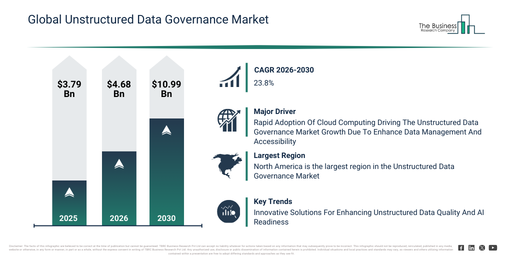
    Unstructured Data Governance Market Growth From $4.68 Billion In 2026 To $10.99 Billion By 2030 At A CAGR Of 23.8%

    The unstructured data governance market size has experienced substantial expansion in recent years. It is projected to grow from $3.79 billion in 2025 to $4.68 billion in 2026, exhibiting a compound annual growth rate (CAGR) of 23.6%. The expansion observed in the historic period can be attributed to several factors, including the rapid increase in enterprise unstructured data volumes, the introduction of early data privacy regulations and compliance mandates, a rise in data breach incidents and misuse, the adoption of enterprise content management systems, and a growing reliance on data-driven decision-making.

    The unstructured data governance market size is projected to undergo significant growth in the near future. It is forecast to reach $10.99 billion in 2030, exhibiting a compound annual growth rate (CAGR) of 23.8%. This expansion during the projection period stems from factors such as more stringent global data protection and privacy regulations, the greater adoption of AI-driven data discovery tools, the broadening of cloud-based unstructured data environments, an increasing need for real-time compliance monitoring, and the escalating requirement for unified data governance frameworks. Key trends identified for this period encompass the rising implementation of enterprise-wide unstructured data cataloging, an enhanced emphasis on data lineage and provenance for compliance auditing, a heightened call for automated policy enforcement across various content types, the convergence of information lifecycle management with governance tools, and the increasing availability of managed services for unstructured data governance.

    Get A Free Sample Report With In-Depth Market Insights:

    https://thebusinessresearchcompany.com/sample_request?id=25481666&type=smp&name=Unstructured%20Data%20Governance%20Market%20Report%202026&utm_source=Blogs&utm_medium=Paid&utm_campaign=Oct_PR

    Unstructured Data Governance Market Growth Factors Behind Sustained Expansion

    The swift integration of cloud computing is projected to fuel the expansion of the unstructured data governance market moving forward. Cloud computing involves the provision of various computing services, including servers, storage, databases, networking, software, and analytics, all delivered over the internet, allowing users to access and utilize these resources on demand without needing to own physical hardware. The increasing uptake of cloud computing is driven by organizations’ demand for enhanced scalability, enabling them to quickly adjust computing resources based on shifting business needs without the requirement for physical infrastructure investment. Cloud computing bolsters unstructured data governance by offering centralized, scalable, and secure platforms that empower organizations to efficiently store, organize, access, and manage large volumes of unstructured data across distributed teams and systems, while simultaneously guaranteeing compliance, control, and data visibility. For instance, in April 2025, according to the American Bar Association, a US-based professional organization, approximately 75% of attorneys reported using cloud computing for work-related tasks, marking an increase from 69% in 2023 and about 70% in 2022. Thus, the rapid adoption of cloud computing is actively stimulating the growth of the unstructured data governance market.

    Unstructured Data Governance Market Segmentation: How Does The Market Break Down By Category?

    The unstructured data governance market covered in this report is segmented –

    1) By Component: Solutions; Services

    2) By Deployment Mode: On-Premises; Cloud

    3) By Organization Size: Large Enterprises; Small And Medium Enterprises

    4) By Application: Data Discovery; Data Classification; Data Security And Privacy; Data Quality And Compliance; Other Applications

    5) By End User: Banking, Financial Services, And Insurance; Healthcare; Information Technology And Telecommunications; Retail And E-Commerce; Government; Manufacturing; Other End Users

    Subsegments:

    1) By Solutions: Data Discovery And Classification; Data Quality Management; Data Security And Privacy Management; Metadata Management; Policy And Compliance Management; Data Lifecycle Management; Data Cataloging; Risk Management

    2) By Services: Consulting And Advisory Services; Implementation And Integration Services; Training And Education Services; Support And Maintenance Services; Managed Services

    Unstructured Data Governance Market Industry Trends Fueling Future Revenue Growth

    Leading companies in the unstructured data governance market are prioritizing the development of innovative solutions, such as artificial intelligence (AI)-ready data monitoring, to elevate data quality, enhance security, and ensure readiness for analytics and artificial intelligence applications. AI-ready data monitoring is a continuous process that tracks, analyzes, and manages unstructured data to guarantee its accuracy, security, and compliance, enabling organizations to uphold data quality, spot anomalies, and prepare trustworthy datasets for AI and analytics applications. For example, in May 2025, Monte Carlo, a US-based data observability and AI governance company, introduced Unstructured Data Monitoring, a no-code solution designed to provide AI-ready data at scale. This allows organizations to build confidence in unstructured data assets like documents, chat logs, and images without needing to write SQL. The platform integrates seamlessly with major data warehouses and lakehouses including Snowflake, Databricks, and BigQuery, offers support for customizable AI-driven quality checks, identifies anomalies in unstructured content, and expedites deployment with minimal setup. The combination of AI-enabled observability, comprehensive data type support, and ease of use strengthens governance throughout the entire data lifecycle, thereby improving reliability for AI applications and analytics.

    Unstructured Data Governance Market Company Landscape And Competitive Strategy

    Major companies operating in the unstructured data governance market are Amazon Web Services Inc., Alphabet Inc., Microsoft Corporation, Deloitte Touche Tohmatsu Limited, Accenture Plc, International Business Machines Corporation (IBM), Oracle Corporation, Ernst & Young Global Limited, KPMG International Cooperative, SAP SE, Tata Consultancy Services Limited, Databricks Inc., Egnyte Inc., Collibra NV, Nuix Limited, Alation Inc., ZL Technologies Inc., Transcend Inc., and Atlan Pte. Ltd.

    View The Full Unstructured Data Governance Market Report:

    https://thebusinessresearchcompany.com/report/unstructured-data-governance-market-report?utm_source=Blogs&utm_medium=Paid&utm_campaign=Oct_PR

    Unstructured Data Governance Market Largest Region: Which Geography Holds The Biggest Share?

    North America was the largest region in the unstructured data governance market in 2025. Asia-Pacific is expected to be the fastest-growing region in the forecast period. The regions covered in the unstructured data governance market report are Asia-Pacific, South East Asia, Western Europe, Eastern Europe, North America, South America, Middle East, Africa.

    Reach Out To Our Team:

    The Business Research Company: https://www.thebusinessresearchcompany.com/

    Americas: +1 310-496-7795

    Asia: +44 7882 955267 & +91 8897263534

    Europe: +44 7882 955267

    Email us at: marketing@tbrc.info

    Follow us on:

    LinkedIn: https://in.linkedin.com/company/the-business-research-company

    YouTube: https://www.youtube.com/channel/UC24_fI0rV8cR5DxlCpgmyFQ

    Global Market Model: https://www.thebusinessresearchcompany.com/global-market-model
  • Tokenization Optimization for LLMs Market Size In 2026: Regional Growth, Key Segments And Future Outlook

    Tokenization Optimization for LLMs Market Size In 2026: Regional Growth, Key Segments And Future Outlook

    Built to provide research that’s more actionable and strategically valuable, The Business Research Company’s 2026 market reports include market attractiveness analysis, total addressable market sizing, company benchmarking matrices, interactive Excel dashboards, broader supply chain intelligence, emerging startup tracking, and in-depth product insights.

    Tokenization Optimization for LLMs Market Expansion Outlook: What Revenue Opportunities Are Ahead?

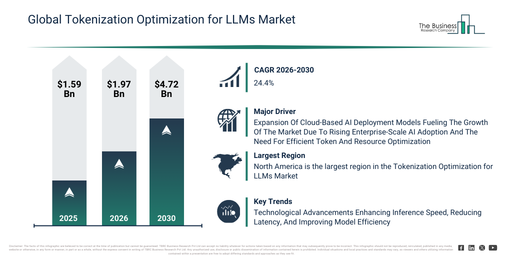
    The tokenization optimization for llms market has experienced rapid expansion in recent years. This market is projected to increase from $1.59 billion in 2025 to $1.97 billion in 2026, reflecting a compound annual growth rate (CAGR) of 24.1%. Historically, this expansion has been driven by factors such as growth in llm training, a rise in nlp applications, the expansion of large text datasets, the need for faster model processing, and an increase in AI model costs.

    The market for tokenization optimization for llms is projected to experience substantial expansion over the upcoming years. This sector is anticipated to reach $4.72 billion by 2030, exhibiting a compound annual growth rate (CAGR) of 24.4%. This expansion during the projection period stems from factors such as the increasing need for cost-effective LLM inference, the proliferation of domain-specific LLMs, the broadening of multilingual AI platforms, a heightened emphasis on computational efficiency, and the integration of tokenizer optimization instruments. Key developments anticipated during this forecast include the creation of custom domain-specific tokenizers, advancements in token compression methodologies, refinement of multilingual token vocabularies, the deployment of adaptive tokenization algorithms, and the development of low token count encoding approaches.

    Get A Free Sample Report With In-Depth Market Insights:

    https://thebusinessresearchcompany.com/sample_request?id=59782645&type=smp&name=Tokenization%20Optimization%20for%20LLMs%20Market%20Report%202026&utm_source=Blogs&utm_medium=Paid&utm_campaign=Oct_PR

    Tokenization Optimization for LLMs Market Demand Drivers Opening New Revenue Streams

    The anticipated expansion of cloud-based AI deployment models is projected to drive the growth of the tokenization optimization for LLM market in the future. These models involve leveraging cloud infrastructure and platforms to host, manage, and scale artificial intelligence workloads, enabling businesses to utilize flexible computing resources, integrate AI services effectively, and minimize initial infrastructure expenditures. This expansion is fueled by increasing enterprise demand for AI, as companies progress from initial trials to extensive, production-grade deployments necessitating optimized tokenization and resource management for large language models. Tokenization optimization for LLM facilitates cloud-based AI deployment by shortening input sequence lengths and enhancing token efficiency, thereby decreasing compute usage, memory consumption, and inference latency within shared cloud infrastructure. For example, in June 2024, AAG reported that public cloud platform-as-a-service (PaaS) revenue hit $111 billion, and the cloud market is anticipated to expand to $376.36 billion by 2029, with approximately 200 zettabytes (2 billion terabytes) forecasted to be stored in the cloud by 2025. Consequently, the expanding use of cloud-based AI deployment models is a key factor propelling the growth of the tokenization optimization for LLM market.

    Tokenization Optimization for LLMs Market Segment Trends And Revenue Contributors

    The tokenization optimization for llms market covered in this report is segmented –

    1) By Solution Type: Software Tools; Hardware Accelerators; Services

    2) By Deployment Mode: On-Premises; Cloud

    3) By Application: Natural Language Processing; Text Analytics; Speech Recognition; Machine Translation; Other Applications

    4) By End-User: Banking, Financial Services, And Insurance (BFSI); Healthcare; Information Technology (IT) And Telecommunications; Retail And E-Commerce; Media And Entertainment; Other End-Users

    Subsegments:

    1) By Software Tools: Tokenization Algorithm Optimization; Vocabulary Management Software; Text Preprocessing And Normalization Tools; Token Compression Software; Language Specific Tokenization Tools

    2) By Hardware Accelerators: Artificial Intelligence Processing Chips; High Performance Computing Processors; Edge Computing Acceleration Devices; Memory Optimized Processing Units

    3) By Services: Consulting And Strategy Services; Custom Tokenization Development Services; System Integration Services; Performance Optimization And Tuning Services; Support And Maintenance Services

    Tokenization Optimization for LLMs Market Trends Powering Strategic Industry Growth

    Leading companies in the tokenization optimization for large language models (LLMs) market are prioritizing technological advancements to boost inference speed, reduce latency, and improve overall model efficiency during deployment. Tokenization optimization involves refining how text is segmented into tokens, allowing LLMs to process inputs more quickly and accurately, which is essential for real-time and large-scale AI applications. As an example, in March 2025, Hugging Face, Inc., a US-based open-source machine learning and data science platform, launched FlashTokenizer to enhance tokenization speed and efficiency for large language model training and inference. FlashTokenizer achieves ultra-low latency tokenization by utilizing highly optimized C++ and GPU-accelerated kernels, thereby significantly cutting down preprocessing overhead during LLM inference. It is built for smooth integration with current LLM pipelines, facilitating greater throughput, reduced memory use, and quicker end-to-end response times at scale.

    Tokenization Optimization for LLMs Market Key Players Shaping Industry Direction

    Major companies operating in the tokenization optimization for llms market are Amazon Web Services Inc., Google LLC, Microsoft Corporation, Meta Platforms Inc., Intel Corporation, Qualcomm Incorporated, Galileo Technologies Inc., Cohere Inc., SambaNova Systems Inc., Cerebras Systems Inc., Together AI Inc., AI21 Labs Ltd., Hugging Face Inc., Predibase Inc., Weaviate B.V., PromptLayer Inc., Baseten Inc., Mistral AI SAS, Stability AI Ltd., Modular AI Inc., Fireworks AI Inc., Deci AI Ltd., Aleph Alpha GmbH, and OpenAI L.L.C.

    View The Full Tokenization Optimization for LLMs Market Report:

    https://thebusinessresearchcompany.com/report/tokenization-optimization-for-llms-market-report?utm_source=Blogs&utm_medium=Paid&utm_campaign=Oct_PR

    Tokenization Optimization for LLMs Market Regional Analysis: Which Geography Leads On Revenue?

    North America was the largest region in the tokenization optimization for LLMs market in 2025. Asia-Pacific is expected to be the fastest-growing region in the forecast period. The regions covered in the tokenization optimization for llms market report are Asia-Pacific, South East Asia, Western Europe, Eastern Europe, North America, South America, Middle East, Africa.

    Reach Out To Our Team:

    The Business Research Company: https://www.thebusinessresearchcompany.com/

    Americas: +1 310-496-7795

    Asia: +44 7882 955267 & +91 8897263534

    Europe: +44 7882 955267

    Email us at: marketing@tbrc.info

    Follow us on:

    LinkedIn: https://in.linkedin.com/company/the-business-research-company

    YouTube: https://www.youtube.com/channel/UC24_fI0rV8cR5DxlCpgmyFQ

    Global Market Model: https://www.thebusinessresearchcompany.com/global-market-model
  • Token-Aware Load Balancing for Large Language Models (LLMs) Market Growth Forecast Through 2030: Market Size And Trends In 2026

    Token-Aware Load Balancing for Large Language Models (LLMs) Market Growth Forecast Through 2030: Market Size And Trends In 2026

    Backed by market attractiveness analysis, total addressable market sizing, company benchmarking matrices, interactive Excel dashboards, wider supply chain intelligence, emerging startup coverage, and detailed product-level insights, The Business Research Company’s 2026 market reports are designed to offer research that is more actionable and strategically valuable than ever.

    Token-Aware Load Balancing for Large Language Models (LLMs) Market Growth Potential: How Will Market Size Shift Through 2030?

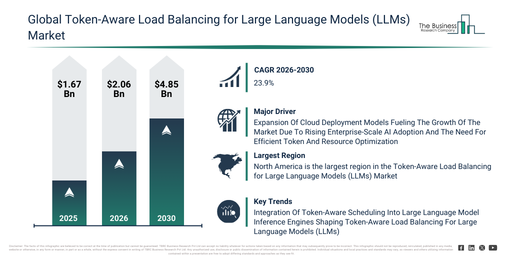
    The market for token-aware load balancing solutions designed for large language models (llms) has witnessed significant expansion in recent times. This market is forecasted to expand from $1.67 billion in 2025 to $2.06 billion in 2026, achieving a compound annual growth rate (CAGR) of 23.6%. The historical growth of this market can be attributed to several factors, including the increasing deployment of llms, a surge in AI inference workloads, the expansion of cloud AI platforms, the requirement for low-latency AI responses, and a rise in multi-model serving applications.

    The market size for token-aware load balancing for large language models (llms) is poised for substantial expansion over the next few years. It is projected to reach $4.85 billion in 2030, exhibiting a compound annual growth rate (CAGR) of 23.9%. This growth throughout the forecast period is driven by factors such as the increasing use of LLMs within enterprises, the rise of real-time AI applications, a growing demand for cost-optimized inference, the expansion of distributed AI serving, and the implementation of multi-cluster AI routing. Significant trends anticipated during this period include the development of token-based request routing engines, advancements in LLM inference traffic shaping, dynamic token cost scheduling, autoscaling solutions for LLM workloads, and real-time token usage analytics.

    Get A Free Sample Report With In-Depth Market Insights:

    https://thebusinessresearchcompany.com/sample_request?id=30673717&type=smp&name=Token-Aware%20Load%20Balancing%20for%20Large%20Language%20Models%20%28LLMs%29%20Market%20Report%202026&utm_source=Blogs&utm_medium=Paid&utm_campaign=Oct_PR

    Token-Aware Load Balancing for Large Language Models (LLMs) Market Growth Backed By Core Demand Fundamentals

    The increasing use of cloud infrastructure is anticipated to drive the expansion of the token-aware load balancing for large language models (LLMs) market in the future. Cloud deployment involves utilizing cloud platforms and infrastructure to host, manage, and scale AI workloads, enabling businesses to utilize flexible computing resources, seamlessly integrate AI services, and lower initial infrastructure expenditures. This growth in cloud deployment models stems from increasing corporate demand for AI, as companies progress from initial testing to extensive, production-grade deployments necessitating enhanced tokenization and resource management specifically for large language models. Within cloud-deployed LLMs, token-aware load balancing optimizes resource usage by distributing requests according to token length and processing requirements, thereby decreasing latency and avoiding system overloads. This method guarantees efficient scaling and stable performance through the dynamic matching of workloads with existing processing capacity. For example, in June 2024, as reported by AAG, public cloud platform-as-a-service (PaaS) revenue hit $111 billion, and the overall cloud market is forecast to expand to $376.36 billion by 2029, with an anticipated 200 zettabytes (2 billion terabytes) of data stored in the cloud by 2025. Consequently, the increased adoption of cloud deployment is propelling the expansion of the token-aware load balancing for large language models (LLMs) market.

    Token-Aware Load Balancing for Large Language Models (LLMs) Market Segment Analysis Spotlighting Growth Areas

    The token-aware load balancing for large language models (llms) market covered in this report is segmented –

    1) By Component: Software; Hardware; Services

    2) By Deployment Mode: On-Premises; Cloud

    3) By Application: Model Training; Inference; Data Processing; Real-Time Analytics; Other Applications

    4) By End-User: Banking, Financial Services, And Insurance (BFSI); Healthcare; Information Technology (IT) And Telecommunications; Retail And E-commerce; Media And Entertainment; Manufacturing; Other End-Users

    Subsegments:

    1) By Software: Load Balancing Software; Traffic Management Software; Performance Monitoring Software; Token Routing Software; Analytics And Reporting Software

    2) By Hardware: High Performance Servers; Network Switches; Storage Systems; Accelerator Cards; Edge Computing Devices

    3) By Services: Consulting Services; Implementation And Integration Services; Monitoring And Optimization Services; Maintenance And Support Services; Training And Advisory Services

    Token-Aware Load Balancing for Large Language Models (LLMs) Market Growth Trends Reshaping The Competitive Landscape

    Major companies operating in the token-aware load balancing for large language models (LLMs) market are concentrating on embedding token-aware scheduling into large language model inference engines, such as zero overhead batch schedulers, which enable the concurrent execution of central processing unit (CPU)-side request scheduling and graphics processing unit (GPU) computation. A zero-overhead batch scheduler is defined as a scheduling mechanism that manages inference batches in parallel with ongoing GPU operations, ensuring the GPU is fully utilized and avoids idle periods due to CPU-side batching delays. For instance, in December 2024, the Laboratory for Machine Systems (LMSYS), a US-based research organization specializing in large language model inference systems, unveiled a cache-aware load balancer. This cache-aware load balancer facilitates intelligent request routing by directing LLM inference requests to workers with the highest probability of reusing prefix key-value (KV) cache, thereby cutting down on superfluous token computation. It enhances throughput and reduces response latency by maximizing cache hit rates during real-time inference. By foregoing naive round-robin routing, it guarantees improved utilization of computational resources across dispersed workers. This strategy scales efficiently across multi-node environments while preserving token locality.

    Token-Aware Load Balancing for Large Language Models (LLMs) Market Competitive Analysis Of Leading Industry Participants

    Major companies operating in the token-aware load balancing for large language models (llms) market are International Business Machines Corporation, NVIDIA Corporation, SAP SE, AkamAI Technologies Inc., Snowflake Inc., Databricks Inc., Datadog Inc., Dynatrace LLC, Cloudflare Inc., Elastic N.V., Fastly Inc., Kong Inc., Redis Ltd., Vercel Inc., Cohere Inc., Together AI Inc., Mistral AI SAS, Solo.io Inc., Fireworks AI Inc., HAProxy Technologies LLC, Fly.io Inc., and Envoy Proxy.

    View The Full Token-Aware Load Balancing for Large Language Models (LLMs) Market Report:

    https://thebusinessresearchcompany.com/report/token-aware-load-balancing-for-large-language-models-llms-market-report?utm_source=Blogs&utm_medium=Paid&utm_campaign=Oct_PR

    Token-Aware Load Balancing for Large Language Models (LLMs) Market Geographic Spread And Regional Opportunities

    North America was the largest region in the token-aware load balancing for large language models (LLMs) market in 2025. Asia-Pacific is expected to be the fastest-growing region in the forecast period. The regions covered in the token-aware load balancing for large language models (llms) market report are Asia-Pacific, South East Asia, Western Europe, Eastern Europe, North America, South America, Middle East, Africa.

    Reach Out To Our Team:

    The Business Research Company: https://www.thebusinessresearchcompany.com/

    Americas: +1 310-496-7795

    Asia: +44 7882 955267 & +91 8897263534

    Europe: +44 7882 955267

    Email us at: marketing@tbrc.info

    Follow us on:

    LinkedIn: https://in.linkedin.com/company/the-business-research-company

    YouTube: https://www.youtube.com/channel/UC24_fI0rV8cR5DxlCpgmyFQ

    Global Market Model: https://www.thebusinessresearchcompany.com/global-market-model
  • Temporary Bypass Conductor Market 2026 Market Size And Growth Forecast: Key Trends To Watch

    Temporary Bypass Conductor Market 2026 Market Size And Growth Forecast: Key Trends To Watch

    Built to provide research that’s more actionable and strategically valuable, The Business Research Company’s 2026 market reports include market attractiveness analysis, total addressable market sizing, company benchmarking matrices, interactive Excel dashboards, broader supply chain intelligence, emerging startup tracking, and in-depth product insights.

    Temporary Bypass Conductor Market Size Forecast: How Big Could The Market Get By 2030?

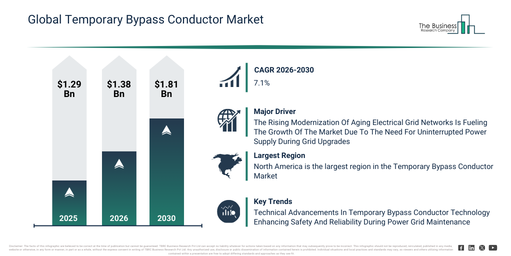
    The temporary bypass conductor market size has witnessed substantial growth over recent years. This market is anticipated to expand from $1.29 billion in 2025 to $1.38 billion in 2026, exhibiting a compound annual growth rate (CAGR) of 6.8%. The historical expansion can be attributed to an increase in grid maintenance activities, the expansion of transmission networks, aging power infrastructure, a rise in planned shutdowns, and a growth in industrial electrical upgrades.

    The temporary bypass conductor market is anticipated to show significant expansion in the coming years. It is projected to achieve a size of $1.81 billion in 2030, demonstrating a compound annual growth rate (CAGR) of 7.1%. This projected growth during the forecast period stems from factors such as the expansion of smart grids, greater integration of renewable energy into the grid, an increase in preventive maintenance programs, more frequent substation upgrades, and heightened investments in grid reliability. Prominent trends within the forecast period include the adoption of high-capacity flexible bypass cables, quick-deploy portable conductor systems, weather-resistant insulated conductors, modular temporary bypass assemblies, and smart monitored bypass lines.

    Get A Free Sample Report With In-Depth Market Insights:

    https://thebusinessresearchcompany.com/sample_request?id=26183186&type=smp&name=Temporary%20Bypass%20Conductor%20Market%20Report%202026&utm_source=Blogs&utm_medium=Paid&utm_campaign=Oct_PR

    Temporary Bypass Conductor Market Opportunity Drivers: What’s Unlocking New Revenue Potential?

    The increasing modernization of older electrical grid networks is anticipated to fuel the expansion of the temporary bypass conductor market in the future. Electrical grid networks are defined as the connected infrastructure responsible for producing and distributing electricity from power generation facilities to consumers. Modernizing old electrical grid networks is prompted by the necessity to improve reliability, given that obsolete infrastructure heightens the potential for malfunctions and power interruptions. During the modernization of aging grids, temporary bypass conductors serve to divert electricity around old or faulty equipment for a period, enabling utility companies to upgrade their lines and substations without cutting off power to users. For example, the International Energy Agency (IEA), an autonomous intergovernmental organization based in France, reported in February 2025 that worldwide investment in power transmission grew by 10% in 2023, totaling $140 billion, and is forecast to require over $200 billion per year by the mid-2030s to meet growing electricity demand. Consequently, the ongoing modernization of aging electrical grid networks is stimulating the expansion of the temporary bypass conductor market.

    Temporary Bypass Conductor Market Segment Landscape And Growth Outlook

    The temporary bypass conductor market covered in this report is segmented –

    1) By Product Type: Insulated Bypass Cables; Retractable Bypass Conductors; Flexible Jumper Cables; Overhead Bypass Conductors; Other Product Types

    2) By Material: Aluminum; Copper; Composite; Other Materials

    3) By Voltage Level: Low Voltage; Medium Voltage; High Voltage

    4) By Application: Transmission Lines; Distribution Lines; Substations; Industrial; Other Applications

    5) By End-User: Utilities; Industrial; Commercial; Other End-Users

    Subsegments:

    1) By Insulated Bypass Cables: Single Core Insulated Bypass Cable; Multi Core Insulated Bypass Cable; Heat Resistant Insulated Bypass Cable; Weather Resistant Insulated Bypass Cable

    2) By Retractable Bypass Conductors: Manually Retractable Bypass Conductor; Spring Loaded Retractable Bypass Conductor; Cable Reel Based Retractable Conductor; Portable Retractable Bypass Conductor

    3) By Flexible Jumper Cables: Low Voltage Flexible Jumper Cable; Medium Voltage Flexible Jumper Cable; High Current Flexible Jumper Cable; Extra Flexible Stranded Jumper Cable

    4) By Overhead Bypass Conductors: Temporary Overhead Aluminum Conductor; Temporary Overhead Alloy Conductor; High Capacity Overhead Bypass Conductor; Lightweight Overhead Bypass Conductor

    5) By Other Product Types: Modular Temporary Bypass Conductor; Portable Temporary Bypass System; Hybrid Temporary Bypass Conductor

    Temporary Bypass Conductor Market Innovation Trends Shaping Future Development

    Companies operating in the temporary bypass conductor market are prioritizing technological advancements, such as XLPE (cross-linked polyethylene) insulated conductors, to facilitate safer and more reliable temporary power rerouting. XLPE insulated conductors specifically refer to copper or aluminum conductors covered with durable cross-linked or high-density polyethylene insulation, providing high electrical, thermal, and weather resistance essential for safe and reliable power transmission. For example, in October 2024, the State Grid Kashgar Power Supply Company, a utility based in China, successfully pioneered a third-category live-line bypass operation using a temporary bypass cable to dismantle a pole-mounted circuit breaker on a 10 kV line. This advanced method ensured an uninterrupted electricity supply during the operation, reducing downtime by 632 customer hours, minimizing service disruptions, and guaranteeing continuous power delivery to downstream customers. Such innovations highlight the increasing importance of advanced bypass conductor technologies in supporting grid modernization, improving operational efficiency, enhancing worker safety, and strengthening overall network resilience.

    Temporary Bypass Conductor Market Industry Leaders And Competitive Landscape

    Major companies operating in the temporary bypass conductor market are General Electric Company, ABB Ltd, Sumitomo Electric Industries Ltd, 3M Company, Eaton Corporation plc, TE Connectivity Ltd, Prysmian SpA, Southwire Company LLC, Nexans Société Anonyme, Furukawa Electric Co Ltd, NKT (Nordiske Kabel- og Traadfabriker) A/S, Belden Inc., APAR Industries Limited, KEI Industries Limited, Sterlite Power Transmission Limited, Houston Wire & Cable Company, Jiangsu Zhongtian Technology Co Ltd, Marmon Utility LLC, Tratos Cavi SpA, and Lamifil NV.

    View The Full Temporary Bypass Conductor Market Report:

    https://thebusinessresearchcompany.com/report/temporary-bypass-conductor-market-report?utm_source=Blogs&utm_medium=Paid&utm_campaign=Oct_PR

    Temporary Bypass Conductor Market Regional Analysis And Top Geography

    North America was the largest region in the temporary bypass conductor market in 2025. Asia-Pacific is expected to be the fastest-growing region in the forecast period. The regions covered in the temporary bypass conductor market report are Asia-Pacific, South East Asia, Western Europe, Eastern Europe, North America, South America, Middle East, Africa.

    Reach Out To Our Team:

    The Business Research Company: https://www.thebusinessresearchcompany.com/

    Americas: +1 310-496-7795

    Asia: +44 7882 955267 & +91 8897263534

    Europe: +44 7882 955267

    Email us at: marketing@tbrc.info

    Follow us on:

    LinkedIn: https://in.linkedin.com/company/the-business-research-company

    YouTube: https://www.youtube.com/channel/UC24_fI0rV8cR5DxlCpgmyFQ

    Global Market Model: https://www.thebusinessresearchcompany.com/global-market-model
  • Synthetic Pretraining Data For Large Language Models (LLMs) Market Size And Forecast 2026–2030: Trends Driving Industry Expansion

    Synthetic Pretraining Data For Large Language Models (LLMs) Market Size And Forecast 2026–2030: Trends Driving Industry Expansion

    Backed by market attractiveness analysis, total addressable market sizing, company benchmarking matrices, interactive Excel dashboards, wider supply chain intelligence, emerging startup coverage, and detailed product-level insights, The Business Research Company’s 2026 market reports are designed to offer research that is more actionable and strategically valuable than ever.

    Synthetic Pretraining Data For Large Language Models (LLMs) Market Size Outlook: How Quickly Will Revenue Expand Through 2030?

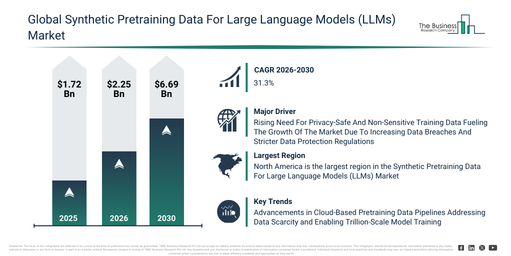
    The market for synthetic pretraining data for large language models (LLMs) has experienced significant expansion in recent years. This market is expected to increase from $1.72 billion in 2025 to $2.25 billion in 2026, achieving a compound annual growth rate (CAGR) of 31.1%. Historically, this growth can be attributed to several factors including the limited availability of labeled text data, strict data privacy restrictions, past shortages of NLP datasets, the increasing need for training large models, and the rising costs associated with data licensing.

    The market for synthetic pretraining data for large language models (LLMs) is anticipated to experience substantial exponential growth in the coming years. It is forecast to reach $6.69 billion in 2030, demonstrating a robust compound annual growth rate (CAGR) of 31.3%. This expansion during the projected period is driven by factors such as the increasing development of foundation models, a rising necessity for safe training datasets, growing demand for multilingual models, heightened regulatory data compliance requirements, and the proliferation of domain-tuned LLMs. Key developments expected within this forecast period include the emergence of domain-specific synthetic text corpora, techniques for generating privacy-safe training data, platforms for multilingual synthetic datasets, sophisticated pipelines for bias-controlled synthetic data, and frameworks for automated data augmentation.

    Get A Free Sample Report With In-Depth Market Insights:

    https://thebusinessresearchcompany.com/sample_request?id=57073122&type=smp&name=Synthetic%20Pretraining%20Data%20For%20Large%20Language%20Models%20%28LLMs%29%20Market%20Report%202026&utm_source=Blogs&utm_medium=Paid&utm_campaign=Oct_PR

    Synthetic Pretraining Data For Large Language Models (LLMs) Market Industry Drivers: What’s Behind The Revenue Growth?

    The increasing necessity for privacy-secure and non-sensitive training data is anticipated to fuel the expansion of the synthetic pretraining data market for large language models (LLMs). This requirement for privacy-safe and non-sensitive training data reflects the intensifying pressure on organizations to protect personal and confidential information, such as health records, financial data, and personally identifiable information, during AI model training and fine-tuning procedures. The demand for privacy-safe training data is on the rise as organizations respond to an increasing number of data breaches and more stringent data protection regulations, which restrict the use of real-world sensitive datasets in AI development. Synthetic pretraining data addresses these challenges by replacing actual personal or proprietary information with artificially generated datasets that retain relevant statistical and semantic characteristics without containing identifiable or sensitive content. For instance, in September 2025, Perforce Software, Inc., a U.S.-based software development company, disclosed that approximately 60% of organizations experienced data breaches or data theft across software development, AI, and analytics environments, representing an 11% year-over-year increase. This trend highlights the escalating risks associated with utilizing real-world data for AI training and reinforces the need for privacy-preserving alternatives. Therefore, the growing need for privacy-safe and non-sensitive training data is propelling the growth of the synthetic pretraining data for large language models (LLMs) market.

    Synthetic Pretraining Data For Large Language Models (LLMs) Market Segment Outlook: Which Categories Are Growing Fastest?

    The synthetic pretraining data for large language models (llms) market covered in this report is segmented –

    1) By Data Type: Text; Code; Multimodal; Domain-Specific; Other Data Types

    2) By Source: Proprietary; Open Source; Third-Party

    3) By Deployment Mode: Cloud; On-Premises

    4) By Application: Model Training; Model Evaluation; Data Augmentation; Other Applications

    5) By End-User: Technology Companies; Research Institutes; Enterprises; Other End-Users

    Subsegments:

    1) By Text: Natural Language Documents; Conversational Text Data; Structured Text Records; Unstructured Text Content

    2) By Code: Programming Language Scripts; Software Development Instructions; Algorithmic Logic Code; Source Code Repositories

    3) By Multimodal: Text And Image Data; Text And Audio Data; Text And Video Data; Integrated Multiformat Content

    4) By Domain-Specific: Healthcare Industry Data; Financial Services Data; Legal And Regulatory Data; Manufacturing And Industrial Data

    5) By Other Data Types: Tabular Data Records; Log And Event Data; Simulated Scenario Data; Annotated Metadata Content

    #Synthetic Pretraining Data For Large Language Models (LLMs) Market Growth Trends: What’s Shaping The Future Outlook?

    Major companies in the synthetic pretraining data for large language models (LLMs) market are concentrating on advancements in cloud-based pretraining data pipelines. These pipelines merge synthetic data generation with extensive data curation and quality-conscious optimization to tackle data scarcity, enhance model performance, and enable the training of trillion-parameter models. Cloud-based synthetic pretraining data pipelines combine artificially produced high-quality datasets with carefully selected proprietary and domain-specific data, improving the efficiency and effectiveness of LLM pretraining beyond conventional web-scale sources. For instance, in August 2025, DatologyAI, a US-based venture-backed AI startup, launched BeyondWeb, an advanced platform for data curation and training optimization designed to extend large language model training beyond traditional web datasets. BeyondWeb prioritizes large-scale synthetic data integration, automated data valuation, and quality-aware filtering to identify and give precedence to high-value training data. These features allow for better model generalization, increased robustness, and improved training efficiency at extreme scales, supporting trillion-parameter model pretraining without a proportional increase in computational cost.

    Synthetic Pretraining Data For Large Language Models (LLMs) Market Competitive Overview And Top Companies

    Major companies operating in the synthetic pretraining data for large language models (llms) market are Amazon Web Services Inc., NVIDIA Corporation, IBM Research, Microsoft Research, OpenAI Inc., Databricks Inc., Anthropic PBC, Cohere Inc., Innodata Inc., AI21 Labs Ltd., Hugging Face Inc., Snorkel AI Inc., Gretel Labs Inc., Meta Platforms Inc., Aleph Alpha GmbH, Bitext Innovations S.L., SuperAnnotate AI Inc., Google LLC, Syntheticus Inc., MOSTLY AI Solutions MP GmbH, YData LDA, Diveplane Corporation

    View The Full Synthetic Pretraining Data For Large Language Models (LLMs) Market Report:

    https://thebusinessresearchcompany.com/report/synthetic-pretraining-data-for-large-language-models-llms-market-report?utm_source=Blogs&utm_medium=Paid&utm_campaign=Oct_PR

    Synthetic Pretraining Data For Large Language Models (LLMs) Market Top Region: Where Does Most Revenue Come From?

    North America was the largest region in the synthetic pretraining data for large language models (LLMs) market in 2025. Asia-Pacific is expected to be the fastest-growing region in the forecast period. The regions covered in the synthetic pretraining data for large language models (llms) market report are Asia-Pacific, South East Asia, Western Europe, Eastern Europe, North America, South America, Middle East, Africa.

    Reach Out To Our Team:

    The Business Research Company: https://www.thebusinessresearchcompany.com/

    Americas: +1 310-496-7795

    Asia: +44 7882 955267 & +91 8897263534

    Europe: +44 7882 955267

    Email us at: marketing@tbrc.info

    Follow us on:

    LinkedIn: https://in.linkedin.com/company/the-business-research-company

    YouTube: https://www.youtube.com/channel/UC24_fI0rV8cR5DxlCpgmyFQ

    Global Market Model: https://www.thebusinessresearchcompany.com/global-market-model
  • Synthetic Media Software Market 2026 Outlook: Market Size, CAGR And Key Growth Opportunities

    Synthetic Media Software Market 2026 Outlook: Market Size, CAGR And Key Growth Opportunities

    Featuring market attractiveness scoring, total addressable market sizing, company benchmarking matrices, interactive Excel dashboards, deeper supply chain intelligence, emerging startup tracking, and granular product-level insights, The Business Research Company’s 2026 market reports are built to deliver research that is both more actionable and more strategically valuable.

    Synthetic Media Software Market Size, Value And Growth Trajectory Through 2030

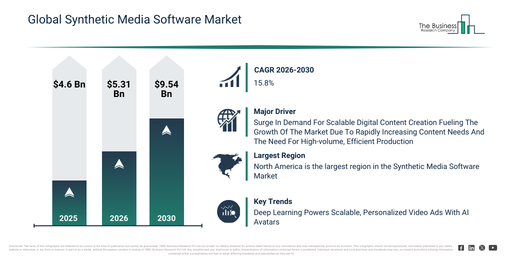
    The synthetic media software market has experienced rapid expansion in recent years. Its valuation is anticipated to climb from $4.6 billion in 2025 to $5.31 billion in 2026, demonstrating a compound annual growth rate (CAGR) of 15.5%. The historical growth trajectory can be ascribed to several factors, including an increase in digital content demand, the proliferation of creator economy platforms, significant past advancements in deep learning models, heightened social media production, and the growing adoption of cloud creative tools.

    The synthetic media software market is set to experience substantial expansion in the upcoming years, with forecasts showing it will achieve $9.54 billion in 2030 at a compound annual growth rate (CAGR) of 15.8%. This projected increase within the forecast period is primarily due to the growing enterprise adoption of generative media, the broadening of virtual content production, an escalating demand for bespoke marketing content, increased utilization in gaming and film sectors, and the continuous rise of AI creative automation. Prominent trends for this period include AI-generated multimodal content tools, advanced realistic voice and video synthesis platforms, deepfake detection and verification software, personalized synthetic content engines, and real-time generative media APIs.

    Get A Free Sample Report With In-Depth Market Insights:

    https://thebusinessresearchcompany.com/sample_request?id=97590806&type=smp&name=Synthetic%20Media%20Software%20Market%20Report%202026&utm_source=Blogs&utm_medium=Paid&utm_campaign=Oct_PR

    Synthetic Media Software Market Growth Factors: What’s Supporting Expansion?

    The increasing need for scalable digital content creation is anticipated to drive expansion in the synthetic media software market in the future. This refers to the capability to quickly produce, tailor, and disseminate substantial quantities of premium digital content through automated and AI-powered technologies across various platforms and to diverse audiences. This need arises from rapidly escalating content requirements, as marketers require quicker, higher-volume output to match growing audience engagement. Synthetic media software is crucial for scalable digital content creation, leveraging AI to automate, personalize, and amplify content output without a proportional rise in time or expense. For example, data from June 2025, based on Adobe’s 2025 research which surveyed over 1,600 global marketers, showed that 96% indicated a rise in content demand; among these, 62% observed a fivefold or greater increase, and 71% foresee content demand expanding more than five times by 2027. Consequently, the expanding demand for scalable digital content creation stands as a primary catalyst for growth within the synthetic media software market.

    Synthetic Media Software Market Segment Landscape: Which Areas Lead Development?

    The synthetic media software market covered in this report is segmented –

    1) By Component: Software; Services

    2) By Deployment Type: On-Premise; Cloud-Based

    3) By Technology: Deep Learning; Natural Language Processing; Generative Adversarial Networks; Computer Vision

    4) By Application: Content Creation; Advertising; Gaming; Film Production

    6) By End Use Industry: Entertainment; Education; Marketing; Healthcare

    Subsegments:

    1) By Software: Text Generation Software; Image Generation Software; Audio Synthesis Software; Video Generation Software; Media Editing And Enhancement Software; Multimodal Content Creation Software

    2) By Services: Consulting And Advisory Services; System Integration Services; Custom Content Development Services; Training And Support Services; Maintenance And Upgradation Services; Managed Synthetic Media Services

    Synthetic Media Software Market Industry Trends: What’s Reshaping Demand?

    Leading corporations within the synthetic media software market are prioritizing the creation of innovative solutions, such as artificial intelligence-powered automated video generation platforms, to address the growing need for scalable, cost-efficient content production, made possible by progress in deep learning–based media generation technologies. These platforms utilize deep neural networks and generative models to produce high-quality videos, dynamic avatars, and synthetic scenes from straightforward inputs like text, images, or URLs, providing capabilities significantly superior to traditional video production workflows that depend on cameras, studios, and extensive post-production editing. As an illustration, in September 2025, DeepBrain AI, a US-based generative artificial intelligence company, introduced Automated UGC Ad Videos, an innovative synthetic media solution leveraging its artificial intelligence Studio platform to create product-use videos featuring lifelike artificial intelligence avatars from just a single product image or a product page URL, thereby removing the necessity of physical filming and cutting down on both development duration and expenses. The platform’s notable functionalities encompass Product Avatar, which enables the generation of scenarios featuring adaptable artificial intelligence characters engaging with products authentically, and Product-to-Video, which autonomously generates promotional videos optimized for concise social media formats, allowing businesses to quickly generate multiple ad variants for testing and deployment.

    Synthetic Media Software Market Competitive Landscape: Which Companies Lead The Industry?

    Major companies operating in the synthetic media software market are Midjourney Inc., ElevenLabs Inc., Synthesia Limited, Stability AI, De-Identification Ltd., Voicemod S.L., DeepBrain AI Inc., VEED Limited, Descript, Colossyan AI, Hour One, Resemble AI, AI Playground Inc., Kaedim Inc., Hyperhuman S.R.L., Deep Art AI GmbH, Kyber Corp, Luma AI Inc., Pika Labs, HeyGen Inc., Genmo Inc., WellSaid Labs Inc., LOVO Inc., Rephrase.AI

    View The Full Synthetic Media Software Market Report:

    https://thebusinessresearchcompany.com/report/synthetic-media-software-market-report?utm_source=Blogs&utm_medium=Paid&utm_campaign=Oct_PR

    Synthetic Media Software Market Regional Breakdown: Where Is Demand Concentrated?

    North America was the largest region in the synthetic media software market in 2025. Asia-Pacific is expected to be the fastest-growing region in the forecast period. The regions covered in the synthetic media software market report are Asia-Pacific, South East Asia, Western Europe, Eastern Europe, North America, South America, Middle East, Africa.

    Reach Out To Our Team:

    The Business Research Company: https://www.thebusinessresearchcompany.com/

    Americas: +1 310-496-7795

    Asia: +44 7882 955267 & +91 8897263534

    Europe: +44 7882 955267

    Email us at: marketing@tbrc.info

    Follow us on:

    LinkedIn: https://in.linkedin.com/company/the-business-research-company

    YouTube: https://www.youtube.com/channel/UC24_fI0rV8cR5DxlCpgmyFQ

    Global Market Model: https://www.thebusinessresearchcompany.com/global-market-model
  • Synchrophasor Data Service Market Size Growth: From $1.38 Billion In 2026 To $2.28 Billion By 2030

    Synchrophasor Data Service Market Size Growth: From $1.38 Billion In 2026 To $2.28 Billion By 2030

    Built to provide research that’s more actionable and strategically valuable, The Business Research Company’s 2026 market reports include market attractiveness analysis, total addressable market sizing, company benchmarking matrices, interactive Excel dashboards, broader supply chain intelligence, emerging startup tracking, and in-depth product insights.

    Synchrophasor Data Service Market CAGR Outlook And Future Development

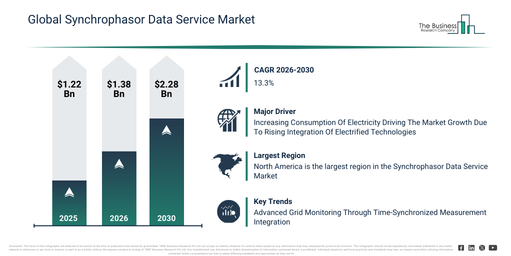
    The synchrophasor data service market has experienced swift expansion recently. This market is projected to expand from $1.22 billion in 2025 to reach $1.38 billion by 2026, demonstrating a compound annual growth rate (CAGR) of 13.1%. Historically, this expansion was driven by factors such as grid blackout incidents, an increase in phasor measurement unit deployments, past grid modernization initiatives, regulatory requirements for reliability, and the increasing complexity of transmission networks.

    The synchrophasor data service market size is expected to undergo rapid expansion in the coming years. It is projected to reach $2.28 billion in 2030, demonstrating a compound annual growth rate (CAGR) of 13.3%. This growth during the forecast period can be attributed to several factors, including the increasing penetration of renewable energy into grids, a rising need for real-time grid visibility, the expansion of digital substations, higher investments in grid analytics platforms, and growing cross-border grid interconnections. Significant trends anticipated in the forecast period include wide-area grid situational awareness platforms, real-time phasor data analytics services, cloud-hosted phasor data management, high-resolution grid event detection, and interoperable phasor data integration frameworks.

    Get A Free Sample Report With In-Depth Market Insights:

    https://thebusinessresearchcompany.com/sample_request?id=33334&type=smp&name=Synchrophasor%20Data%20Service%20Market%20Report%202026&utm_source=Blogs&utm_medium=Paid&utm_campaign=Oct_PR

    Synchrophasor Data Service Market Demand Drivers: What’s Powering Industry Growth?

    The anticipated rise in electricity usage is projected to fuel the expansion of the synchrophasor data service market in the future. Electricity consumption encompasses the overall electrical energy utilized by residential, commercial, industrial, and transport sectors for powering devices, machinery, heating, cooling, and various other activities. This consumption is growing due to rapid urbanization and industrial development, which places a greater burden on power grids and necessitates advanced monitoring, analytics, and grid-stability solutions, including synchrophasor data services. These services assist electricity systems by providing real-time, time-synchronized grid measurements, thereby improving the visibility, stability, and control of power networks. This empowers utilities to effectively handle increasing demand, incorporate renewable energy sources, avert power interruptions, and guarantee a dependable, secure, and resilient electricity supply. As an illustration, in April 2024, data from the Department of Climate Change, Energy, the Environment and Water, an Australia-based government administration, indicated that Australia’s total electricity generation reached approximately 273,106 gigawatt hours (GWh) in 2023. Of this, renewable energy sources contributed about 95,963 GWh, representing 35% of the total generation, which highlights both continuous high electricity usage and increasing grid complexity due to the integration of variable renewables. Consequently, the rising consumption of electricity is propelling the growth of the synchrophasor data service market.

    Synchrophasor Data Service Market Segments: Where Is Growth Concentrated?

    The synchrophasor data service market covered in this report is segmented –

    1) By Component: Software; Hardware; Services

    2) By Deployment Mode: On-Premises; Cloud

    3) By Application: Grid Monitoring; Fault Analysis; State Estimation; Power System Control; Other Applications

    4) By End-User: Utilities; Independent System Operators; Industrial; Other End-Users

    Subsegments:

    1) By Software: Phasor Data Management Software; Real Time Grid Analytics Software; Visualization and Reporting Software; State Estimation Software

    2) By Hardware: Phasor Measurement Units; Phasor Data Concentrators; Time Synchronization Devices; Communication Interface Hardware

    3) By Services: System Integration Services; Data Hosting and Management Services; Monitoring and Analytics Services; Maintenance and Support Services

    Synchrophasor Data Service Market Innovation Trends: What Developments Are Reshaping The Industry?

    Leading companies in the synchrophasor data service market are prioritizing the implementation of advanced solutions for synchrophasor data acquisition and concentration. This strategic focus aims to enhance grid visibility, improve fault detection, facilitate load forecasting, and enable more efficient distribution network planning, especially with increasing renewable energy integration and battery storage adoption. Synchrophasor data services are defined as systems that capture GPS time-synchronized measurements from Phasor Measurement Units (PMUs) and stream them into Phasor Data Concentrators (PDCs), where this information is aligned and made available for real-time analysis and interpretation across the power grid. For example, in June 2023, NOJA Power, an Australia-based electricity distribution equipment provider, unveiled a distribution-level synchrophasor acquisition capability as part of an ARENA-supported trial. This involved using the openPDC platform to aggregate synchrophasor data from around 100 RC-20 recloser controls. This specific implementation allowed engineers to analyze synchronized grid measurements across the distribution network, resulting in improvements to network impedance calculations, equipment failure detection, and operational planning.

    Synchrophasor Data Service Market Competitive Landscape: Who Leads The Industry?

    Major companies operating in the synchrophasor data service market are Siemens AG, Hitachi Energy Ltd., General Electric Company, ABB Ltd., Quanta Technology Inc., XJ Electric Co. Ltd., Schweitzer Engineering Laboratories Inc., CG Power and Industrial Solutions Limited, Qualitrol Company LLC, Electro Industries/GaugeTech, Vizimax Inc., Kalkitech Pvt. Ltd., Power System Engineering Inc., SATEC Global Ltd., Electric Power Group LLC, ERLPhase Power Technologies, NR Electric Co. Ltd., Arcteq Relays Ltd., Arbiter Systems Inc., LogicLab GmbH,

    View The Full Synchrophasor Data Service Market Report:

    https://thebusinessresearchcompany.com/report/synchrophasor-data-service-market-report?utm_source=Blogs&utm_medium=Paid&utm_campaign=Oct_PR

    Synchrophasor Data Service Market Geographic Landscape: Which Region Dominates Industry Growth?

    North America was the largest region in the synchrophasor data service market in 2025. Asia-Pacific` is expected to be the fastest-growing region in the forecast period. The regions covered in the synchrophasor data service market report are Asia-Pacific, South East Asia, Western Europe, Eastern Europe, North America, South America, Middle East, Africa.

    Reach Out To Our Team:

    The Business Research Company: https://www.thebusinessresearchcompany.com/

    Americas: +1 310-496-7795

    Asia: +44 7882 955267 & +91 8897263534

    Europe: +44 7882 955267

    Email us at: marketing@tbrc.info

    Follow us on:

    LinkedIn: https://in.linkedin.com/company/the-business-research-company

    YouTube: https://www.youtube.com/channel/UC24_fI0rV8cR5DxlCpgmyFQ

    Global Market Model: https://www.thebusinessresearchcompany.com/global-market-model
  • Switching Automation Light Grids Market Analysis 2026: Market Size, Growth Trends And Industry Outlook

    Switching Automation Light Grids Market Analysis 2026: Market Size, Growth Trends And Industry Outlook

    Backed by market attractiveness analysis, total addressable market sizing, company benchmarking matrices, interactive Excel dashboards, wider supply chain intelligence, emerging startup coverage, and detailed product-level insights, The Business Research Company’s 2026 market reports are designed to offer research that is more actionable and strategically valuable than ever.

    Switching Automation Light Grids Market Set To Climb From $2.62 Billion In 2026 To $3.96 Billion By 2030

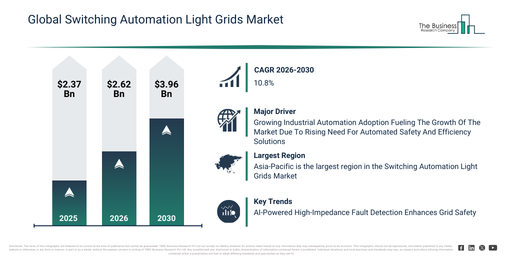
    The switching automation light grids market has experienced rapid growth in recent years. It is projected to expand from $2.37 billion in 2025 to $2.62 billion in 2026, at a compound annual growth rate (CAGR) of 10.6%. In previous periods, this growth was driven by factors such as distribution grid expansion, an increase in outage management requirements, advancements in feeder automation, a rise in industrial power demand, and the implementation of early smart grid pilots.

    The switching automation light grids market is anticipated to experience substantial growth over the coming years. It is projected to reach $3.96 billion by 2030, exhibiting a compound annual growth rate (CAGR) of 10.8%. The expansion during this forecast period is attributable to enhancements in smart distribution grids, an increase in renewable feeder connections, the widespread adoption of automated substations, greater investment in grid reliability, and the proliferation of digital utility programs. Significant trends for the forecast duration encompass the deployment of intelligent switching devices, an uptick in remote-controlled grid switching, broader smart relay integration, increasing embrace of automated fault isolation, and an escalation in sensor-based distribution control.

    Get A Free Sample Report With In-Depth Market Insights:

    https://thebusinessresearchcompany.com/sample_request?id=31181071&type=smp&name=Switching%20Automation%20Light%20Grids%20Market%20Report%202026&utm_source=Blogs&utm_medium=Paid&utm_campaign=Oct_PR

    Switching Automation Light Grids Market Growth Drivers: What’s Behind The Acceleration?

    The increasing embrace of industrial automation is projected to boost the expansion of the switching automation light grids market. Industrial automation involves incorporating technologies like robots, sensors, and computer-controlled systems into manufacturing processes to lessen human involvement and streamline operations. Its rise stems from businesses deploying automated systems to minimize human errors, accelerate production, and make better use of resources, leading to greater output at reduced operational expenses. Switching automation light grids facilitate this adoption by offering accurate, non-contact detection and safety oversight on production lines, allowing for the seamless and dependable coexistence of machinery and personnel. For example, data from the International Federation of Robotics (IFR), a Germany-based non-profit organization, indicated that by September 2025, 393,700 industrial robots were operational in US factories, marking a 3% rise from the previous year, with 34,200 new robots installed in 2024. Consequently, the expanding implementation of industrial automation is propelling the growth of the switching automation light grids market.

    Switching Automation Light Grids Market Segment Analysis: What Are The Core Market Categories?

    The switching automation light grids market covered in this report is segmented –

    1) By Product Type: Through Beam Light Grids; Retro Reflective Light Grids; Diffuse Light Grids

    2) By Voltage: Low Voltage; Medium Voltage; High Voltage

    3) By Application: Object Detection; Parts Counting; Presence Monitoring; Vehicle Separation; Pallet Overhang Detection; Access Guarding

    4) By Distribution Channel: Direct Sales; Distributors; Online Sales

    5) By End User Industry: Energy And Power; Oil And Gas; Manufacturing; Construction; Automotive

    Subsegments:

    1) By Through Beam Light Grids: Single Beam Through Beam Grid; Multi Beam Through Beam Grid; Safety Through Beam Grid; Industrial Through Beam Grid; High Speed Through Beam Grid

    2) By Retro Reflective Light Grids: Standard Retro Reflective Grid; Safety Retro Reflective Grid; Long Range Retro Reflective Grid; Industrial Retro Reflective Grid; High Precision Retro Reflective Grid

    3) By Diffuse Light Grids: Standard Diffuse Grid; Safety Diffuse Grid; Compact Diffuse Grid; Industrial Diffuse Grid; High Accuracy Diffuse Grid

    Switching Automation Light Grids Market Trends: What’s Defining The Industry’s Next Phase?

    Major companies in the switching automation light grids market are prioritizing the development of AI-powered high-impedance (HiZ) fault detection and edge-based grid monitors to elevate accuracy, speed, and safety within electricity distribution networks. This AI-powered high-impedance fault detection is a technological feature embedded in switching automation light grids that autonomously identifies, isolates, and de-energizes low-current faults stemming from damaged equipment or fallen trees, thereby enabling rapid intervention and averting potential wildfire incidents. For example, in March 2025, Eaton Corporation, a US-based power management company, launched its Eaton HiZ Protect solution, an AI-driven innovation deployed in Form-7 recloser controls. This solution is engineered to assist utilities with wildfire prevention and grid resiliency by integrating advanced sensors, machine learning, and edge-based implementation to detect and mitigate high-impedance faults with over 90% accuracy. Key capabilities include real-time fault isolation, the collection of high-fidelity data in remote grid areas, and predictive analytics for proactive system management, all of which empower utilities to improve operational safety and reliability.

    Switching Automation Light Grids Market Company Landscape And Competitive Strategy

    Major companies operating in the switching automation light grids market are Siemens AG, Panasonic Corporation, General Electric Co., Schneider Electric SE, Honeywell International Inc., Mitsubishi Electric Corporation, ABB Ltd., Eaton Corporation Plc, Johnson Controls Inc., Rockwell Automation Inc., Keyence Corporation, Omron Corporation, SICK AG, IFM Electronic GmbH, Banner Engineering Corp., Pepperl Fuchs Inc., Balluff GmbH, Datalogic S.p.A., Turck Inc., Leuze electronic GmbH + Co. KG, Carlo Gavazzi Holding AG, Autonics Corporation, and Contrinex AG.

    View The Full Switching Automation Light Grids Market Report:

    https://thebusinessresearchcompany.com/report/switching-automation-light-grids-market-report?utm_source=Blogs&utm_medium=Paid&utm_campaign=Oct_PR

    Switching Automation Light Grids Market Largest Region: Which Geography Holds The Highest Market Share?

    Asia-Pacific was the largest region in the switching automation light grids market in 2025. Asia-Pacific is expected to be the fastest-growing region in the forecast period. The regions covered in the switching automation light grids market report are Asia-Pacific, South East Asia, Western Europe, Eastern Europe, North America, South America, Middle East, Africa.

    Reach Out To Our Team:

    The Business Research Company: https://www.thebusinessresearchcompany.com/

    Americas: +1 310-496-7795

    Asia: +44 7882 955267 & +91 8897263534

    Europe: +44 7882 955267

    Email us at: marketing@tbrc.info

    Follow us on:

    LinkedIn: https://in.linkedin.com/company/the-business-research-company

    YouTube: https://www.youtube.com/channel/UC24_fI0rV8cR5DxlCpgmyFQ

    Global Market Model: https://www.thebusinessresearchcompany.com/global-market-model
  • Substation Wide Area Monitoring System Market Reaches $2.22 Billion In 2026: Key Developments Shaping Expansion

    Substation Wide Area Monitoring System Market Reaches $2.22 Billion In 2026: Key Developments Shaping Expansion

    Backed by market attractiveness analysis, total addressable market sizing, company benchmarking matrices, interactive Excel dashboards, wider supply chain intelligence, emerging startup coverage, and detailed product-level insights, The Business Research Company’s 2026 market reports are designed to offer research that is more actionable and strategically valuable than ever.

    Substation Wide Area Monitoring System Market Value Growth And Long-Term Outlook

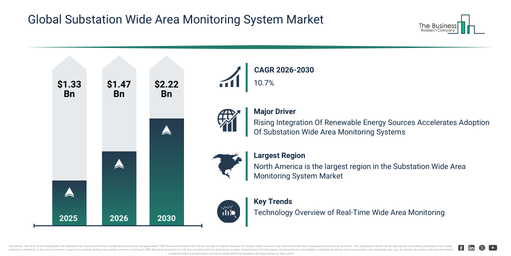
    The substation wide area monitoring system market has seen rapid growth in recent years. It is anticipated to expand from $1.33 billion in 2025 to $1.47 billion in 2026, exhibiting a compound annual growth rate (CAGR) of 10.5%. The historical rise in this market can be attributed to an increase in grid instability events, the expansion of high voltage networks, a surge in substation automation, a heightened focus on blackout prevention, and the development of synchrophasor technology.

    The substation wide area monitoring system market size is projected to experience substantial growth over the next few years. This market is expected to expand to $2.22 billion in 2030, exhibiting a compound annual growth rate (CAGR) of 10.7%. This projected growth can be linked to smart grid modernization programs, increasing renewable energy grid integration, the expansion of cross-border grid links, elevated investment in grid visibility tools, and a growing demand for predictive grid monitoring. Significant trends anticipated during the forecast period include the implementation of phasor measurement networks, the rise of real-time grid analytics platforms, the broadening deployment of high-speed substation sensors, the increasing utilization of event detection software, and the integration of wide area grid visualization tools.

    Get A Free Sample Report With In-Depth Market Insights:

    https://thebusinessresearchcompany.com/sample_request?id=33330&type=smp&name=Substation%20Wide%20Area%20Monitoring%20System%20Market%20Report%202026&utm_source=Blogs&utm_medium=Paid&utm_campaign=Oct_PR

    Substation Wide Area Monitoring System Market Growth Backed By Core Demand Fundamentals

    The incorporation of renewable energy sources is anticipated to drive expansion in the substation wide area monitoring system market in the future. These energy sources are naturally restored within a human timeframe and are capable of repeated use without depletion. The impetus for integrating renewable energy comes from the imperative to decrease greenhouse gas emissions and address climate change. A substation wide area monitoring system (WAMS) facilitates this integration by offering real-time visibility, synchronized operations, and stability surveillance across the electrical grid, thereby allowing operators to handle the fluctuating and intermittent nature of renewable power generation while upholding grid reliability. As an illustration, in January 2024, data from the International Energy Agency (IEA) revealed that worldwide renewable power capacity additions hit an unprecedented 510 GW in 2023, representing the quickest growth in over more than two decades, which substantially increases the demand for sophisticated grid monitoring and automation technologies. Consequently, the integration of renewable energy sources is fueling the expansion of the substation wide area monitoring system market.

    Substation Wide Area Monitoring System Market Segment Trends And Revenue Contributors

    The substation wide area monitoring system market covered in this report is segmented –

    1) By Component: Hardware; Software; Services

    2) By Deployment Type: On-Premises; Cloud-Based

    3) By Technology: Phasor Measurement Units; Wide Area Monitoring Protection and Control; Communication Systems; Other Technologies

    4) By Application: Voltage Monitoring; Current Monitoring

    5) By End-User: Utilities; Industrial Sector; Renewable Energy Sector; Other End-Users

    Subsegments:

    1) By Hardware: Phasor Measurement Units; Global Positioning System Receivers; Data Concentrators; Intelligent Electronic Devices; Communication Equipment

    2) By Software: Wide Area Monitoring Software; Data Analytics and Visualization Software; Event Detection and Alarm Software; System Management and Control Software; Performance Monitoring Software

    3) By Services: System Integration and Deployment Services; Consulting and Advisory Services; Support and Maintenance Services; Training and Education Services; Monitoring and Diagnostic Services

    Substation Wide Area Monitoring System Market Growth Trends Reshaping The Competitive Landscape

    Leading companies within the substation wide area monitoring systems market are increasingly concentrating on developing advanced real-time grid observability solutions to enhance situational awareness and operational reliability. Real-time grid observability utilizes high-frequency data from phasor measurement units (PMUs) to capture the dynamic behavior of power systems across wide areas, thereby enabling proactive decision-making and the early detection of system disturbances. For instance, in August 2024, Hitachi Energy, a Switzerland-based company, introduced a modernized iteration of its Network Manager WAMS, integrating PMU data directly into control room operations alongside traditional energy management system (EMS) measurements. This integration provides operators with detailed visualizations concerning sub-synchronous oscillations, system interactions, and voltage angle stability. The solution integrates seamlessly with Network Manager SCADA/EMS to deliver a unified operational view, allowing high-frequency WAMS analytics to be employed within existing applications for state estimation and voltage stability analysis, consequently offering early warnings of unsafe grid conditions. Additionally, Hitachi Energy launched an intuitive single user interface that unifies SCADA/EMS and WAMS views, while cloud-enabled capabilities facilitate scalable data processing to meet future grid monitoring requirements.

    Substation Wide Area Monitoring System Market Leading Companies And Competitive Benchmarking

    Major companies operating in the substation wide area monitoring system market are Mitsubishi Electric Corporation, Honeywell International Inc., Siemens AG, Hitachi Ltd., Cisco Systems Inc., General Electric Company, Schneider Electric SE, Siemens Energy AG, ABB Ltd, Toshiba Corporation, Eaton Eaton Corporation plc, Emerson Electric Co., Alstom SA, Rockwell Automation Inc, Nexans SA, Schweitzer Engineering Laboratories LLC, Open Systems International Inc., Kalkitech LLC, Quanta Technology LLC, Electric Power Group LLC, Vizimax Inc., Wasion Group Holdings Limited

    View The Full Substation Wide Area Monitoring System Market Report:

    https://thebusinessresearchcompany.com/report/substation-wide-area-monitoring-system-market-report?utm_source=Blogs&utm_medium=Paid&utm_campaign=Oct_PR

    Substation Wide Area Monitoring System Market Largest Region By Revenue And Market Share

    North America was the largest region in the substation wide area monitoring system market in 2025. Asia-Pacific is expected to be the fastest-growing region in the forecast period. The regions covered in the substation wide area monitoring system market report are Asia-Pacific, South East Asia, Western Europe, Eastern Europe, North America, South America, Middle East, Africa.

    Reach Out To Our Team:

    The Business Research Company: https://www.thebusinessresearchcompany.com/

    Americas: +1 310-496-7795

    Asia: +44 7882 955267 & +91 8897263534

    Europe: +44 7882 955267

    Email us at: marketing@tbrc.info

    Follow us on:

    LinkedIn: https://in.linkedin.com/company/the-business-research-company

    YouTube: https://www.youtube.com/channel/UC24_fI0rV8cR5DxlCpgmyFQ

    Global Market Model: https://www.thebusinessresearchcompany.com/global-market-model
  • Substation Battery Charger Market Growth Outlook For 2026: Drivers, Trends And Future Opportunities

    Substation Battery Charger Market Growth Outlook For 2026: Drivers, Trends And Future Opportunities

    Featuring market attractiveness scoring, total addressable market sizing, company benchmarking matrices, interactive Excel dashboards, deeper supply chain intelligence, emerging startup tracking, and granular product-level insights, The Business Research Company’s 2026 market reports are built to deliver research that is both more actionable and more strategically valuable.

    Substation Battery Charger Market Poised To Hit $2.31 Billion By 2030 With A 7.1% CAGR

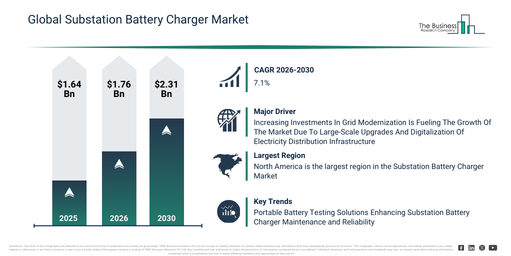
    The substation battery charger market size has shown strong growth in recent years. It is anticipated to expand from $1.64 billion in 2025 to $1.76 billion in 2026, achieving a compound annual growth rate (CAGR) of 6.9%. This historical growth can be attributed to factors such as grid expansion projects, the growth of transmission and distribution networks, increasing substation automation, elevated power reliability standards, and the expansion of industrial power infrastructure.

    The substation battery charger market is anticipated to experience robust expansion over the coming years. This market is projected to reach $2.31 billion by 2030, exhibiting a compound annual growth rate (CAGR) of 7.1%. Key drivers for this growth during the forecast period include the increasing deployment of smart grids, a rise in renewable substation installations, the expansion of EV charging grid nodes, greater investment in grid resilience, and more frequent digital substation upgrades. Noteworthy trends expected over the forecast period encompass the embrace of microprocessor-controlled charging units, an increase in modular rectifier-based chargers, greater integration of battery health diagnostics, the broader implementation of high-reliability DC backup systems, and a growing demand for intelligent dual-mode chargers.

    Get A Free Sample Report With In-Depth Market Insights:

    https://thebusinessresearchcompany.com/sample_request?id=31036534&type=smp&name=Substation%20Battery%20Charger%20Market%20Report%202026&utm_source=Blogs&utm_medium=Paid&utm_campaign=Oct_PR

    Substation Battery Charger Market Growth Catalysts And Demand Drivers

    Rising financial commitments to grid modernization are projected to boost the expansion of the substation battery charger market in the future. These investments encompass capital outlays and strategic funding dedicated to enhancing, digitalizing, and enlarging electrical grid infrastructure, thereby boosting reliability, resilience, and supporting advanced technological integration. The surge in grid modernization investments stems from the urgent requirement to modernize outdated grid infrastructure and incorporate renewable energy sources, leading utilities and governments to channel substantial funds into smart grid projects and transmission improvements. Such investments support substation battery chargers through the enhancement of substations with sophisticated power management, automation, and backup energy systems, guaranteeing dependable charging, monitoring, and continuous functioning even during power disruptions. As an illustration, in July 2023, data from the International Energy Agency (IEA), a France-based intergovernmental body, indicated that the European Union’s 2022 action plan projects cumulative electricity grid investments of approximately EUR 584 billion (USD 633 billion) up to 2030. Of this total, roughly EUR 400 billion (USD 434 billion) is designated for distribution network upgrades, with EUR 170 billion (USD 184 billion) specifically earmarked for grid digitalization. Consequently, the escalating investments in grid modernization are fueling the expansion of the substation battery charger market.

    Substation Battery Charger Market Segment Analysis Spotlighting Growth Areas

    The substation battery charger market covered in this report is segmented –

    1) By Type: Float Charger; Boost Charger; Dual-Mode Charger; Other Types

    2) By Battery Type: Lead-Acid; Nickel-Cadmium; Lithium-Ion; Other Battery Types

    3) By Application: Transmission Substations; Distribution Substations; Other Applications

    4) By Sales Channel: Direct Sales; System Integrators; Distributors and Wholesalers

    5) By End-User: Utilities; Industrial; Commercial; Other End-Users

    Subsegments:

    1) By Float Charger: Constant Voltage Float Charging; Automatic Voltage Regulation Float Charging; Temperature Compensated Float Charging; Digital Controlled Float Charging

    2) By Boost Charger: High Current Boost Charging; Timed Boost Charging; Manual Boost Charging; Automatic Boost Charging

    3) By Dual-Mode Charger: Automatic Float and Boost Switching; Microprocessor Controlled Dual Mode Charging; Load Sharing Dual Mode Charging; Battery Health Based Dual Mode Charging

    4) By Other Types: Portable Battery Charging Systems; Customized Industrial Charging Systems; Environment Resistant Charging Systems; Auxiliary Power Charging Systems

    Substation Battery Charger Market Trends Shaping Long-Term Demand

    Leading companies within the substation battery charger market are concentrating on developing advanced solutions, such as portable offerings, to facilitate on-site battery analysis, rapid testing, and preventative upkeep in remote and critical utility environments. Portable solutions are defined as compact, easily movable battery charging and testing apparatus that can be transported to substations or field locations for immediate diagnostics, servicing, and emergency assistance. For example, in November 2025, Trystar LLC, a US-based manufacturer of electrical power solutions, unveiled its ChargePak Portable Battery Testing System (BTS) to assist in the efficient testing and maintenance of vital battery systems. This system supports automated test sequences, real-time data acquisition, and thorough performance reporting to promptly pinpoint battery health concerns. It is engineered to be compatible with a broad spectrum of industrial battery types and capacities, allowing adaptable deployment across substations, utilities, and other critical infrastructure applications, consequently enhancing maintenance efficiency and reliability.

    Substation Battery Charger Market Industry Leaders And Competitive Landscape

    Major companies operating in the substation battery charger market are Siemens AG, Hitachi Energy Ltd., General Electric Company, Schneider Electric SE, ABB Ltd., Eaton Corporation plc, Emerson Electric Co., Exide Industries Limited, Saft Groupe S.A., Narada Power Source Co. Ltd., Socomec Group S.A., C&D Technologies Inc., Benning Elektrotechnik und Elektronik GmbH & Co. KG, AEG Power Solutions GmbH, Statron AG, Alcad Ltd., Unipower LLC, Chloride Power Systems & Solutions Ltd., AEES Power Systems Pvt. Ltd., Powertron India Private Limited.

    View The Full Substation Battery Charger Market Report:

    https://thebusinessresearchcompany.com/report/substation-battery-charger-market-report?utm_source=Blogs&utm_medium=Paid&utm_campaign=Oct_PR

    Substation Battery Charger Market Regional Analysis And Leading Geography

    North America was the largest region in the substation battery charger market in 2025. Asia-Pacific is expected to be the fastest-growing region in the forecast period. The regions covered in the substation battery charger market report are Asia-Pacific, South East Asia, Western Europe, Eastern Europe, North America, South America, Middle East, Africa.

    Reach Out To Our Team:

    The Business Research Company: https://www.thebusinessresearchcompany.com/

    Americas: +1 310-496-7795

    Asia: +44 7882 955267 & +91 8897263534

    Europe: +44 7882 955267

    Email us at: marketing@tbrc.info

    Follow us on:

    LinkedIn: https://in.linkedin.com/company/the-business-research-company

    YouTube: https://www.youtube.com/channel/UC24_fI0rV8cR5DxlCpgmyFQ

    Global Market Model: https://www.thebusinessresearchcompany.com/global-market-model