The Business Research Company’s 2026 market reports combine market attractiveness scoring, total addressable market sizing, company benchmarking matrices, interactive Excel dashboards, deeper supply chain intelligence, emerging startup tracking, and granular product-level insights to deliver research that is more actionable and strategically valuable.
What Is The 3D Hydrogel Culture Market Growth Rate? A 16.9% CAGR Outlook Through 2030
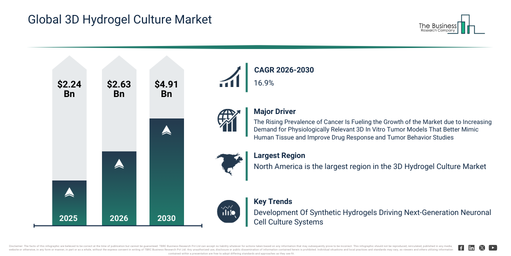
The 3D hydrogel culture market has seen significant growth in recent years. It is anticipated to expand from $2.24 billion in 2025 to $2.63 billion in 2026, achieving a compound annual growth rate (CAGR) of 17.2%. Historically, this market expansion has been driven by advancements in cell culture techniques, the increased adoption of in vitro disease models, the growth of pharmaceutical R&D activities, a rising demand for predictive drug testing models, and the increasing use of tissue engineering tools.
The 3D hydrogel culture market is set to experience substantial growth over the next few years, with its valuation expected to reach $4.91 billion by 2030, driven by a compound annual growth rate (CAGR) of 16.9%. This anticipated expansion can be attributed to increasing investments in regenerative medicine research, the rising adoption of personalized medicine approaches, the broadening scope of organ-on-chip technologies, a greater demand for advanced toxicology testing platforms, and ongoing innovation in hydrogel material science. Key trends during this period are projected to include the wider adoption of organoid and spheroid culture models, an increased utilization of biomimetic hydrogel matrices, deeper integration of microfluidic 3D culture platforms, the expansion of bioprinting-based cell culture systems, and a heightened emphasis on physiologically relevant drug screening.
Access A Free Sample Of The Latest 3D Hydrogel Culture Market Analysis:
Why Is The 3D Hydrogel Culture Market Growing? The Key Demand Driver Explained
The rising occurrence of cancer is anticipated to drive the expansion of the 3D hydrogel culture market in the future. Cancer refers to a collection of illnesses marked by unregulated cell proliferation and the capacity to infiltrate or spread to other bodily regions, posing intricate challenges for scientific investigation and pharmaceutical development. The increase in cancer diagnoses is generating a need for sophisticated in vitro models that can closely replicate human tissue environments, facilitating more precise investigations into tumor behavior and treatment responses. 3D hydrogel culture assists cancer research by supplying three-dimensional scaffolds that imitate the extracellular matrix, allowing researchers to examine cell-cell interactions, tumor progression, and drug effectiveness within a physiologically relevant setting. For instance, in October 2025, according to the Australian Institute of Health and Welfare, an Australia-based government agency, it is projected that approximately 969,000 people will be alive who were diagnosed with cancer over the last 10 years, and roughly 170,000 new cases of cancer will be diagnosed in Australia. This indicates an increase of around 93% over 25 years, with age-standardized cancer incidence estimated at 614 cases per 100,000 people and mortality rates projected to decline to 194 deaths per 100,000 people. Hence, the increasing prevalence of cancer is fueling the 3D hydrogel culture market.
What Are The Main Segments Of The 3D Hydrogel Culture Market?
The 3D hydrogel culture market covered in this report is segmented –
1) By Product: Scaffold Based, Scaffold Free, Bioreactors, Microfluidic, Bioprinting
2) By Application: Cancer Research, Stem Cell Research And Tissue Engineering, Drug Discovery And Toxicology Testing, Other Applications
3) By End-User: Pharmaceutical And Biotechnology Companies, Academic And Research Institutes, Hospitals, Other End-Users
Subsegments:
1) By Scaffold Based: Natural Polymer Hydrogels, Synthetic Polymer Hydrogels, Composite Hydrogels, Functionalized Hydrogels, Thermoresponsive Hydrogels
2) By Scaffold Free: Multicellular Spheroids, Patient Derived Organoids, Cell Sheets, Low Attachment Plate Aggregates, Magnetic Levitation Microtissues
3) By Bioreactors: Spinner Flask Bioreactors, Rotating Wall Vessel Bioreactors, Perfusion Bioreactors, Wave Bag Bioreactors, Stirred Tank Bioreactors
4) By Microfluidic: Organ On A Chip Platforms, Perfusion Microfluidic Chips, Droplet Microfluidic Systems, Gradient Generation Chips, Barrier Model Chips
5) By Bioprinting: Inkjet Bioprinting, Extrusion Bioprinting, Laser Assisted Bioprinting, Microvalve Bioprinting, Stereolithography Bioprinting
3D Hydrogel Culture Market Trend Analysis: Where Leading Companies Are Focusing
Major companies operating in the 3D hydrogel culture market are prioritizing innovation in tissue engineering, focusing on developing synthetic and xeno-free hydrogels. This initiative seeks to enable more physiologically relevant, accurate, and reproducible three-dimensional neuronal cell culture systems. The development of synthetic and xeno-free hydrogels involves creating formulations that exclude animal-derived components while still supporting robust cell-cell and cell-matrix interactions for improved in vitro modeling and potential in vivo applications. For instance, in September 2025, TheWell Bioscience Inc., a US-based company specializing in advanced 3D cell culture platforms, commercially launched its VitroGel NEURON. This innovative synthetic and xeno-free hydrogel establishes a defined, reproducible, and scalable environment for neuronal growth, differentiation, and network formation. The product effectively overcomes the limitations of animal-derived matrices by efficiently supporting both 3D and 2D neuronal cultures and serving as an injectable carrier for in vivo delivery. This hydrogel is engineered to foster robust cell-cell and cell-matrix interactions, empowering researchers to create more physiologically relevant neuronal models for studies in neurodevelopment and neurodegeneration.
Which Companies Are Major Players In The 3D Hydrogel Culture Market?
Major companies operating in the 3D hydrogel culture market are Merck KGaA, Thermo Fisher Scientific Inc., Corning Incorporated, Lonza Group AG, Sartorius, Bio-Techne Corporation, PromoCell GmbH, Cosmo Bio, AIM Biotech, AMSBIO (AMS Biotechnology), TheWell Bioscience, Cell Guidance Systems (CellGS), Cellendes GmbH, CD Bioparticles, Ferentis (Ferentis AG), Gelomics, TissueLabs, CELLINK (BICO), PepGel LLC, 3D Biotek Inc.
Get The Complete 3D Hydrogel Culture Market Analysis Here:
Which Region Held The Largest Share Of The 3D Hydrogel Culture Market In 2025?
North America was the largest region in the 3D hydrogel culture market in 2025. Asia-Pacific is expected to be the fastest-growing region in the forecast period. The regions covered in the 3D hydrogel culture market report are Asia-Pacific, South East Asia, Western Europe, Eastern Europe, North America, South America, Middle East, Africa.
Reach Out To Our Team:
The Business Research Company: https://www.thebusinessresearchcompany.com/
Americas: +1 310-496-7795
Asia: +44 7882 955267 & +91 8897263534
Europe: +44 7882 955267
Email us at: marketing@tbrc.info
Follow us on:
LinkedIn: https://in.linkedin.com/company/the-business-research-company
YouTube: https://www.youtube.com/channel/UC24_fI0rV8cR5DxlCpgmyFQ
Global Market Model: https://www.thebusinessresearchcompany.com/global-market-model
Leave a Reply