Heart Blocks Treatment Devices Market Trends Are Creating New Opportunities For Industry Leaders
Through market attractiveness analysis, total addressable market evaluation, company benchmarking matrices, interactive Excel dashboards, expanded supply chain intelligence, emerging startup coverage, and detailed product insights, The Business Research Company’s 2026 market reports provide more actionable and strategically valuable research.
The heart blocks treatment devices market has witnessed significant progress recently, driven by various healthcare and demographic factors. As cardiovascular diseases continue to rise globally, the demand for effective treatment options, including advanced devices, is growing steadily. This overview explores the market’s size, growth drivers, key segments, ongoing trends, major players, and regional outlook to provide a comprehensive understanding of the sector’s future trajectory.
Heart Blocks Treatment Devices Market Size and Expected Growth Through 2030
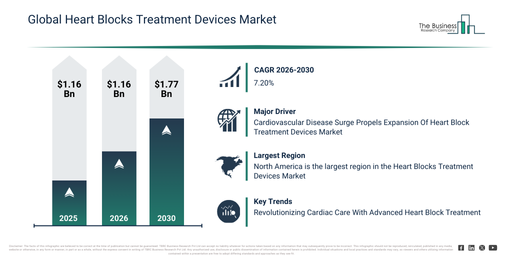
The market for heart blocks treatment devices has demonstrated solid growth in recent years. It is forecasted to expand from $3.36 billion in 2025 to $3.59 billion in 2026, marking a compound annual growth rate (CAGR) of 6.9%. Looking ahead, this market is projected to further increase to $4.74 billion by 2030, growing at an accelerated CAGR of 7.2%. Factors contributing to this expansion include a rising number of cardiovascular disease cases, an aging population, enhancements in hospital cardiac care infrastructure, wider access to cardiac diagnostics, and technological improvements in implantable devices.
Download A Free Sample Report For Comprehensive Market Insights:
https://www.thebusinessresearchcompany.com/sample.aspx?id=12062&type=smp
Growing Adoption of Digital Health and Remote Monitoring Boosts Heart Blocks Device Market
The period ahead is expected to see expanding use of remote patient monitoring systems and increased investments in cardiac digital health solutions. These advancements are driving demand for personalized rhythm management and pushing the growth of home-based cardiac care models. Continuous innovation in implantable cardiac devices is playing a crucial role as well. Key trends influencing the market include wider adoption of advanced pacemaker technologies, greater utilization of implantable cardiac rhythm devices, integration of remote cardiac monitoring tools, a shift toward minimally invasive cardiac procedures, and increasing emphasis on long-term rhythm management strategies.
Rising Cardiovascular Disease Rates Propel Market Demand for Heart Block Treatment Devices
One of the primary factors fueling growth in the heart blocks treatment devices market is the increasing prevalence of cardiovascular diseases. These conditions, which affect the heart and blood vessels, include coronary artery disease, heart failure, and stroke. The surge in cardiovascular disease cases is largely driven by lifestyle changes, dietary habits, rising obesity and diabetes rates, and an aging global population. Heart block treatment devices are essential in managing abnormalities or defects in the heart’s electrical conduction system, offering critical support for those affected. For example, in March 2024, GOV.UK reported that over 1,862,500 people in England—approximately 3% of the population—were diagnosed with coronary heart disease during the 2023 financial year, illustrating the large patient base driving demand for these devices.
Access The Complete Heart Blocks Treatment Devices Market Report:
Aging Population as a Key Factor Supporting Heart Blocks Treatment Device Market Expansion
The growing proportion of older adults worldwide represents another significant market driver. As people age, the likelihood of developing heart block and other cardiac conduction system disorders increases, consequently boosting the need for treatment devices. In July 2024, data from the UK Parliament’s House of Commons Library indicated that in 2022 there were 12.7 million individuals aged 65 or older in the UK, making up 19% of the total population. This number is expected to climb to 22.1 million by 2072, or 27% of the population. Such demographic shifts are anticipated to elevate demand for heart blocks treatment devices in the coming decades.
Heart Blocks Treatment Devices Market Segmentation by Clinical Type, Product, and End User
The market is categorized into several key segments:
– By Clinical Classification: First-Degree Heart Block, Second-Degree Heart Block, Third-Degree Heart Block
– By Product Type: Transcutaneous Pacing (TCP), Pacemakers
– By End-User: Hospitals and Cardiac Care Centers, Clinics, Home-Care and Remote Monitoring Users
Additional subsegments include:
– For First-Degree Heart Block: Cardiac Monitoring Devices, Temporary Pacing Devices (rare or symptomatic cases)
– For Second-Degree Heart Block: Type I (Wenckebach) Management Devices, Type II Management Devices, Pacemakers
– For Third-Degree Heart Block: Permanent Pacemakers (primary treatment), Cardiac Resynchronization Therapy (CRT) Devices, Temporary Pacing Devices (acute or emergency management)
Emerging Technological Advances Highlighted in Heart Blocks Treatment Devices
Market leaders are focusing on cutting-edge technologies, such as dual-chamber pacemakers, to enhance treatment reliability. These devices, including leadless pacing systems, address abnormal or slow heart rhythms by pacing two chambers of the heart—the right atrium and right ventricle. For instance, in November 2023, Abbott Laboratories introduced a dual-chamber pacemaker in the U.S. using innovative i2i technology. This method uses high-frequency pulses transmitted through the body’s blood to communicate between the leadless pacemakers, representing a major leap in device functionality and patient care.
Key Players Driving Innovation and Competition in the Heart Blocks Treatment Devices Market
The heart blocks treatment devices market is competitive, with several prominent companies shaping its development. Leading organizations include Medtronic plc, Abbott Laboratories, Boston Scientific Corporation, Biotronik SE & Co. KG, MicroPort Scientific Corporation, Lepu Medical Technology (Beijing) Co. Ltd., Nihon Kohden Corporation, ZOLL Medical Corporation, LivaNova PLC, Osypka Medical GmbH, Shree Pacetronix Ltd., EBR Systems Inc., Medico S.p.A., Cook Medical, B. Braun SE, Oscor Inc., Pacetronix Ltd., Fukuda Denshi Co. Ltd., Teleflex Incorporated, and NIPRO Corporation.
Regional Market Leadership and Growth Outlook for Heart Blocks Treatment Devices
In 2025, North America held the largest market share in the heart blocks treatment devices sector. Meanwhile, the Asia-Pacific region is expected to experience the fastest growth during the forecast period. The report covers multiple geographic regions, including Asia-Pacific, South East Asia, Western Europe, Eastern Europe, North America, South America, the Middle East, and Africa, providing a global perspective on market opportunities and trends.
Get in touch with us:
The Business Research Company: https://www.thebusinessresearchcompany.com/
Americas: +1 310-496-7795
Asia: +44 7882 955267 & +91 8897263534
Europe: +44 7882 955267
Email us at: marketing@tbrc.info
Follow us on:
LinkedIn: https://in.linkedin.com/company/the-business-research-company
YouTube: https://www.youtube.com/channel/UC24_fI0rV8cR5DxlCpgmyFQ
Global Market Model: https://www.thebusinessresearchcompany.com/global-market-model