Hormonal Intrauterine Devices (IUDs) Market Set To Grow From $3.17 Billion In 2026 To $4.74 Billion By 2030 At A CAGR Of 10.5%
Through market attractiveness analysis, total addressable market evaluation, company benchmarking matrices, interactive Excel dashboards, expanded supply chain intelligence, emerging startup coverage, and detailed product insights, The Business Research Company’s 2026 market reports provide more actionable and strategically valuable research.
The hormonal intrauterine devices (IUDs) market has witnessed significant expansion recently, reflecting a growing preference for effective long-term contraceptive options. Rising awareness about family planning and advancements in women’s reproductive health are contributing to this rapid growth. Here, we explore the current market size, key growth drivers, important market segments, industry trends, major players, and regional outlook shaping the future of hormonal IUDs.
Market Size and Projected Growth in the Hormonal Intrauterine Devices Market
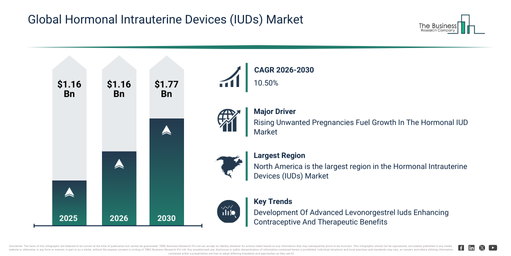
The hormonal intrauterine devices market has shown impressive growth, expanding from $2.87 billion in 2025 to an expected $3.18 billion in 2026, with a compound annual growth rate (CAGR) of 10.6%. This growth reflects increasing awareness of family planning choices, broader reproductive healthcare initiatives, a rising preference for long-acting contraceptive methods, and greater availability of hormone-based intrauterine devices. Public health programs supporting contraception have also played a crucial role in this expansion. Looking ahead, the market is forecasted to reach $4.74 billion by 2030, growing at a steady CAGR of 10.5%. The anticipated growth is fueled by a surge in demand for non-surgical contraceptive methods, increased attention to menstrual health management, wider access in developing regions, and continuous innovation in hormone delivery technologies. Notable trends include greater adoption of low-dose hormonal IUDs, rising interest in long-acting reversible contraceptives, increasing popularity of frameless IUD designs, expanded therapeutic uses, and a heightened focus on patient comfort and safety.
Download A Free Sample Report For Comprehensive Market Insights:
https://www.thebusinessresearchcompany.com/sample.aspx?id=19091&type=smp
Factors Fueling Hormonal Intrauterine Devices Market Expansion
A significant contributor to the hormonal IUD market growth is the rising incidence of unwanted pregnancies worldwide. Unintended pregnancies, defined as those not planned or desired at conception, can result from contraceptive failure, limited access to birth control, incorrect usage, or even sexual violence. Restricted availability of effective contraception diminishes individuals’ control over their reproductive choices, thereby increasing the risk of unplanned pregnancies. Hormonal IUDs, known for their high efficacy with a failure rate of less than 1%, offer reliable, long-term contraception ranging from 3 to 7 years depending on the type. For example, data from the Society for Family Planning in July 2025 highlighted an increase in abortions in the US to 1.14 million in 2024, up from 1.05 million in 2023. This rise in unintended pregnancies directly stimulates demand for hormonal IUDs as a preventive measure.
Market Segmentation Reveals Key Opportunities Within the Hormonal IUD Industry
This market is categorized across several dimensions to capture its full diversity. The segments include:
1) Type of hormonal IUD: 13 milligram, 19 milligram, and 52 milligram devices
2) Device design: framed and frameless intrauterine devices
3) Hormone type: levonorgestrel-releasing and progesterone-releasing IUDs
4) Application by age groups: 20-24 years, 25-34 years, 35-44 years, and other uses
Further subcategories break down into distinctions such as low-dose versus specialty devices within each milligram grouping. For example, 13 mg IUDs include low-dose and specialty options for specific medical conditions. The 19 mg devices are similarly divided, while 52 mg IUDs include standard, extended-release, and specialty devices designed to address heavy menstrual bleeding or endometriosis.
Access The Complete Hormonal Intrauterine Devices (IUDs) Market Report:
Current Industry Trends Advancing Hormonal Intrauterine Devices Market Growth
Leading players in the hormonal IUD space are focusing on creating advanced solutions that not only prevent pregnancy but also address menstrual health issues. Levonorgestrel-releasing IUDs are gaining traction as they offer long-term contraception while helping reduce menstrual bleeding and cramps. For instance, in October 2024, the US nonprofit Medicines360 introduced Avibela, a 52 mg levonorgestrel IUD in Zambia. This device provides up to eight years of pregnancy prevention and up to five years of relief from heavy menstrual bleeding. It works by thickening cervical mucus to block sperm and thinning the uterine lining to lessen menstrual flow.
Competitive Landscape of Key Players in the Hormonal IUD Market
Several major companies are actively competing and innovating in the hormonal intrauterine devices market. Prominent industry participants include Bayer AG, Organon & Companies, Gedeon Richter Plc, Meril Life Science Pvt Ltd., Teva UK Limited, Medicines360, HLL Lifecare Limited, Pregna International Ltd., DKT WomanCare Global, SMB Corporation of India, Oy Leiras, OCON Healthcare, Bayer Healthcare Pharmaceuticals, CooperSurgical Inc., Mithra Pharmaceuticals, Shanghai Dahua Medical Apparatus Co. Ltd., Beijing Zizhu Pharmaceutical Co. Ltd., Shanghai Jiansheng Medical Devices Co. Ltd., Zhejiang Xianju Pharmaceutical Co. Ltd., and Shanghai Chuangling Medical Devices Co. Ltd. These companies focus on expanding product portfolios, enhancing hormone delivery technologies, and increasing market penetration globally.
Regional Outlook Highlights North America’s Lead and Asia-Pacific’s Rapid Growth
In 2025, North America dominated the hormonal intrauterine devices market, holding the largest regional share. However, the Asia-Pacific region is projected to experience the fastest growth throughout the forecast period. The market analysis encompasses major regions including Asia-Pacific, South East Asia, Western Europe, Eastern Europe, North America, South America, the Middle East, and Africa, providing a comprehensive global perspective on evolving demand and regional dynamics.
Get in touch with us:
The Business Research Company: https://www.thebusinessresearchcompany.com/
Americas: +1 310-496-7795
Asia: +44 7882 955267 & +91 8897263534
Europe: +44 7882 955267
Email us at: marketing@tbrc.info
Follow us on:
LinkedIn: https://in.linkedin.com/company/the-business-research-company
YouTube: https://www.youtube.com/channel/UC24_fI0rV8cR5DxlCpgmyFQ
Global Market Model: https://www.thebusinessresearchcompany.com/global-market-model