Hereditary Transthyretin Amyloidosis Market Opportunities Are Emerging Beyond Traditional Growth Areas
Enhanced with market attractiveness analysis, total addressable market evaluation, company benchmarking matrices, interactive Excel dashboards, expanded supply chain intelligence, emerging startup coverage, and detailed product insights, The Business Research Company’s 2026 market reports deliver more actionable and strategically valuable research.
Hereditary Transthyretin Amyloidosis Market Value Expansion And Long-Term Growth Outlook
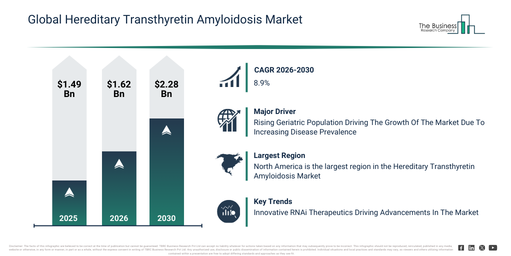
The market for hereditary transthyretin amyloidosis has experienced substantial expansion, projected to advance from a valuation of $1.49 billion in 2025 to $1.62 billion by 2026, reflecting a compound annual growth rate of 9.0%. This growth trajectory during the historical period is attributable to several key factors, including heightened awareness of ATTR amyloidosis within the medical community, the successful introduction and adoption of tafamidis as a therapeutic option, the proliferation of dedicated neurology and cardiology centers, advancements in genetic testing for TTR mutations, and the increasing establishment of patient registry programs.
The market for hereditary transthyretin amyloidosis is poised for substantial expansion in the coming years, projected to reach $2.28 billion by 2030 with a compound annual growth rate of 8.9%. This anticipated growth is fueled by advancements in gene therapies, increased funding for rare disease investigations, broader implementation of personalized medicine, the development of CRISPR-based interventions, and enhanced diagnostic monitoring tools. Key developments shaping this period include a greater embrace of gene silencing techniques, the growing utility of RNAi treatments, a heightened emphasis on early detection of cardiac and neurological symptoms, the proliferation of oral treatment alternatives, and the refinement of long-term disease management plans.
Download A Free Sample Report For Comprehensive Market Insights:
https://www.thebusinessresearchcompany.com/sample.aspx?id=22003&type=smp
Hereditary Transthyretin Amyloidosis Market Growth Factors: Which Forces Are Supporting Market Expansion?
The expanding cohort of elderly individuals is anticipated to be a significant catalyst for the hereditary transthyretin amyloidosis market’s expansion in the foreseeable future, as this demographic, encompassing those aged 65 and above, frequently necessitates tailored medical attention and care due to the natural aging process. This demographic surge is primarily attributable to enhanced lifespans, a consequence of improvements in medical science and overall living standards. Hereditary transthyretin amyloidosis (hATTR) presents a considerable health challenge to this aging population, manifesting as debilitating neuropathy and cardiomyopathy, which consequently elevates illness and mortality rates among older adults. Illustrating this trend, data from the Population Reference Bureau, a non-profit entity based in the United States, projected in January 2024 that the number of individuals in the US aged 65 and older will surge from 58 million in 2022 to 82 million by 2050, representing a substantial 47% rise. Consequently, the increasing prevalence of the geriatric population directly correlates with the upward trajectory of the hereditary transthyretin amyloidosis market.
Hereditary Transthyretin Amyloidosis Market Segments: Where Are The Largest Growth Opportunities?
The hereditary transthyretin amyloidosis market covered in this report is segmented –
1) By Type: Oral, Subcutaneous Injection, Other Types
2) By Drug Class: RNAi Agents (Patisiran), Small Interfering RNAs (siRNAs) (Vutrisiran)
3) By Distribution Channel: Hospital Pharmacies, Retail Pharmacies
4) By Application: Hospital, Clinic, Other Applications
Subsegments:
1) By Oral: Tafamidis, Experimental Oral Therapies
2) By Subcutaneous Injection: Inotersen, Vutrisiran
3) By Other Types: Intravenous Therapies, Gene Silencing Therapies, CRISPR-Based Therapies
Hereditary Transthyretin Amyloidosis Market Industry Trends: What Changes Are Reshaping Demand?
Within the competitive landscape of the hereditary transthyretin amyloidosis sector, leading pharmaceutical entities are pioneering novel treatment modalities, prominently featuring RNA interference (RNAi) therapies engineered to diminish the synthesis of the transthyretin (TTR) protein. These RNAi therapies leverage the mechanism of RNA interference to selectively inhibit gene expression, consequently curtailing the production of proteins implicated in disease pathology. As a case in point, Alnylam Pharmaceuticals, Inc., an American biopharmaceutical firm, presented an sNDA to the US FDA in October 2024, seeking approval for Vutrisiran (AMVUTTRA) as a therapeutic intervention for amyloidosis concerning the heart muscle in individuals with transthyretin amyloidosis. This regulatory action highlights their forward-thinking RNAi strategy, aimed at suppressing TTR protein levels, a critical determinant in the advancement of the disease. The prospect of Vutrisiran being administered subcutaneously suggests a more accessible and less burdensome treatment schedule than conventional intravenous methods, potentially establishing it as a groundbreaking alternative for those affected by this severe ailment.
Hereditary Transthyretin Amyloidosis Market Major Participants And Competitive Dynamics
Major companies operating in the hereditary transthyretin amyloidosis market are Alnylam Pharmaceuticals Inc., Ionis Pharmaceuticals Inc., BridgeBio Pharma Inc., Pfizer Inc., Eli Lilly and Company, Intellia Therapeutics Inc., Regeneron Pharmaceuticals Inc., AstraZeneca plc, Novartis AG, Roche Holding AG, Sanofi S.A., Takeda Pharmaceutical Company Limited, GlaxoSmithKline plc, Bristol Myers Squibb, Merck and Co Inc., Johnson and Johnson, AbbVie Inc., Biogen Inc., Vertex Pharmaceuticals Incorporated, Amgen Inc.
Access The Complete Hereditary Transthyretin Amyloidosis Market Report:
Hereditary Transthyretin Amyloidosis Market Leading Geography: Which Region Generates The Most Revenue?
North Americawas the largest region in the hereditary transthyretin amyloidosis market in 2025. Asia-Pacificis expected to be the fastest-growing region in the forecast period. The regions covered in the hereditary transthyretin amyloidosis market report are Asia-Pacific, South East Asia, Western Europe, Eastern Europe, North America, South America, Middle East, Africa.
Get in touch with us:
The Business Research Company: https://www.thebusinessresearchcompany.com/
Americas: +1 310-496-7795
Asia: +44 7882 955267 & +91 8897263534
Europe: +44 7882 955267
Email us at: marketing@tbrc.info
Follow us on:
LinkedIn: https://in.linkedin.com/company/the-business-research-company
YouTube: https://www.youtube.com/channel/UC24_fI0rV8cR5DxlCpgmyFQ
Global Market Model: https://www.thebusinessresearchcompany.com/global-market-model