Built to provide research that’s more actionable and strategically valuable, The Business Research Company’s 2026 market reports include market attractiveness analysis, total addressable market sizing, company benchmarking matrices, interactive Excel dashboards, broader supply chain intelligence, emerging startup tracking, and in-depth product insights.
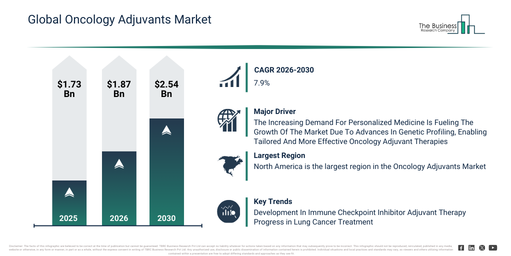
Oncology Adjuvants Market Growth From $1.87 Billion In 2026 To $2.53 Billion By 2030 At A CAGR Of 7.9%
The oncology adjuvants market has shown strong expansion in recent years. It is projected to grow from $1.73 billion in 2025 to $1.87 billion in 2026, maintaining a compound annual growth rate (CAGR) of 8.2%. This historical growth can be attributed to several factors: the limited availability of oncology adjuvants, a reliance on chemotherapy and radiation as primary treatments, the growing cancer incidence globally, increasing clinical research on adjuvant therapies, and a rising awareness of adjuvant benefits among oncologists.
The oncology adjuvants market is expected to experience substantial growth in the upcoming years, with its valuation projected to reach $2.54 billion by 2030, demonstrating a compound annual growth rate (CAGR) of 7.9%. This expansion during the forecast period is largely attributable to the development of innovative immunotherapy adjuvants, the proliferation of targeted therapy options, the growing adoption of combination therapy approaches, the integration of precision medicine and genomic profiling, and increased investment in oncology research and clinical trials. Significant trends for the forecast period include the rising acceptance of immunotherapy and targeted therapy adjuvants, enhanced integration of personalized cancer treatment plans, the expansion of oral and subcutaneous administration routes, an increase in multi-modal cancer treatment strategies, and a strong focus on improving patient outcomes and reducing therapy side effects.
Get A Free Sample Report With In-Depth Market Insights:
Oncology Adjuvants Market Opportunity Drivers: What’s Unlocking New Revenue Potential?
The growing demand for personalized medicine is expected to propel the growth of the oncology adjuvants market going forward. Personalized medicine refers to a medical model that uses information about a person’s genes and lifestyle environment to tailor treatments and healthcare to their specific needs. Personalized medicine is rising due to advancements in genetic and molecular profiling, which enable treatments tailored to an individual’s unique biological makeup, improving effectiveness and reducing adverse effects. Oncology adjuvants help personalized medicine by allowing the customization of additional cancer treatments based on a patient’s unique genetic makeup and tumor characteristics, ensuring that therapies target residual cancer cells effectively while minimizing unnecessary side effects. For instance, in February 2024, according to the Personalized Medicine Coalition (PMC), a US-based organization, in 2023, the FDA approved 16 new personalized treatments for patients with rare diseases, up from 6 in 2022. Therefore, the increasing demand for personalized medicine is driving the growth of the oncology adjuvants market.
Oncology Adjuvants Market Breakdown By Product Type And Application
The oncology adjuvants market covered in this report is segmented –
1) By Type Of Adjuvant: Chemotherapy Adjuvants, Radiation Adjuvants, Immunotherapy Adjuvants, Hormonal Adjuvants, Targeted Therapy Adjuvants
2) By Administration Route: Oral, Intravenous, Subcutaneous, Topical, Intramuscular
3) By Indication: Breast Cancer, Glioblastoma, Lung Cancer, Colorectal Cancer, Ovarian Cancer, Sarcoma, Prostate Cancer, Other Indications
4) By End User: Cancer Research Institute, Cancer Hospitals
Subsegments:
1) By Chemotherapy Adjuvants: Alkylating Agents, Antimetabolites, Anthracyclines, Plant Alkaloids, Topoisomerase Inhibitors, Platinum-Based Compounds, Others
2) By Radiation Adjuvants: Radiosensitizers, Radioprotectors, Hypoxic Cell Sensitizers, Deoxyribonucleic Acid (DNA) Repair Inhibitors, Immune Modulating Agents Combined With Radiation
3) By Immunotherapy Adjuvants: Checkpoint Inhibitors, Cytokines, Cancer Vaccines, Adoptive Cell Transfer, Immune Modulating Agents
4) By Hormonal Adjuvants: Selective Estrogen Receptor Modulators, Aromatase Inhibitors, Gonadotropin-Releasing Hormone Agonists Or Antagonists, Androgen Receptor Inhibitors, Estrogen Receptor Downregulators
5) By Targeted Therapy Adjuvants: Tyrosine Kinase Inhibitors (TKIs), Proteasome Inhibitors, Poly (ADP-Ribose) Polymerase (PARP) Inhibitors, mTOR Inhibitors, v-Raf Murine Sarcoma Viral Oncogene Homolog B (BRAF) Or Mitogen-Activated Protein Kinase Kinase (MEK) Inhibitors, Vascular Endothelial Growth Factor (VEGF) Inhibitors
Oncology Adjuvants Market Innovation Trends Shaping Future Development
Leading companies in the oncology adjuvants market are concentrating on developing advanced solutions, such as immune checkpoint inhibitor adjuvant therapy, to enhance the effectiveness of post-surgical treatment and improve overall patient survival by leveraging the body’s immune system to target remaining tumor cells. Immune checkpoint inhibitor adjuvant therapy involves the use of drugs that block immune checkpoint proteins like PD-1, PD-L1, or CTLA-4, which typically act as suppressors of the immune system. For example, in January 2023, Merck & Co., Inc., a US-based pharmaceutical company, launched KEYTRUDA (pembrolizumab) as an adjuvant treatment, which gained approval from the Food and Drug Administration (FDA). This treatment is administered following surgical resection and platinum-based chemotherapy for patients with Stage IB (T2a =4 centimeters), II, or IIIA non-small cell lung cancer (NSCLC). KEYTRUDA (pembrolizumab) achieves targeted immune checkpoint inhibition by blocking the PD-1 receptor, thereby restoring the immune system’s capacity to detect and attack cancer cells. It offers an effective adjuvant treatment option for patients with non-small cell lung cancer (NSCLC) after surgery and chemotherapy, helping to reduce the risk of cancer recurrence and improve overall survival. Additionally, KEYTRUDA supports personalized cancer therapy by utilizing the patient’s immune response, establishing it as a crucial tool in modern immuno-oncology.
Oncology Adjuvants Market Company Landscape And Competitive Strategy
Major companies operating in the oncology adjuvants market are Pfizer Inc., Johnson And Johnson, Roche Holding AG, Merck And Co. Inc., Bayer AG, Bristol-Myers Squibb Company, AstraZeneca PLC, Novartis AG, Eli Lilly And Company, Amgen Inc., Regeneron Pharmaceuticals, Daiichi Sankyo Company Limited, Ipsen S.A., Jiangsu Hengrui Pharmaceuticals Co. Ltd., Croda International Plc, Dynavax Technologies Corporation, Agenus Inc., Elicio Therapeutics Inc.
View The Full Oncology Adjuvants Market Report:
Oncology Adjuvants Market Top Region: Where Does Most Revenue Come From?
North America was the largest region in the oncology adjuvants market in 2025. Asia-Pacific is expected to be the fastest-growing region in the forecast period. The regions covered in the oncology adjuvants market report are Asia-Pacific, South East Asia, Western Europe, Eastern Europe, North America, South America, Middle East, Africa.
Reach Out To Our Team:
The Business Research Company: https://www.thebusinessresearchcompany.com/
Americas: +1 310-496-7795
Asia: +44 7882 955267 & +91 8897263534
Europe: +44 7882 955267
Email us at: marketing@tbrc.info
Follow us on:
LinkedIn: https://in.linkedin.com/company/the-business-research-company
YouTube: https://www.youtube.com/channel/UC24_fI0rV8cR5DxlCpgmyFQ
Global Market Model: https://www.thebusinessresearchcompany.com/global-market-model