Built to provide research that’s more actionable and strategically valuable, The Business Research Company’s 2026 market reports include market attractiveness analysis, total addressable market sizing, company benchmarking matrices, interactive Excel dashboards, broader supply chain intelligence, emerging startup tracking, and in-depth product insights.
Hematologic Malignancies Detection Market Forecast: Value Set To Climb From $3.57 Billion To $6.28 Billion
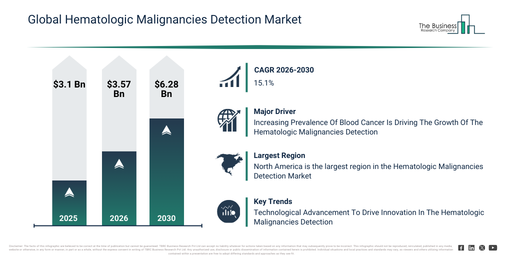
The hematologic malignancies detection market has experienced rapid expansion recently. Projections indicate it will expand from $3.1 billion in 2025 to $3.57 billion in 2026, exhibiting a compound annual growth rate (CAGR) of 15.5%. This historical growth can be linked to factors such as a rising incidence of blood cancers, the uptake of PCR and immunochemistry methods, the development of clinical laboratory infrastructure, increased awareness regarding early cancer diagnosis, and the accessibility of sophisticated diagnostic kits.
The hematologic malignancies detection market size is projected to experience substantial growth in the upcoming years. It is anticipated to expand to $6.28 billion by 2030, achieving a compound annual growth rate (CAGR) of 15.1%. This expansion during the forecast period can be attributed to the rising acceptance of liquid biopsy diagnostics, increased investments in precision oncology, the broadening of genomic testing programs, the growing implementation of AI-based diagnostic platforms, and a heightened focus on the early and accurate identification of cancer. Prominent trends expected in this period include the increased adoption of molecular diagnostic techniques, the expanding utilization of next-generation sequencing in oncology, the deeper integration of AI in diagnostic interpretation, the enlargement of early cancer screening initiatives, and an enhanced concentration on personalized oncology diagnostics.
Get A Free Sample Report With In-Depth Market Insights:
Hematologic Malignancies Detection Market Demand Drivers: What’s Powering Industry Growth?
The expansion of the hematologic malignancy detection market is anticipated to be driven by the rising occurrence of blood cancer. Blood cancer encompasses various malignancies impacting the blood, bone marrow, or lymphatic system, thereby interfering with normal blood cell generation and operation. This elevated prevalence stems from an aging global demographic and advancements in diagnostic methodologies, enabling earlier and more precise identification. Detecting hematologic malignancies is crucial for treating blood cancer, as it facilitates prompt and precise diagnosis, paving the way for tailored and impactful therapeutic approaches. Illustratively, data from March 2024, based on the Cancer Facts & Figures 2023 report from the Leukemia & Lymphoma Society, a professional organization company situated in the US, indicates that around 437,337 individuals in the US are currently living with or in remission from leukemia. Moreover, projections suggest that approximately 59,610 new cases will be diagnosed during 2024. Consequently, the growing incidence of blood cancer is fueling the expansion of the hematologic malignancy detection market.
Hematologic Malignancies Detection Market Segment Analysis: What Are The Core Market Categories?
The hematologic malignancies detection market covered in this report is segmented –
1) By Type: Polymerase Chain Reaction, Immunochemistry, Next Generation Sequencing, Fluorescence In Situ Hybridization
2) By Application: Multiple Myeloma, Myelodysplastic Syndrome, Leukemia, Myeloproliferative Neoplasms, Lymphoma, Other Applications
3) By End-Users: Hospitals, Specialty Clinics, Other End-Users
Subsegments:
1) By Polymerase Chain Reaction (PCR): Real-Time PCR (qPCR), Digital PCR, Reverse Transcription PCR (RT-PCR), Nested PCR, Multiplex PCR, PCR-Based Detection Kits
2) By Immunochemistry: Enzyme-Linked Immunosorbent Assay (ELISA), Immunohistochemistry (IHC), Flow Cytometry, Immunofluorescence, Immunohistochemical Staining Kits
3) By Next Generation Sequencing (NGS): Whole Genome Sequencing (WGS), Whole Exome Sequencing (WES), Targeted Sequencing, RNA Sequencing (RNA-Seq), Liquid Biopsy NGS, Next-Generation Sequencing Kits For Hematologic Malignancies
4) By Fluorescence In Situ Hybridization (FISH): Chromosome-Specific FISH Probes, DNA FISH, RNA FISH, Multicolor FISH, FISH-Based Detection Kits For Leukemia And Lymphoma
Hematologic Malignancies Detection Market Innovation Trends Shaping Future Development
Leading companies in the hematologic malignancy detection market are concentrating on creating innovative solutions, like blood cancer diagnostic tests, to elevate diagnostic precision and enhance patient results. Blood cancer diagnostic tests are essential for detecting and confirming the existence of hematologic malignancies, including leukemia, lymphoma, and multiple myeloma. For example, in November 2023, Roswell Park Comprehensive Cancer Center, a US-based research and treatment facility, introduced PanHeme, an advanced blood cancer diagnostic test that employs next-generation gene sequencing technology for identifying hematologic malignancies. Through the application of next-generation sequencing technology, PanHeme detects genetic mutations in blood cancers such as leukemia, lymphoma, and multiple myeloma within 72 hours, offering a notable speed advantage over conventional methods. This swift processing time supports personalized treatment blueprints by empowering healthcare professionals to deploy targeted FDA-approved therapies based on particular mutations.
Hematologic Malignancies Detection Market Top Companies Driving Competitive Growth
Major companies operating in the hematologic malignancies detection market are Thermo Fisher Scientific Inc., Abbott Laboratories Inc., Roche Diagnostics International Ltd., Illumina Inc., Agilent Technologies Inc., Bio-Rad Laboratories Inc., QIAGEN N.V., Becton Dickinson and Company, Beckman Coulter Inc., Sysmex Corporation, Adaptive Biotechnologies Corporation, NeoGenomics Laboratories Inc., Invivoscribe Technologies Inc., ArcherDx Inc., Invitae Corporation, Natera Inc., Genetron Health, SOPHiA GENETICS, Guardant Health Inc., Genetica Diagnostics
View The Full Hematologic Malignancies Detection Market Report:
Hematologic Malignancies Detection Market Regional Split: Which Areas Are Fueling Growth?
North America was the largest region in the hematologic malignancies’ detection market in 2025. Asia-Pacific is expected to be the fastest-growing region in the forecast period. The regions covered in the hematologic malignancies detection market report are Asia-Pacific, South East Asia, Western Europe, Eastern Europe, North America, South America, Middle East, Africa.
Reach Out To Our Team:
The Business Research Company: https://www.thebusinessresearchcompany.com/
Americas: +1 310-496-7795
Asia: +44 7882 955267 & +91 8897263534
Europe: +44 7882 955267
Email us at: marketing@tbrc.info
Follow us on:
LinkedIn: https://in.linkedin.com/company/the-business-research-company
YouTube: https://www.youtube.com/channel/UC24_fI0rV8cR5DxlCpgmyFQ
Global Market Model: https://www.thebusinessresearchcompany.com/global-market-model