Featuring market attractiveness scoring, total addressable market sizing, company benchmarking matrices, interactive Excel dashboards, deeper supply chain intelligence, emerging startup tracking, and granular product-level insights, The Business Research Company’s 2026 market reports are built to deliver research that is both more actionable and more strategically valuable.
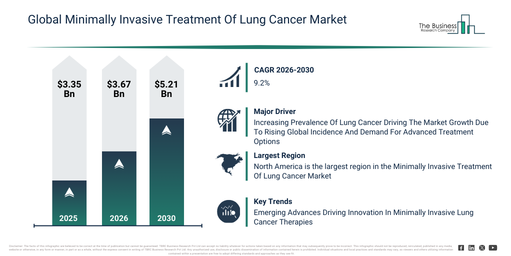
Minimally Invasive Treatment Of Lung Cancer Market Growth From $3.67 Billion In 2026 To $5.21 Billion By 2030 At A CAGR Of 9.2%
The market size for the minimally invasive treatment of lung cancer has demonstrated robust expansion in recent years. It is forecast to grow from $3.35 billion in 2025 to $3.67 billion in 2026, achieving a compound annual growth rate (CAGR) of 9.5%. This historical growth can be ascribed to several factors, including an increase in lung cancer incidence rates, the proliferation of oncology treatment centers, advancements in interventional radiology techniques, greater availability of minimally invasive treatment options, and the growing clinical acceptance of ablation therapies.
The minimally invasive treatment of lung cancer market is anticipated to experience substantial growth in the upcoming years. It is projected to expand to $5.21 billion by 2030, exhibiting a compound annual growth rate (CAGR) of 9.2%. This growth during the forecast period is driven by increasing investments in precision cancer care, the rising adoption of robotic and AI-assisted oncology treatments, the expansion of early-stage lung cancer detection programs, a growing demand for outpatient cancer procedures, and an increasing focus on personalized treatment pathways. Major trends expected in this period include the rising adoption of image-guided tumor ablation techniques, an increase in minimally invasive embolization procedures, the growing integration of robotic assistance in oncology care, the expansion of precision oncology treatment platforms, and an enhanced emphasis on reducing treatment-related complications.
Get A Free Sample Report With In-Depth Market Insights:
Minimally Invasive Treatment Of Lung Cancer Market Growth Factors Behind Sustained Expansion
The rising prevalence of lung cancer is projected to fuel the expansion of the minimally invasive treatment of lung cancer market in the future. Lung cancer, a disease originating in the lungs, is characterized by unchecked cellular growth. The increase in lung cancer cases is largely attributed to a rise in tobacco smoking, which elevates the risk of uncontrolled cell proliferation and tumor formation. Minimally invasive treatment assists lung cancer patients by precisely targeting, removing, or destroying tumors through small incisions or imaging-guided probes. This method reduces recovery time, minimizes damage to healthy lung tissue, lowers complication risks, and allows patients to resume normal activities sooner. Thus, the growing incidence of lung cancer is propelling the growth of the minimally invasive treatment of lung cancer market.
Minimally Invasive Treatment Of Lung Cancer Market Segmentation: How Does The Market Break Down By Category?
The minimally invasive treatment of lung cancer market covered in this report is segmented –
1) By Type: Lung Tumor Ablation, Lung Tumor Embolization
2) By Stage: Stage I, Stage II, Stage III, Stage IV
3) By Age Group: Under 30 Years, 31 To 45 Years, 46 To 60 Years
4) By End-User: Hospitals, Ambulatory Surgical Centers (ASCs), Specialty Clinics, Research Institutions
Subsegments:
1) By Lung Tumor Ablation: Radiofrequency Ablation, Microwave Ablation, Cryoablation, Laser Ablation
2) By Lung Tumor Embolization: Bronchial Artery Embolization, Pulmonary Artery Embolization, Chemoembolization, Radioembolization
Minimally Invasive Treatment Of Lung Cancer Market Industry Trends Fueling Future Revenue Growth
Leading companies in the minimally invasive treatment of lung cancer market are prioritizing the creation of cutting-edge solutions, including microwave ablation systems and navigation-assisted biopsy platforms, to address the growing need for lung-sparing procedures, quicker diagnoses, reduced hospital stays, and viable treatments for individuals unsuitable for open surgery. Microwave ablation (MWA) equipment transmits high-frequency electromagnetic energy via a probe to swiftly heat and congeal tumour tissue, resulting in predictable spherical ablation zones with quicker treatment durations and a lesser heat-sink effect compared to radiofrequency ablation. For example, in January 2025, Creo Medical Group plc, a medical device company from the UK specializing in minimally invasive surgical endoscopy, unveiled its MicroBlate Flex soft-tissue microwave ablation system and initiated its clinical study for lung lesions. The MicroBlate Flex consists of a microwave generator and an adaptable ablation applicator, engineered for application across various soft-tissue indications. It operates by emitting high-frequency microwave energy at the applicator’s tip to form controlled thermal zones that eliminate tumour cells. The system’s distinctive attributes encompass a high-frequency power profile for effective energy delivery, a pliable design meant for accessing challenging anatomical areas, and compatibility with endoscopic or percutaneous methods, facilitating its use in small pulmonary nodules, metastatic lung lesions, and for patients unable to undergo lobectomy. From a clinical perspective, these advantages translate into expedited procedure times, a diminished requirement for general anaesthesia, potential for outpatient settings, and an expanded range of treatment choices when contrasted with open surgery or stereotactic radiotherapy.
Minimally Invasive Treatment Of Lung Cancer Market Competitive Overview And Top Companies
Major companies operating in the minimally invasive treatment of lung cancer market are Johnson & Johnson, Medtronic plc, Siemens Healthineers AG, Stryker Corporation, Boston Scientific Corporation, Olympus Corporation, Intuitive Surgical Inc., Accuray Incorporated, Richard Wolf GmbH, AngioDynamics Inc., CMR Surgical Ltd., Guangzhou Geyi Medical Instrument Co. Ltd., Quantum Surgical SA, Scanlan International Inc., RZ Medizintechnik GmbH & Co. KG, August Reuchlen GmbH, SBH Surgical GmbH & Co. KG, Geister Medizintechnik GmbH, Cook Medical Incorporated, Terumo Corporation, Merit Medical Systems Inc., Sirtex Medical Limited
View The Full Minimally Invasive Treatment Of Lung Cancer Market Report:
Minimally Invasive Treatment Of Lung Cancer Market Largest Region: Which Geography Holds The Biggest Share?
North America was the largest region in the minimally invasive treatment of lung cancer market in 2025. Asia-Pacific is expected to be the fastest-growing region in the forecast period. The regions covered in the minimally invasive treatment of lung cancer market report are Asia-Pacific, South East Asia, Western Europe, Eastern Europe, North America, South America, Middle East, Africa.
Reach Out To Our Team:
The Business Research Company: https://www.thebusinessresearchcompany.com/
Americas: +1 310-496-7795
Asia: +44 7882 955267 & +91 8897263534
Europe: +44 7882 955267
Email us at: marketing@tbrc.info
Follow us on:
LinkedIn: https://in.linkedin.com/company/the-business-research-company
YouTube: https://www.youtube.com/channel/UC24_fI0rV8cR5DxlCpgmyFQ
Global Market Model: https://www.thebusinessresearchcompany.com/global-market-model
Leave a Reply