Built to provide research that’s more actionable and strategically valuable, The Business Research Company’s 2026 market reports include market attractiveness analysis, total addressable market sizing, company benchmarking matrices, interactive Excel dashboards, broader supply chain intelligence, emerging startup tracking, and in-depth product insights.
Myelofibrosis (MF) Market Forecast: What Value Will The Market Reach By 2030?
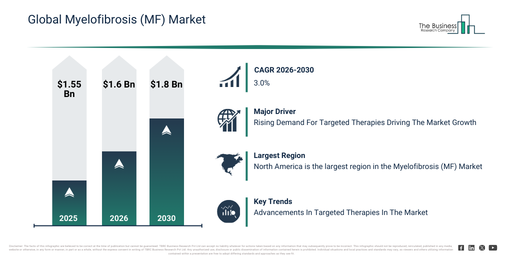
The myelofibrosis (mf) market has seen consistent expansion over recent years. Its size is anticipated to expand from $1.55 billion in 2025 to $1.6 billion in 2026, exhibiting a compound annual growth rate (CAGR) of 3.2%. The historical increase in the market can be attributed to several factors, including the scarcity of available treatment options, the elevated prevalence of anemia in mf patients, a rise in autoimmune-related conditions, growing diagnostic challenges, and a reliance on corticosteroid-based management.
The myelofibrosis (mf) market size is projected to demonstrate steady expansion in the coming years, with an expected increase to $1.8 billion by 2030, achieving a compound annual growth rate (CAGR) of 3.0%. This anticipated growth during the forecast period is fueled by several factors, including breakthroughs in JAK inhibitor development, the increasing integration of precision medicine, heightened investment in hematology research and development, ongoing advancements in stem-cell therapies, and the growing accessibility of targeted oral treatments. Prominent trends throughout this period are expected to include the rising adoption of JAK inhibitor-based therapies, an increased focus on combination treatment approaches, a greater emphasis on early diagnosis and screening programs, expanding research in stem-cell transplantation and regenerative care, and a broader application of supportive care to manage symptom burden.
Get A Free Sample Report With In-Depth Market Insights:
Myelofibrosis (MF) Market Opportunity Drivers: What’s Unlocking New Revenue Potential?
The myelofibrosis (MF) market is anticipated to expand, driven by the increasing need for targeted therapies. This medical approach involves customizing treatments and healthcare choices according to an individual’s unique genetic makeup, environmental influences, and lifestyle habits. This rising demand stems from breakthroughs in genomics, biotechnology, and data analytics, which facilitate the creation of more precise, impactful, and personalized treatments. Myelofibrosis (MF) offers a vital foundation for developing these therapies by pinpointing crucial molecular pathways, including JAK-STAT signaling. This identification allows for the formulation of precision treatments, such as JAK inhibitors (Ruxolitinib, Fedratinib, and Pacritinib), aimed at controlling symptoms and decelerating the disease’s progression. Consequently, the increasing need for targeted therapies is propelling the expansion of the myelofibrosis (MF) market.
Myelofibrosis (MF) Market Segment Outlook: Which Categories Are Growing Fastest?
The myelofibrosis (mf) market covered in this report is segmented –
1) By Drug Type: Jak Inhibitor, Immunomodulators, Hydroxyurea, Other Drug Types
2) By Treatment Type: Chemotherapy, Targeted Therapy, Other Treatment Types
3) By Route Of Administration: Oral, Parenteral, Other Routes Of Administration
4) By Distribution Channel: Hospital Pharmacy, Online Pharmacy, Retail Pharmacy
5) By End-User: Hospitals, Homecare, Specialty Clinics, Other End-Users
Subsegments:
1) By Jak Inhibitor: Ruxolitinib, Fedratinib, Momelotinib, Itacitinib
2) By Immunomodulators: Thalidomide, Lenalidomide, Pomalidomide
3) By Hydroxyurea: Oral Hydroxyurea, Injectable Hydroxyurea
4) By Other Drug Types: Erythropoiesis-Stimulating Agents (ESAs), Danazol, Monoclonal Antibodies, Chemotherapy Agents
Myelofibrosis (MF) Market Innovation Trends Shaping Future Development
Leading pharmaceutical firms in the myelofibrosis (MF) sector are concentrating on expanding advanced targeted therapies, including JAK1/JAK2 and ACVR1 inhibitors, to boost treatment effectiveness, manage disease advancement, and better patient results in myelofibrosis (MF). JAK1/JAK2 inhibitors function by targeting the Janus kinase pathway, thereby diminishing inflammation and the atypical production of blood cells in myelofibrosis, whereas ACVR1 inhibitors work to impede activin receptor-like kinase 2 (ALK2) to control bone marrow fibrosis and halt disease progression.
Myelofibrosis (MF) Market Leading Companies And Competitive Benchmarking
Major companies operating in the myelofibrosis (mf) market are Pfizer Inc, Novartis AG, Incyte Corporation, CTI BioPharma Corp, Karyopharm Therapeutics Inc, Sierra Oncology Inc, Kartos Therapeutics Inc, NS Pharma Inc, Keros Therapeutics Inc, Pharmaxis Ltd, Sumitomo Pharma Oncology, Galecto Biotech AB, Actuate Therapeutics Inc, AbbVie Inc, Bristol-Myers Squibb Company, Chia Tai Tianqing Pharmaceutical Group Co Ltd, Taiga Biotechnologies Inc, Rigel Pharmaceuticals Inc, Imago BioSciences Inc, Samus Therapeutics Inc.
View The Full Myelofibrosis (MF) Market Report:
Myelofibrosis (MF) Market Largest Region: Which Geography Holds The Biggest Share?
North America was the largest region in the myelofibrosis (MF) market in 2025. Asia-Pacific is expected to be the fastest-growing region in the forecast period. The regions covered in the myelofibrosis (mf) market report are Asia-Pacific, South East Asia, Western Europe, Eastern Europe, North America, South America, Middle East, Africa.
Reach Out To Our Team:
The Business Research Company: https://www.thebusinessresearchcompany.com/
Americas: +1 310-496-7795
Asia: +44 7882 955267 & +91 8897263534
Europe: +44 7882 955267
Email us at: marketing@tbrc.info
Follow us on:
LinkedIn: https://in.linkedin.com/company/the-business-research-company
YouTube: https://www.youtube.com/channel/UC24_fI0rV8cR5DxlCpgmyFQ
Global Market Model: https://www.thebusinessresearchcompany.com/global-market-model
Leave a Reply