Backed by market attractiveness analysis, total addressable market sizing, company benchmarking matrices, interactive Excel dashboards, wider supply chain intelligence, emerging startup coverage, and detailed product-level insights, The Business Research Company’s 2026 market reports are designed to offer research that is more actionable and strategically valuable than ever.
Rabbit Monoclonal Antibody Market Size Outlook: How Quickly Will Revenue Expand Through 2030?
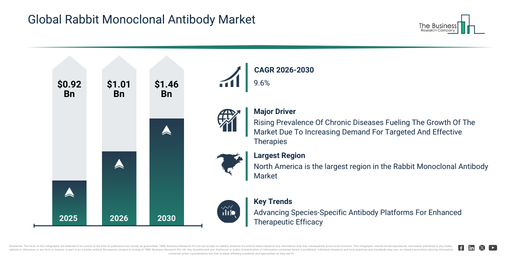
In recent years, the rabbit monoclonal antibody market has experienced robust growth. The market is set to expand from $0.92 billion in 2025 to $1.01 billion in 2026, achieving a compound annual growth rate (CAGR) of 9.9%. Historically, this growth has been driven by factors such as the widening scope of protein research applications, an escalating need for sensitive detection reagents, increased adoption of immunohistochemistry, augmented biomedical research funding, and the presence of hybridoma technologies.
The rabbit monoclonal antibody market is anticipated to experience robust expansion over the coming years. By 2030, its valuation is projected to reach $1.46 billion, advancing at a compound annual growth rate (CAGR) of 9.6%. This anticipated growth throughout the forecast period stems from factors such as the escalating need for precision diagnostics, the expanding application of antibodies in drug discovery, the broadening scope of personalized medicine research, the increasing embrace of recombinant antibody platforms, and an intensified emphasis on optimizing assay sensitivity. Key trends characterizing the forecast period encompass the augmented utilization of rabbit antibodies for challenging epitopes, their increased integration into advanced diagnostics, a discernible preference for high-affinity antibodies, the expansion of recombinant rabbit antibody production, and a heightened focus on analytical sensitivity.
Get A Free Sample Report With In-Depth Market Insights:
Rabbit Monoclonal Antibody Market Growth Backed By Core Demand Fundamentals
The escalating incidence of chronic diseases is projected to drive the expansion of the rabbit monoclonal antibody market moving forward. Chronic diseases are persistent medical conditions that develop slowly and persist for prolonged durations, often demanding continuous healthcare. The increasing occurrence of chronic diseases is partly attributed to inactive lifestyles, as extended sitting and limited physical activity heighten the risk of conditions such as heart ailments and diabetes. Rabbit monoclonal antibodies contribute to chronic disease treatment by offering highly specific and high-affinity targeting of disease-associated proteins. They enhance therapeutic precision, reduce off-target effects, and improve treatment efficacy, fostering better patient outcomes and streamlined drug development.
Rabbit Monoclonal Antibody Market Segment Analysis And Revenue Potential
The rabbit monoclonal antibody market covered in this report is segmented –
1) By Type: Immunoglobulin G (IgG), Immunoglobulin M (IgM), Immunoglobulin A (IgA), Immunoglobulin E (IgE), Immunoglobulin D (IgD)
2) By Application: Diagnostics, Therapeutics, Research, Drug Discovery, Immunohistochemistry
3) By End User: Pharmaceutical Companies, Academic And Research Institutions, Diagnostic Laboratories, Contract Research Organizations, Biotechnology Companies
Subsegments:
1) By Immunoglobulin G (IgG): Subclass 1 Immunoglobulin G, Subclass 2 Immunoglobulin G, Subclass 3 Immunoglobulin G, Subclass 4 Immunoglobulin G
2) By Immunoglobulin M (IgM): Pentameric Immunoglobulin M, Monomeric Immunoglobulin M
3) By Immunoglobulin A (IgA): Serum Immunoglobulin A, Secretory Immunoglobulin A
4) By Immunoglobulin E (IgE): Allergen Specific Immunoglobulin E, Total Immunoglobulin E
5) By Immunoglobulin D (IgD): Membrane Bound Immunoglobulin D, Secreted Immunoglobulin D
#Rabbit Monoclonal Antibody Market Growth Trends: What’s Shaping The Future Outlook?
Major companies in the rabbit monoclonal antibody market are concentrating on developing advanced platforms, such as species-specific antibody development, to enhance therapeutic effectiveness, improve target specificity, and decrease immunogenicity. Species-specific antibody development involves the strategic use of distinct animal immune systems to generate antibodies with unique binding properties and high affinity for challenging drug targets.
Rabbit Monoclonal Antibody Market Key Players Shaping Industry Direction
Major companies operating in the rabbit monoclonal antibody market are F. Hoffmann-La Roche Ltd., Merck KGaA, Thermo Fisher Scientific Inc., Bio-Rad Laboratories Inc., Bio-Techne Corporation, Elabscience Biotechnology Inc., GenScript Biotech Corporation, Takara Bio Inc., Rockland Immunochemicals Inc., Creative Biolabs Inc., Bioss Antibodies Inc., Cell Signaling Technology Inc., MyBioSource Inc., Boster Biological Technology Co. Ltd., GeneTex Inc., Proteintech Group Inc., Santa Cruz Biotechnology Inc., AvantGen Inc., ImmunoWay Biotechnology Company, Abcam plc
View The Full Rabbit Monoclonal Antibody Market Report:
Rabbit Monoclonal Antibody Market Largest Region: Which Geography Holds The Biggest Share?
North America was the largest region in the rabbit monoclonal antibody market in 2025. Asia-Pacific is expected to be the fastest-growing region in the forecast period. The regions covered in the rabbit monoclonal antibody market report are Asia-Pacific, South East Asia, Western Europe, Eastern Europe, North America, South America, Middle East, Africa.
Reach Out To Our Team:
The Business Research Company: https://www.thebusinessresearchcompany.com/
Americas: +1 310-496-7795
Asia: +44 7882 955267 & +91 8897263534
Europe: +44 7882 955267
Email us at: marketing@tbrc.info
Follow us on:
LinkedIn: https://in.linkedin.com/company/the-business-research-company
YouTube: https://www.youtube.com/channel/UC24_fI0rV8cR5DxlCpgmyFQ
Global Market Model: https://www.thebusinessresearchcompany.com/global-market-model
Leave a Reply