Featuring market attractiveness scoring, total addressable market sizing, company benchmarking matrices, interactive Excel dashboards, deeper supply chain intelligence, emerging startup tracking, and granular product-level insights, The Business Research Company’s 2026 market reports are built to deliver research that is both more actionable and more strategically valuable.
Rare Hematology Market Growth Potential: How Will Market Size Shift Through 2030?
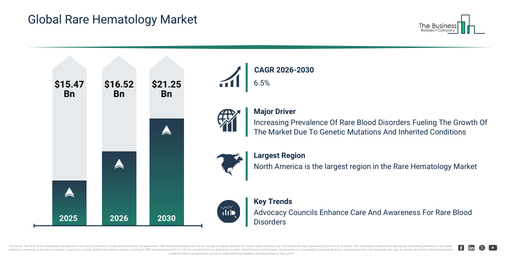
The rare hematology market size has experienced robust expansion over recent years. This market is projected to increase from $15.47 billion in 2025 to $16.52 billion in 2026, with a compound annual growth rate (CAGR) of 6.8%. Factors contributing to this historical growth include the limited availability of effective therapies, expansion of rare disease research initiatives, increasing awareness of rare blood disorders, improvements in diagnostic laboratory capabilities, and growth in specialized hematology clinics.
The rare hematology market is projected to experience substantial expansion over the coming years. It is anticipated to reach a valuation of $21.25 billion by 2030, exhibiting a compound annual growth rate (CAGR) of 6.5%. This growth during the projection period stems from factors such as increasing investments in gene therapy development, a greater emphasis on precision medicine for uncommon diseases, the broadening of newborn and carrier screening programs, intensified collaboration between research institutions and pharmaceutical firms, and advancements in genomic sequencing technologies. Key trends anticipated during the forecast period include the rising adoption of gene and cell therapies, increased utilization of advanced genetic diagnostics, a heightened focus on individualized treatment approaches, the expansion of specialized centers for rare diseases, and improved integration of digital patient monitoring.
Get A Free Sample Report With In-Depth Market Insights:
Rare Hematology Market Growth Catalysts And Demand Drivers
The rising occurrence of rare blood conditions is anticipated to fuel the expansion of the rare hematology market moving forward. Rare blood disorders are defined as uncommon medical conditions impacting the formation, function, or longevity of blood cells or clotting factors, leading to issues such as anemia, bleeding complications, or hemolysis. The escalating incidence of these disorders is attributed to genetic mutations and inherited traits passed down through generations. The rare hematology market addresses this trend by offering specialized diagnostic tools and targeted therapies that assist in managing complex and unusual blood ailments, thereby mitigating complications and enhancing long-term patient outcomes.
Rare Hematology Market Segment Landscape: Which Areas Lead Development?
The rare hematology market covered in this report is segmented –
1) By Disease Type: Hemophilia, Sickle Cell Disease, Thalassemia, Myelodysplastic Syndromes, Other Disease Types
2) By Treatment Type: Gene Therapy, Stem Cell Transplantation, Blood Transfusion, Pharmacotherapy
3) By Diagnostic Technique: Laboratory Tests, Blood Tests, Bone Marrow Biopsies, Imaging Techniques, Magnetic Resonance Imaging (MRI) Scans, Ultrasounds, Genetic Testing, Carrier Screening, Whole Genome Sequencing
4) By Application: Pediatric, Adult
5) By End-User: Hospitals, Specialty Clinics, Research Institutes
Subsegments:
1) By Hemophilia: Hemophilia A, Hemophilia B, Hemophilia C, Acquired Hemophilia
2) By Sickle Cell Disease: Sickle Cell Anemia, Sickle Hemoglobin C Disease, Sickle Beta Thalassemia
3) By Thalassemia: Alpha Thalassemia, Beta Thalassemia
4) By Myelodysplastic Syndromes: Refractory Anemia (RA), Refractory Anemia With Ring Sideroblasts (RARS), Refractory Cytopenia With Multilineage Dysplasia (RCMD), Refractory Anemia With Excess Blasts (RAEB), Myelodysplastic Syndrome With Isolated Del(5Q), Unclassified Myelodysplastic Syndromes
5) By Other Disease Types: Aplastic Anemia, Paroxysmal Nocturnal Hemoglobinuria, Rare Coagulation Disorders
Rare Hematology Market Industry Trends: What’s Reshaping Demand?
Leading companies in the rare hematology market are concentrating on developing innovative treatments and strategic initiatives, such as multi-stakeholder advocacy councils, to tackle unmet medical needs, improve patient support, and drive solutions across various indications. Multi-stakeholder advocacy councils are groups consisting of patients, caregivers, and experts who collaborate to enhance care, awareness, and solutions for specific health conditions.
Rare Hematology Market Industry Leaders And Competitive Landscape
Major companies operating in the rare hematology market are F. Hoffmann-La Roche Ltd, Pfizer Inc., Abbvie Inc., Bayer AG, Sanofi S.A., Novartis AG, Astrazeneca Plc, Bristol-Myers Squibb Company, Takeda Pharmaceutical Company Limited, Amgen Inc., CSL Behring LLC, Biogen Inc., Jazz Pharmaceuticals Plc, Octapharma AG, PharmaEssentia Corporation, Disc Medicine Inc., BioInvent International AB, Mustang Bio Inc., BlueSphere Bio Inc., Rallybio LLC
View The Full Rare Hematology Market Report:
Rare Hematology Market Geographic Landscape: Which Region Leads Industry Growth?
North America was the largest region in the rare hematology market in 2025. Asia-Pacific is expected to be the fastest-growing region in the forecast period. The regions covered in the rare hematology market report are Asia-Pacific, South East Asia, Western Europe, Eastern Europe, North America, South America, Middle East, Africa.
Reach Out To Our Team:
The Business Research Company: https://www.thebusinessresearchcompany.com/
Americas: +1 310-496-7795
Asia: +44 7882 955267 & +91 8897263534
Europe: +44 7882 955267
Email us at: marketing@tbrc.info
Follow us on:
LinkedIn: https://in.linkedin.com/company/the-business-research-company
YouTube: https://www.youtube.com/channel/UC24_fI0rV8cR5DxlCpgmyFQ
Global Market Model: https://www.thebusinessresearchcompany.com/global-market-model
Leave a Reply