Designed to make market research more actionable and strategically valuable, The Business Research Company’s 2026 market reports feature market attractiveness scoring, total addressable market sizing, company benchmarking matrices, interactive Excel dashboards, deeper supply chain intelligence, emerging startup tracking, and granular product-level insights.
How Fast Is The Antimicrobial Regenerative Wound Matrix Market Growing? Market Size, CAGR And Forecast Insights
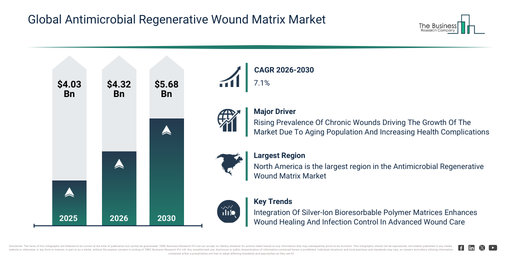
The antimicrobial regenerative wound matrix market has experienced robust expansion in recent years. This market is projected to increase from $4.03 billion in 2025 to $4.32 billion in 2026, at a compound annual growth rate (CAGR) of 7.4%. The historical growth of this market can be attributed to factors such as the increasing prevalence of chronic wounds, a rising incidence of diabetes-related ulcers, the expansion of surgical procedures, growing awareness of advanced wound care solutions, and the availability of antimicrobial biomaterials.
The antimicrobial regenerative wound matrix market is poised for significant expansion over the coming years, with projections indicating a rise to $5.68 billion by 2030, at a compound annual growth rate (CAGR) of 7.1%. This anticipated growth can be attributed to an expanding aging population, an increasing requirement for sophisticated wound management techniques, the broadening reach of home healthcare services, a heightened focus on mitigating hospital-acquired infections, and continuous advancements in regenerative biomaterials. Major developments expected during this period include a greater adoption of advanced wound care biomaterials, an escalating demand for infection-resistant healing solutions, wider application of bioactive regenerative matrices, an expansion of treatments for chronic wounds, and an intensified focus on accelerating tissue regeneration.
Unlock Antimicrobial Regenerative Wound Matrix Market Insights With A Free Sample Report:
Antimicrobial Regenerative Wound Matrix Market Momentum: Key Driver Expected To Boost Growth Through 2030
The growing occurrence of chronic wounds is projected to drive the expansion of the antimicrobial regenerative wound matrix market moving forward. These injuries are defined as those that fail to progress through the expected healing stages within a typical timeframe, usually extending beyond 4 to 6 weeks, often stemming from underlying health issues such as diabetes, infection, or compromised circulation. The increased occurrence of chronic wounds stems from the growing rates of diabetes, obesity, and vascular diseases, alongside a demographic shift towards an older population, all of which hinder natural healing processes and result in a greater number of wounds that do not heal or heal slowly, necessitating advanced wound care solutions. Antimicrobial regenerative wound matrices function by promoting tissue regrowth while simultaneously warding off infection, thereby accelerating recovery in chronic, persistent wounds. Thus, the increasing prevalence of chronic wounds is a key driver for the growth of the antimicrobial regenerative wound matrix market.
Antimicrobial Regenerative Wound Matrix Market Segments: A Category-By-Category Overview
The antimicrobial regenerative wound matrix market covered in this report is segmented –
1) By Product Type: Antimicrobial Matrix, Regenerative Matrix
2) By Wound Type: Acute, Chronic
3) By Material: Collagen-Based Matrix, Chitosan-Based Matrix, Hyaluronic Acid-Based Matrix
4) By Application: Diabetic Foot Ulcers, Pressure Ulcers, Venous Leg Ulcers, Burns
5) By End User: Hospitals, Clinics, Ambulatory Surgical Centers, Home Healthcare
Subsegments:
1) By Antimicrobial Matrix: Silver-Ion Impregnated Matrices, Iodine-Based Matrices, PHMB (Polyhexamethylene Biguanide)-Based Matrices, Honey-Infused Matrices, Chitosan-Based Matrices, Antibiotic-Loaded Polymer Matrices, Enzyme Or Peptide-Based Antimicrobial Matrices
2) By Regenerative Matrix: Collagen-Based Matrices, Hydrogel Matrices, Hyaluronic Acid-Based Matrices, Human Or Animal-Derived Dermal Substitutes, Synthetic Polymer (Bioresorbable) Matrices, Amniotic Membrane-Derived Matrices, Composite (Hybrid) Regenerative Matrices
Which Emerging Trends Are Gaining Traction In The Antimicrobial Regenerative Wound Matrix Market?
Leading firms within the antimicrobial regenerative wound matrix market are progressively incorporating antimicrobial substances like silver-ion–impregnated bioresorbable polymer matrices. This integration aims to meet the escalating demand for quicker recovery, diminished infection hazards, and decreased hospitalization expenses in managing both chronic and surgical wounds. Such a matrix, specifically a silver-ion–impregnated bioresorbable polymer matrix, functions as a wound-healing framework. It is constructed from biodegradable polymers embedded with silver ions, intended to facilitate tissue regrowth while delivering ongoing antimicrobial defense as it slowly dissolves within the body. As an example, in August 2025, Imbed Biosciences Inc., a US-based medical device company focused on advanced wound care, introduced SAM PainGuard with Lidocaine. This product is a dual-action wound matrix, consisting of a bioresorbable polymer scaffold saturated with ionic silver to provide antimicrobial protection and lidocaine HCl for prompt pain alleviation. This matrix adapts to the minute textures of wounds, guarantees a sustained microbial reduction of =99.99% for as long as 72 hours, and delivers instant pain relief. Having received FDA 510(k) clearance for application in surgical, burn, donor-site, and trauma wounds, this product signifies a substantial improvement compared to conventional antimicrobial dressings and standard collagen matrices.
Antimicrobial Regenerative Wound Matrix Market Key Participants: Prominent Companies At A Glance
Major companies operating in the antimicrobial regenerative wound matrix market are Cardinal Health Inc., Medline Industries Inc., 3M Company, Essity AB, DSM Biomedical, Baxter International Inc., B. Braun Melsungen AG, Mölnlycke Health Care AB, ConvaTec Group plc, MTF Biologics, Organogenesis Inc., DeRoyal Industries Inc., MiMedx Group Inc., AdMedSol, Avita Medical, Aroa Biosurgery Ltd., Harbor Medtech Inc., Omeza LLC, ProgenaCare Global, RenovoDerm.
Get Detailed Antimicrobial Regenerative Wound Matrix Market Forecasts In The Complete Report:
Top Region In The Antimicrobial Regenerative Wound Matrix Market: A Global Perspective
North America was the largest region in the antimicrobial regenerative wound matrix market in 2025. Asia-Pacific is expected to be the fastest-growing region in the forecast period. The regions covered in the antimicrobial regenerative wound matrix market report are Asia-Pacific, South East Asia, Western Europe, Eastern Europe, North America, South America, Middle East, Africa.
Reach Out To Our Team:
The Business Research Company: https://www.thebusinessresearchcompany.com/
Americas: +1 310-496-7795
Asia: +44 7882 955267 & +91 8897263534
Europe: +44 7882 955267
Email us at: marketing@tbrc.info
Follow us on:
LinkedIn: https://in.linkedin.com/company/the-business-research-company
YouTube: https://www.youtube.com/channel/UC24_fI0rV8cR5DxlCpgmyFQ
Global Market Model: https://www.thebusinessresearchcompany.com/global-market-model
Leave a Reply