The Business Research Company’s 2026 market reports are designed to deliver research that is more actionable and strategically valuable. Key offerings include market attractiveness scoring, total addressable market sizing, company benchmarking matrices, interactive Excel dashboards, deeper supply chain intelligence, emerging startup tracking, and granular product-level insights.
Antidiabetics Market Historical Growth Vs. Forecast Growth: How Do The Numbers Compare?
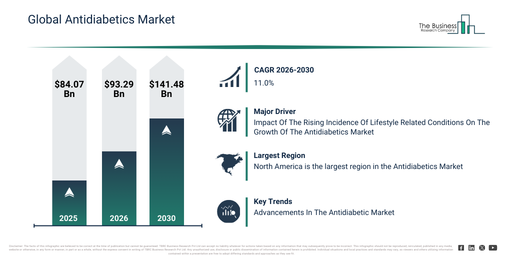
The antidiabetics market has experienced rapid expansion recently. It is projected to expand from $84.07 billion in 2025 to $93.29 billion in 2026, exhibiting a compound annual growth rate (CAGR) of 11.0%. Historically, this growth was driven by factors such as the increasing worldwide prevalence of diabetes, greater access to insulin treatments, the proliferation of oral antidiabetic drugs, enhanced understanding and identification of the disease, and broader healthcare accessibility.
The antidiabetics market is projected to experience swift expansion over the coming years. By 2030, its value is anticipated to reach $141.48 billion, demonstrating a compound annual growth rate (CAGR) of 11.0%. This anticipated growth during the forecast period stems from factors such as the increasing uptake of advanced diabetes medications, a heightened emphasis on long-acting and once-weekly treatment regimens, broader integration of digital diabetes management solutions, rising investments in metabolic disorder investigations, and a growing call for patient-focused treatment approaches. Key trends expected during this period involve a greater embrace of glp-1 and sglt2 therapies, an increased concentration on combination drug regimens, escalating demand for individualized diabetes care, wider utilization of oral antidiabetic drugs, and an amplified focus on cardiovascular and weight-related advantages.
Start With A Free Sample Of The Antidiabetics Market Research Report:
The Leading Growth Driver In The Antidiabetics Market Explained
The increasing prevalence of lifestyle-related health conditions is projected to fuel the growth of the antidiabetics market in the future. Lifestyle-related conditions refer to health problems caused or worsened by behaviors such as inadequate diet, insufficient physical activity, smoking, and excessive alcohol consumption. The occurrence of these conditions is on the rise due to poor eating habits, a sedentary lifestyle, and heightened stress levels. Antidiabetic medications can assist in managing lifestyle-associated issues like obesity and metabolic syndrome by improving insulin sensitivity and regulating blood sugar levels. Consequently, a growing incidence of lifestyle-related conditions is a key driver for the antidiabetic market.
Key Segments Shaping The Antidiabetics Market Landscape
The antidiabetics market covered in this report is segmented –
1) By Drug Class: Insulin, GLP-1 Receptor Agonists, DPP- 4 Inhibitors, SGLT2 Inhibitors, Other Drug Classes
2) By Diabetes Type: Type 1, Type 2
3) By Patient Population: Antidiabetics For Pediatrics, Antidiabetics For Adults, Antidiabetics For Geriatrics
4) By Route Of Administration: Antidiabetics Administration Through Insulin Syringes Or Insulin Pens, Antidiabetics Administration Through Insulin Pumps, Intravenous Antidiabetics Infusion, Oral Antidiabetics Administration, Other Routes Of Antidiabetics Administration
5) By Distribution Channel: Online Pharmacies, Hospital Pharmacies, Retail Pharmacies
Subsegments:
1) By Insulin: Rapid-Acting Insulin, Short-Acting Insulin, Intermediate-Acting Insulin, Long-Acting Insulin, Premixed Insulin
2) By GLP-1 Receptor Agonists: Exenatide, Liraglutide, Dulaglutide, Semaglutide, Lixisenatide
3) By DPP-4 Inhibitors: Sitagliptin, Saxagliptin, Linagliptin, Alogliptin
4) By SGLT2 Inhibitors: Canagliflozin, Dapagliflozin, Empagliflozin, Ertugliflozin
5) By Other Drug Classes: Sulfonylureas, Thiazolidinediones (TZDs), Alpha-Glucosidase Inhibitors, Meglitinides, GLP-1/Insulin Combination Therapy
Antidiabetics Market Trend Spotlight: Key Shifts Shaping Future Demand
Major companies operating in the antidiabetics market are developing advanced products, such as anti-diabetic biosimilars, to improve glycemic control, reduce the risk of cardiovascular events, and offer more effective treatment options for individuals with diabetes. An anti-diabetic biosimilar is a medication biologically similar to an already approved reference drug used for diabetes, providing comparable safety, effectiveness, and quality.
Antidiabetics Market Competitive Analysis: Who Are The Main Competitors?
Major companies operating in the antidiabetics market are Pfizer Inc., Johnson & Johnson, Merck & Co. Inc., Sanofi S.A., Bristol-Myers Squibb Company, AstraZeneca plc, Abbott Laboratories, Novartis AG, Takeda Pharmaceutical Company Limited, GSK plc, Eli Lilly and Company, Boehringer Ingelheim International GmbH, Novo Nordisk A/S, Teva Pharmaceutical Industries Ltd., Astellas Pharma Inc., Sun Pharmaceutical Industries Limited, Cipla Limited, Dr. Reddy’s Laboratories, Lupin Limited, Torrent Pharmaceuticals Ltd, Biocon Limited, Glenmark Pharmaceuticals Ltd.
Find The Complete Antidiabetics Market Outlook In The Full Report:
Mapping The Antidiabetics Market: Regional Leadership And Global Reach
North America was the largest region in the antidiabetics market in 2025. The regions covered in the antidiabetics market report are Asia-Pacific, South East Asia, Western Europe, Eastern Europe, North America, South America, Middle East, Africa.
Reach Out To Our Team:
The Business Research Company: https://www.thebusinessresearchcompany.com/
Americas: +1 310-496-7795
Asia: +44 7882 955267 & +91 8897263534
Europe: +44 7882 955267
Email us at: marketing@tbrc.info
Follow us on:
LinkedIn: https://in.linkedin.com/company/the-business-research-company
YouTube: https://www.youtube.com/channel/UC24_fI0rV8cR5DxlCpgmyFQ
Global Market Model: https://www.thebusinessresearchcompany.com/global-market-model
Leave a Reply