Arthralgia Market Growth To $8.26 Billion By 2030: What’s Driving The Expansion?
Built to provide research that’s more actionable and strategically valuable, The Business Research Company’s 2026 market reports include market attractiveness analysis, total addressable market sizing, company benchmarking matrices, interactive Excel dashboards, broader supply chain intelligence, emerging startup tracking, and in-depth product insights.
Arthralgia Market Value Growth And Long-Term Outlook
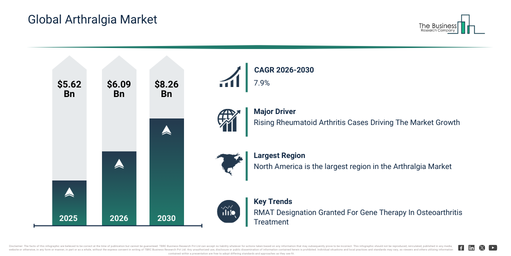
The arthralgia market size has shown significant growth over recent years. It is forecast to expand from $5.62 billion in 2025 to $6.09 billion in 2026, exhibiting a compound annual growth rate (CAGR) of 8.2%. The historical increase can be attributed to several factors, including the increasing occurrence of joint-related conditions, the demographic trend of an aging population, greater awareness of musculoskeletal health, the widening availability of pharmaceutical options for pain management, and the expansion of outpatient orthopedic services.
The arthralgia market is projected to demonstrate significant expansion in the coming years, with its size expected to reach $8.26 billion by 2030, growing at a compound annual growth rate (CAGR) of 7.9%. This growth throughout the forecast period can be attributed to several factors, including an escalating demand for personalized treatment regimens, the rising adoption of biologic and targeted therapies, the expansion of home-based pain management solutions, an increasing focus on long-term symptom management, and growing investments in joint health research. Notable trends during this period are expected to include the increasing embrace of personalized pain management therapies, the rising utilization of combination treatment approaches, a growing emphasis on the early diagnosis of joint disorders, the expansion of non-invasive pain relief solutions, and enhanced patient-centered treatment models.
Get A Free Sample Report With In-Depth Market Insights:
Arthralgia Market Opportunity Drivers: What’s Unlocking New Revenue Potential?
The rising incidence of rheumatoid arthritis is projected to fuel the expansion of the arthralgia market in the future. Rheumatoid arthritis is a persistent autoimmune ailment predominantly impacting joints, resulting in inflammation, discomfort, and potential deterioration of joint structure. The escalation in rheumatoid arthritis diagnoses is linked to factors such as an aging populace, inherited susceptibility, alterations in lifestyle, and environmental elements including smoking and atmospheric contamination. RA induces arthralgia through the initiation of long-term inflammation within joints, which manifests as pain, rigidity, and gradual impairment. To illustrate this, data from Arthritis Australia, an Australian non-profit organization, indicated in February 2024 that by 2040, the number of arthritis cases in Australia is anticipated to climb to 5.39 million from 4.11 million in 2025. Within this total, osteoarthritis is foreseen to grow to 3.11 million from 2.35 million, and rheumatoid arthritis is predicted to reach 748,721. Consequently, the growing prevalence of rheumatoid arthritis cases is a key impetus for the expansion of the arthralgia market.
Arthralgia Market Segment Analysis Spotlighting Growth Areas
The arthralgia market covered in this report is segmented –
1) By Cause: Osteoarthritis, Rheumatoid Arthritis, Gout, Psoriatic Arthritis, Lupus, Injuries, Infections, Other Causes
2) By Treatment Type: Medications, Therapies, Surgical Interventions, Lifestyle And Home Remedies
3) By Route Of Administration: Oral, Injectable, Topical, Transdermal
4) By Distribution Channel: Hospital Pharmacies, Retail Pharmacies, Online Pharmacies
5) By End User: Hospital, Clinics, Homecare Settings, Rehabilitation Centers
Subsegments:
1) By Osteoarthritis: Knee Osteoarthritis, Hip Osteoarthritis, Hand Osteoarthritis, Spine Osteoarthritis, Shoulder Osteoarthritis
2) By Rheumatoid Arthritis: Seropositive Rheumatoid Arthritis, Seronegative Rheumatoid Arthritis, Juvenile Rheumatoid Arthritis, Early-Onset Rheumatoid Arthritis
3) By Gout: Primary Gout, Secondary Gout, Gouty Arthritis
4) By Psoriatic Arthritis: Symmetric Psoriatic Arthritis, Asymmetric Psoriatic Arthritis, Psoriatic Spondylitis, Distal Interphalangeal Predominant Psoriatic Arthritis
5) By Lupus: Systemic Lupus Erythematosus (SLE), Discoid Lupus Erythematosus, Drug-induced Lupus, Neonatal Lupus
6) By Injuries: Sports-related Injuries, Trauma and Fractures, Sprains and Strains, Tendon or Ligament Damage
7) By Infections: Septic Arthritis, Viral Arthritis, Bacterial Infections, Fungal Infections
8) By Other Causes: Fibromyalgia, Overuse Injuries, Sarcoidosis, Ankylosing Spondylitis, Crystal-induced Arthritis
Arthralgia Market Innovation Trends Shaping Future Development
Leading companies in the arthralgia market are focused on developing cutting-edge therapies, such as RMAT-designated gene therapy, to offer patients advanced treatments providing lasting pain relief and improved joint functionality. An RMAT-designated gene therapy denotes a treatment that has secured Regenerative Medicine Advanced Therapy (RMAT) designation from the FDA, which serves to expedite the development and review processes for innovative gene therapies addressing serious or life-threatening conditions. For example, in March 2024, Pacira BioSciences Inc., a US-based pharmaceutical company, was granted Regenerative Medicine Advanced Therapy (RMAT) designation for its product PCRX-201 (enekinragene inzadenovec) by the U.S. Food and Drug Administration (FDA). This product is an innovative, intra-articular gene therapy candidate that uses a helper-dependent adenovirus (HDAd) to treat knee osteoarthritis. The therapy is engineered to produce interleukin-1 receptor antagonists (IL-1Ra). Pacira conveyed its pride in achieving the FDA’s first-ever RMAT designation for an osteoarthritis-targeting gene therapy and underscored the promising preliminary clinical findings suggesting PCRX-201 has the potential to be a disease-modifying treatment.
Arthralgia Market Leading Companies: Who Holds The Strongest Market Presence?
Major companies operating in the arthralgia market are Pfizer Inc., Johnson & Johnson Services Inc., AbbVie Inc., Sanofi S.A., Bristol-Myers Squibb Company, AstraZeneca PLC, Novartis AG, GlaxoSmithKline PLC, Eli Lilly and Company, Amgen Inc., Teva Pharmaceutical Industries Ltd., Regeneron Pharmaceuticals Inc., Astellas Pharma Inc., Biogen Inc., UCB S.A., Hikma Pharmaceuticals PLC, Ferring Pharmaceuticals, KD Pharma Group S.A., SI-BONE Inc., Xalud Therapeutics Inc., Incannex Healthcare Limited, Cytonics Corporation
View The Full Arthralgia Market Report:
Arthralgia Market Top Region: Where Does Most Revenue Come From?
North America was the largest region in the arthralgia market in 2025. The regions covered in the arthralgia market report are Asia-Pacific, South East Asia, Western Europe, Eastern Europe, North America, South America, Middle East, Africa.
Reach Out To Our Team:
The Business Research Company: https://www.thebusinessresearchcompany.com/
Americas: +1 310-496-7795
Asia: +44 7882 955267 & +91 8897263534
Europe: +44 7882 955267
Email us at: marketing@tbrc.info
Follow us on:
LinkedIn: https://in.linkedin.com/company/the-business-research-company
YouTube: https://www.youtube.com/channel/UC24_fI0rV8cR5DxlCpgmyFQ
Global Market Model: https://www.thebusinessresearchcompany.com/global-market-model