With a focus on actionable insights and strategic value, The Business Research Company’s 2026 market reports include market attractiveness scoring, total addressable market sizing, company benchmarking matrices, interactive Excel dashboards, deeper supply chain intelligence, emerging startup tracking, and granular product-level insights.
Automated Microbiology Market Size Analysis: Historical Growth And Future Revenue Projections
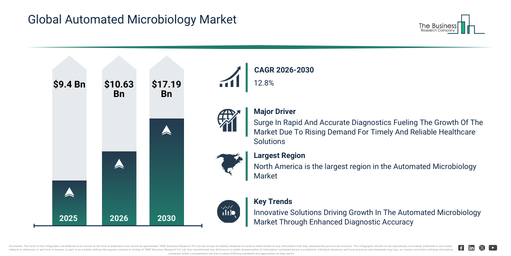
The automated microbiology market size has expanded quickly over recent years. It is anticipated to increase from $9.4 billion in 2025 to $10.63 billion in 2026, achieving a compound annual growth rate (CAGR) of 13.0%. Historically, this growth can be attributed to factors such as rising clinical testing volumes, a greater need for expedited diagnostic results, the expansion of hospital laboratory infrastructure, insufficient numbers of skilled laboratory personnel, and the adoption of standardized diagnostic protocols.
The automated microbiology market is projected to experience substantial expansion in the coming years, forecast to reach $17.19 billion by 2030, exhibiting a compound annual growth rate (CAGR) of 12.8%. This anticipated growth is driven by several factors, including heightened investments in intelligent laboratories, a rising need for swift infectious disease diagnosis, the broadening scope of molecular microbiology uses, increasing integration of data-driven laboratory systems, and an enhanced emphasis on the precision of diagnostics. Key trends anticipated during this period encompass the greater embrace of fully automated microbiology solutions, the expanding application of AI for pathogen identification, a growing convergence of LIMS platforms, the proliferation of high-throughput diagnostic tests, and a heightened emphasis on streamlining laboratory workflows.
Preview The Automated Microbiology Market Report With A Free Sample:
Automated Microbiology Market Drivers: What Is Fueling Demand Through 2030?
The escalating demand for swift and precise diagnostic tools is poised to boost the expansion of the automated microbiology market moving forward. These rapid and accurate diagnostics refer to medical testing procedures that efficiently and precisely identify infections or diseases, allowing for timely and effective medical interventions. The surge in demand for such diagnostics is driven by the increasing necessity for prompt disease identification to prevent complications and improve patient health outcomes, coupled with the desire for minimal result waiting times. Automated microbiology supports this need by enabling high-throughput, standardized, and error-reduced testing, which guarantees faster results and enhanced patient care. Thus, the growing need for rapid and accurate diagnostics is stimulating growth in the automated microbiology market.
Automated Microbiology Market Segmentation Analysis: Core Categories And Subcategories
The automated microbiology market covered in this report is segmented –
1) By Product: Instruments, Reagents And Kits, Software
2) By Automation Type: Fully Automated, Semi-Automated
3) By Diagnostic Technology: DNA And RNA Probe Technology, Detection Techniques
4) By Application: Biopharmaceutical Production, Clinical Diagnostics, Environmental And Water Testing, Food And Beverage Testing, Other Applications
5) By End Use: Pharmaceutical And Biotechnology Companies, Hospitals And Diagnostic Laboratories, Academic And Research Institutes, Other End Uses
Subsegments:
1) By Instruments: Automated Gram Stainers, Microbial Detection Systems, Automated ID/AST Systems, Blood Culture Systems, Sample Preparation Systems
2) By Reagents And Kits: Culture Media, Identification Kits, Susceptibility Testing Kits, Staining Reagents, Molecular Diagnostic Reagents
3) By Software: Data Analysis And Interpretation Tools, Laboratory Workflow Management Software, Integration And Connectivity Solutions, Quality Control And Compliance Software
Which Trends Will Define The Automated Microbiology Market Through 2030?
Leading companies in the automated microbiology market are focusing on developing advanced solutions, such as matrix-assisted laser desorption or ionization (MALDI) biotyper systems, to enhance the speed and accuracy of microbial identification. This technique, based on mass spectrometry, identifies microorganisms, including bacteria and fungi, by analyzing their unique protein profiles.
Automated Microbiology Market Major Companies And Industry Participants
Major companies operating in the automated microbiology market are Thermo Fisher Scientific Inc, Danaher Corporation, Becton Dickinson and Company, bioMérieux SA, Abbott Laboratories, Merck KGaA, Agilent Technologies Inc, Sysmex Corporation, Bio-Rad Laboratories Inc, PerkinElmer Inc, HORIBA Ltd, DiaSorin SpA, Neogen Corporation, Rapid Micro Biosystems Inc, Bruker Corporation, Tecan Group AG, Roche Diagnostics International AG, QIAGEN NV, Illumina Inc, Luminex Corporation
Buy The Full Automated Microbiology Global Market Report 2026:
Automated Microbiology Market Geographic Analysis: Which Region Accounts For The Biggest Share?
North America was the largest region in the automated microbiology market in 2025. The regions covered in the automated microbiology market report are Asia-Pacific, South East Asia, Western Europe, Eastern Europe, North America, South America, Middle East, Africa.
Reach Out To Our Team:
The Business Research Company: https://www.thebusinessresearchcompany.com/
Americas: +1 310-496-7795
Asia: +44 7882 955267 & +91 8897263534
Europe: +44 7882 955267
Email us at: marketing@tbrc.info
Follow us on:
LinkedIn: https://in.linkedin.com/company/the-business-research-company
YouTube: https://www.youtube.com/channel/UC24_fI0rV8cR5DxlCpgmyFQ
Global Market Model: https://www.thebusinessresearchcompany.com/global-market-model
Leave a Reply