Category: Healthcare Services

  • AI ICU ventilation weaning market forecast (2026–2030)

    AI ICU ventilation weaning market forecast (2026–2030)

    The Business Research Company’s 2026 market reports feature enhanced tools like market attractiveness analysis, TAM assessment, and company scoring matrices, along with interactive dashboards, deeper supply chain insights, and startup coverage strengthening the depth, usability, and strategic value of insights.

    How Will The Market Value Of The Artificial Intelligence (AI)-Enhanced Intensive Care Unit (ICU) Ventilation Weaning Market Progress Between 2026 And 2030?

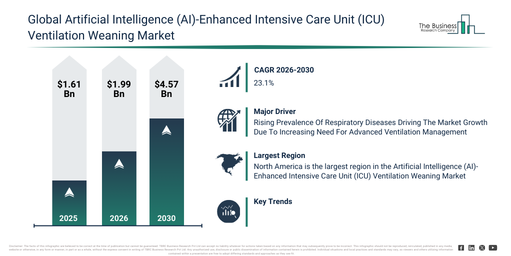
    The artificial intelligence (AI)-enhanced intensive care unit (icu) ventilation weaning market size has experienced significant expansion recently. It is forecast to increase from $1.61 billion in 2025 to $1.99 billion in 2026, achieving a compound annual growth rate (CAGR) of 23.3%. The growth observed in the past can be attributed to the increasing utilization of mechanical ventilation in critical care, growing icu patient volumes, rising clinical complexity in respiratory management, expansion of critical care monitoring technologies, and increased adoption of data-driven icu protocols.

    The artificial intelligence (AI)-enhanced intensive care unit (icu) ventilation weaning market is projected to experience rapid expansion in the coming years. This market is anticipated to reach $4.57 billion by 2030, demonstrating a robust compound annual growth rate (CAGR) of 23.1%. Key drivers for this growth during the forecast period include the rising acceptance of AI-powered critical care interventions, an increasing need for results-oriented ICU management, the broadening of smart ventilator environments, the expanding incorporation of predictive analytics in intensive care settings, and a heightened emphasis on shortening ICU stays. Notable trends expected in this period encompass the wider application of predictive weaning methods, the growing integration of real-time data analysis for ventilators, the increased uptake of AI-supported ICU decision-making tools, the expansion of automated ventilation control, and a greater emphasis on minimizing the duration of ventilation.

    Access Your Free Sample Report For In-Depth Market Analysis:

    https://www.thebusinessresearchcompany.com/report/artificial-intelligence-ai-enhanced-intensive-care-unit-icu-ventilation-weaning-global-market-report

    What Primary Drivers Are Shaping The Artificial Intelligence (AI)-Enhanced Intensive Care Unit (ICU) Ventilation Weaning Market?

    The increasing occurrence of respiratory illnesses is projected to fuel the expansion of the artificial intelligence (AI)-enhanced intensive care unit (ICU) ventilation weaning market moving forward. These medical conditions impact the lungs and airways, impeding normal breathing and the body’s oxygen exchange. The rise in respiratory disease cases is attributed to an aging populace in developed nations, as older individuals are significantly more susceptible to chronic respiratory issues due to weakened immune systems and cumulative environmental exposures. AI-enhanced ICU ventilation weaning systems assist in managing respiratory diseases by continuously assessing specific patient data, forecasting ideal weaning periods, decreasing the length of mechanical ventilation, mitigating complications, and facilitating customized, effective, and prompt clinical interventions that enhance patient results. For example, in June 2024, the Australian Institute of Health and Welfare, an Australia-based government agency, reported that in 2023, chronic obstructive pulmonary disease (COPD) constituted 3.6% of Australia’s total disease burden and accounted for 50% of the overall burden from respiratory conditions. Consequently, the increasing incidence of respiratory diseases is propelling the growth of the artificial intelligence (AI)-enhanced intensive care unit (ICU) ventilation weaning market.

    What Segment Categories Shape The Artificial Intelligence (AI)-Enhanced Intensive Care Unit (ICU) Ventilation Weaning Market Segment Landscape?

    The artificial intelligence (AI)-enhanced intensive care unit (icu) ventilation weaning market covered in this report is segmented –

    1) By Component: Software, Hardware, Services

    2) By Deployment Mode: On-Premises, Cloud-Based

    3) By Application: Adult Intensive Care Unit (ICU), Pediatric Intensive Care Unit (ICU), Neonatal Intensive Care Unit (ICU)

    4) By End-User: Hospitals, Specialty Clinics, Other End-Users

    Subsegments:

    1) By Software: Ventilation Management Software, Predictive Weaning Algorithms, Patient Monitoring Software, Data Analytics And Visualization Software

    2) By Hardware: Ventilators, Sensors And Monitors, Computing Systems, Connectivity Devices

    3) By Services: Implementation And Integration Services, Training And Education Services, Maintenance And Support Services, Remote Monitoring Services

    Who Are The Companies Operating Across The Artificial Intelligence (AI)-Enhanced Intensive Care Unit (ICU) Ventilation Weaning Market Value Chain?

    Major companies operating in the artificial intelligence (AI)-enhanced intensive care unit (icu) ventilation weaning market are Medtronic plc, Koninklijke Philips N.V., GE HealthCare Technologies Inc., Drägerwerk AG & Co. KGaA, Getinge AB, Hamilton Medical AG, Hicuity Health Inc., Etiometry Inc., Clew Medical Ltd., Ambient Clinical Analytics Inc., ResMed Inc., Vyaire Medical, Inc., Mindray Medical International Limited, Zoll Medical Corporation, Baxter International Inc., Siemens Healthineers AG, Smiths Medical (ICU Medical, Inc.), Masimo Corporation, Aeonmed, Timpel S.A

    Get The Full Artificial Intelligence (AI)-Enhanced Intensive Care Unit (ICU) Ventilation Weaning Market Report:

    https://www.thebusinessresearchcompany.com/report/artificial-intelligence-ai-enhanced-intensive-care-unit-icu-ventilation-weaning-global-market-report

    Which Geographic Region Dominates The Artificial Intelligence (AI)-Enhanced Intensive Care Unit (ICU) Ventilation Weaning Market?

    North America was the largest region in the artificial intelligence (AI)-enhanced intensive care unit (ICU) ventilation weaning market in 2025. Asia-Pacific is expected to be the fastest-growing region in the forecast period. The regions covered in the artificial intelligence (AI)-enhanced intensive care unit (icu) ventilation weaning market report are Asia-Pacific, South East Asia, Western Europe, Eastern Europe, North America, South America, Middle East, Africa.

    Request A Customized Artificial Intelligence (AI)-Enhanced Intensive Care Unit (ICU) Ventilation Weaning Market Report For Competitive Insights:

    https://www.thebusinessresearchcompany.com/report/artificial-intelligence-ai-enhanced-intensive-care-unit-icu-ventilation-weaning-global-market-report

    Browse Through More Reports Similar to the Global Artificial Intelligence (AI)-Enhanced Intensive Care Unit (ICU) Ventilation Weaning Market 2026, By The Business Research Company

    Artificial Intelligence In Healthcare Market Report 2026

    https://www.thebusinessresearchcompany.com/report/artificial-intelligence-in-healthcare-global-market-report

    Artificial Intelligence Ai In Operating Room Market Report 2026

    https://www.thebusinessresearchcompany.com/report/artificial-intelligence-ai-in-operating-room-global-market-report

    Ai In Medical Devices Market Report 2026

    https://www.thebusinessresearchcompany.com/report/ai-in-medical-devices-global-market-report

    Get in touch with us:

    The Business Research Company: https://www.thebusinessresearchcompany.com/

    Americas +1 310-496-7795

    Asia +44 7882 955267 & +91 8897263534

    Europe +44 7882 955267

    Email us at info@tbrc.info

    Follow us on:

    LinkedIn: https://in.linkedin.com/company/the-business-research-company

    YouTube: https://www.youtube.com/channel/UC24_fI0rV8cR5DxlCpgmyFQ

    Global Market Model: https://www.thebusinessresearchcompany.com/global-market-model
  • Allergy Immunotherapy Market: Trends, Drivers, and Opportunities

    Allergy Immunotherapy Market: Trends, Drivers, and Opportunities

    The Business Research Company’s 2026 market reports feature enhanced tools like market attractiveness analysis, TAM assessment, and company scoring matrices, along with interactive dashboards, deeper supply chain insights, and startup coverage strengthening the depth, usability, and strategic value of insights.

    How Will The Market Value Of The Allergy Immunotherapy Market Progress Between 2026 And 2030?

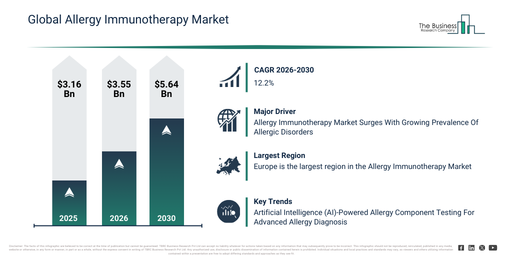
    The allergy immunotherapy market size has experienced rapid expansion in recent years. It is forecast to increase from $3.16 billion in 2025 to $3.55 billion in 2026, at a compound annual growth rate (CAGR) of 12.3%. The growth observed in the historic period is attributable to limited awareness about allergy immunotherapy, a rising incidence of seasonal allergic rhinitis, dependency on hospital-based treatment channels, the adoption of traditional treatment methods, and regulatory approvals for immunotherapy products.

    The allergy immunotherapy market is projected for substantial expansion over the next few years. It is forecast to achieve a valuation of $5.64 billion by 2030, progressing at a compound annual growth rate (CAGR) of 12.2%. This anticipated growth is influenced by several factors, including the proliferation of personalized immunotherapy solutions, the increasing use of online pharmacy channels, the expansion of pediatric allergy treatment options, a surge in investment dedicated to immunotherapy research, and the ongoing development of combination immunotherapy products. Prominent trends for the forecast duration encompass the growing acceptance of subcutaneous and sublingual immunotherapy, an escalating incidence of allergic rhinitis and asthma, the broadening scope of food and venom allergy treatments, an enhanced focus on tailored allergy treatment protocols, and improved awareness leading to earlier diagnosis of allergic conditions.

    Access Your Free Sample Report For In-Depth Market Analysis:

    https://www.thebusinessresearchcompany.com/report/allergy-immunotherapy-global-market-report

    Which Primary Drivers Are Impacting The Allergy Immunotherapy Market Growth?

    The increasing incidence of allergic disorders is projected to fuel the expansion of the allergy immunotherapy market moving forward. Allergic disorders are defined as exaggerated immune responses to specific antigens, distinct from autoimmune diseases where immune responses are mistakenly directed against the body’s own components. Allergy immunotherapy is available for atopic individuals who suffer from conditions such as IgE-mediated allergic rhinitis and allergic asthma, triggered by inhaled allergens including pollens and house dust mites (HDMs). For example, in August 2023, the Medicines and Healthcare Products Regulatory Agency (MHRA), a UK-based executive agency, reported that English hospitals recorded over 25,000 admissions for allergies and anaphylaxis in 2022-23, a figure more than double that seen in the last twenty years. Additionally, in May 2024, the Food Standards Agency, a UK-based government department, published its Patterns and Prevalence of Adult Food Allergy (PAFA) report, revealing that around 6% of adults in the UK, approximately 2.4 million individuals, are affected by food allergies. Hence, the growing prevalence of allergic disorders is a key factor driving the growth of the allergy immunotherapy market.

    How Is The Allergy Immunotherapy Market Organized By Segment Classification?

    The allergy immunotherapy market covered in this report is segmented –

    1) By Allergy Type: Allergic Rhinitis, Allergic Asthma, Food Allergy, Venom Allergy, Allergic Conjunctivitis, Environmental Allergies

    2) By Treatment: Subcutaneous Immunotherapy (SCIT), Sublingual Immunotherapy, Specific Immunotherapy (SIT)

    3) By Channel: Hospital Pharmacy, Retail Pharmacy

    Subsegments:

    1) By Allergic Rhinitis: Seasonal Allergic Rhinitis, Perennial Allergic Rhinitis

    2) By Allergic Asthma: House Dust Mite–Induced Allergic Asthma, Pollen-Induced Allergic Asthma, Animal Dander–Induced Allergic Asthma

    3) By Food Allergy: Peanut Allergy, Tree Nut Allergy, Milk Allergy, Egg Allergy, Other Food Allergies

    4) By Venom Allergy: Bee Venom Allergy, Wasp Venom Allergy, Hornet Venom Allergy, Other Insect Venom Allergies

    5) By Allergic Conjunctivitis: Seasonal Allergic Conjunctivitis, Perennial Allergic Conjunctivitis

    6) By Environmental Allergies: House Dust Mite Allergy, Pollen Allergy, Mold Allergy, Animal Dander Allergy

    Which Trends Are Shaping Growth In The Allergy Immunotherapy Market?

    Major companies operating within the allergy immunotherapy market are innovating technological products, such as artificial intelligence (AI)-powered allergy component testing, to sustain their market position. This AI-powered allergy component testing is a novel diagnostic platform rooted in component resolved diagnostics (CRD) designed for diagnosing diverse forms of allergies. As an example, in May 2023, Metropolis Healthcare Limited, an Indian-based Medical laboratory company, launched its artificial intelligence (AI)-powered allergy component testing. This innovative fourth-generation allergy testing technology utilizes Artificial Intelligence (AI) to assist clinicians in their clinical decision-making. It offers significant insights for selecting and optimizing the treatment course for allergic diseases. Moreover, it can predict the effectiveness of immunotherapy for allergy vaccinations, indicating their potential success.

    Who Are The Industry Participants Involved In The Allergy Immunotherapy Market?

    Major companies operating in the allergy immunotherapy market are LETI Pharma, Stallergenes Greer International AG, Allergy Therapeutics plc, ALK-Abelló A/S, HAL Allergy B.V., DBV Technologies, Circassia Pharmaceuticals Inc., Jubilant HollisterStier LLC, Allergopharma GmbH & Co. KG, Biomay AG, Anergis SA, HollisterStier Allergy, Desentum Oy, WOLW Pharma Limited, AllerGenics Inc., Greer Laboratories Inc., Aimmune Therapeutics Inc., Reliant Laboratories Inc., Mylan N.V., Adamis Pharmaceuticals Corporation, Endo Pharmaceuticals Inc., Sun Pharmaceutical Industries Ltd., Cipla Ltd.

    Get The Full Allergy Immunotherapy Market Report:

    https://www.thebusinessresearchcompany.com/report/allergy-immunotherapy-global-market-report

    Which Region Dominates The Allergy Immunotherapy Market By Market Share?

    Europe was the largest region in the allergy immunotherapy market in 2025. Asia-Pacific is expected to be the fastest-growing region in the allergy immunotherapy market report during the forecast period. The regions covered in the allergy immunotherapy market report are Asia-Pacific, South East Asia, Western Europe, Eastern Europe, North America, South America, Middle East, Africa.

    Request A Customized Allergy Immunotherapy Market Report For Competitive Insights:

    https://www.thebusinessresearchcompany.com/report/allergy-immunotherapy-global-market-report

    Browse Through More Reports Similar to the Global Allergy Immunotherapy Market 2026, By The Business Research Company

    Cellulars Immunotherapy Market Report 2026

    https://www.thebusinessresearchcompany.com/report/cellulars-immunotherapy-global-market-report

    Allergy Treatment Market Report 2026

    https://www.thebusinessresearchcompany.com/report/allergy-treatment-global-market-report

    Allergy Diagnostics Market Report 2026

    https://www.thebusinessresearchcompany.com/report/allergy-diagnostics-global-market-report

    Get in touch with us:

    The Business Research Company: https://www.thebusinessresearchcompany.com/

    Americas +1 310-496-7795

    Asia +44 7882 955267 & +91 8897263534

    Europe +44 7882 955267

    Email us at info@tbrc.info

    Follow us on:

    LinkedIn: https://in.linkedin.com/company/the-business-research-company

    YouTube: https://www.youtube.com/channel/UC24_fI0rV8cR5DxlCpgmyFQ

    Global Market Model: https://www.thebusinessresearchcompany.com/global-market-model
  • AI diabetes foot ulcer monitoring market analysis (2026–2030)

    AI diabetes foot ulcer monitoring market analysis (2026–2030)

    The Business Research Company’s 2026 market reports feature enhanced tools like market attractiveness analysis, TAM assessment, and company scoring matrices, along with interactive dashboards, deeper supply chain insights, and startup coverage strengthening the depth, usability, and strategic value of insights.

    What Are The Market Size Estimates For The Artificial Intelligence (AI)-Enhanced Diabetes Foot Ulcer Monitor Market In 2026 And 2030?

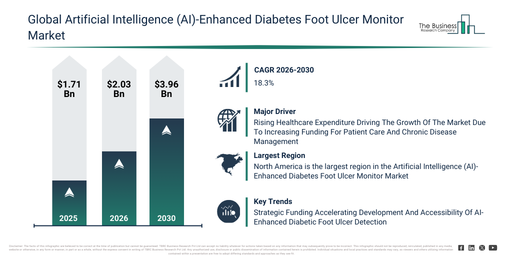
    The market size for artificial intelligence (AI)-enhanced diabetes foot ulcer monitors has shown significant expansion in recent years. This market is expected to increase from $1.71 billion in 2025 to $2.03 billion in 2026, reflecting a compound annual growth rate (CAGR) of 18.5%. The historical growth in this sector is attributable to increasing diabetes prevalence worldwide, rising incidence of diabetic foot complications, expansion of telehealth monitoring solutions, growing clinical focus on preventive wound care, and improvements in medical imaging technologies.

    The artificial intelligence (AI)-enhanced diabetes foot ulcer monitor market is projected for significant expansion over the coming years. This market is anticipated to reach $3.96 billion by 2030, exhibiting a compound annual growth rate (CAGR) of 18.3%. This anticipated growth during the forecast period is driven by factors such as the increasing acceptance of AI-powered diagnostic instruments, a growing need for homecare monitoring systems, the broadening scope of predictive healthcare analytics, the expanding incorporation of imaging and sensor technologies, and a heightened focus on proactive diabetic care. Key trends anticipated within this period involve the increasing uptake of AI-based tools for foot ulcer risk evaluation, the greater utilization of computer vision in wound analysis, the expanding implementation of smart wearable foot sensors, the growth of home-based monitoring for diabetic feet, and an intensified focus on identifying ulcers at an early stage.

    Access Your Free Sample Report For In-Depth Market Analysis:

    https://www.thebusinessresearchcompany.com/report/artificial-intelligence-ai-enhanced-diabetes-foot-ulcer-monitor-global-market-report

    Which Major Drivers Are Influencing The Expansion Of The Artificial Intelligence (AI)-Enhanced Diabetes Foot Ulcer Monitor Market?

    Increased spending on healthcare is anticipated to drive expansion within the artificial intelligence (AI)-enhanced diabetes foot ulcer monitor market in the future. This expenditure encompasses the total funds allocated by individuals, organizations, and governmental bodies towards services and initiatives focused on preserving or enhancing health. The rise in healthcare costs stems from the increasing incidence of chronic illnesses, necessitating greater continuous medical attention, extended treatment plans, and comprehensive management resources. Such spending enables medical facilities like hospitals and clinics to acquire AI-enhanced diabetes foot ulcer monitors, thereby facilitating more effective patient management and reducing ongoing treatment costs. An example illustrates this: in April 2025, data from the UK’s Office for National Statistics indicated that government-funded healthcare constituted the majority of health spending in the UK, totaling $344 billion (£258 billion) in 2024, which represented a 2.5% increase in real terms compared to 2023. Consequently, the upward trend in healthcare expenditure is a significant factor propelling the expansion of the artificial intelligence (AI)-enhanced diabetes foot ulcer monitor market.

    Which Segment Types Are Examined In The Artificial Intelligence (AI)-Enhanced Diabetes Foot Ulcer Monitor Market Segment Study?

    The artificial intelligence (AI)-enhanced diabetes foot ulcer monitor market covered in this report is segmented –

    1) By Product Type: Wearable Devices, Non-Wearable Devices, Smart Sensors, Imaging Systems

    2) By Technology: Machine Learning, Deep Learning, Computer Vision, Other Technologies

    3) By Application: Hospitals And Clinics, Homecare, Ambulatory Surgical Centers, Research Institutes, Other Applications

    4) By End-User: Healthcare Providers, Patients, Research Organizations, Other End-Users

    Subsegments:

    1) By Wearable Devices: Smart Watches, Smart Boots, Smart Insoles, Smart Socks

    2) By Non-Wearable Devices: Digital Cameras, Mobile Scanners, Handheld Imaging Devices, Pressure Mapping Platforms

    3) By Smart Sensors: Temperature Sensors, Pressure Sensors, Moisture Sensors, Motion Sensors

    4) By Imaging Systems: Thermal Imaging Systems, Hyperspectral Imaging Systems, Optical Imaging Systems, Ultrasonic Imaging Systems

    Which Trends Are Shaping The Artificial Intelligence (AI)-Enhanced Diabetes Foot Ulcer Monitor Market?

    Major companies within the artificial intelligence (AI)-enhanced diabetes foot ulcer monitor market are concentrating on establishing funds to facilitate scaling production, extending market reach, and enhancing accessibility for patients. These funds are sums of money allocated or pooled for a particular purpose, investment, or expenditure. For instance, in July 2024, IR-MED Inc., an Israel-based medical device developer, announced it had secured a grant of $500,000 to bolster the development of its device for the early detection of diabetic foot ulcers. With this funding, IR-MED can accelerate the development and commercialization of its AI-enhanced DiaSafe device for diabetes foot ulcer monitoring during the second half of 2025, through a 13-month program. The DiaSafe device, building on the PressureSafe platform set to launch in late 2024, integrates AI data analysis with infra-red sensing to enable the early detection of diabetic foot ulcers. This technology is capable of identifying conditions that are otherwise concealed or imperceptible to the naked eye, especially in patients with darker skin tones. Additionally, the platform’s AI-powered decision support system evaluates bioinformation against condition-specific biomarker profiles to ascertain whether tissue is healthy or at risk.

    Which Players Are Part Of The Competitive Landscape Of The Artificial Intelligence (AI)-Enhanced Diabetes Foot Ulcer Monitor Market?

    Major companies operating in the artificial intelligence (AI)-enhanced diabetes foot ulcer monitor market are Net Health Systems Inc., Podimetrics Inc., Orpyx Medical Technologies Inc., Spectral AI Inc., Siren Care Inc., Calceus Health Pty Ltd., WoundVision LLC., Bluedrop Medical Inc., Moticon GmbH., eKare Inc., Sensoria Health Inc., Baliston Limited., Empo Health Inc., MolecuLight Inc., MIMOSA Diagnostics Inc., Thermology Health Ltd., IR-MED Inc., DiabSense Private Limited, HeloCare Inc., SmartDiabetes Tech Ltd.

    Get The Full Artificial Intelligence (AI)-Enhanced Diabetes Foot Ulcer Monitor Market Report:

    https://www.thebusinessresearchcompany.com/report/artificial-intelligence-ai-enhanced-diabetes-foot-ulcer-monitor-global-market-report

    Which Region Is The Leading Market For The Artificial Intelligence (AI)-Enhanced Diabetes Foot Ulcer Monitor Market?

    North America was the largest region in the artificial intelligence (AI)-enhanced diabetes foot ulcer monitor market in 2025. Asia-Pacific is expected to be the fastest-growing region in the forecast period. The regions covered in the artificial intelligence (AI)-enhanced diabetes foot ulcer monitor market report are Asia-Pacific, South East Asia, Western Europe, Eastern Europe, North America, South America, Middle East, Africa.

    Request A Customized Artificial Intelligence (AI)-Enhanced Diabetes Foot Ulcer Monitor Market Report For Competitive Insights:

    https://www.thebusinessresearchcompany.com/report/artificial-intelligence-ai-enhanced-diabetes-foot-ulcer-monitor-global-market-report

    Browse Through More Reports Similar to the Global Artificial Intelligence (AI)-Enhanced Diabetes Foot Ulcer Monitor Market 2026, By The Business Research Company

    Artificial Intelligence Or Machine Learning Ai Or Ml Medical Device Market Report 2026

    https://www.thebusinessresearchcompany.com/report/artificial-intelligence-or-machine-learning-ai-or-ml-medical-device-global-market-report

    Artificial Intelligence In Healthcare Diagnosis Market Report 2026

    https://www.thebusinessresearchcompany.com/report/artificial-intelligence-in-healthcare-diagnosis-global-market-report

    Ai In Medical Devices Market Report 2026

    https://www.thebusinessresearchcompany.com/report/ai-in-medical-devices-global-market-report

    Get in touch with us:

    The Business Research Company: https://www.thebusinessresearchcompany.com/

    Americas +1 310-496-7795

    Asia +44 7882 955267 & +91 8897263534

    Europe +44 7882 955267

    Email us at info@tbrc.info

    Follow us on:

    LinkedIn: https://in.linkedin.com/company/the-business-research-company

    YouTube: https://www.youtube.com/channel/UC24_fI0rV8cR5DxlCpgmyFQ

    Global Market Model: https://www.thebusinessresearchcompany.com/global-market-model
  • Allergy Diagnostics Market: Developments Driving Growth

    Allergy Diagnostics Market: Developments Driving Growth

    The Business Research Company’s 2026 market reports feature enhanced tools like market attractiveness analysis, TAM assessment, and company scoring matrices, along with interactive dashboards, deeper supply chain insights, and startup coverage strengthening the depth, usability, and strategic value of insights.

    What Are The Market Size Estimates For The Allergy Diagnostics Market In 2026 And 2030?

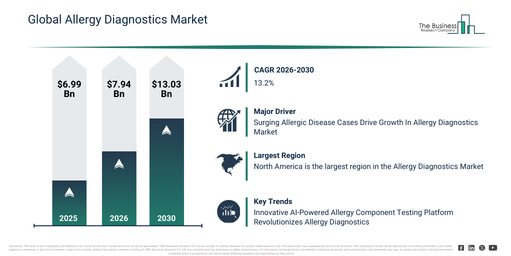
    The allergy diagnostics market size has seen rapid expansion in recent years. It is anticipated to increase from $6.99 billion in 2025 to $7.94 billion in 2026, exhibiting a compound annual growth rate (CAGR) of 13.5%. The historical growth of this market can be ascribed to the rising global incidence of allergies, the adoption of skin prick and intradermal tests, the expansion of hospital-based laboratories, increasing awareness regarding allergy management, and the limited availability of advanced in-vitro kits.

    The allergy diagnostics market is projected to experience substantial expansion over the upcoming years. This market is anticipated to reach $13.03 billion by 2030, exhibiting a compound annual growth rate (CAGR) of 13.2%. Several factors contribute to this growth during the forecast period, including progress in component-resolved diagnostics, the incorporation of automation into allergy testing, increased funding for research into new allergens, the proliferation of academic and diagnostic laboratories, and a rising need for individualized allergy treatment. Key trends expected during the forecast period encompass an escalating need for precise allergy diagnostics, the increasing acceptance of in-vitro testing techniques, broader application of food and drug allergen testing, enhanced utilization of ELISA, RAST, and CRD kits, and an emphasis on swift and point-of-care allergy detection.

    Access Your Free Sample Report For In-Depth Market Analysis:

    https://www.thebusinessresearchcompany.com/report/allergy-diagnostics-global-market-report

    What Significant Factors Are Influencing The Allergy Diagnostics Market Expansion?

    The escalating prevalence of allergic diseases is set to drive the expansion of the allergy diagnostics market. This increase in allergic conditions has been attributed to heightened environmental pollution stemming from traffic and various industries. An allergic reaction is defined as an abnormal immune system response to a specific allergen. Allergy diseases encompass anaphylaxis, allergic rhinitis (frequently referred to as ‘hay fever’), food allergies, skin allergies, and allergic asthma. The most crucial treatment for allergic disorders involves avoiding the allergen; therefore, accurate allergy diagnosis is essential for effective allergy treatment. For instance, in September 2024, data from Anaphylaxis UK, a UK-based charity, revealed that 20% of food allergy reactions occur at school. One in five children with food allergies experience bullying, and one in five parents report moderate-to-extreme anxiety. Nearly all parents of affected children exhibit post-traumatic stress symptoms (PTSS), with rates seven times higher among those whose children use adrenaline auto-injectors (AAIs). Consequently, the growing incidence of allergic diseases will further support the growth of the allergic diagnostics market.

    Which Segments Define The Allergy Diagnostics Market Segment Structure?

    The allergy diagnostics market covered in this report is segmented –

    1) By Test Type: In-Vivo Allergy Tests, In-Vitro Allergy Tests

    2) By Allergen: Inhaled Allergens, Food Allergens, Drug Allergens

    3) By Products: Consumables, Instruments

    4) By End User: Diagnostics Laboratories, Hospital-based Laboratories, Academic and Research Institutes

    Subsegments:

    1) By In-Vivo Allergy Tests: Skin Prick Tests, Intradermal Tests, Patch Tests, Oral Food Challenge Tests

    2) By In-Vitro Allergy Tests: Enzyme-Linked Immunosorbent Assay (ELISA), Radioallergosorbent Test (RAST), Component-Resolved Diagnostics (CRD), Basophil Activation Tests (BAT)

    What Trends Are Affecting The Direction Of The Allergy Diagnostics Market?

    Major enterprises operating within the allergy diagnostics market are developing new technologies, including an AI-powered allergy component testing platform, to enhance their market profitability. An AI-powered allergy component testing platform functions as an advanced system employing artificial intelligence (AI) to interpret and analyze allergy testing outcomes. As an illustration, in May 2023, Metropolis, an India-based pathology lab and diagnostic center, launched an artificial intelligence (AI)-driven platform for allergy component testing that can identify 127 respiratory allergens, 10 contact allergens, and 158 food allergens. This testing platform furnishes extensive knowledge for establishing and refining an individual’s allergy treatment plan and assists clinicians in formulating informed clinical decisions by leveraging component-resolved diagnostics (CRD) and artificial intelligence (AI).

    Who Are The Established Players Within The Allergy Diagnostics Market?

    Major companies operating in the allergy diagnostics market are bioMérieux SA, Danaher Corporation, HOB Biotech Group Corp. Ltd., HYCOR Biomedical, Lincoln Diagnostics Inc., Omega Diagnostics Group PLC, Siemens Healthineers AG, Thermo Fisher Scientific Inc., PerkinElmer Inc., R-Biopharm AG, Abbott Laboratories, HollisterStier Allergy, NEOGEN Corporation, AESKU.GROUP GmbH, ACON Laboratories Inc., Erba Group, Stallergenes Greer, HAL Allergy Group, INDOOR Biotechnologies Inc., MacroArray Technologies LLC, Phadia AB, Quest Diagnostics, Randox Laboratories Ltd., Eurofins Viracor Inc., VRL Laboratories

    Get The Full Allergy Diagnostics Market Report:

    https://www.thebusinessresearchcompany.com/report/allergy-diagnostics-global-market-report

    Which Region Is The Largest In The Allergy Diagnostics Market?

    North America was the largest region in the allergy diagnostics market in 2025. The regions covered in the allergy diagnostics market report are Asia-Pacific, South East Asia, Western Europe, Eastern Europe, North America, South America, Middle East, Africa.

    Request A Customized Allergy Diagnostics Market Report For Competitive Insights:

    https://www.thebusinessresearchcompany.com/report/allergy-diagnostics-global-market-report

    Browse Through More Reports Similar to the Global Allergy Diagnostics Market 2026, By The Business Research Company

    Immunoglobulin E Ige Allergy Blood Tests Market Report 2026

    https://www.thebusinessresearchcompany.com/report/immunoglobulin-e-ige-allergy-blood-tests-global-market-report

    Allergy Treatment Market Report 2026

    https://www.thebusinessresearchcompany.com/report/allergy-treatment-global-market-report

    Allergy Immunotherapy Market Report 2026

    https://www.thebusinessresearchcompany.com/report/allergy-immunotherapy-global-market-report

    Get in touch with us:

    The Business Research Company: https://www.thebusinessresearchcompany.com/

    Americas +1 310-496-7795

    Asia +44 7882 955267 & +91 8897263534

    Europe +44 7882 955267

    Email us at info@tbrc.info

    Follow us on:

    LinkedIn: https://in.linkedin.com/company/the-business-research-company

    YouTube: https://www.youtube.com/channel/UC24_fI0rV8cR5DxlCpgmyFQ

    Global Market Model: https://www.thebusinessresearchcompany.com/global-market-model
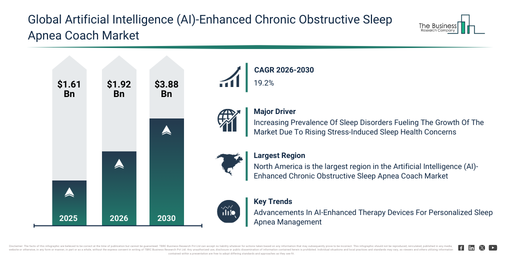
  • AI sleep apnea coaching solutions market forecast through 2030

    AI sleep apnea coaching solutions market forecast through 2030

    The Business Research Company’s 2026 market reports feature enhanced tools like market attractiveness analysis, TAM assessment, and company scoring matrices, along with interactive dashboards, deeper supply chain insights, and startup coverage strengthening the depth, usability, and strategic value of insights.

    What Expansion In Market Value Is Forecasted For The Artificial Intelligence (AI)-Enhanced Chronic Obstructive Sleep Apnea Coach Market Between 2026 And 2030?

    The artificial intelligence (AI)-enhanced chronic obstructive sleep apnea coach market size has experienced swift expansion in recent years. It is projected to grow from $1.61 billion in 2025 to $1.92 billion in 2026, at a compound annual growth rate (CAGR) of 19.5%. This growth observed historically can be attributed to the increasing occurrence of sleep apnea and respiratory conditions, a rising recognition of sleep health management, the advancement of home-based sleep monitoring solutions, the broadening of digital health platforms, and an intensified clinical focus on therapy adherence.

    The market for artificial intelligence (AI)-enhanced chronic obstructive sleep apnea coaches is projected to experience substantial expansion over the forthcoming years. This market is anticipated to reach a valuation of $3.88 billion by 2030, exhibiting a compound annual growth rate (CAGR) of 19.2%. This anticipated growth stems from several factors, including the rising uptake of AI-powered tools for managing chronic diseases, a growing need for remote patient monitoring, the development of personalized digital therapies, increased integration with connected medical devices, and a broader move in healthcare towards preventative care approaches. Key trends identified for this period encompass the wider implementation of continuous sleep and respiratory monitoring, increased utilization of AI-powered coaching to improve therapy adherence, greater incorporation of wearable sleep diagnostic technologies, the proliferation of individualized sleep health platforms, and a heightened emphasis on proactive disease management strategies.

    Access Your Free Sample Report For In-Depth Market Analysis:

    https://www.thebusinessresearchcompany.com/report/artificial-intelligence-ai-enhanced-chronic-obstructive-sleep-apnea-coach-global-market-report

    What Key Drivers Are Fueling The Growth Of The Artificial Intelligence (AI)-Enhanced Chronic Obstructive Sleep Apnea Coach Market?

    The rising occurrence of sleep conditions is anticipated to fuel expansion in the artificial intelligence (AI)-enhanced chronic obstructive sleep apnea coach market in the future. These are health issues that disrupt normal sleep cycles, negatively affecting the quality of sleep, general well-being, and daily functioning. The primary cause behind the surge in sleep disorders is elevated stress, with factors such as contemporary workplace demands, academic pressures, and extensive screen usage leading to increased anxiety and irregular sleep patterns. An artificial intelligence (AI)-enhanced chronic obstructive sleep apnea coach addresses these conditions by monitoring an individual’s breathing and sleep habits, providing customized advice and therapeutic assistance, which facilitates the prompt identification of potential issues and fosters improved sleep quality and overall health. To illustrate, data from November 2023, reported by the National Health Service, a UK government health statistics body, indicated a slight increase in young individuals aged 17 to 23 years facing sleep difficulties three or more times weekly, reaching 64.9% from 64.0% in 2022. Consequently, the expanding occurrence of sleep disorders is stimulating the market growth for artificial intelligence (AI)-enhanced chronic obstructive sleep apnea coaches.

    How Are Different Segments Classified In The Artificial Intelligence (AI)-Enhanced Chronic Obstructive Sleep Apnea Coach Market Segment Analysis?

    The artificial intelligence (AI)-enhanced chronic obstructive sleep apnea coach market covered in this report is segmented –

    1) By Component: Software, Hardware, Services

    2) By Deployment Mode: Cloud-Based, On-Premises

    3) By Application: Home Care, Sleep Clinics, Hospitals, Research Institutes, Other Applications

    4) By End-User: Patients, Healthcare Providers, Sleep Specialists, Other End-Users

    Subsegments:

    1) By Software: Cloud-Based Platforms, Mobile Applications, Patient Monitoring Dashboards, Sleep Data Analytics Tools, Therapeutic Guidance Systems, Compliance Management Software

    2) By Hardware: Wearable Sleep Trackers, Respiratory Monitoring Devices, Pulse Oximeters, Smart Sleep Masks, Connected Airflow Sensors, Portable Sleep Diagnostic Units

    3) By Services: Remote Patient Monitoring Services, Sleep Coaching Programs, Data Integration And Management Services, Technical Support And Maintenance, Clinical Consultation Services, Training And Education Services

    What Trends Are Influencing The Artificial Intelligence (AI)-Enhanced Chronic Obstructive Sleep Apnea Coach Market?

    Leading firms within the artificial intelligence (AI)-enhanced chronic obstructive sleep apnea coach sector are prioritizing the creation of sophisticated products, including positive airway pressure (PAP) devices, to offer tailored treatment and facilitate distant oversight via AI-powered insights. These PAP devices function by supplying a consistent or adjustable air stream through a mask, maintaining open airways during sleep and preventing collapses for individuals with obstructive sleep apnea, thereby enhancing respiration and sleep quality. As an illustration, in February 2024, ResMed Inc., an American medical device and digital health enterprise, introduced its AirCurve 11 series of bilevel devices. The AirCurve 11 devices offer dual support levels, providing elevated pressure during inhalation and reduced pressure during exhalation, which simplifies sleep apnea management for clinicians and supports patient adherence to treatment. Built upon the AirSense 11 platform, these AirCurve 11 units incorporate digital functionalities such as secure cellular data transmission, automated software upgrades, and patient engagement tools like the myAir application. This series features models tailored for both obstructive and central sleep apnea, with the objective of boosting comfort and compliance through personalized therapeutic assistance. Currently available in the U.S., a worldwide launch of these devices is anticipated.

    Who Are The Companies Driving Activity In The Artificial Intelligence (AI)-Enhanced Chronic Obstructive Sleep Apnea Coach Market?

    Major companies operating in the artificial intelligence (AI)-enhanced chronic obstructive sleep apnea coach market are Koninklijke Philips N.V., ResMed Inc., Sleep Number Corporation, Nihon Kohden Corporation, Fisher & Paykel Healthcare Corporation Limited, Verily Life Sciences LLC, Natus Medical Incorporated, SomnoMed Limited, BMC Medical Co.,Ltd., Eight Sleep,Inc., Sleepiz AG, Sleep.ai B.V. (SleepScore Labs), EnsoData,Inc., SovaSage,Inc., Somnics Inc., Sleep Doctor,LLC, Sommetrics,Inc., Nyxoah S.A., Neru Health Inc., Apnea-Tech Limited.

    Get The Full Artificial Intelligence (AI)-Enhanced Chronic Obstructive Sleep Apnea Coach Market Report:

    https://www.thebusinessresearchcompany.com/report/artificial-intelligence-ai-enhanced-chronic-obstructive-sleep-apnea-coach-global-market-report

    Where Is The Artificial Intelligence (AI)-Enhanced Chronic Obstructive Sleep Apnea Coach Market Primarily Concentrated By Region?

    North America was the largest region in the artificial intelligence (AI)-enhanced chronic obstructive sleep apnea coach market in 2025. Asia-Pacific is expected to be the fastest-growing region in the forecast period. The regions covered in the artificial intelligence (AI)-enhanced chronic obstructive sleep apnea coach market report are Asia-Pacific, South East Asia, Western Europe, Eastern Europe, North America, South America, Middle East, Africa.

    Request A Customized Artificial Intelligence (AI)-Enhanced Chronic Obstructive Sleep Apnea Coach Market Report For Competitive Insights:

    https://www.thebusinessresearchcompany.com/report/artificial-intelligence-ai-enhanced-chronic-obstructive-sleep-apnea-coach-global-market-report

    Browse Through More Reports Similar to the Global Artificial Intelligence (AI)-Enhanced Chronic Obstructive Sleep Apnea Coach Market 2026, By The Business Research Company

    Wearable Ai Market Report 2026

    https://www.thebusinessresearchcompany.com/report/wearable-ai-global-market-report

    Sleep Apnea Devices Market Report 2026

    https://www.thebusinessresearchcompany.com/report/sleep-apnea-devices-global-market-report

    Artificial Intelligence In Diabetes Management Market Report 2026

    https://www.thebusinessresearchcompany.com/report/artificial-intelligence-in-diabetes-management-global-market-report

    Get in touch with us:

    The Business Research Company: https://www.thebusinessresearchcompany.com/

    Americas +1 310-496-7795

    Asia +44 7882 955267 & +91 8897263534

    Europe +44 7882 955267

    Email us at info@tbrc.info

    Follow us on:

    LinkedIn: https://in.linkedin.com/company/the-business-research-company

    YouTube: https://www.youtube.com/channel/UC24_fI0rV8cR5DxlCpgmyFQ

    Global Market Model: https://www.thebusinessresearchcompany.com/global-market-model
  • AI virtual nursing assistants market outlook (2026–2030)

    AI virtual nursing assistants market outlook (2026–2030)

    The Business Research Company’s 2026 market reports feature enhanced tools like market attractiveness analysis, TAM assessment, and company scoring matrices, along with interactive dashboards, deeper supply chain insights, and startup coverage strengthening the depth, usability, and strategic value of insights.

    How Large Will The Artificial Intelligence (AI)-Driven Virtual Nursing Assistants Market Be By 2030 Compared To Its 2026 Market Size?

    The artificial intelligence (AI)-driven virtual nursing assistants market has experienced significant expansion in recent years. It is projected to increase from $1.76 billion in 2025 to $2.19 billion in 2026, achieving a compound annual growth rate (CAGR) of 24.4%. The historical development of this market is attributable to various factors including increasing healthcare staff shortages, the early adoption of telehealth services, a growing demand for patient self-management tools, the expansion of digital health platforms, and the availability of conversational AI technologies.

    The market for artificial intelligence (AI)-driven virtual nursing assistants is poised for significant expansion in the foreseeable future, with its valuation expected to climb to $5.19 billion by 2030, demonstrating a compound annual growth rate (CAGR) of 24.1%. This projected growth is driven by increasing investments in virtual care infrastructure, a rising need for ongoing patient support, the expansion of AI-assisted clinical workflows, a heightened emphasis on cost-efficient healthcare delivery, and the growing adoption of remote patient monitoring solutions. Major developments anticipated in this period include the wider embrace of virtual nursing support tools, an increase in the use of AI-powered platforms for patient engagement, the expanding integration of remote monitoring capabilities, the proliferation of 24/7 digital care assistance, and a stronger focus on automating care coordination.

    Access Your Free Sample Report For In-Depth Market Analysis:

    https://www.thebusinessresearchcompany.com/report/artificial-intelligence-ai-driven-virtual-nursing-assistants-global-market-report

    Which Drivers Are Supporting The Artificial Intelligence (AI)-Driven Virtual Nursing Assistants Market Growth?

    The increasing need for remote patient monitoring is anticipated to drive the expansion of the artificial intelligence (AI)-driven virtual nursing assistants market in the future. Remote patient monitoring (RPM) involves leveraging digital tools to gather patient health information from non-traditional medical environments and relay it to healthcare professionals for evaluation and management. This rising demand for remote patient monitoring stems from the increasing requirement for ongoing, real-time health supervision beyond conventional clinic environments. Within remote patient monitoring, artificial intelligence (AI)-driven virtual nursing assistants facilitate real-time tracking of patient health data, issue prompt alerts, and aid in personalized care, concurrently lessening the workload for healthcare personnel. For example, data from August 2025 by the US Department of Health and Human Services, a US-based government administration, showed that close to 1 million enrollees utilized remote patient monitoring in 2024, marking a 27% rise compared to 2023. Consequently, the escalating demand for remote patient monitoring is fueling the expansion of the artificial intelligence (AI)-driven virtual nursing assistants market.

    How Is The Artificial Intelligence (AI)-Driven Virtual Nursing Assistants Market Categorized Across Its Segment Groups?

    The artificial intelligence (AI)-driven virtual nursing assistants market covered in this report is segmented –

    1) By Component: Software, Services

    2) By Technology: Automatic Speech Recognition(ASR), Text-To-Speech(TTS), Text-Based Interface, Natural Language Processing (NLP), Other Technologies

    3) By Deployment: Cloud Based, On-Premise, Hybrid

    4) By Application: Symptom Checking And Virtual Triage, Appointment Scheduling And Reminders, Medication Management, Medical Information Retrieval, Patient Engagement And Education, Clinical Decision Support, Administrative Support, Remote Monitoring

    5) By End User: Hospitals And Clinics, Patients, Healthcare Payers Pharmaceutical And Life Sciences Companies, Other End Users

    Subsegments:

    1) By Software: Clinical Decision Support, Patient Monitoring And Engagement, Workflow And Care Coordination, Medication Management, Predictive Analytics And Risk Assessment, Communication And Chat Interfaces

    2) By Services: Training And Education, Consulting And Advisory, Support And Maintenance, Managed Services, Data Management And Security, Implementation And Integration

    Which Trends Are Expected To Impact The Artificial Intelligence (AI)-Driven Virtual Nursing Assistants Market?

    Leading companies in the artificial intelligence (AI)-driven virtual nursing assistants market are advancing new technologies, such as LIDAR-based spatial intelligence, to facilitate real-time patient monitoring, bolster safety through the early detection of risks like falls or sudden health declines, and support virtual nursing models. Light detection and ranging (LIDAR) is an sophisticated remote sensing method that employs laser light pulses to precisely measure distances. As an illustration, in March 2025, Emory Healthcare, a US-based healthcare system, initiated a virtual nursing program utilizing AI-driven technology to improve patient care. This program integrates Light detection and ranging (LIDAR) technology in patient rooms to observe movements and predict falls up to 30 seconds before they occur, using automated voice alerts to advise patients to remain in bed. It allows nurses located in a central control room to manage admission paperwork, medication administration, patient education, and discharge processes remotely, thereby enabling bedside nurses to dedicate more time to direct patient care. The system continuously analyzes patient data to identify initial signs of clinical deterioration or emergencies, ensuring timely alerts reach bedside care teams.

    Which Firms Are Influencing Competition In The Artificial Intelligence (AI)-Driven Virtual Nursing Assistants Market?

    Major companies operating in the artificial intelligence (AI)-driven virtual nursing assistants market are Microsoft Corporation, HealthTap Inc., Artera Inc., Caregility LLC, Luma Health Inc., Infermedica Sp. z o.o., Memora Health Inc., Buoy Health Inc., Hyro AI Ltd., Care Angel Inc., Sensely Inc., Artisight Inc., K Health Inc., Mediktor International S.L., Corti ApS, AvaSure LLC, Care.AI Inc., Tap Health Inc., GetWellNetwork Inc., Biofourmis Inc.

    Get The Full Artificial Intelligence (AI)-Driven Virtual Nursing Assistants Market Report:

    https://www.thebusinessresearchcompany.com/report/artificial-intelligence-ai-driven-virtual-nursing-assistants-global-market-report

    Which Region Has The Greatest Market Share In The Artificial Intelligence (AI)-Driven Virtual Nursing Assistants Market?

    North America was the largest region in the artificial intelligence (AI)-driven virtual nursing assistants market in 2025. Asia-Pacific is expected to be the fastest-growing region in the forecast period. The regions covered in the artificial intelligence (AI)-driven virtual nursing assistants market report are Asia-Pacific, South East Asia, Western Europe, Eastern Europe, North America, South America, Middle East, Africa.

    Request A Customized Artificial Intelligence (AI)-Driven Virtual Nursing Assistants Market Report For Competitive Insights:

    https://www.thebusinessresearchcompany.com/report/artificial-intelligence-ai-driven-virtual-nursing-assistants-global-market-report

    Browse Through More Reports Similar to the Global Artificial Intelligence (AI)-Driven Virtual Nursing Assistants Market 2026, By The Business Research Company

    Intelligent virtual assistants software market report 2026

    https://www.thebusinessresearchcompany.com/report/intelligent-virtual-assistants-software-global-market-report

    intelligent virtual assistant global market report

    https://www.thebusinessresearchcompany.com/report/intelligent-virtual-assistant-global-market-report

    virtual assistant global market report

    https://www.thebusinessresearchcompany.com/report/virtual-assistant-global-market-report

    Get in touch with us:

    The Business Research Company: https://www.thebusinessresearchcompany.com/

    Americas +1 310-496-7795

    Asia +44 7882 955267 & +91 8897263534

    Europe +44 7882 955267

    Email us at info@tbrc.info

    Follow us on:

    LinkedIn: https://in.linkedin.com/company/the-business-research-company

    YouTube: https://www.youtube.com/channel/UC24_fI0rV8cR5DxlCpgmyFQ

    Global Market Model: https://www.thebusinessresearchcompany.com/global-market-model
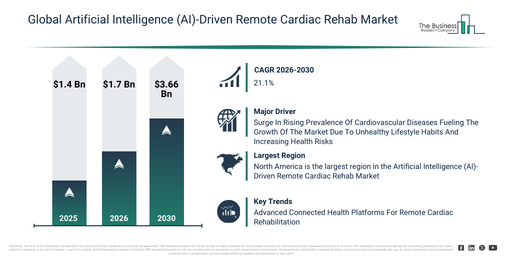
  • Rising cardiovascular diseases are fueling the AI remote cardiac rehab market

    Rising cardiovascular diseases are fueling the AI remote cardiac rehab market

    The Business Research Company’s 2026 market reports feature enhanced tools like market attractiveness analysis, TAM assessment, and company scoring matrices, along with interactive dashboards, deeper supply chain insights, and startup coverage strengthening the depth, usability, and strategic value of insights.

    What Is The Projected Increase In Market Value Of The Artificial Intelligence (AI)-Driven Remote Cardiac Rehab Market During 2026–2030?

    The artificial intelligence (AI)-driven remote cardiac rehab market size has witnessed substantial growth in recent years. This market is projected to expand from $1.4 billion in 2025 to $1.7 billion in 2026, achieving a compound annual growth rate (CAGR) of 21.4%. The historical growth can be attributed to several key factors, including the expansion of cardiac rehabilitation programs, a rising prevalence of cardiovascular diseases, increased adoption of telehealth services, the advancement of wearable cardiac devices, and improved remote monitoring capabilities.

    The artificial intelligence (AI)-driven remote cardiac rehab market is projected to experience rapid expansion over the coming years. This market is anticipated to reach a valuation of $3.66 billion by 2030, exhibiting a compound annual growth rate (CAGR) of 21.1%. Factors contributing to this growth during the forecast period include greater investments in AI-based cardiac care, an escalating demand for rehabilitation services at home, the expansion of cloud-based platforms for cardiac analytics, a heightened emphasis on preventive cardiac health, and more widespread integration with digital health records. Key trends expected during this period involve the rising application of AI-driven cardiac monitoring algorithms, an increase in the adoption of wearable heart monitoring devices, a heightened need for personalized rehabilitation programs, the broader availability of remote patient engagement tools, and a stronger focus on continuous tracking of outcomes.

    Access Your Free Sample Report For In-Depth Market Analysis:

    https://www.thebusinessresearchcompany.com/report/artificial-intelligence-ai-driven-remote-cardiac-rehab-global-market-report

    What Key Factors Are Affecting The Artificial Intelligence (AI)-Driven Remote Cardiac Rehab Market Demand?

    The escalating incidence of cardiovascular diseases is anticipated to fuel the expansion of the artificial intelligence (AI)-driven remote cardiac rehab market in the future. These conditions represent disorders affecting the heart and blood vessels, encompassing ailments such as heart attack, stroke, and hypertension. The surge in cardiovascular diseases is predominantly a consequence of unhealthy lifestyles, which contribute to obesity, high blood pressure, and elevated cholesterol, consequently placing strain on the heart and arteries. AI-driven remote cardiac rehab aids patients with cardiovascular diseases by remotely overseeing heart health, customizing exercise and medication regimens, and offering immediate feedback, which in turn enhances recovery, boosts adherence, and diminishes hospital readmissions. For example, in August 2025, figures from the National Institutes of Health, a US-based government agency, indicated that between 2025 and 2050, cardiovascular prevalence is forecasted to climb by 90%, mortality by 73%, and DALYs by 55%, with the number of deaths projected to grow from 20.5 million to 35.6 million. Therefore, the increasing prevalence of cardiovascular diseases is a key driver for the growth of the artificial intelligence (AI)-driven remote cardiac rehab market.

    How Are Segments Identified Within The Artificial Intelligence (AI)-Driven Remote Cardiac Rehab Market Segment Framework?

    The artificial intelligence (AI)-driven remote cardiac rehab market covered in this report is segmented –

    1) By Component: Software, Hardware, Services

    2) By Delivery Mode: Web-Based, App-Based, Telehealth Platforms

    3) By Deployment Mode: Cloud-Based, On-Premises

    4) By Application: Chronic Heart Failure, Post-Myocardial Infarction, Post-Cardiac Surgery, Hypertension Management, Other Applications

    5) By End-User: Hospitals And Clinics, Homecare Settings, Rehabilitation Centers, Other End-Users

    Subsegments:

    1) By Software: Remote Monitoring Software, Patient Engagement Software, Data Analytics Software

    2) By Hardware: Wearable Devices, Sensors And Monitors, Mobile Devices

    3) By Services: Telehealth Services, Consultation Services, Training And Support Services

    What Trends Are Influencing Changes In The Artificial Intelligence (AI)-Driven Remote Cardiac Rehab Market?

    Major companies operating in the artificial intelligence (AI)-driven remote cardiac rehabilitation market are concentrating on developing innovative solutions, such as advanced connected health platforms. These platforms are designed to enable continuous remote monitoring, personalized rehabilitation programs, and improved patient engagement for better cardiovascular outcomes. An advanced connected health platform refers to a digital system that integrates wearable devices, sensors, mobile applications, and cloud-based analytics to remotely oversee patients’ health, deliver tailored care, and facilitate real-time communication between patients and healthcare providers. For instance, in July 2025, OMRON Healthcare, a Japan-based healthcare company, partnered with Tricog Health Services Pvt Limited, an India-based medtech company, to launch KeeboHealth. This platform is specifically designed to combat India’s cardiac crisis and advance OMRON’s Going for Zero vision, a goal aimed at eliminating cardiovascular events like heart attacks and strokes. KeeboHealth allows for real-time monitoring through OMRON’s home ECG and blood pressure devices combined with Tricog’s AI cardiac analysis, thereby enabling early detection of heart issues and timely medical intervention. Ultimately, the platform helps reduce hospitalizations, enhances therapy adherence, and supports personalized heart health management.

    Who Are The Companies Competing Within The Artificial Intelligence (AI)-Driven Remote Cardiac Rehab Market?

    Major companies operating in the artificial intelligence (AI)-driven remote cardiac rehab market are Medtronic PLC, Philips Healthcare, Biofourmis Inc., Neurosoft Ltd., Cadence Health Solutions, Wellframe Inc., Amwell, Datos Health Ltd., VivaLNK Inc., Carda Health Inc., Heartbeat Health Inc., Cardihab Pty Ltd., Chanl Health Inc., HealthSnap Inc., Kento Health Inc., Lyfe by Lupin Digital Health, Movn Health Inc., RecoveryPlus Health, Wellinks Inc., CardioCare Fit.

    Get The Full Artificial Intelligence (AI)-Driven Remote Cardiac Rehab Market Report:

    https://www.thebusinessresearchcompany.com/report/artificial-intelligence-ai-driven-remote-cardiac-rehab-global-market-report

    Which Region Accounts For The Largest Portion Of The Artificial Intelligence (AI)-Driven Remote Cardiac Rehab Market?

    North America was the largest region in the artificial intelligence (AI)-driven remote cardiac rehab market in 2025. Asia-Pacific is expected to be the fastest-growing region in the forecast period. The regions covered in the artificial intelligence (AI)-driven remote cardiac rehab market report are Asia-Pacific, South East Asia, Western Europe, Eastern Europe, North America, South America, Middle East, Africa.

    Request A Customized Artificial Intelligence (AI)-Driven Remote Cardiac Rehab Market Report For Competitive Insights:

    https://www.thebusinessresearchcompany.com/report/artificial-intelligence-ai-driven-remote-cardiac-rehab-global-market-report

    Browse Through More Reports Similar to the Global Artificial Intelligence (AI)-Driven Remote Cardiac Rehab Market 2026, By The Business Research Company

    Rehabilitation Robotics Market Report 2026

    https://www.thebusinessresearchcompany.com/report/rehabilitation-robotics-global-market-report

    Cardiac Ai Monitoring And Diagnostics Market Report 2026

    https://www.thebusinessresearchcompany.com/report/cardiac-ai-monitoring-and-diagnostics-global-market-report

    Artificial Intelligence Ai In Remote Patient Monitoring Market Report 2026

    https://www.thebusinessresearchcompany.com/report/artificial-intelligence-ai-in-remote-patient-monitoring-global-market-report

    Get in touch with us:

    The Business Research Company: https://www.thebusinessresearchcompany.com/

    Americas +1 310-496-7795

    Asia +44 7882 955267 & +91 8897263534

    Europe +44 7882 955267

    Email us at info@tbrc.info

    Follow us on:

    LinkedIn: https://in.linkedin.com/company/the-business-research-company

    YouTube: https://www.youtube.com/channel/UC24_fI0rV8cR5DxlCpgmyFQ

    Global Market Model: https://www.thebusinessresearchcompany.com/global-market-model
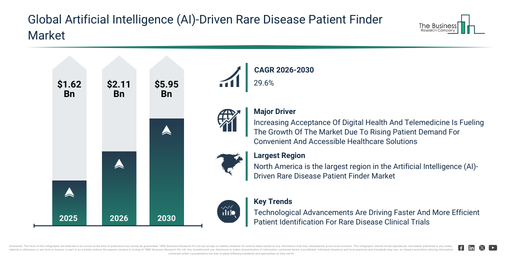
  • Increased telehealth adoption is boosting AI rare disease patient finder market growth

    Increased telehealth adoption is boosting AI rare disease patient finder market growth

    The Business Research Company’s 2026 market reports feature enhanced tools like market attractiveness analysis, TAM assessment, and company scoring matrices, along with interactive dashboards, deeper supply chain insights, and startup coverage strengthening the depth, usability, and strategic value of insights.

    How Is The Market Size Of The Artificial Intelligence (AI)-Driven Rare Disease Patient Finder Market Expected To Change From 2026 To 2030?

    The artificial intelligence (AI)-driven rare disease patient finder market size has witnessed exponential growth in recent years. It is projected to expand from $1.62 billion in 2025 to $2.11 billion in 2026, demonstrating a compound annual growth rate (CAGR) of 29.9%. The growth observed in previous periods is attributable to the increasing availability of electronic health records, the early adoption of data analytics in clinical research, the expansion of genomic databases, a rising focus on orphan diseases, and the initial use of AI in trial recruitment.

    The market for artificial intelligence (AI)-driven rare disease patient finders is projected to experience rapid expansion in the coming years. This market is anticipated to reach $5.95 billion by 2030, exhibiting a compound annual growth rate (CAGR) of 29.6%. This anticipated growth stems from several factors, including heightened investments in precision medicine research, an escalating need for quicker clinical trial enrollment, the broadening scope of real-world evidence analytics, increased partnerships between healthcare and life sciences companies, and stronger regulatory backing for rare disease advancements. Key trends predicted for this period involve a greater adoption of AI-based patient identification algorithms, an increasing integration of health data from multiple sources, enhanced automation in clinical trial recruitment processes, the proliferation of precision patient matching platforms, and a reinforced emphasis on facilitating rare disease research.

    Access Your Free Sample Report For In-Depth Market Analysis:

    https://www.thebusinessresearchcompany.com/report/artificial-intelligence-ai-driven-rare-disease-patient-finder-global-market-report

    Which Primary Drivers Are Impacting The Artificial Intelligence (AI)-Driven Rare Disease Patient Finder Market Growth?

    The future expansion of the artificial intelligence (AI)-driven rare disease patient finder market is anticipated, propelled by the growing adoption of digital health and telemedicine. Digital health encompasses the application of technology, software, and electronic instruments for monitoring, managing, and enhancing health and well-being. Telemedicine involves providing healthcare services remotely via telecommunications technology, including video consultations, mobile applications, and online platforms. This rising acceptance of digital health and telemedicine stems from both patients and providers seeking healthcare solutions that are convenient, save time, and are easily accessible. The artificial intelligence (AI)-driven rare disease patient finder aids digital health and telemedicine through precise patient identification, facilitation of remote monitoring, prompt virtual consultations, and customized care. For example, in November 2025, the Organisation for Economic Co operation and Development, an intergovernmental organization headquartered in France, noted that OECD nations have advanced in broadening access to Electronic Health Records (EHRs). The average availability of online digital health services in 2024 reached 82%, marking an increase from 79% in 2023 across countries with comparable data. Consequently, the growing adoption of digital health and telemedicine is propelling the expansion of the artificial intelligence (AI)-driven rare disease patient finder market.

    What Are The Key Segment Divisions In The Artificial Intelligence (AI)-Driven Rare Disease Patient Finder Market Segment Structure?

    The artificial intelligence (AI)-driven rare disease patient finder market covered in this report is segmented –

    1) By Component: Software, Services

    2) By Deployment Mode: Cloud-Based, On-Premises

    3) By Application: Hospitals, Clinics, Research Institutes, Pharmaceutical Companies, Other Applications

    4) By End-User: Healthcare Providers, Life Sciences Companies, Payers, Other End-Users

    Subsegments:

    1) By Software: Electronic Data Capture, Data Management Platform, Analytics And Reporting Tools, Patient Engagement Tools, Clinical Trial Management System

    2) By Services: Implementation And Integration, Training And Support, Data Hosting And Security, Consulting Services, Maintenance And Upgrades

    Which Trends Are Shaping Growth In The Artificial Intelligence (AI)-Driven Rare Disease Patient Finder Market?

    Companies operating within the AI-driven rare disease patient finder market are primarily focused on advancing technological capabilities, such as precision patient recruitment solutions. This effort is designed to improve the accuracy, speed, and overall efficiency of pinpointing eligible patients for rare disease clinical trials, thereby reducing recruitment timelines and elevating trial success rates. A precision patient recruitment solution represents a technology-driven methodology that utilizes advanced algorithms and real-world data to accurately identify and engage patients who fulfill specific clinical trial eligibility requirements. As an illustration, in April 2024, Citeline, a US-based business intelligence and data analytics company, introduced Citeline PatientMatch. This platform merges sophisticated algorithms with comprehensive real-world data, encompassing lab results, biomarkers, and electronic medical records from over 400 hospitals and health systems, to aid sponsors and investigators in efficiently finding eligible patients for clinical trials, streamlining the enrollment process, and supporting varied and intricate study protocols across multiple therapeutic areas.

    Which Organizations Are Engaged In The Artificial Intelligence (AI)-Driven Rare Disease Patient Finder Market?

    Major companies operating in the artificial intelligence (AI)-driven rare disease patient finder market are UnitedHealth Group Incorporated, Dassault Systèmes SE, GeneDx Holdings Corp., HealthVerity Inc., ConcertAI Inc., Komodo Health Inc., Unlearn.AI Inc., Antidote Technologies Inc., Healx Ltd., FDNA Inc., Saventic Health Sp. z o.o., Digital Pharma Lab SAS, AnnieGuard Ltd., Rapid Innovation Labs Inc., Sqilline EOOD, TrialX Inc., enGenome Srl, EveryCure Inc., ThinkGenetic Inc., RareSum Inc.

    Get The Full Artificial Intelligence (AI)-Driven Rare Disease Patient Finder Market Report:

    https://www.thebusinessresearchcompany.com/report/artificial-intelligence-ai-driven-rare-disease-patient-finder-global-market-report

    Which Region Holds The Highest Market Share In The Artificial Intelligence (AI)-Driven Rare Disease Patient Finder Market?

    North America was the largest region in the artificial intelligence (AI)-driven rare disease patient finder market in 2025. Asia-Pacific is expected to be the fastest-growing region in the forecast period. The regions covered in the artificial intelligence (AI)-driven rare disease patient finder market report are Asia-Pacific, South East Asia, Western Europe, Eastern Europe, North America, South America, Middle East, Africa.

    Request A Customized Artificial Intelligence (AI)-Driven Rare Disease Patient Finder Market Report For Competitive Insights:

    https://www.thebusinessresearchcompany.com/report/artificial-intelligence-ai-driven-rare-disease-patient-finder-global-market-report

    Browse Through More Reports Similar to the Global Artificial Intelligence (AI)-Driven Rare Disease Patient Finder Market 2026, By The Business Research Company

    Artificial Intelligence In Cancer Diagnostics Market Report 2026

    https://www.thebusinessresearchcompany.com/report/artificial-intelligence-in-cancer-diagnostics-global-market-report

    Ai In Medical Diagnostics Market Report 2026

    https://www.thebusinessresearchcompany.com/report/ai-in-medical-diagnostics-global-market-report

    Artificial Intelligence Ai In Clinical Trials Market Report 2026

    https://www.thebusinessresearchcompany.com/report/artificial-intelligence-ai-in-clinical-trials-global-market-report

    Get in touch with us:

    The Business Research Company: https://www.thebusinessresearchcompany.com/

    Americas +1 310-496-7795

    Asia +44 7882 955267 & +91 8897263534

    Europe +44 7882 955267

    Email us at info@tbrc.info

    Follow us on:

    LinkedIn: https://in.linkedin.com/company/the-business-research-company

    YouTube: https://www.youtube.com/channel/UC24_fI0rV8cR5DxlCpgmyFQ

    Global Market Model: https://www.thebusinessresearchcompany.com/global-market-model
  • Rising healthcare spending is driving growth in AI medical device vigilance platforms

    Rising healthcare spending is driving growth in AI medical device vigilance platforms

    The Business Research Company’s 2026 market reports feature enhanced tools like market attractiveness analysis, TAM assessment, and company scoring matrices, along with interactive dashboards, deeper supply chain insights, and startup coverage strengthening the depth, usability, and strategic value of insights.

    From Its 2026 Market Size, What Value Is The Artificial Intelligence (AI)-Driven Medical Device Vigilance Platform Market Projected To Reach By 2030?

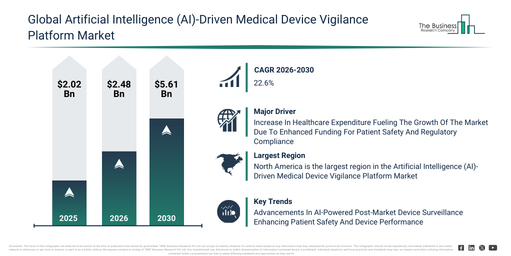
    The artificial intelligence (AI)-driven medical device vigilance platform market has experienced significant expansion recently. Its valuation is projected to increase from $2.02 billion in 2025 to $2.48 billion in 2026, achieving a compound annual growth rate (CAGR) of 22.9%. Historically, this expansion can be attributed to several factors, including higher rates of medical device adoption, more extensive post-market surveillance mandates, the increasing intricacy of device portfolios, an increase in adverse event reporting databases, and the initial application of data analytics in vigilance.

    The artificial intelligence (AI)-driven medical device vigilance platform market is projected to experience rapid expansion over the coming years. This market is predicted to reach $5.61 billion by 2030, exhibiting a compound annual growth rate (CAGR) of 22.6%. Factors contributing to this anticipated growth include stricter regulatory oversight concerning device safety, a heightened need for continuous risk monitoring, the proliferation of cloud-based vigilance platforms, deeper integration with hospital device information, and a greater uptake of AI-powered compliance solutions. Key developments expected during this period involve the wider implementation of AI-based signal detection systems, an increasing reliance on predictive analytics for ensuring device safety, enhanced integration of real-time vigilance platforms, the broadening of automated regulatory reporting, and a strengthened emphasis on proactive risk management strategies.

    Access Your Free Sample Report For In-Depth Market Analysis:

    https://www.thebusinessresearchcompany.com/report/artificial-intelligence-ai-driven-medical-device-vigilance-platform-global-market-report

    What Significant Factors Are Influencing The Artificial Intelligence (AI)-Driven Medical Device Vigilance Platform Market Expansion?

    The increasing healthcare expenditure is projected to stimulate the growth of the artificial intelligence (AI)-driven medical device vigilance platform market in the future. Healthcare expenditure refers to the aggregate spending by individuals, institutions, and governments on services and activities focused on preserving or enhancing health. This spending is escalating due to the rising prevalence of chronic diseases, which subsequently increases the demand for continuous medical care, extended treatment, and management resources. Healthcare expenditure supports AI-driven medical device vigilance platforms by providing hospitals and healthcare providers with the financial means to implement comprehensive safety and monitoring programs, thereby ensuring adherence to regulatory standards and improving patient protection. For instance, in April 2025, as per the Office for National Statistics, a UK-based government agency, government-funded healthcare constituted most healthcare spending in the UK, amounting to $344 billion (£258 billion) in 2024, which reflects a 2.5% increase in real terms compared to 2023. Therefore, the escalating healthcare expenditure is a significant factor driving the expansion of the artificial intelligence (AI)-driven medical device vigilance platform market.

    Which Segment Categories Are Included In The Artificial Intelligence (AI)-Driven Medical Device Vigilance Platform Market Segment Analysis?

    The artificial intelligence (AI)-driven medical device vigilance platform market covered in this report is segmented –

    1) By Component: Software, Hardware, Services

    2) By Deployment Mode: On-Premises, Cloud-Based

    3) By Application: Adverse Event Detection, Regulatory Compliance, Risk Management, Data Analytics, Other Applications

    4) By End-User: Hospitals, Medical Device Manufacturers, Regulatory Agencies, Contract Research Organizations, Other End-Users

    Subsegments:

    1) By Software: Predictive Analytics, Signal Detection, Data Integration, Reporting And Visualization

    2) By Hardware: Servers, Storage Devices, Networking Equipment, Sensors, Monitoring Devices

    3) By Services: Implementation Services, Maintenance And Support, Consulting Services, Training Services, Data Management Services

    What Trends Are Affecting The Direction Of The Artificial Intelligence (AI)-Driven Medical Device Vigilance Platform Market?

    Companies operating within the artificial intelligence (AI)-driven medical device vigilance platform market are concentrating on creating sophisticated solutions, such as post-market device surveillance platforms, to offer healthcare providers and manufacturers valuable insights for enhancing patient results and optimizing device use. Post-market device surveillance platforms are systems designed to monitor and evaluate the safety and performance of medical devices after their availability in healthcare settings. For example, in October 2025, Basil Systems, a US-based company specializing in AI-powered platforms, introduced its MedTech Safety Signaling platform. This platform employs AI to detect potential risks quickly, thereby transforming post-market device surveillance into a proactive safety approach. It processes regulatory documents, inspection reports, and adverse event narratives utilizing large language models trained on an extensive industry dataset to uncover patterns that are challenging to identify manually. The system organizes and interprets this data, linking related occurrences to their original sources with confidence levels. This functionality empowers manufacturers to identify safety trends, strengthen preventive measures, foresee regulatory attention, and inform product development decisions.

    Who Are The Active Companies Shaping The Artificial Intelligence (AI)-Driven Medical Device Vigilance Platform Market?

    Major companies operating in the artificial intelligence (AI)-driven medical device vigilance platform market are Amazon Web Services Inc., Johnson & Johnson Services Inc., International Business Machines Corporation, Oracle Corporation, Abbott Laboratories, Medtronic Plc, Siemens Healthineers AG, Stryker Corporation, Koninklijke Philips N.V., GE HealthCare Technologies Inc., Cognizant Technology Solutions Corporation, Boston Scientific Corporation, DXC TECHNOLOGY COMPANY, Baxter International Inc., Wipro Limited, Zimmer Biomet Holdings Inc., Veeva Systems Inc., Medidata Solutions Inc., Tata Consultancy Services Limited, AssurX Inc.

    Get The Full Artificial Intelligence (AI)-Driven Medical Device Vigilance Platform Market Report:

    https://www.thebusinessresearchcompany.com/report/artificial-intelligence-ai-driven-medical-device-vigilance-platform-global-market-report

    Where Is The Artificial Intelligence (AI)-Driven Medical Device Vigilance Platform Market Most Concentrated Geographically?

    North America was the largest region in the artificial intelligence (AI)-driven medical device vigilance platform market in 2025. Asia-Pacific is expected to be the fastest-growing region in the forecast period. The regions covered in the artificial intelligence (AI)-driven medical device vigilance platform market report are Asia-Pacific, South East Asia, Western Europe, Eastern Europe, North America, South America, Middle East, Africa.

    Request A Customized Artificial Intelligence (AI)-Driven Medical Device Vigilance Platform Market Report For Competitive Insights:

    https://www.thebusinessresearchcompany.com/report/artificial-intelligence-ai-driven-medical-device-vigilance-platform-global-market-report

    Browse Through More Reports Similar to the Global Artificial Intelligence (AI)-Driven Medical Device Vigilance Platform Market 2026, By The Business Research Company

    Artificial Intelligence Ai In Remote Patient Monitoring Market Report 2026

    https://www.thebusinessresearchcompany.com/report/artificial-intelligence-ai-in-remote-patient-monitoring-global-market-report

    Ai In Medical Devices Market Report 2026

    https://www.thebusinessresearchcompany.com/report/ai-in-medical-devices-global-market-report

    Artificial Intelligence Or Machine Learning Ai Or Ml Medical Device Market Report 2026

    https://www.thebusinessresearchcompany.com/report/artificial-intelligence-or-machine-learning-ai-or-ml-medical-device-global-market-report

    Get in touch with us:

    The Business Research Company: https://www.thebusinessresearchcompany.com/

    Americas +1 310-496-7795

    Asia +44 7882 955267 & +91 8897263534

    Europe +44 7882 955267

    Email us at info@tbrc.info

    Follow us on:

    LinkedIn: https://in.linkedin.com/company/the-business-research-company

    YouTube: https://www.youtube.com/channel/UC24_fI0rV8cR5DxlCpgmyFQ

    Global Market Model: https://www.thebusinessresearchcompany.com/global-market-model
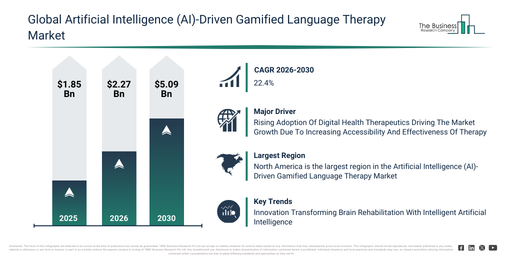
  • AI-powered innovations in brain rehabilitation are driving the gamified language therapy market

    AI-powered innovations in brain rehabilitation are driving the gamified language therapy market

    The Business Research Company’s 2026 market reports feature enhanced tools like market attractiveness analysis, TAM assessment, and company scoring matrices, along with interactive dashboards, deeper supply chain insights, and startup coverage strengthening the depth, usability, and strategic value of insights.

    How Much Growth In Market Value Is Expected For The Artificial Intelligence (AI)-Driven Gamified Language Therapy Market Between 2026 And 2030?

    The artificial intelligence (AI)-driven gamified language therapy market size has seen substantial growth over the past few years. This market is projected to expand from $1.85 billion in 2025 to $2.27 billion in 2026, exhibiting a compound annual growth rate (CAGR) of 22.6%. Historically, this expansion has been driven by factors such as increasing awareness of speech and language disorders, the early implementation of digital therapy tools, the growing adoption of mobile health applications, the broadening of pediatric therapy programs, and the accessibility of remote therapy platforms.

    The artificial intelligence (AI)-driven gamified language therapy market is projected to experience substantial growth in the coming years, expected to reach $5.09 billion by 2030, exhibiting a compound annual growth rate (CAGR) of 22.4%. This expansion is attributed to factors such as increasing demand for home-based rehabilitation solutions, the rising adoption of AI-personalized therapy models, the expansion of virtual and immersive therapy tools, a growing focus on long-term patient adherence, and increasing investments in digital therapeutics. Key trends anticipated in this period include the increasing adoption of gamified therapy platforms, a rising utilization of personalized language rehabilitation tools, the growing integration of real-time progress adaptation, the expansion of interactive therapy environments, and an enhanced focus on patient engagement and motivation.

    Access Your Free Sample Report For In-Depth Market Analysis:

    https://www.thebusinessresearchcompany.com/report/artificial-intelligence-ai-driven-gamified-language-therapy-global-market-report

    Which Important Drivers Are Guiding The Artificial Intelligence (AI)-Driven Gamified Language Therapy Market Growth?

    The increasing use of digital health therapeutics is projected to fuel the expansion of the artificial intelligence (AI)-driven gamified language therapy market in the future. Digital health therapeutics are defined as evidence-based treatments provided through digital platforms for the prevention, management, or treatment of various medical conditions. The embrace of digital health therapeutics is growing because patients are looking for more accessible healthcare to manage long-term conditions, receive tailored treatments, and easily track their health from home. Artificial intelligence (AI)-driven gamified language therapy complements digital health therapeutics by offering personalized, engaging exercises that enhance patient involvement, monitor progress instantly, and speed up language recovery. An example of this trend is a report from November 2025 by the Organisation for Economic Co operation and Development, a France-based intergovernmental organization, which indicated that OECD countries have advanced in broadening access to EHRs. In 2024, the average availability of online digital health services hit 82%, representing a rise from 79% in 2023 for nations with comparable statistics. Consequently, the increasing uptake of digital health therapeutics is stimulating the expansion of the artificial intelligence (AI)-driven gamified language therapy market.

    How Is The Artificial Intelligence (AI)-Driven Gamified Language Therapy Market Broken Down By Segment Categories?

    The artificial intelligence (AI)-driven gamified language therapy market covered in this report is segmented –

    1) By Component: Software, Hardware, Services

    2) By Deployment Mode: Cloud-Based, On-Premises

    3) By Therapy: Speech Therapy, Language Therapy, Cognitive Therapy, Other Therapies

    4) By Application: Children, Adults, Geriatric

    5) By End-User: Hospitals And Clinics, Rehabilitation Centers, Educational Institutions, Homecare, Other End Users

    Subsegments:

    1) By Software: Mobile Applications, Web-Based Platforms, Gamification Engines, Analytics And Reporting Tools

    2) By Hardware: Virtual Reality Headsets, Augmented Reality Devices, Wearables And Sensors, Interactive Consoles

    3) By Services: Implementation And Integration, Training And Education, Support And Maintenance, Consulting Services

    What Trends Are Influencing The Evolution Of The Artificial Intelligence (AI)-Driven Gamified Language Therapy Market?

    Leading companies in the artificial intelligence (AI)-driven gamified language therapy market are concentrating on developing innovative solutions, such as personalized adaptive learning platforms, to boost user engagement, accelerate recovery, and improve therapeutic outcomes. Personalized adaptive learning platforms are digital systems that continually adjust exercises, content, and difficulty based on an individual’s performance and needs, helping users learn or recover more efficiently, stay motivated, track real-time progress, and achieve superior long-term results. For example, in April 2025, Constant Therapy Health, a U.S.-based digital health company, announced the expansion of its AI-driven speech, language, and cognitive therapy platform to include Spanish and Indian English editions. This update enables non-native speakers recovering from stroke, traumatic brain injury (TBI), aphasia, dementia, or other neurological conditions to access over 1 million evidence-based, culturally and linguistically tailored exercises. The platform’s AI constantly monitors user progress, personalizes therapy in real time, and permits caregivers and clinicians to track outcomes, making therapy more engaging, effective, and accessible from home.

    Which Players Are Present In The Artificial Intelligence (AI)-Driven Gamified Language Therapy Market Space?

    Major companies operating in the artificial intelligence (AI)-driven gamified language therapy market are Babbel GmbH, Rosetta Stone LLC, SAY IT Labs BV, SPRY Ally, MINDMAZE SA, Busuu Ltd., Memrise Ltd., Lingvist Technologies OÜ, Constant Therapy Inc., Lingraphica LLC, Gemiini Systems LLC, Speechace LLC, Otsimo Inc., Blub Blub Inc., Melospeech Inc., LiriCare BV, Gabify Ltd., FunWattle Inc., TikTalk Inc., Hevolve AI

    Get The Full Artificial Intelligence (AI)-Driven Gamified Language Therapy Market Report:

    https://www.thebusinessresearchcompany.com/report/artificial-intelligence-ai-driven-gamified-language-therapy-global-market-report

    Which Region Dominates The Artificial Intelligence (AI)-Driven Gamified Language Therapy Market By Market Share?

    North America was the largest region in the artificial intelligence (AI)-driven gamified language therapy market in 2025. Asia-Pacific is expected to be the fastest-growing region in the forecast period. The regions covered in the artificial intelligence (AI)-driven gamified language therapy market report are Asia-Pacific, South East Asia, Western Europe, Eastern Europe, North America, South America, Middle East, Africa.

    Request A Customized Artificial Intelligence (AI)-Driven Gamified Language Therapy Market Report For Competitive Insights:

    https://www.thebusinessresearchcompany.com/report/artificial-intelligence-ai-driven-gamified-language-therapy-global-market-report

    Browse Through More Reports Similar to the Global Artificial Intelligence (AI)-Driven Gamified Language Therapy Market 2026, By The Business Research Company

    Conversational Ai Market Report 2026

    https://www.thebusinessresearchcompany.com/report/conversational-ai-global-market-report

    Healthcare Gamification Market Report 2026

    https://www.thebusinessresearchcompany.com/report/healthcare-gamification-global-market-report

    Artificial Intelligence Ai In Games Market Report 2026

    https://www.thebusinessresearchcompany.com/report/artificial-intelligence-ai-in-games-global-market-report

    Get in touch with us:

    The Business Research Company: https://www.thebusinessresearchcompany.com/

    Americas +1 310-496-7795

    Asia +44 7882 955267 & +91 8897263534

    Europe +44 7882 955267

    Email us at info@tbrc.info

    Follow us on:

    LinkedIn: https://in.linkedin.com/company/the-business-research-company

    YouTube: https://www.youtube.com/channel/UC24_fI0rV8cR5DxlCpgmyFQ

    Global Market Model: https://www.thebusinessresearchcompany.com/global-market-model