Category: Healthcare Services

  • Artificial Intelligence (AI)-Driven Hospital Readmission Predictor Market Expected to Grow Steadily to $6.08 Billion by 2030

    Artificial Intelligence (AI)-Driven Hospital Readmission Predictor Market Expected to Grow Steadily to $6.08 Billion by 2030

    The Business Research Company’s 2026 market reports include new capabilities such as market attractiveness scoring and analysis, total addressable market analysis, company scoring matrix, interactive excel data dashboard, improved supply chain analysis, upcoming startups in the market, and overview of key products, aimed at improving the depth, usability, and strategic value of the insights delivered.

    What Is The Forecasted Market Value Of The Artificial Intelligence (AI)-Driven Hospital Readmission Predictor Market Across 2026–2030?

    The artificial intelligence (AI)-driven hospital readmission predictor market has seen significant expansion in recent years. Its size is forecast to increase from $1.92 billion in 2025 to $2.42 billion in 2026, reflecting a compound annual growth rate (CAGR) of 26.2%. This historical growth can be attributed to factors such as the rising incorporation of AI in healthcare, a growing imperative to decrease hospital readmissions, enhanced accessibility of electronic health records, the broader use of predictive analytics, and an intensified concentration on patient outcomes.

    The market size for artificial intelligence (AI)-driven hospital readmission predictors is expected to experience substantial growth in the upcoming years. This market is projected to reach $6.09 billion by 2030, demonstrating a compound annual growth rate (CAGR) of 25.9%. The anticipated growth during the forecast period can be attributed to increased investments in healthcare IT infrastructure, the expanding integration of clinical decision support systems, a wider adoption of cloud-based analytics platforms, the broadening use of remote patient monitoring tools, and a heightened focus on value-based care models. Prominent trends for the forecast period include technological advancements in machine learning models, new developments in real-time patient monitoring, ongoing research and development in natural language processing, the creation of explainable AI for healthcare, and improvements in interoperable healthcare IT systems.

    Download the Free Sample Report to Explore Key Market Insights:

    https://www.thebusinessresearchcompany.com/sample.aspx?id=30521&type=smp

    What Major Growth Drivers Are Shaping The Outlook Of The Artificial Intelligence (AI)-Driven Hospital Readmission Predictor Market?

    The expanding occurrence of chronic illnesses is anticipated to drive the advancement of the artificial intelligence (AI)-driven hospital readmission predictor market in the future. These conditions are enduring health issues, exemplified by diabetes, heart disease, and arthritis, which typically advance gradually and necessitate continuous medical care and lifestyle adjustments to manage symptoms and avert complications. Their rise is primarily linked to detrimental lifestyle choices, such as inadequate nutrition, lack of physical activity, and tobacco use, all of which elevate the likelihood of developing conditions like diabetes, heart disease, and obesity. Tools that predict hospital readmissions using artificial intelligence (AI) assist in managing chronic diseases by examining patient information to pinpoint individuals with a high probability of readmission. These tools enhance patient results through facilitating early interventions, customized treatment strategies, and prompt follow-up, thereby preventing complications and shortening hospital admissions. An illustrative example comes from the National Health Service, a UK government body, which reported in June 2024 that 3,615,330 individuals registered with a general practitioner were diagnosed with non-diabetic hyperglycemia or pre-diabetes (a state of elevated blood sugar not yet meeting diabetes criteria) in 2023, representing an 18% surge from 3,065,825 instances recorded in 2022. Consequently, the growing incidence of chronic illnesses is fostering the expansion of the artificial intelligence (AI)-driven hospital readmission predictor market.

    What Segmentation Levels Are Considered In The Artificial Intelligence (AI)-Driven Hospital Readmission Predictor Market?

    The artificial intelligence (AI)-driven hospital readmission predictor market covered in this report is segmented –

    1) By Component: Software, Hardware, Services

    2) By Deployment Mode: On-Premises, Cloud

    3) By Application: Patient Risk Assessment, Care Management, Clinical Decision Support, Population Health Management, Other Applications

    4) By End-User: Hospitals, Clinics, Ambulatory Surgical Centers, Other End-Users

    Subsegments:

    1) By Software: Electronic Health Record Integration, Predictive Analytics Platforms, Risk Scoring Systems, Clinical Decision Support Tools

    2) By Hardware: Servers, Sensors, Monitoring Devices, Data Storage Devices

    3) By Services: Data Analytics Services, Predictive Modeling Services, Integration And Deployment Services, Training And Support Services, Monitoring And Reporting Services

    What Trends Are Projected To Affect The Artificial Intelligence (AI)-Driven Hospital Readmission Predictor Market?

    Prominent companies operating in the artificial intelligence (AI)-driven hospital readmission predictor market are concentrating on developing enhanced solutions, such as sophisticated predictive modeling, to pinpoint patients at high risk, enable proactive interventions, and optimize care following discharge. Sophisticated predictive modeling involves utilizing advanced statistical algorithms and machine learning methods on both historical and current data to uncover intricate patterns and produce very accurate forecasts of future outcomes. For example, in July 2025, Innovaccer Inc., a US-based healthcare AI company, unveiled its AI-Powered Readmissions Management Solution. This solution integrates advanced predictive modeling to highlight avoidable readmissions among Medicare, Medicaid, and uninsured populations. The platform also provides holistic 360-degree patient views, agentic AI tools like Care Management Copilot and Pre-Call Coordinator Agent for automating workflows, and benchmark intelligence for planning proactive interventions. This offering aids healthcare providers in reducing readmission rates, improving resource allocation, and elevating overall patient outcomes.

    Which Leading Firms Are Contributing To The Growth Of The Artificial Intelligence (AI)-Driven Hospital Readmission Predictor Market?

    Major companies operating in the artificial intelligence (AI)-driven hospital readmission predictor market are Oracle Corporation, Siemens Healthineers AG, Cognizant Technology Solutions Corp., Epic Systems Corporation, SAS Institute Inc., Veradigm Inc., Merative LLP, Health Catalyst Inc., Lumeris Inc., Innovaccer Inc., Optum Inc., H2O.ai Inc., Healthfirst Inc., Qventus Inc., Lightbeam Health Solutions Inc., HealthEC LLC, Collective Medical Technologies Inc., CarePredict Inc., HBI Solutions Inc., CloudMedx

    Read the full artificial intelligence (ai)-driven hospital readmission predictor market report here:

    https://www.thebusinessresearchcompany.com/report/artificial-intelligence-ai-driven-hospital-readmission-predictor-market-report

    How Does The Artificial Intelligence (AI)-Driven Hospital Readmission Predictor Market Perform Across Major Global Regions?

    North America was the largest region in the artificial intelligence (AI)-driven hospital readmission predictor market in 2025. Asia-Pacific is expected to be the fastest-growing region in the forecast period. The regions covered in the artificial intelligence (AI)-driven hospital readmission predictor market report are Asia-Pacific, South East Asia, Western Europe, Eastern Europe, North America, South America, Middle East, Africa.

    Request A Tailored Artificial Intelligence (AI)-Driven Hospital Readmission Predictor Market Research Report For Competitive Advantage:

    https://www.thebusinessresearchcompany.com/customise?id=30521&type=smp

    Browse Through More Reports Similar to the Global Artificial Intelligence (AI)-Driven Hospital Readmission Predictor Market 2026, By The Business Research Company

    Artificial Intelligence In Healthcare Diagnosis Market Report 2026

    https://www.thebusinessresearchcompany.com/report/artificial-intelligence-in-healthcare-diagnosis-global-market-report

    Artificial Intelligence In Healthcare Market 2026

    https://www.thebusinessresearchcompany.com/report/artificial-intelligence-in-healthcare-market

    generative ai in healthcare global market report

    https://www.thebusinessresearchcompany.com/report/generative-ai-in-healthcare-global-market-report

    Get in touch with us:

    The Business Research Company: https://www.thebusinessresearchcompany.com/

    Americas +1 310-496-7795

    Asia +44 7882 955267 & +91 8897263534

    Europe +44 7882 955267

    Email us at info@tbrc.info

    Follow us on:

    LinkedIn: https://in.linkedin.com/company/the-business-research-company

    YouTube: https://www.youtube.com/channel/UC24_fI0rV8cR5DxlCpgmyFQ

    Global Market Model: https://www.thebusinessresearchcompany.com/global-market-model
  • Artificial Intelligence (AI) Tele-Oncology Radiation Dose Scheduler Market Forecast to Reach $2.27 Billion by 2030 at 23% CAGR

    Artificial Intelligence (AI) Tele-Oncology Radiation Dose Scheduler Market Forecast to Reach $2.27 Billion by 2030 at 23% CAGR

    The Business Research Company’s 2026 market reports include new capabilities such as market attractiveness scoring and analysis, total addressable market analysis, company scoring matrix, interactive excel data dashboard, improved supply chain analysis, upcoming startups in the market, and overview of key products, aimed at improving the depth, usability, and strategic value of the insights delivered.

    What Market Size Increase Is Anticipated For The Artificial Intelligence (AI) Tele-Oncology Radiation Dose Scheduler Market Over The 2026–2030 Period?

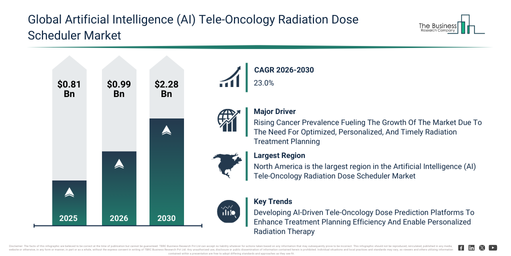
    The market size for artificial intelligence (AI) tele-oncology radiation dose schedulers has seen significant expansion in recent years. This market is projected to increase from $0.81 billion in 2025 to $0.99 billion in 2026, achieving a compound annual growth rate (CAGR) of 23.3%. The growth observed historically stems from various factors, including a heightened requirement for remote cancer treatment planning, the increasing acceptance of tele-oncology platforms, a rising call for precise radiation dose calculation, the expanded utilization of AI in oncology decision support, the global escalation in cancer occurrence, the ongoing digital evolution within hospitals, the greater deployment of cloud-based medical systems, a growing need for workflow automation in radiotherapy, an intensified focus on reducing treatment inaccuracies, and the broader integration of intelligent oncology scheduling tools.

    The artificial intelligence (AI) tele-oncology radiation dose scheduler market size is anticipated to undergo significant expansion in the coming years, reaching $2.28 billion by 2030, at a compound annual growth rate (CAGR) of 23.0%. This projected growth during the forecast period is driven by factors such as the broadening of tele-oncology networks, the adoption of AI-enabled treatment planning platforms, an increasing need for automated dose calculation systems, the uptake of cloud-based oncology scheduling modules, the deployment of predictive oncology algorithms, the development of remote radiotherapy review tools, the demand for precision-based cancer care, the integration of AI tools within oncology departments, strategic partnerships between AI vendors and cancer centers, and the growing acceptance of tele-radiation workflows. Prominent trends for the forecast period include advancements in AI-driven radiotherapy dose prediction, enhancements in cloud-based oncology scheduling platforms, progress in real-time dose optimization engines, innovations in automated treatment planning systems, new developments in predictive oncology algorithms, breakthroughs in virtual radiation oncology workflows, the merging of tele-oncology with hospital information systems, the integration of AI dose schedulers with imaging platforms, the incorporation of remote dose-review tools for oncologists, and the establishment of multi-center tele-radiation networks.

    Download the Free Sample Report to Explore Key Market Insights:

    https://www.thebusinessresearchcompany.com/sample.aspx?id=30520&type=smp

    What Drivers Are Expected To Influence The Artificial Intelligence (AI) Tele-Oncology Radiation Dose Scheduler Market During The Forecast Period?

    The artificial intelligence (AI) tele-oncology radiation dose scheduler market is expected to expand in the future, driven by the increasing incidence of cancer. Cancer, a condition characterized by the uncontrolled proliferation and spread of abnormal cells, can damage surrounding tissues and organs if not effectively managed. The growing prevalence of cancer is linked to lifestyle-related risk factors such as poor diet, smoking, alcohol consumption, and exposure to environmental pollutants, which elevate the likelihood of developing various cancers. Artificial intelligence (AI) tele-oncology radiation dose schedulers support cancer management by optimizing and personalizing radiation treatment plans through remote, data-driven analysis, thereby enhancing patient outcomes by ensuring accurate dosing, reducing treatment delays, and facilitating consistent care across locations. For example, NHS Digital, a UK government organization, reported in October 2025 that England recorded 354,820 new cancer diagnoses in 2023, averaging 972 diagnoses daily, representing an increase of 8,605 cases compared to 2022; prostate cancer was the most frequently diagnosed at 58,137 new cases, marking a 6% rise in registrations from the previous year. Thus, the rising prevalence of cancer is a primary driver for the growth of the artificial intelligence (AI) tele-oncology radiation dose scheduler market.

    How Is The Artificial Intelligence (AI) Tele-Oncology Radiation Dose Scheduler Market Segmented Across Key Categories?

    The artificial intelligence (AI) tele-oncology radiation dose scheduler market covered in this report is segmented –

    1) By Component: Software, Hardware, Services

    2) By Technology: Machine Learning Algorithms, Natural Language Processing, Computer Vision, Predictive Analytics

    3) By Deployment Mode: On-Premise (Local Installation), Cloud-Based (SaaS), Hybrid Deployment

    4) By Application: Auto-Contouring And Segmentation (OAR Or Target), Treatment Plan Generation And Optimization, Dose Prediction And Quality Assurance (QA), Workflow And Resource Scheduling Optimization, Adaptive Radiotherapy Planning

    5) By End-User: Hospitals, Cancer Treatment Centers, Research Institutes, Other End-Users

    Subsegments:

    1) By Software: Analytics And Reporting Software, Recommendation Engine Software, Natural Language Processing Software, Machine Learning Model Management Tools, Computer Vision Software, Integration And API Management Software, Mobile And Web Application Software

    2) By Hardware: AI-Optimized Servers, Edge Computing Devices, Sensors And IoT Devices, Smart Cameras, GPUs And AI Accelerators, Storage Systems, Networking And Connectivity Hardware

    3) By Services: Consulting Services, Implementation And Integration Services, Training And Support Services, Managed AI Services, Maintenance And Upgradation Services, Custom AI Development Services, Data Management And Annotation Services

    Which Upcoming Trends Are Expected To Influence The Artificial Intelligence (AI) Tele-Oncology Radiation Dose Scheduler Market?

    Leading companies in the AI tele-oncology and radiation therapy market are prioritizing the development of advanced solutions, such as AI-powered dose prediction, to forecast personalized radiation dose distributions and thereby enhance the efficiency of treatment planning. These AI-powered dose prediction platforms are software solutions designed to analyze imaging and anatomical data, generate clinically achievable 3D dose distributions, and support timely adjustments for optimizing therapy. For instance, in March 2025, MVision AI, a health-tech company based in Finland, unveiled Dose+. This particular AI-powered dose prediction platform incorporates specialized models for prostate and pelvic lymph node cases, customizes dose distributions to each patient’s anatomy, and supports integration with standard treatment planning systems via DICOM to facilitate efficient planning workflows. This launch signifies a considerable technological stride by integrating AI-driven dose prediction into routine clinical practice, connecting traditional planning with automated, patient-specific optimization, and equipping clinicians with a scalable, efficient solution for precise, personalized radiation therapy.

    Who Are The Dominant Players Shaping The Artificial Intelligence (AI) Tele-Oncology Radiation Dose Scheduler Market Landscape?

    Major companies operating in the artificial intelligence (AI) tele-oncology radiation dose scheduler market are IBM Corporation, Siemens Healthineers AG, GE HealthCare Technologies Inc., Koninklijke Philips N.V., Varian Medical Systems Inc., Elekta AB, Shanghai United Imaging Healthcare Co. Ltd., Accuray Incorporated, Brainlab AG, RaySearch Laboratories AB, MIM Software Inc., Sun Nuclear Corp., DeepHealth, Radformation Inc., MVision AI Ltd., Mirada Medical Ltd., ViewRay Inc., Oncora Medical, Enlitic, Optellum Ltd.

    Read the full artificial intelligence (ai) tele-oncology radiation dose scheduler market report here:

    https://www.thebusinessresearchcompany.com/report/artificial-intelligence-ai-tele-oncology-radiation-dose-scheduler-market-report

    Which Region Is Anticipated To See The Fastest Growth In The Artificial Intelligence (AI) Tele-Oncology Radiation Dose Scheduler Market?

    North America was the largest region in the AI tele-oncology radiation dose scheduler market in 2025. Asia-Pacific is expected to be the fastest-growing region in the forecast period. The regions covered in the artificial intelligence (AI) tele-oncology radiation dose scheduler market report are Asia-Pacific, South East Asia, Western Europe, Eastern Europe, North America, South America, Middle East, Africa.

    Request A Tailored Artificial Intelligence (AI) Tele-Oncology Radiation Dose Scheduler Market Research Report For Competitive Advantage:

    https://www.thebusinessresearchcompany.com/customise?id=30520&type=smp

    Browse Through More Reports Similar to the Global Artificial Intelligence (AI) Tele-Oncology Radiation Dose Scheduler Market 2026, By The Business Research Company

    Artificial Intelligence In Oncology Market Report 2026

    https://www.thebusinessresearchcompany.com/report/artificial-intelligence-in-oncology-global-market-report

    Radiation Dose Management Market Report 2026

    https://www.thebusinessresearchcompany.com/report/radiation-dose-management-global-market-report

    artificial intelligence ai radiology tool global market report

    https://www.thebusinessresearchcompany.com/report/artificial-intelligence-ai-radiology-tool-global-market-report

    Get in touch with us:

    The Business Research Company: https://www.thebusinessresearchcompany.com/

    Americas +1 310-496-7795

    Asia +44 7882 955267 & +91 8897263534

    Europe +44 7882 955267

    Email us at info@tbrc.info

    Follow us on:

    LinkedIn: https://in.linkedin.com/company/the-business-research-company

    YouTube: https://www.youtube.com/channel/UC24_fI0rV8cR5DxlCpgmyFQ

    Global Market Model: https://www.thebusinessresearchcompany.com/global-market-model
  • Artificial Intelligence (AI) Safety Market Anticipated to Hit $16.55 Billion by 2030 with 35.6% CAGR

    Artificial Intelligence (AI) Safety Market Anticipated to Hit $16.55 Billion by 2030 with 35.6% CAGR

    The Business Research Company’s 2026 market reports include new capabilities such as market attractiveness scoring and analysis, total addressable market analysis, company scoring matrix, interactive excel data dashboard, improved supply chain analysis, upcoming startups in the market, and overview of key products, aimed at improving the depth, usability, and strategic value of the insights delivered.

    How Much Is The Artificial Intelligence (AI) Safety Market Expected To Grow In Terms Of Market Value Between 2026 And 2030?

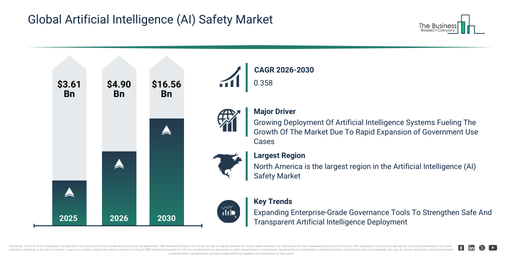
    The artificial intelligence (AI) safety market has experienced substantial expansion in recent times. Forecasts indicate a rise in its value from $3.61 billion in 2025 to $4.90 billion in 2026, demonstrating a compound annual growth rate (CAGR) of 35.8 %. This historical growth is primarily driven by several factors, including a heightened regulatory emphasis on secure AI practices, an increasing demand from businesses for AI deployment with controlled risks, mounting worries about unforeseen AI actions, the wider acceptance of ethical AI guidelines, and greater funding in mechanisms for AI oversight.

    The artificial intelligence (AI) safety market size is projected for substantial expansion in the upcoming years. This market is forecast to reach $16.56 billion by 2030, demonstrating a compound annual growth rate (CAGR) of 35.6 %. This projected growth during the forecast period is driven by the increasing need for explainable and reliable AI systems, escalating adoption of AI governance standards, wider incorporation of AI safety solutions across various sectors, a heightened focus on mitigating AI model bias, and greater importance placed on secure AI lifecycle management. Key developments anticipated for the forecast timeframe encompass technological advancements in AI risk detection, innovations in explainable AI modeling, progress in autonomous system safety protocols, research and development in human-AI alignment, and improvements in AI governance and auditing tools.

    Download the Free Sample Report to Explore Key Market Insights:

    https://www.thebusinessresearchcompany.com/sample.aspx?id=30519&type=smp

    What Drivers Are Influencing The Artificial Intelligence (AI) Safety Market?

    The expansion in the use of artificial intelligence systems is projected to stimulate the growth of the artificial intelligence (AI) safety market in the coming years. Artificial Intelligence systems are intelligent models or applications that can significantly affect safety, civil rights, public services, or vital infrastructure if they fail or behave unpredictably. The increased adoption of artificial intelligence systems stems from the rising demand for automation and improved efficiency across various sectors. This widespread implementation of AI systems boosts artificial intelligence (AI) safety by necessitating strong safeguards, vigilant monitoring, and robust governance to ensure AI functions reliably, transparently, and responsibly in crucial applications. For example, in July 2025, data from the U.S. Government Accountability Office, a US-based government agency, showed a substantial increase in reported AI use cases, climbing from 571 in 2023 to 1,110 in 2024. During the same timeframe, generative AI applications saw an almost ninefold surge, escalating from merely 32 to 282. Consequently, the growing deployment of artificial intelligence systems is a key factor propelling the artificial intelligence (AI) safety market forward.

    What Major Segment Divisions Exist Within The Artificial Intelligence (AI) Safety Market?

    The artificial intelligence (AI) safety market covered in this report is segmented –

    1) By Component: Software, Hardware, Services

    2) By Deployment Mode: On-Premises, Cloud

    3) By Technology: Machine Learning Safety Systems, Deep Learning Safety Systems, Natural Language Processing Safety Systems, Computer Vision Safety Systems, Reinforcement Learning Safety Systems

    4) By Organization Size: Large Enterprises, Medium Enterprises, Small Enterprises, Micro Enterprises, Public Sector Organizations

    5) By End-User: Banking, Financial Services And Insurance (BFSI), Healthcare, Automotive, Information Technology And Telecommunications, Government, Other End Users

    Subsegments:

    1) By Software: AI Safety Platforms, Robustness And Monitoring Tools, Alignment And Oversight Software, Data Security And Privacy Software

    2) By Hardware: Specialized AI Safety Chips, Secure Enclaves And Trusted Execution Environments, Hardware For Controlled Testing Environments, Biometric And Physical Access Systems

    3) By Services: AI Safety Consulting And Auditing, Red Teaming And Adversarial Testing, Incident Response And Management, Training And Certification

    How Are Trends Shaping The Direction Of The Artificial Intelligence (AI) Safety Market?

    Leading companies in the artificial intelligence (AI) safety market are concentrating on developing technologically advanced solutions, such as open-source model frameworks and enhanced governance capabilities, to elevate transparency, ensure safety compliance, and improve risk management in enterprise AI deployments. Open-source model frameworks and governance solutions integrate collaborative development, interpretability tools, and community-driven safeguards, allowing organizations to build, monitor, and align AI systems while mitigating unintended or harmful behaviors. For instance, in May 2024, International Business Machines Corporation, a US-based technology corporation, unveiled the next phase of its WatsonX platform with open-source product and ecosystem innovations, releasing a family of Granite open-source models and launching InstructLab, a model alignment technique that invites community contributions and supports safer model development and deployment practices. These advancements are designed to enhance visibility, governance, and safety oversight across open and hybrid Artificial Intelligence environments. Therefore, the ongoing trend toward open-source model releases and safety-focused governance innovations is shaping the Artificial Intelligence safety market.

    Which Companies Are Leading Innovation In The Artificial Intelligence (AI) Safety Market?

    Major companies operating in the artificial intelligence (AI) safety market are Microsoft Corporation, OpenAI LLC, MITRE Corporation, Anthropic PBC, DeepMind Technologies Limited, HiddenLayer Inc., Fiddler AI Inc., Arthur AI Inc., ModelOp Center Inc., CalypsoAI Corp., Credo AI Inc., Truera Inc., WhyLabs Inc., Robust Intelligence Inc., Aequitas AI Inc., Fairly AI Inc., Holistic AI Ltd., Goodfire AI Inc., Giskard AI Inc., Center for AI Safety Inc.

    Read the full artificial intelligence (ai) safety market report here:

    https://www.thebusinessresearchcompany.com/report/artificial-intelligence-ai-safety-market-report

    Which Region Is Anticipated To See The Fastest Growth In The Artificial Intelligence (AI) Safety Market?

    North America was the largest region in the artificial intelligence (AI) safety market in 2025. Asia-Pacific is expected to be the fastest-growing region in the forecast period. The regions covered in the artificial intelligence (AI) safety market report are Asia-Pacific, South East Asia, Western Europe, Eastern Europe, North America, South America, Middle East, Africa.

    Request A Tailored Artificial Intelligence (AI) Safety Market Research Report For Competitive Advantage:

    https://www.thebusinessresearchcompany.com/customise?id=30519&type=smp

    Browse Through More Reports Similar to the Global Artificial Intelligence (AI) Safety Market 2026, By The Business Research Company

    Ai For Public Security And Safety Market Report 2026

    https://www.thebusinessresearchcompany.com/report/ai-for-public-security-and-safety-global-market-report

    Ai Trust Risk And Security Management Market Report 2026

    https://www.thebusinessresearchcompany.com/report/ai-trust-risk-and-security-management-global-market-report

    artificial intelligence ai in games global market report

    https://www.thebusinessresearchcompany.com/report/artificial-intelligence-ai-in-games-global-market-report

    Get in touch with us:

    The Business Research Company: https://www.thebusinessresearchcompany.com/

    Americas +1 310-496-7795

    Asia +44 7882 955267 & +91 8897263534

    Europe +44 7882 955267

    Email us at info@tbrc.info

    Follow us on:

    LinkedIn: https://in.linkedin.com/company/the-business-research-company

    YouTube: https://www.youtube.com/channel/UC24_fI0rV8cR5DxlCpgmyFQ

    Global Market Model: https://www.thebusinessresearchcompany.com/global-market-model
  • Global Artificial Intelligence (AI) Productivity Tools Market Projected to Reach $41.12 Billion by 2030 at 24.7% CAGR

    Global Artificial Intelligence (AI) Productivity Tools Market Projected to Reach $41.12 Billion by 2030 at 24.7% CAGR

    The Business Research Company’s 2026 market reports include new capabilities such as market attractiveness scoring and analysis, total addressable market analysis, company scoring matrix, interactive excel data dashboard, improved supply chain analysis, upcoming startups in the market, and overview of key products, aimed at improving the depth, usability, and strategic value of the insights delivered.

    What Market Value Is Expected For The Artificial Intelligence (AI) Productivity Tools Market At The End Of The 2026–2030 Forecast Period?

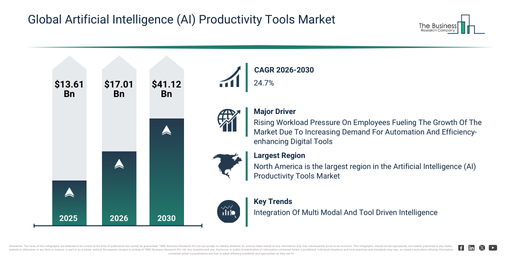
    The market size for artificial intelligence (AI) productivity tools has seen significant expansion in recent years. This sector is projected to increase from $13.61 billion in 2025 to $17.01 billion in 2026, registering a compound annual growth rate (CAGR) of 25.0%. The growth observed in the past can be linked to factors such as the increasing adoption of enterprise automation, the growing utilization of cloud-based workforce tools, a heightened demand for remote collaboration, the expansion of digital transformation initiatives, and an emphasis on data-driven decision-making.

    The artificial intelligence (AI) productivity tools market is projected to experience rapid expansion over the coming years, reaching $41.12 billion by 2030, with a compound annual growth rate (CAGR) of 24.7%.

    This anticipated expansion is driven by several factors, including increased investment in AI-powered productivity platforms, the wider uptake of generative AI assistants, the growing demand for large-scale workflow optimization, the broader integration of AI across various business applications, and an intensified emphasis on automating processes cost-effectively.

    Key trends shaping this period encompass technological progress in generative AI models, ongoing breakthroughs in automation workflows, swift evolution in multimodal AI tools, augmented research and development efforts in productivity AI, and new strides in adaptive and personalized AI systems.

    Download the Free Sample Report to Explore Key Market Insights:

    https://www.thebusinessresearchcompany.com/sample.aspx?id=30517&type=smp

    What Drivers Are Shaping The Future Growth Of The Artificial Intelligence (AI) Productivity Tools Market?

    The projected expansion of the artificial intelligence (AI) productivity tools market is anticipated to be fueled by the increasing workload demands placed on employees. This employee workload pressure describes the degree of physical and mental stress workers encounter, resulting from intense job requirements, stringent deadlines, extended work hours, or inadequate personnel. The escalation in employee workload pressure stems from companies’ efforts towards greater organizational cost optimization, where they reduce staff numbers yet sustain or boost operational output. Consequently, this pressure encourages the uptake of artificial intelligence–based productivity tools by generating a need for solutions capable of automating tasks, enhancing efficiency, and minimizing time dedicated to repetitive labor. An example supporting this is the finding in January 2025 from Mental Health UK, a UK-based charitable organization, indicating that the risk of burnout persists as substantial, with 34% of adults in the last year reporting sustained high or extreme pressure or stress levels, which closely mirrors the 35% observed in the year prior. Thus, the growing workload pressure on employees is a primary impetus for the artificial intelligence (AI) productivity tools market.

    What Segment Types Make Up The Artificial Intelligence (AI) Productivity Tools Market?

    The artificial intelligence (AI) productivity tools market covered in this report is segmented –

    1) By Offering Or Product Type: Virtual Assistants, Document Management, Robotic Process Automation (RPA), Data Analytics And Business Intelligence, Content Creation And Writing Assistance, Code Generation And Assistance, Project Management Tools, Communication And Collaboration Tools, Artificial Intelligence (AI)-Powered Scheduling Tools

    2) By Deployment: Cloud-Based, On-Premises, Hybrid

    3) By Technology: Machine Learning And Deep Learning, Natural Language Processing, Computer Vision, Generative Artificial Intelligence (AI), Other Technologies

    4) By Application: Content Creation And Writing Assistance, Code Development And Assistance, Communication And Meeting Enhancement, Task And Project Management, Data Analysis And Visualization, Other Applications

    5) By End Use: Banking, Financial Services, And Insurance (BFSI), Healthcare, Retail And E-Commerce, Information Technology (IT) And Telecom, Media And Entertainment, Other End Uses

    Subsegments:

    1) By Virtual Assistants: Voice-Based Assistants, Text-Based Assistants, Multimodal Assistants, Task-Oriented Assistants, Customer Support Assistants

    2) By Document Management: Intelligent Document Processing, Automated File Organization, Document Summarization, Document Classification, Smart Search And Retrieval

    3) By Robotic Process Automation (RPA): Rule-Based Automation, Cognitive Automation, Workflow Automation, Intelligent Data Extraction, Automated Error Handling

    4) By Data Analytics And Business Intelligence: Predictive Analytics, Diagnostic Analytics, Prescriptive Analytics, Real-Time Analytics, Natural Language Query Analytics

    5) By Content Creation And Writing Assistance: Text Generation Tools, Editing And Proofreading Tools, Creative Content Tools, Marketing Copy Tools, Academic Writing Tools

    6) By Code Generation And Assistance: Code Completion Tools, Code Review Tools, Code Debugging Tools, Automated Documentation Tools, Software Testing Tools

    7) By Project Management Tools: Task Automation Tools, Resource Allocation Tools, Workflow Optimization Tools, Risk Analysis Tools, Timeline Forecasting Tools

    8) By Communication And Collaboration Tools: Intelligent Meeting Assistants, Automated Transcription Tools, Team Messaging Tools, Real-Time Translation Tools, Collaboration Enhancement Tools

    9) By Artificial Intelligence (AI)-Powered Scheduling Tools: Automated Calendar Management, Meeting Coordination Tools, Availability Prediction Tools, Resource Scheduling Tools, Time Optimization Tools

    Which Market Trends Are Creating New Opportunities In The Artificial Intelligence (AI) Productivity Tools Market?

    Major companies in the artificial intelligence (AI) productivity tools market are prioritizing technological advancements, such as autonomous artificial intelligence (AI) agent technologies, to automate intricate workflows, minimize manual intervention, and substantially boost productivity across diverse tasks and industries. Autonomous artificial intelligence (AI) agent technologies refer to sophisticated artificial intelligence (AI) systems designed to independently plan, execute, and complete multi-step tasks like data analysis, content creation, and workflow automation without requiring continuous human input, thus evolving traditional productivity tools into proactive digital collaborators. As an illustration, in March 2025, Beijing Butterfly Effect Technology Co. Ltd. (Monica), an artificial intelligence (AI) startup based in Singapore-China, unveiled Manus artificial intelligence (AI), a cutting-edge autonomous artificial intelligence (AI) agent. This solution offers independent task execution capabilities that automate complex processes with minimal user interaction, multi-modal processing that integrates text, images, and code within unified workflows, and advanced tool integration facilitating seamless interaction with external systems to enhance real-world productivity outcomes.

    Who Are The Key Players Driving Competition In The Artificial Intelligence (AI) Productivity Tools Market?

    Major companies operating in the artificial intelligence (AI) productivity tools market are Nvidia Corporation, Blue Yonder Group Inc., Cognex Corporation, Asana Inc., Lectra SA, Zapier Inc., Centric Software Inc., Datacolor AG, Inspectorio Inc., Uptake Technologies Inc., Alvanon Inc., Coats Digital Ltd., Optitex Ltd., Landing AI inc., Vue.ai, Techmind Solutions LLC, Deepomatic SAS, Resonance Companies Inc., Texel Inc., Unspun Inc., Sewbo Inc.

    Read the full artificial intelligence (ai) productivity tools market report here:

    https://www.thebusinessresearchcompany.com/report/artificial-intelligence-ai-productivity-tools-market-report

    Which Global Regions Are Shaping The Competitive Landscape Of The Artificial Intelligence (AI) Productivity Tools Market?

    North America was the largest region in the AI productivity tools market in 2025. Asia-Pacific is expected to be the fastest-growing region in the forecast period. The regions covered in the artificial intelligence (AI) productivity tools market report are Asia-Pacific, South East Asia, Western Europe, Eastern Europe, North America, South America, Middle East, Africa.

    Request A Tailored Artificial Intelligence (AI) Productivity Tools Market Research Report For Competitive Advantage:

    https://www.thebusinessresearchcompany.com/customise?id=30517&type=smp

    Browse Through More Reports Similar to the Global Artificial Intelligence (AI) Productivity Tools Market 2026, By The Business Research Company

    Productivity Software Market Report 2026

    https://www.thebusinessresearchcompany.com/report/productivity-software-global-market-report

    Business Productivity Software Market Report 2026

    https://www.thebusinessresearchcompany.com/report/business-productivity-software-global-market-report

    artificial intelligence ai studio global market report

    https://www.thebusinessresearchcompany.com/report/artificial-intelligence-ai-studio-global-market-report

    Get in touch with us:

    The Business Research Company: https://www.thebusinessresearchcompany.com/

    Americas +1 310-496-7795

    Asia +44 7882 955267 & +91 8897263534

    Europe +44 7882 955267

    Email us at info@tbrc.info

    Follow us on:

    LinkedIn: https://in.linkedin.com/company/the-business-research-company

    YouTube: https://www.youtube.com/channel/UC24_fI0rV8cR5DxlCpgmyFQ

    Global Market Model: https://www.thebusinessresearchcompany.com/global-market-model
  • Artificial Intelligence (AI) Math Problem Tutors Market Expected to Reach $9.15 Billion by 2030 at 25.1% CAGR

    Artificial Intelligence (AI) Math Problem Tutors Market Expected to Reach $9.15 Billion by 2030 at 25.1% CAGR

    The Business Research Company’s 2026 market reports include new capabilities such as market attractiveness scoring and analysis, total addressable market analysis, company scoring matrix, interactive excel data dashboard, improved supply chain analysis, upcoming startups in the market, and overview of key products, aimed at improving the depth, usability, and strategic value of the insights delivered.

    What Is The Estimated Market Size Of The Artificial Intelligence (AI) Math Problem Tutors Market During 2026–2030?

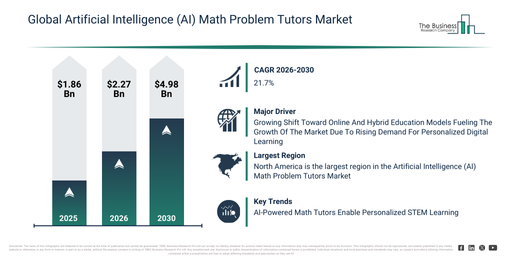
    The market size for artificial intelligence (AI) math problem tutors has expanded significantly in recent years. Its value is projected to climb from $1.86 billion in 2025 to $2.27 billion in 2026, reflecting a compound annual growth rate (CAGR) of 22.0%. This historical surge can be linked to the increased embrace of digital learning instruments, a growing dependence on online math instruction, the rising requirement for customized student assistance, the broadening of K-12 STEM initiatives, and an upward trend in parental expenditure on supplemental math education.

    The artificial intelligence (AI) math problem tutors market is anticipated to experience substantial growth in the coming years. It is projected to expand to $4.98 billion by 2030, demonstrating a compound annual growth rate (CAGR) of 21.7%. This expansion during the forecast period can be attributed to several factors, including the increasing demand for artificial intelligence (AI)-powered math tutors, the rising adoption of adaptive learning platforms, the growing availability of mobile math learning applications, an increased emphasis on improving STEM proficiency, and the expanding implementation of artificial intelligence (AI) tutors in hybrid classroom environments. Prominent trends throughout this period involve technological advancements in artificial intelligence (AI) reasoning models, new developments in adaptive math algorithms, progress in multimodal math understanding, continued research and development in AI-driven tutoring systems, and the integration of advanced artificial intelligence (AI) features into various learning platforms.

    Download the Free Sample Report to Explore Key Market Insights:

    https://www.thebusinessresearchcompany.com/sample.aspx?id=30514&type=smp

    Which Economic Or Industry Drivers Are Impacting The Artificial Intelligence (AI) Math Problem Tutors Market?

    The increasing adoption of online and hybrid education models is anticipated to stimulate the expansion of the artificial intelligence (AI) math problem tutors market in the future. These educational models are defined as learning frameworks integrating digital platforms with traditional classroom teaching, thus enabling students to access learning materials regardless of time or location. The growth of online and hybrid education models stems from a heightened need for adaptive and readily available educational options. The artificial intelligence (AI) math problem tutors market facilitates online and hybrid education models through intelligent tutoring systems capable of creating customized math problems, assessing student performance, and dynamically adjusting learning routes. As an illustration, data from September 2024, provided by the Institute of Education Sciences, a government agency in the US, indicated that during the 2022–23 school year, around 3.4% of students were homeschooled, and 2.5% participated in full-time virtual education. Consequently, the expanding trend towards online and hybrid education models is fueling the expansion of the artificial intelligence (AI) math problem tutors market.

    How Are The Various Segments Of The Artificial Intelligence (AI) Math Problem Tutors Market Categorized?

    The artificial intelligence (AI) math problem tutors market covered in this report is segmented –

    1) By Component: Software, Services

    2) By Deployment Mode: Cloud-Based, On-Premises

    3) By Technology: Machine Learning and Predictive Analytics, Natural Language Processing (NLP), Computer Vision, Generative Artificial Intelligence (AI)

    4) By Application: K-12 Education, Higher Education, Test Preparation, Professional Training, Other Applications

    5) By End-User: Students, Educational Institutions, Private Tutors, Other End-Users

    Subsegments:

    1) By Software: Interactive Learning Platforms, Intelligent Problem Solving Engines, Automated Feedback Systems, Adaptive Learning Modules, Performance Analytics Tools, Virtual Classroom Interfaces

    2) By Services: Implementation Support Services, Training And Onboarding Services, Technical Assistance Services, Customization And Integration Services, Subscription Management Services, Continuous Improvement Services

    What Trends Are Affecting The Expansion Of The Artificial Intelligence (AI) Math Problem Tutors Market?

    Leading companies in the artificial intelligence (AI) math problem tutors market are concentrating on creating advanced products, such as AI-powered learning assistants, to improve educational accessibility, foster personalized learning, and lessen obstacles to comprehending complex subjects. AI-powered learning assistants are sophisticated artificial intelligence systems crafted to deliver interactive, step-by-step explanations and solutions for intricate topics like mathematics. For example, in November 2023, Google LLC, a US-based technology company, introduced an AI-powered math tutor. This intelligent, search-integrated tool is capable of processing text and visual queries through Google Lens to grasp student problems, significantly easing the challenge of articulating technical queries. It features sequential problem-solving and personalized practice functionality, allowing for uninterrupted learning across various skill levels and topics without the need for a separate platform. The tool also integrates into common applications such as Search, broadening its availability and lowering the expense of accessing educational support for students.

    Which Major Firms Influence Developments In The Artificial Intelligence (AI) Math Problem Tutors Market?

    Major companies operating in the artificial intelligence (AI) math problem tutors market are Google LLC, Microsoft Corporation, Chegg Inc., Eldan Recycling A/S, Wolfram Alpha, Quizlet Inc., Khan Academy Inc., Bartleby Learn Inc., Pearson plc, Symbolab, Tutor.com Inc., Cuemath Private Limited, Doubtnut Learning Solutions Pvt. Ltd., Photomath Inc., Snapask Ltd., Cognii Inc., Mathway LLC, Querium Corporation, TutorOcean Inc., BYJU’S

    Read the full artificial intelligence (ai) math problem tutors market report here:

    https://www.thebusinessresearchcompany.com/report/artificial-intelligence-ai-math-problem-tutors-market-report

    Which Regions Are Poised For Strategic Growth In The Artificial Intelligence (AI) Math Problem Tutors Market?

    North America was the largest region in the artificial intelligence (AI) math problem tutors market in 2025. Asia-Pacific is expected to be the fastest-growing region in the forecast period. The regions covered in the artificial intelligence (AI) math problem tutors market report are Asia-Pacific, South East Asia, Western Europe, Eastern Europe, North America, South America, Middle East, Africa.

    Request A Tailored Artificial Intelligence (AI) Math Problem Tutors Market Research Report For Competitive Advantage:

    https://www.thebusinessresearchcompany.com/customise?id=30514&type=smp

    Browse Through More Reports Similar to the Global Artificial Intelligence (AI) Math Problem Tutors Market 2026, By The Business Research Company

    Ai In Education Market Report 2026

    https://www.thebusinessresearchcompany.com/report/ai-in-education-global-market-report

    Artificial Intelligence Market Report 2026

    https://www.thebusinessresearchcompany.com/report/artificial-intelligence-global-market-report

    artificial intelligence ai studio global market report

    https://www.thebusinessresearchcompany.com/report/artificial-intelligence-ai-studio-global-market-report

    Get in touch with us:

    The Business Research Company: https://www.thebusinessresearchcompany.com/

    Americas +1 310-496-7795

    Asia +44 7882 955267 & +91 8897263534

    Europe +44 7882 955267

    Email us at info@tbrc.info

    Follow us on:

    LinkedIn: https://in.linkedin.com/company/the-business-research-company

    YouTube: https://www.youtube.com/channel/UC24_fI0rV8cR5DxlCpgmyFQ

    Global Market Model: https://www.thebusinessresearchcompany.com/global-market-model
  • Application Programming Interface (API) Testing Market Trends and Growth Opportunities During 2026–2030

    Application Programming Interface (API) Testing Market Trends and Growth Opportunities During 2026–2030

    The Business Research Company’s 2026 market reports include new capabilities such as market attractiveness scoring and analysis, total addressable market analysis, company scoring matrix, interactive excel data dashboard, improved supply chain analysis, upcoming startups in the market, and overview of key products, aimed at improving the depth, usability, and strategic value of the insights delivered.

    What Is The Expected Market Size Of The Application Programming Interface (API) Testing Market From 2026 To 2030?

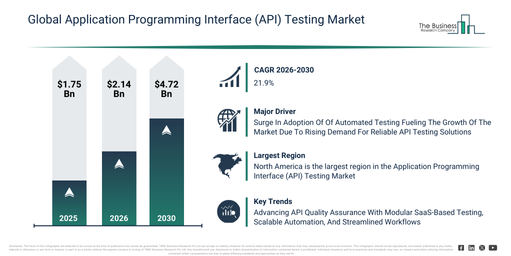
    The market size for application programming interface (API) testing has witnessed significant expansion over recent years. This sector is projected to grow from $1.75 billion in 2025 to $2.14 billion in 2026, demonstrating a compound annual growth rate (CAGR) of 22.2%. The historical growth in this market can be attributed to factors such as the increasing adoption of cloud-based applications, a rising demand for automated testing tools, the growth of software development outsourcing, the expansion of mobile and web applications, and the imperative for faster software release cycles.

    The application programming interface (API) testing market is poised for significant expansion in the coming years, with projections indicating a rise to $4.72 billion by 2030, reflecting a compound annual growth rate (CAGR) of 21.9%. This anticipated growth is driven by several factors, including the increasing incorporation of artificial intelligence and machine learning into testing, heightened investment in development and operations alongside continuous integration, a growing demand for application programming interface security testing, the widespread adoption of the internet of things and connected devices, and a concentrated effort to reduce software development life cycle costs. Major trends expected during this forecast period include a strategic shift towards continuous and shift-left testing, the integration of artificial intelligence-driven test automation, a greater reliance on cloud-based testing platforms, the adoption of application programming interface monitoring and observability tools, and an increased focus on testing microservices and serverless architectures.

    Download the Free Sample Report to Explore Key Market Insights:

    https://www.thebusinessresearchcompany.com/sample.aspx?id=30502&type=smp

    Which Growth Drivers Are Contributing To The Progress Of The Application Programming Interface (API) Testing Market?

    The increasing adoption of automated testing is expected to propel the growth of the application programming interface (API) testing market going forward. Automated testing refers to the use of software tools that automatically execute predefined test scripts to validate API functionality, reliability, and performance without manual involvement. Adoption of automated testing is rising as organizations need faster and more reliable quality assurance to keep up with rapid release cycles while reducing manual effort and minimizing defects in complex software systems. The API testing supports automated testing by enabling fast repeatable validation of backend services through scriptable requests and responses, which helps detect integration defects early and maintain reliability as applications evolve. For instance, in November 2025, according to PractiTest Ltd., an Israel-based software testing platform, the share of organizations reporting that automation replaced 75% or more of manual testing efforts increased from 18% in 2023 to 19% in 2024 and 20% in 2025. Therefore, the increasing adoption of software development and integration is driving the growth of the application programming interface (API) testing market.

    Which Segments Are Included In The Analysis Of The Application Programming Interface (API) Testing Market?

    The application programming interface (api) testing market covered in this report is segmented –

    1) By Component: Software, Services

    2) By Deployment Mode: Cloud-Based, On-Premise

    3) By Test Type: Functional Testing, Security Testing, Performance Testing, Runtime And Error Detection Testing

    4) By Organization Size: Small And Medium Enterprises, Large Enterprises

    5) By End User Industry: Information Technology And Telecommunications, Banking, Financial Services, And Insurance, Healthcare And Life Sciences, Retail And E-Commerce, Manufacturing And Industrial, Government And Public Sector

    Subsegments:

    1) By Software: Development Tools, Integration Platforms, Security Solutions, Monitoring And Analytics

    2) By Services: Consulting Services, Implementation Services, Support And Maintenance Services, Training And Education Services

    Which Trends Are Impacting The Growth Of The Application Programming Interface (API) Testing Market?

    Major companies in the application programming interface (API) testing sector are concentrating on creating cutting-edge technology, such as modular SaaS-based solutions, to boost testing efficiency, scalability, and teamwork among development teams. A modular SaaS-based solution represents a cloud-delivered platform comprising independent, interoperable modules that can be configured to meet specific testing needs, allowing for adaptable deployment, quick scaling, and continuous updates without requiring on-site infrastructure. For instance, in April 2025, SmartBear Software, a US-based provider of software quality and testing tools, expanded its API Hub by introducing a modular SaaS-based solution. This integrates automated testing capabilities, improved collaboration features, and unified management for API tests. This launch enables development and QA teams to efficiently plan, run, and oversee API tests within a flexible, cloud-native environment, which reduces testing costs and speeds up the delivery of top-notch applications.

    Which Key Industry Participants Are Active In The Application Programming Interface (API) Testing Market?

    Major companies operating in the application programming interface (api) testing market are Google LLC, Microsoft Corporation, International Business Machines Corporation, Oracle Corporation, Broadcom Inc., Postman Inc., Tricentis N.V., SmartBear Software Inc., Sauce Labs Inc., Parasoft Corporation, Katalon Inc., TestSigma Inc., Neotys Co., Akana, BlazeMeter Ltd., RapidAPI, Checkly Inc., Micro Focus Ltd., Assertible Inc., Karate Labs Inc., Loadmill Ltd., Testfully GmbH, Firecamp Analytics

    Read the full application programming interface (api) testing market report here:

    https://www.thebusinessresearchcompany.com/report/application-programming-interface-api-testing-market-report

    Which Region Is Projected To Lead The Application Programming Interface (API) Testing Market During The Forecast Period?

    North America was the largest region in the application programming interface (API) testing market in 2025. Asia-Pacific is expected to be the fastest-growing region in the forecast period. The regions covered in the application programming interface (api) testing market report are Asia-Pacific, South East Asia, Western Europe, Eastern Europe, North America, South America, Middle East, Africa.

    Request A Tailored Application Programming Interface (API) Testing Market Research Report For Competitive Advantage:

    https://www.thebusinessresearchcompany.com/customise?id=30502&type=smp

    Browse Through More Reports Similar to the Global Application Programming Interface (API) Testing Market 2026, By The Business Research Company

    Application Testing Services Market Report 2026

    https://www.thebusinessresearchcompany.com/report/application-testing-services-global-market-report

    Application Programming Interface Api Security Market Report 2026

    https://www.thebusinessresearchcompany.com/report/application-programming-interface-api-security-global-market-report

    software testing global market report

    https://www.thebusinessresearchcompany.com/report/software-testing-global-market-report

    Get in touch with us:

    The Business Research Company: https://www.thebusinessresearchcompany.com/

    Americas +1 310-496-7795

    Asia +44 7882 955267 & +91 8897263534

    Europe +44 7882 955267

    Email us at info@tbrc.info

    Follow us on:

    LinkedIn: https://in.linkedin.com/company/the-business-research-company

    YouTube: https://www.youtube.com/channel/UC24_fI0rV8cR5DxlCpgmyFQ

    Global Market Model: https://www.thebusinessresearchcompany.com/global-market-model
  • A notable trend in the High-Throughput Slide Scanning-as-a-Service Market is the rise of subscription-based cloud scanning solutions

    A notable trend in the High-Throughput Slide Scanning-as-a-Service Market is the rise of subscription-based cloud scanning solutions

    The Business Research Company’s 2026 market reports include new capabilities such as market attractiveness scoring and analysis, total addressable market analysis, company scoring matrix, interactive excel data dashboard, improved supply chain analysis, upcoming startups in the market, and overview of key products, aimed at improving the depth, usability, and strategic value of the insights delivered.

    What Is The Expected Market Size Of The High-Throughput Slide Scanning-As-A-Service Market From 2026 To 2030?

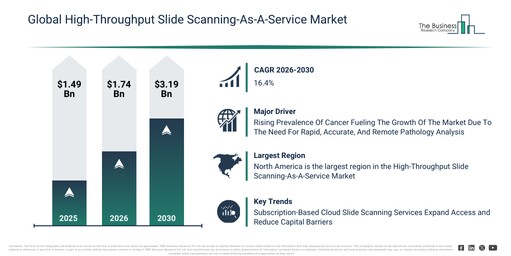
    In recent years, the market size for high-throughput slide scanning-as-a-service has expanded significantly. This market is anticipated to increase from $1.49 billion in 2025 to $1.74 billion in 2026, achieving a compound annual growth rate (CAGR) of 16.7%. Historically, its expansion has been propelled by factors such as the increasing adoption of digital pathology, a growing demand for high-throughput scanning, amplified investment in pharmaceutical research, the broadening of academic and research applications, and the rising integration of AI in pathology workflows.

    The high-throughput slide scanning-as-a-service market is projected to experience substantial expansion over the upcoming years. This market is predicted to reach $3.19 billion by 2030, demonstrating a compound annual growth rate (CAGR) of 16.4%. This anticipated growth can be attributed to several factors, including the increasing requirement for remote diagnostics, the expanding uptake of telepathology services, a heightened demand for multiplexed imaging, the proliferation of cloud-based slide platforms, and a greater emphasis on precision medicine applications. Key trends during this forecast period encompass technological progress in AI-powered image analysis, novel developments in cloud-based digital slide platforms, the evolution of whole slide imaging for high-throughput scanning, significant research breakthroughs in automated pathology workflows, and improvements in multiplexed fluorescence imaging techniques.

    Download the Free Sample Report to Explore Key Market Insights:

    https://www.thebusinessresearchcompany.com/sample.aspx?id=30606&type=smp

    Which Economic Or Industry Drivers Are Impacting The High-Throughput Slide Scanning-As-A-Service Market?

    The increasing occurrence of cancer is anticipated to fuel the expansion of the high-throughput slide scanning-as-a-service market moving forward. Cancer is defined by the uncontrolled multiplication and spread of abnormal cells, which can damage surrounding tissues and organs if left untreated. The growing incidence of cancer is attributable to lifestyle-related risk factors such as poor diet, smoking, alcohol consumption, and exposure to environmental pollutants, all of which elevate the likelihood of developing various cancers. High-throughput slide scanning-as-a-service aids in managing cancer by swiftly digitizing vast quantities of pathology slides for detailed examination and remote consultations. This service boosts diagnostic accuracy and efficiency, facilitating timely treatment decisions and improving patient outcomes. For instance, in October 2025, according to NHS Digital, a UK government organisation, 354,820 new cancer diagnoses were recorded in England in 2023, averaging 972 diagnoses per day and indicating an increase of 8,605 cases compared to 2022, with prostate cancer being the most frequently diagnosed cancer at 58,137 new cases, reflecting a 6% increase in registrations compared to the previous year. Therefore, the rising prevalence of cancer is a significant impetus for the growth of the high-throughput slide scanning-as-a-service market.

    Which Segments Are Included In The Analysis Of The High-Throughput Slide Scanning-As-A-Service Market?

    The high-throughput slide scanning-as-a-service market covered in this report is segmented –

    1) By Service Type: Brightfield Scanning, Fluorescence Scanning, Multiplexed Imaging, Other Service Types

    2) By Technology: Optical System, Automation Level, Scanning Resolution

    3) By Application: Pathology, Research, Drug Discovery, Clinical Diagnostics, Other Applications

    4) By End User: Hospitals And Clinics, Research Institutes, Pharmaceutical And Biotechnology Companies, Other End Users

    Subsegments:

    1) By Brightfield Scanning: Single Channel Brightfield, Multi-Channel Brightfield, High-Resolution Brightfield

    2) By Fluorescence Scanning: Single Fluorescence Channel, Multi-Fluorescence Channel, High-Sensitivity Fluorescence

    3) By Multiplexed Imaging: Sequential Multiplexing, Simultaneous Multiplexing, High-Plex Imaging

    4) By Other Service Types: Slide Quality Control, Tissue Morphology Analysis, Custom Imaging Services

    Which Trends Are Impacting The Growth Of The High-Throughput Slide Scanning-As-A-Service Market?

    Leading businesses within the high-throughput slide scanning-as-a-service market are concentrating on creating subscription-based offerings, including cloud-enabled slide scanning service models, to facilitate remote access to high-throughput whole slide imaging without necessitating investment in on-site infrastructure. These cloud-enabled slide scanning service models describe outsourced whole-slide imaging solutions where glass slides undergo digitization and secure storage on cloud platforms, thereby permitting remote viewing, sharing, and analysis without the need for on-premise scanners or IT infrastructure. As an illustration, in March 2023, OptraSCAN Inc., a US-based provider of digital pathology solutions, unveiled OnDemand Digital Pathology, a cloud-enabled slide scanning service model that grants subscription access to whole slide scanners featuring a 15–480 slide loading capacity and rapid scanning. This service will extend access to OptraSCAN whole-slide digital scanners (covering brightfield and fluorescence) with a 15–480 slide capacity, capable of scanning a slide in approximately 58 seconds at 40x. Additionally, it includes a high-end workstation preconfigured with workflow software, telepathology instruments, and AI analysis modules tailored for IHC, morphology, immunofluorescence, and cytology, complemented by Microsoft Azure–based cloud storage and continuous support and services.

    Who Are The Top Companies Competing In The High-Throughput Slide Scanning-As-A-Service Market?

    Major companies operating in the high-throughput slide scanning-as-a-service market are Koninklijke Philips N.V., IQVIA Holdings Inc., Laboratory Corporation of America Holdings, Roche Diagnostics International AG, Iron Mountain Incorporated, WuXi AppTec Co. Ltd., PerkinElmer Inc., Leica Biosystems Nussloch GmbH, Medical Imaging Solutions Pvt. Ltd., Charles River Laboratories International Inc., OptraSCAN Inc., Scopio Labs Inc., Pramana Inc., Molecular Pathology Laboratory Network Inc., 3DHISTECH Ltd., Experimental Pathology Laboratories Inc., Labtron Equipment Ltd., Applied Spectral Imaging Ltd., HistoWiz Inc., iHisto LLC

    Read the full high-throughput slide scanning-as-a-service market report here:

    https://www.thebusinessresearchcompany.com/report/high-throughput-slide-scanning-as-a-service-market-report

    Which Global Regions Are Shaping The Competitive Landscape Of The High-Throughput Slide Scanning-As-A-Service Market?

    North America was the largest region in the high-throughput slide scanning-as-a-service market in 2025. Asia-Pacific is expected to be the fastest-growing region in the forecast period. The regions covered in the high-throughput slide scanning-as-a-service market report are Asia-Pacific, South East Asia, Western Europe, Eastern Europe, North America, South America, Middle East, Africa.

    Request A Tailored High-Throughput Slide Scanning-As-A-Service Market Research Report For Competitive Advantage:

    https://www.thebusinessresearchcompany.com/customise?id=30606&type=smp

    Browse Through More Reports Similar to the Global High-Throughput Slide Scanning-As-A-Service Market 2026, By The Business Research Company

    Plasticizers Market Report 2026

    https://www.thebusinessresearchcompany.com/report/plasticizers-global-market-report

    Bio Plasticizers Market Report 2026

    https://www.thebusinessresearchcompany.com/report/bio-plasticizers-global-market-report

    plastic products global market report

    https://www.thebusinessresearchcompany.com/report/plastic-products-global-market-report

    Get in touch with us:

    The Business Research Company: https://www.thebusinessresearchcompany.com/

    Americas +1 310-496-7795

    Asia +44 7882 955267 & +91 8897263534

    Europe +44 7882 955267

    Email us at info@tbrc.info

    Follow us on:

    LinkedIn: https://in.linkedin.com/company/the-business-research-company

    YouTube: https://www.youtube.com/channel/UC24_fI0rV8cR5DxlCpgmyFQ

    Global Market Model: https://www.thebusinessresearchcompany.com/global-market-model

  • Implantable Brain-Computer Interfaces Market Outlook 2026–2030 Exploring New Opportunities

    Implantable Brain-Computer Interfaces Market Outlook 2026–2030 Exploring New Opportunities

    The Business Research Company’s 2026 market reports include new capabilities such as market attractiveness scoring and analysis, total addressable market analysis, company scoring matrix, interactive excel data dashboard, improved supply chain analysis, upcoming startups in the market, and overview of key products, aimed at improving the depth, usability, and strategic value of the insights delivered.

    What Market Size Increase Is Anticipated For The Implantable Brain-Computer Interfaces Market Over The 2026–2030 Period?

    The implantable brain–computer interface market size has experienced rapid growth in recent years. This market is expected to expand from $1.34 billion in 2025 to $1.53 billion in 2026, exhibiting a compound annual growth rate (CAGR) of 13.6%. Historically, this expansion has been driven by several factors, including an increasing demand for neuroprosthetics, a growing prevalence of neurological disorders, the rising adoption of non-invasive brain–computer interfaces, expanding research funding in neuroscience, and the increasing use of brain–computer interfaces in rehabilitation.

    The implantable brain–computer interface market is projected to experience substantial expansion in the coming years. This market is set to reach a valuation of $2.52 billion by 2030, exhibiting a compound annual growth rate (CAGR) of 13.3%. This projected growth is driven by several factors, including the increasing incorporation of artificial intelligence into brain–computer interfaces, augmented investments in neural interface advancements, a rise in the use of minimally invasive brain–computer interfaces, broader applications in assistive communication, and a heightened need for brain–controlled robotic systems. Key developments anticipated during this forecast period encompass enhancements in neural signal decoding technology, breakthroughs in entirely implantable brain–computer interfaces, progress in wireless brain–computer interface devices, dedicated research and development efforts in brain–controlled prosthetics, and improvements in high-resolution neuroimaging methods.

    Download the Free Sample Report to Explore Key Market Insights:

    https://www.thebusinessresearchcompany.com/sample.aspx?id=30618&type=smp

    What Primary Drivers Are Shaping The Development Of The Implantable Brain-Computer Interfaces Market?

    The rising incidence of spinal cord injury cases is projected to drive the growth of the implantable brain-computer interfaces market moving forward. Spinal cord injury cases describe damage to the spinal cord, whether from trauma or other causes, which disrupts communication between the brain and body, often resulting in partial or complete loss of motor and sensory functions. This increase in spinal cord injuries stems from the growing prevalence of falls among older populations, as seniors face elevated risks due to osteoporosis, mobility issues, and household accidents. Implantable brain-computer interfaces aid individuals with spinal cord injuries by translating neural signals from the brain into commands to control assistive devices, wheelchairs, or computers, thereby enabling paralyzed individuals to regain communication abilities and independence. For example, in June 2025, NeoMotion Assistive Solutions Private Limited, an India-based manufacturer of assistive mobility devices, reported that the estimated prevalence of individuals living with spinal cord injury in the United States increased from around 302,000 in 2023 to approximately 308,620 in 2024. Therefore, the increasing spinal cord injury cases are a significant driver for the implantable brain-computer interfaces market.

    How Is The Implantable Brain-Computer Interfaces Market Segmented Across Key Categories?

    The implantable brain-computer interfaces market covered in this report is segmented –

    1) By Component: Hardware, Software

    2) By Type: Non-invasive Brain–Computer Interfaces, Partially Invasive Brain–Computer Interfaces, Fully Invasive Brain–Computer Interfaces

    3) By Application: Healthcare And Rehabilitation, Communication And Control, Gaming And Entertainment, Smart Home And Automotive Control

    4) By End User: Hospitals And Specialty Clinics, Research Centers And Academic Institutes, Home Care Settings, Other End Users

    Subsegments:

    1) By Hardware: Neural Electrodes, Signal Amplifiers, Data Acquisition Units, Wireless Transmitters, Power Supply Units

    2) By Software: Signal Processing Software, Neural Decoding Software, Data Analysis Software, Control Interface Software, Feedback And Visualization Software

    Which Upcoming Trends Are Expected To Influence The Implantable Brain-Computer Interfaces Market?

    Major companies engaged in the implantable brain-computer interfaces market are prioritizing the development of technologically advanced products, such as fully implantable, wireless brain-computer interface devices, with the goal of restoring communication capabilities for individuals experiencing severe neurological conditions. Implantable wireless brain-computer interface devices are defined as medical or neurotechnology instruments surgically inserted into the brain that wirelessly record neural activity and/or stimulate neural circuits, thereby enabling direct interaction between the brain and external apparatus. For instance, in January 2024, Neuralink Corp., a US-based neurotechnology company, introduced its Telepathy device in a human patient. This device is engineered to interpret neural activity, allowing individuals with quadriplegia or amyotrophic lateral sclerosis (ALS) to manipulate a computer cursor or keyboard using only their thoughts. Additionally, the system provides a pathway for the restoration of lost sensory and motor functions, marking a significant accomplishment in the clinical application of high-bandwidth brain-machine interfaces for medical rehabilitation.

    Who Are The Top Companies Competing In The Implantable Brain-Computer Interfaces Market?

    Major companies operating in the implantable brain-computer interfaces market are Medtronic plc, NeuroPace Inc., PINS Medical Co. Ltd., Neurosoft Ltd., Precision Neuroscience Corporation, Onward Medical N.V., NeuroOne Medical Technologies Corporation, Emotiv Systems Inc., NextMind S.A., Neuralink Corp., CorTec GmbH, Microprobes for Life Science Inc., Synchron Inc., Shanghai Rishena Medical Instrument Co. Ltd., Paradromics Inc., SceneRay Corporation Ltd., Blackrock Neurotech LLC, NeuroXess Inc., Inbrain Neuroelectronics S.L., BrainGate Company Inc.

    Read the full implantable brain-computer interfaces market report here:

    https://www.thebusinessresearchcompany.com/report/implantable-brain-computer-interfaces-market-report

    Which Region Is Expected To Experience The Fastest Growth In The Implantable Brain-Computer Interfaces Market?

    North America was the largest region in the implantable brain–computer interface market in 2025. Asia-Pacific is expected to be the fastest-growing region in the forecast period. The regions covered in the implantable brain-computer interfaces market report are Asia-Pacific, South East Asia, Western Europe, Eastern Europe, North America, South America, Middle East, Africa.

    Request A Tailored Implantable Brain-Computer Interfaces Market Research Report For Competitive Advantage:

    https://www.thebusinessresearchcompany.com/customise?id=30618&type=smp

    Browse Through More Reports Similar to the Global Implantable Brain-Computer Interfaces Market 2026, By The Business Research Company

    Brain Computer Interface Market Report 2026

    https://www.thebusinessresearchcompany.com/report/brain-computer-interface-global-market-report

    Brain And Neuroimaging Devices Market Report 2026

    https://www.thebusinessresearchcompany.com/report/brain-and-neuroimaging-devices-global-market-report

    human machine interface global market report

    https://www.thebusinessresearchcompany.com/report/human-machine-interface-global-market-report

    Get in touch with us:

    The Business Research Company: https://www.thebusinessresearchcompany.com/

    Americas +1 310-496-7795

    Asia +44 7882 955267 & +91 8897263534

    Europe +44 7882 955267

    Email us at info@tbrc.info

    Follow us on:

    LinkedIn: https://in.linkedin.com/company/the-business-research-company

    YouTube: https://www.youtube.com/channel/UC24_fI0rV8cR5DxlCpgmyFQ

    Global Market Model: https://www.thebusinessresearchcompany.com/global-market-model
  • Hospital Command Center Software Market Forecast 2026–2035 Presenting Industry Insights

    Hospital Command Center Software Market Forecast 2026–2035 Presenting Industry Insights

    The Business Research Company’s 2026 market reports include new capabilities such as market attractiveness scoring and analysis, total addressable market analysis, company scoring matrix, interactive excel data dashboard, improved supply chain analysis, upcoming startups in the market, and overview of key products, aimed at improving the depth, usability, and strategic value of the insights delivered.

    What Is The Estimated Market Size Of The Hospital Command Center Software Market During 2026–2030?

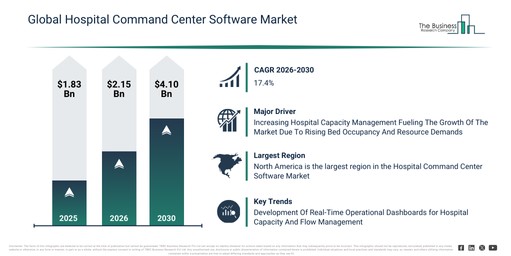
    The hospital command center software market size has seen rapid growth in recent years. It is projected to increase from $1.83 billion in 2025 to $2.15 billion in 2026, at a compound annual growth rate (CAGR) of 17.7%. This historic period’s growth can be ascribed to the increasing need for real-time hospital visibility, the growing adoption of digital health systems, the rising demand for patient flow optimization, the expansion of hospital capacity management initiatives, and an increasing focus on reducing operational inefficiencies.

    The hospital command center software market is anticipated to experience swift expansion over the coming years. By 2030, its value is projected to reach $4.10 billion, exhibiting a compound annual growth rate (CAGR) of 17.4%. This anticipated growth throughout the forecast period stems from factors such as the expanding integration of AI and predictive analytics, escalating investments in hospital automation, a heightened demand for adaptable cloud-based command centers, the broadening of telehealth and remote monitoring ecosystems, and the greater necessity for emergency readiness and swift response mechanisms. Key developments expected during this period encompass technological progress in AI-powered workflow automation, novel advancements in consolidated hospital command platforms, the evolution of cloud-native healthcare orchestration tools, intensified research and development in real-time operational analytics, and a wider acceptance of interoperability and data integration standards.

    Download the Free Sample Report to Explore Key Market Insights:

    https://www.thebusinessresearchcompany.com/sample.aspx?id=30610&type=smp

    What Major Growth Drivers Are Shaping The Outlook Of The Hospital Command Center Software Market?

    The growing emphasis on hospital capacity management is anticipated to fuel the expansion of the hospital command center software market moving ahead. This management involves the strategic planning and operational supervision of hospital assets, including beds and personnel, to effectively satisfy patient requirements. The heightened attention to hospital capacity management stems from rising patient numbers coupled with limited beds, staff, and financial resources, compelling hospitals to optimize their resource utilization for consistent, safe, and economical care delivery. Hospital command center software aids hospital capacity management by consolidating data from diverse departments, offering a comprehensive operational perspective, which facilitates improved decision-making and resource distribution. As an illustration, in January 2024, the National Health Service (NHS) England, a publicly funded healthcare system in the UK, reported achieving its objective of adding 5,000 permanent core beds by early 2024. This was measured against a 2022-23 baseline of 94,500 core beds, resulting in an average of 99,750 core beds by the week ending January 21, 2024. Consequently, the expansion of hospital capacity management is stimulating the growth of the hospital command center software market.

    How Are The Various Segments Of The Hospital Command Center Software Market Categorized?

    The hospital command center software market covered in this report is segmented –

    1) By Component: Software, Services

    2) By Deployment Mode: On-Premises, Cloud-Based

    3) By Application: Patient Flow Management, Resource Allocation, Bed Management, Emergency Response, Operational Analytics, Other Applications

    4) By End-User: Hospitals, Specialty Clinics, Ambulatory Surgical Centers, Other End-Users

    Subsegments:

    1) By Software: Hospital Information Management Software, Patient Flow Software, Resource Scheduling Software, Bed Management Software, Emergency Response Software, Operational Analytics Software

    2) By Services: Implementation Services, Training And Support Services, Maintenance Services, Cloud Hosting Services, Data Analytics Services, Telehealth Integration Services

    What Trends Are Affecting The Expansion Of The Hospital Command Center Software Market?

    Leading companies in the hospital command center software market are prioritizing the creation of advanced solutions, such as real-time predictive analytics, to elevate operational effectiveness, patient movement, and clinical judgment across healthcare systems. Real-time predictive analytics denotes software-driven functionalities that consistently gather and scrutinize live hospital information to project demand, pinpoint constraints, and facilitate timely operational adjustments. For example, in October 2024, GE HealthCare Technologies Inc., a medical technology enterprise based in the US, unveiled the Hospital Pulse Tile for its Command Center Software. This launch integrates real-time predictive analytics to offer comprehensive visibility across the entire system concerning capacity, staffing, patient throughput, and the efficiency of care delivery. The Command Center utilizes sophisticated analytics and AI to convert intricate hospital data into practical insights, enabling leaders to predict demand spikes, enhance resource deployment, and shorten care delays.

    Who Are The Primary Competitors In The Hospital Command Center Software Market?

    Major companies operating in the hospital command center software market are Oracle Corporation, GE HealthCare Technologies Inc., Koninklijke Philips N.V., Baxter International Inc., Palantir Technologies Inc., Epic Systems Corporation, Getinge AB, Dedalus Group S.p.A., Ascom Holding AG, Biofourmis Inc., TeleTracking Technologies Inc., Qmatic Group AB, LeanTaaS Inc., CenTrak Inc., Qventus Inc., Spok Holdings Inc., Alcidion Group Limited, Connexall Corporation, Q-nomy Inc., ABOUT Healthcare Inc., Zebra Technologies Corporation

    Read the full hospital command center software market report here:

    https://www.thebusinessresearchcompany.com/report/hospital-command-center-software-market-report

    Which Region Currently Holds The Largest Share Of The Hospital Command Center Software Market?

    North America was the largest region in the hospital command center software market in 2025. Asia-Pacific is expected to be the fastest-growing region in the forecast period. The regions covered in the hospital command center software market report are Asia-Pacific, South East Asia, Western Europe, Eastern Europe, North America, South America, Middle East, Africa.

    Request A Tailored Hospital Command Center Software Market Research Report For Competitive Advantage:

    https://www.thebusinessresearchcompany.com/customise?id=30610&type=smp

    Browse Through More Reports Similar to the Global Hospital Command Center Software Market 2026, By The Business Research Company

    Hospital Information System Market Report 2026

    https://www.thebusinessresearchcompany.com/report/hospital-information-system-global-market-report

    Medical Software Market Report 2026

    https://www.thebusinessresearchcompany.com/report/medical-software-global-market-report

    healthcare quality management software global market report

    https://www.thebusinessresearchcompany.com/report/healthcare-quality-management-software-global-market-report

    Get in touch with us:

    The Business Research Company: https://www.thebusinessresearchcompany.com/

    Americas +1 310-496-7795

    Asia +44 7882 955267 & +91 8897263534

    Europe +44 7882 955267

    Email us at info@tbrc.info

    Follow us on:

    LinkedIn: https://in.linkedin.com/company/the-business-research-company

    YouTube: https://www.youtube.com/channel/UC24_fI0rV8cR5DxlCpgmyFQ

    Global Market Model: https://www.thebusinessresearchcompany.com/global-market-model
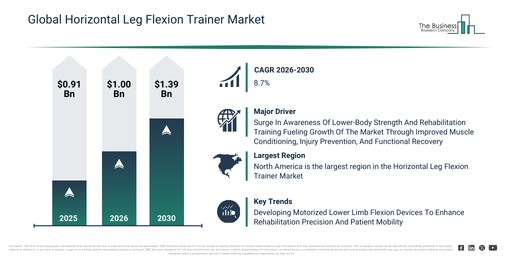
  • Horizontal Leg Flexion Trainer Market Outlook 2026–2030 Highlighting Growth Drivers and Trends

    Horizontal Leg Flexion Trainer Market Outlook 2026–2030 Highlighting Growth Drivers and Trends

    The Business Research Company’s 2026 market reports include new capabilities such as market attractiveness scoring and analysis, total addressable market analysis, company scoring matrix, interactive excel data dashboard, improved supply chain analysis, upcoming startups in the market, and overview of key products, aimed at improving the depth, usability, and strategic value of the insights delivered.

    What Market Size Expansion Is Predicted For The Horizontal Leg Flexion Trainer Market Between 2026 And 2030?

    The market size for horizontal leg flexion trainers has demonstrated substantial growth in recent years. This market is projected to expand from $0.91 billion in 2025 to $1.00 billion in 2026, achieving a compound annual growth rate (CAGR) of 9.0%. The factors contributing to its historical growth include an increasing demand for fitness equipment in gyms, a rising interest in lower-body strength training, growing awareness of injury prevention exercises, an increasing adoption of rehabilitation machines, and the rising popularity of sports conditioning programs.

    The horizontal leg flexion trainer market is projected to experience substantial expansion in the coming years. By 2030, its value is anticipated to reach $1.39 billion, exhibiting a compound annual growth rate (CAGR) of 8.7%. This expansion during the forecast period is primarily driven by factors such as the increasing proliferation of gym memberships, a growing inclination towards enhancing leg strength, the integration of sophisticated rehabilitation equipment, the advancement of sports performance training, and greater capital allocation towards high-end fitness machinery. Key developments anticipated throughout the forecast period encompass progress in adjustable resistance technology, enhancements in ergonomic machine design, improvements in durability and material engineering, novel compact training equipment solutions, and breakthroughs in professional athletic training instruments.

    Download the Free Sample Report to Explore Key Market Insights:

    https://www.thebusinessresearchcompany.com/sample.aspx?id=30609&type=smp

    What Drivers Are Expected To Influence The Horizontal Leg Flexion Trainer Market During The Forecast Period?

    The horizontal leg flexion trainer market is expected to experience future growth, driven by increasing awareness regarding lower-body strength and rehabilitation training. This type of training involves structured exercises and programs specifically designed to enhance the strength, flexibility, and functional recovery of leg muscles, including the quadriceps, hamstrings, and hip flexors. The growing awareness is spurred by increasing public health initiatives and clinical guidance that emphasize the importance of muscle-strengthening activities for injury prevention, improved mobility, and overall physical well-being. Horizontal leg flexion trainers support this trend by offering a controlled, low-impact option suitable for lower-body strengthening and rehabilitation, particularly within clinical, physiotherapy, and specialized fitness settings, consistent with broader exercise recommendations. For example, in December 2023, according to the U.S. Centers for Disease Control and Prevention (CDC), a U.S.-based government public health authority, 24% of adults met the recommended muscle-strengthening activity guidelines in 2023, an increase from 21% in 2022. This represents a rise of 3 percentage points, or approximately 14% year-over-year. Therefore, the rising awareness of lower-body strength and rehabilitation training is propelling the growth of the horizontal leg flexion trainer market.

    Which Market Segments Are Examined In The Horizontal Leg Flexion Trainer Market Study?

    The horizontal leg flexion trainer market covered in this report is segmented –

    1) By Product Type: Standard Horizontal Leg Flexion Trainers, Smart Horizontal Leg Flexion Trainers, Adjustable Horizontal Leg Flexion Trainers

    2) By Distribution Channel: Online Stores, Specialty Stores, Supermarkets Or Hypermarkets, Other Distribution Channels

    3) By Application: Rehabilitation Centers, Fitness Centers, Home Use, Hospitals, Other Applications

    4) By End-User: Adults, Geriatric, Athletes, Other End-Users

    Subsegments:

    1) By Standard Horizontal Leg Flexion Trainers: Plate-loaded trainers, Pin-loaded (selectorized) trainers, Fixed-resistance trainers, Standard gym-grade benches, Basic home-use flexion trainers, Non-digital resistance trainers, Single-function flexion machines

    2) By Smart Horizontal Leg Flexion Trainers: App-connected trainers, Bluetooth-enabled trainers, AI-guided training systems, Smart resistance-adjusting machines, Performance-tracking trainers, Cloud-integrated fitness units, Interactive screen-based trainers

    3) By Adjustable Horizontal Leg Flexion Trainers: Multi-resistance adjustable trainers, Adjustable angle or seat-position trainers, Multi-function strength machines with flexion mode, Manual-adjust resistance models, Hydraulic-adjustable trainers, Commercial-grade adjustable units, Adjustable home-use trainers

    Which Trends Are Influencing The Horizontal Leg Flexion Trainer Market?

    Key players in the rehabilitation and therapeutic exercise equipment market are increasingly directing their efforts towards developing motorized solutions for lower limb flexion, notably multifunction physiotherapy devices that incorporate powered leg flexion systems. These offerings are engineered to enable precise and consistent leg flexion movements, foster enhancements in patient strength and mobility, and lessen the physical burden on therapists during rehabilitation sessions. Powered leg flexion systems denote technological functionalities within rehabilitation equipment that leverage electric motors or actuators to execute controlled flexion and extension movements of the lower limbs, thereby allowing for standardized therapy protocols and consistent treatment provision. For example, in January 2025, AGILIS, a U.S.-based medical device company, unveiled multifunction physiotherapy tables featuring powered lower limb flexion systems that have received U.S. FDA 510(k)-clearance for clinical application. These devices, crafted to support postoperative rehabilitation and improve mobility, integrate 24 Vdc electric motors to deliver consistent powered flexion, provide both manual and electrical adjustment options, and permit configurations for linear and rotational lower limb movements to meet individualized therapy requirements.

    Which Companies Hold Significant Positions In The Horizontal Leg Flexion Trainer Market?

    Major companies operating in the horizontal leg flexion trainer market are Johnson Health Tech, Technogym SpA, Life Fitness Inc., Rogue Fitness, Precor Inc., Cybex International, Impulse Health Tech, Matrix Fitness, SportsArt Inc., Shuhua Co. Ltd., Panatta Srl, Body-Solid Inc., TRUE Fitness Technology Inc., HOIST Fitness Systems Inc., BH Fitness, Yanre Fitness, DHZ Fitness GmbH, Nautilus Inc., Unique Gym Equipment Pvt. Ltd., Kraftathlet

    Read the full horizontal leg flexion trainer market report here:

    https://www.thebusinessresearchcompany.com/report/horizontal-leg-flexion-trainer-market-report

    How Does The Horizontal Leg Flexion Trainer Market Perform Across Major Global Regions?

    North America was the largest region in the horizontal leg flexion trainer market in 202. Asia-Pacific is expected to be the fastest-growing region in the forecast period. The regions covered in the horizontal leg flexion trainer market report are Asia-Pacific, South East Asia, Western Europe, Eastern Europe, North America, South America, Middle East, Africa.

    Request A Tailored Horizontal Leg Flexion Trainer Market Research Report For Competitive Advantage:

    https://www.thebusinessresearchcompany.com/customise?id=30609&type=smp

    Browse Through More Reports Similar to the Global Horizontal Leg Flexion Trainer Market 2026, By The Business Research Company

    Personal Fitness Trainer Market Report 2026

    https://www.thebusinessresearchcompany.com/report/personal-fitness-trainer-global-market-report

    Foot And Ankle Devices Market Report 2026

    https://www.thebusinessresearchcompany.com/report/foot-and-ankle-devices-global-market-report

    flexion tires global market report

    https://www.thebusinessresearchcompany.com/report/flexion-tires-global-market-report

    Get in touch with us:

    The Business Research Company: https://www.thebusinessresearchcompany.com/

    Americas +1 310-496-7795

    Asia +44 7882 955267 & +91 8897263534

    Europe +44 7882 955267

    Email us at info@tbrc.info

    Follow us on:

    LinkedIn: https://in.linkedin.com/company/the-business-research-company

    YouTube: https://www.youtube.com/channel/UC24_fI0rV8cR5DxlCpgmyFQ

    Global Market Model: https://www.thebusinessresearchcompany.com/global-market-model