Category: Medical Equipment

  • Multi-Port Robot Market Forecast 2026–2035 Presenting Industry Insights and Data Trends

    Multi-Port Robot Market Forecast 2026–2035 Presenting Industry Insights and Data Trends

    The Business Research Company’s 2026 market reports include new capabilities such as market attractiveness scoring and analysis, total addressable market analysis, company scoring matrix, interactive excel data dashboard, improved supply chain analysis, upcoming startups in the market, and overview of key products, aimed at improving the depth, usability, and strategic value of the insights delivered.

    What Market Value Is Anticipated For The Multi-Port Robot Market Over The Period 2026–2030?

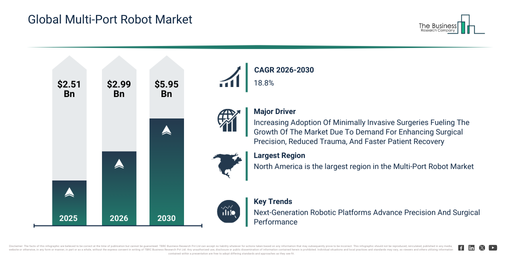
    The multi-port robot market has experienced substantial growth in recent years. This market is projected to expand significantly, climbing from $2.51 billion in 2025 to reach $2.99 billion by 2026, achieving a compound annual growth rate (CAGR) of 19.1%. The historical drivers of this growth include the increasing adoption of minimally invasive procedures, a rising demand for high-precision surgical tools, growing investments in healthcare infrastructure, the expansion of robotic-assisted surgery programs, and the increasing availability of advanced imaging components.

    The multi-port robot market is projected to experience substantial expansion over the coming years. By 2030, this market is anticipated to reach a valuation of $5.95 billion, exhibiting a compound annual growth rate (CAGR) of 18.8%. This expansion during the projection period stems from factors such as the increasing integration of AI-enabled robotic control, a rise in the deployment of multi-port surgical systems, a surging demand for robotic instruments and accompanying accessories, the broadening scope of medical and industrial automation applications, and an intensified emphasis on mobile and adaptable robotic platforms. Key trends anticipated within this period involve technological progress in multi-arm coordination, breakthroughs in imaging and visualization systems, the evolution of cloud-based robotic software, ongoing research and development in user-friendly robotic interfaces, and further technological advancements in autonomous assistance systems.

    Download the Free Sample Report to Explore Key Market Insights:

    https://www.thebusinessresearchcompany.com/sample.aspx?id=30666&type=smp

    What Drivers Are Influencing The Multi-Port Robot Market?

    The expanding utilization of minimally invasive surgeries is projected to boost the growth of the multi-port robot market in the coming years. Minimally invasive surgeries are defined as surgical interventions carried out through small incisions or a singular access point, thereby diminishing patient trauma, recovery periods, and the likelihood of complications. The uptake of these procedures is increasing as both hospitals and patients increasingly prioritize faster recovery, reduced discomfort post-operation, lower risk of adverse events, and minimal scarring, contrasting with traditional open surgical methods. Multi-port robots facilitate minimally invasive surgeries by delivering heightened dexterity, precision, and control through multiple points of instrument entry. They enhance surgical outcomes by enabling complex procedures with smaller cuts, less trauma, and quicker patient recuperation. For instance, in January 2025, according to Intuitive Surgical Inc., a US-based medical technology company, worldwide da Vinci procedures, a form of minimally invasive robotic-assisted surgery, grew approximately 18% in the fourth quarter of 2024 compared with the fourth quarter of 2023, full year 2024 procedures grew approximately 17% compared with 2023, and the company expects worldwide da Vinci procedures to increase approximately 13% to 16% in 2025 as compared to 2024. Therefore, the growing acceptance of minimally invasive and single-port surgeries is fueling the expansion of the multi-port robot market.

    How Is The Multi-Port Robot Market Divided Into Its Major Segments?

    The multi-port robot market covered in this report is segmented –

    1) By Product Type: Multi-Port Robotic Surgical Systems, Accessories And Instruments, System Services And Maintenance

    2) By Technology: Fully Automated Multi-Port Robots, Semi-Automated Multi-Port Robots, AI-Enabled Multi-Port Surgical Platforms, Teleoperated Multi-Port Robotic Systems

    3) By Application: General Surgery, Gynecological Surgery, Urological Surgery, Cardiothoracic Surgery, Orthopedic Surgery, Neurosurgery, Others

    4) By End-User: Hospitals, Ambulatory Surgical Centers, Specialty Surgical Centers, Academic And Research Institutions

    Subsegments:

    1) By Multi-Port Robotic Surgical Systems: Laparoscopic Multi-Port Surgical Systems, Thoracoscopic Multi-Port Surgical Systems, Robotic-Assisted General Surgery Systems, Robotic-Assisted Endoscopic Surgery Systems, Robotic-Assisted Specialty Surgery Systems

    2) By Accessories And Instruments: Robotic Surgical Arms, Endoscopic Visualization Instruments, Robotic Energy Devices, Suturing And Stapling Instruments, Robotic Surgical Consumables

    3) By System Services And Maintenance: Installation And Integration Services, Preventive Maintenance Services, Software Upgrade Services, Technical Support Services, Training And Education Services

    How Are Trends Transforming The Multi-Port Robot Market Landscape?

    Leading companies in the multi‑port surgical robot market are concentrating on developing sophisticated robotic systems, such as next-generation platforms, to boost surgical precision, optimize operational efficiency, and broaden clinical capabilities across various specialties. These next-generation multi-port robotic platforms are technologies employed to refine surgical accuracy, deliver real-time procedural data, and facilitate complex workflows across a spectrum of surgical interventions. For instance, in July 2025, Intuitive Surgical, a US-based medical technology company, secured CE clearance to introduce the da Vinci 5 Surgical System in the United States, an advanced robotic platform. This system incorporates over 150 design innovations, enhanced data analytics for improved procedural outcomes, and an architecture tailored for expanded clinical workflows. The da Vinci 5 also obtained CE marking for broader clinical use in Europe in 2025, enabling its wider adoption across healthcare centers. This launch represents a significant technological advancement by integrating high-precision robotic assistance with data-driven surgical workflows, bridging conventional surgery with next-generation robotic platforms, and providing surgeons with a scalable, efficient solution for superior procedural performance.

    Which Key Industry Participants Are Active In The Multi-Port Robot Market?

    Major companies operating in the multi-port robot market are Johnson & Johnson, Hanwha Group, ABB Ltd., Medtronic plc, Stryker Corporation, Intuitive Surgical Inc., Avatera Medical GmbH, CMR Surgical Ltd., Flexiv Ltd., Distalmotion SA, RobotLAB Inc., Shanghai MicroPort MedBot (Group) Co. Ltd., WEGO Medical Holdings Ltd., Asensus Surgical Inc., Microsure BV, Medicaroid Corporation, Sudhir Srivastava Innovations Pvt. Ltd., Riverfield Inc., Beijing Surgerii Robotics Co. Ltd., Shenzhen Jingfeng Medical Technology Co. Ltd.

    Read the full multi-port robot market report here:

    https://www.thebusinessresearchcompany.com/report/multi-port-robot-market-report

    Which Region Is Anticipated To See The Fastest Growth In The Multi-Port Robot Market?

    North America was the largest region in the multi-port robot market in 2025. Asia-Pacific is expected to be the fastest-growing region in the forecast period. The regions covered in the multi-port robot market report are Asia-Pacific, South East Asia, Western Europe, Eastern Europe, North America, South America, Middle East, Africa.

    Request A Tailored Multi-Port Robot Market Research Report For Competitive Advantage:

    https://www.thebusinessresearchcompany.com/customise?id=30666&type=smp

    Browse Through More Reports Similar to the Global Multi-Port Robot Market 2026, By The Business Research Company

    Mobile Robots Market Report 2026

    https://www.thebusinessresearchcompany.com/report/mobile-robots-global-market-report

    Industrial Robots Warehousing And Storage Robots Market Report 2026

    https://www.thebusinessresearchcompany.com/report/industrial-robots-warehousing-and-storage-robots-global-market-report

    road logistics global market report

    https://www.thebusinessresearchcompany.com/report/road-logistics-global-market-report

    Get in touch with us:

    The Business Research Company: https://www.thebusinessresearchcompany.com/

    Americas +1 310-496-7795

    Asia +44 7882 955267 & +91 8897263534

    Europe +44 7882 955267

    Email us at info@tbrc.info

    Follow us on:

    LinkedIn: https://in.linkedin.com/company/the-business-research-company

    YouTube: https://www.youtube.com/channel/UC24_fI0rV8cR5DxlCpgmyFQ

    Global Market Model: https://www.thebusinessresearchcompany.com/global-market-model
  • One of the major drivers of the Modular Process Skid Packages Market is the growing adoption of Industry 4.0 and smart factory systems

    One of the major drivers of the Modular Process Skid Packages Market is the growing adoption of Industry 4.0 and smart factory systems

    The Business Research Company’s 2026 market reports include new capabilities such as market attractiveness scoring and analysis, total addressable market analysis, company scoring matrix, interactive excel data dashboard, improved supply chain analysis, upcoming startups in the market, and overview of key products, aimed at improving the depth, usability, and strategic value of the insights delivered.

    What Market Valuation Is Forecasted For The Modular Process Skid Packages Market By 2030 Starting From Its 2026 Size?

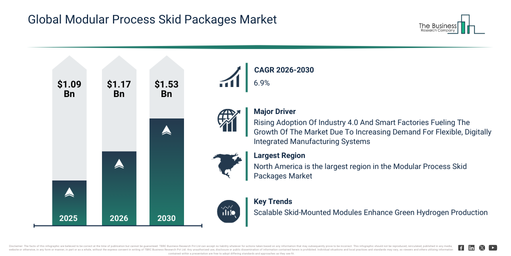
    The market for modular process skid packages has experienced robust expansion in recent years. This market is projected to expand from $1.09 billion in 2025 to $1.17 billion in 2026, demonstrating a compound annual growth rate (CAGR) of 7.2%. Historically, this growth has been driven by the implementation of solutions within the chemical and oil sectors, increasing industrial automation across manufacturing facilities, the expanding need for adaptable and portable processing systems, a growing trend towards offsite fabrication for enhanced safety, a heightened emphasis on minimizing construction timelines in various industries, increasing capital expenditure in pharmaceutical and biotech installations, and the expanding application of modular systems in energy and gas operations.

    The modular process skid packages market is anticipated to experience substantial expansion over the coming years. Its valuation is projected to reach $1.53 billion by 2030, exhibiting a compound annual growth rate (CAGR) of 6.9%. This projected increase during the forecast period is largely due to factors such as improved automation-enabled skid systems, innovative compact and energy-efficient designs, the incorporation of IoT monitoring, enhancements in modularization techniques, novel multifunctional skid units, the adoption of digital twin technology, developments in sustainable skid systems, inventive plug-and-play skid designs, the integration of AI control systems, and advances in corrosion-resistant materials. Key trends expected in this period encompass advancements in automation-enabled skid systems, innovations in compact, energy-efficient skid designs, the integration of IoT-based monitoring systems, progress in modularization techniques, new multifunctional skid units, the implementation of digital twin systems, developments in eco-friendly skid technologies, creative plug-and-play modular solutions, the integration of AI-powered controls, and improvements in durable and corrosion-resistant materials.

    Download the Free Sample Report to Explore Key Market Insights:

    https://www.thebusinessresearchcompany.com/sample.aspx?id=30663&type=smp

    Which Economic Or Industry Drivers Are Impacting The Modular Process Skid Packages Market?

    The increasing integration of Industry 4.0 and smart factory concepts is anticipated to drive expansion in the modular process skid packages market moving ahead. Industry 4.0 and smart factories encompass the incorporation of sophisticated digital tools like the Internet of Things (IoT), artificial intelligence, automation, robotics, and data analytics into manufacturing, facilitating real-time oversight, informed choices, and adaptable production capabilities. Manufacturers are increasingly adopting Industry 4.0 and smart factories to achieve enhanced productivity, lower operating expenses, support mass customization, and accelerate product launch times. Modular process skid packages contribute to Industry 4.0 and smart factory environments by providing standardized, pre-designed, and readily connectable manufacturing units. These packages boost operational efficiency and adaptability through their support for automation, continuous monitoring, and quick adjustments to cope with evolving production requirements. An illustrative example, as reported by the International Federation of Robotics, a Germany-based non-profit organization, in September 2025, showed 4,664,000 robotic units were operational in factories worldwide in 2024. This represented a 9% rise from the 4,281,585 units recorded in 2023. Consequently, the expanding adoption of Industry 4.0 and smart factories is propelling the growth of the modular process skid packages market.

    Which Segment Categories Define The Modular Process Skid Packages Market?

    The modular process skid packages market covered in this report is segmented –

    1) By Type: Open Type, Closed Type

    2) By Component: Pressure Vessels, Piping Systems, Pumping and Metering Systems

    3) By Deployment: Onsite Integrated Systems, Offsite Modular Units, Mobile Skid Packages

    4) By Skid Function: Pumping Skids, Filtration Skids, Separation Skids

    5) By Application: Oil And Gas, Chemical Processing, Pharmaceuticals, Food And Beverage, Water And Wastewater Treatment, Other Applications

    Subsegments:

    1) By Open Type: Non-Enclosed Insulator Design, Air-Cooled Configurations, Outdoor Installation Designs, Exposed Conductor Support Insulators, Low-Voltage Open Structure Insulators, Medium-Voltage Open Structure Insulators, Open-Frame Post Insulators, Open-Pin and Open-Suspension Styles

    2) By Closed Type: Enclosed Insulator Design, Weatherproof Insulated Housings, Fully Sealed Insulator Assemblies, Indoor Protection-Type Insulators, High-Voltage Enclosed Insulators, Composite Closed-Body Insulators, Encapsulated Post Insulators, Closed Suspension and Strain Designs

    What Major Market Trends Are Driving Changes In The Modular Process Skid Packages Market?

    Leading companies in the modular process skid packages market are concentrating on developing advanced solutions, such as scalable skid-mounted electrolyser modules, to boost the efficiency of green hydrogen production. A scalable skid-mounted module is defined as a prefabricated and pre-tested unit that lessens deployment times, reduces construction expenses, and lowers the risk for large-scale projects. For example, in August 2023, ITM Power, an energy company based in the UK, unveiled the POSEIDON 20 MW electrolyser module. This innovation delivers large-scale hydrogen production using an optimized skid footprint suitable for both indoor and outdoor installation, while allowing developers to efficiently integrate the module into commercial hydrogen projects. It provides pre-fabricated and pre-tested units that streamline project execution and reduce risks. Integrated with ITM Power’s other electrolyser platforms, such as the Trident and Neptune 2 MW plug-and-play electrolyzers for small to mid-size projects, it offers a seamless solution for extensive hydrogen production. The POSEIDON module enhances operational efficiency, simplifies project implementation, and supports the growth of green hydrogen infrastructure.

    Which Major Players Dominate The Modular Process Skid Packages Market?

    Major companies operating in the modular process skid packages market are Fluor Corporation, Technip Energies N.V., GEA Group AG, Zeton Inc., Gray Construction Inc., INMA Steel Inc., Integrated Flow Solutions LLC, ASL Group, EPIC Systems Inc., ABJ Engineering & Contracting Co., ViENERG Resources Pvt Ltd., Udkam Process Equipment India Pvt Ltd., Nano-Purification Solutions, BlissFlow Systems, Robinson Inc., Petrak Industries Inc., SalCon SA, Khaas Designing and Engineering, Integra Skid Systems, Flomek Singapore Private Limited, PT Perkasa Marine Indonesia

    Read the full modular process skid packages market report here:

    https://www.thebusinessresearchcompany.com/report/modular-process-skid-packages-market-report

    Which Regions Are Poised For Strategic Growth In The Modular Process Skid Packages Market?

    North America was the largest region in the modular process skid packages market in 2025. Asia-Pacific is expected to be the fastest-growing region in the forecast period. The regions covered in the modular process skid packages market report are Asia-Pacific, South East Asia, Western Europe, Eastern Europe, North America, South America, Middle East, Africa.

    Request A Tailored Modular Process Skid Packages Market Research Report For Competitive Advantage:

    https://www.thebusinessresearchcompany.com/customise?id=30663&type=smp

    Browse Through More Reports Similar to the Global Modular Process Skid Packages Market 2026, By The Business Research Company

    Packaging Machinery Market Report 2026

    https://www.thebusinessresearchcompany.com/report/packaging-machinery-global-market-report

    Packaging Robots Market Report 2026

    https://www.thebusinessresearchcompany.com/report/packaging-robots-global-market-report

    packaging automation global market report

    https://www.thebusinessresearchcompany.com/report/packaging-automation-global-market-report

    Get in touch with us:

    The Business Research Company: https://www.thebusinessresearchcompany.com/

    Americas +1 310-496-7795

    Asia +44 7882 955267 & +91 8897263534

    Europe +44 7882 955267

    Email us at info@tbrc.info

    Follow us on:

    LinkedIn: https://in.linkedin.com/company/the-business-research-company

    YouTube: https://www.youtube.com/channel/UC24_fI0rV8cR5DxlCpgmyFQ

    Global Market Model: https://www.thebusinessresearchcompany.com/global-market-model
  • A notable industry trend in the Metaverse Retail Market is the adoption of immersive virtual store launches by global brands

    A notable industry trend in the Metaverse Retail Market is the adoption of immersive virtual store launches by global brands

    The Business Research Company’s 2026 market reports include new capabilities such as market attractiveness scoring and analysis, total addressable market analysis, company scoring matrix, interactive excel data dashboard, improved supply chain analysis, upcoming startups in the market, and overview of key products, aimed at improving the depth, usability, and strategic value of the insights delivered.

    What Is The Market Size Of The Metaverse Retail Market In 2026 And What Value Is Projected For 2030?

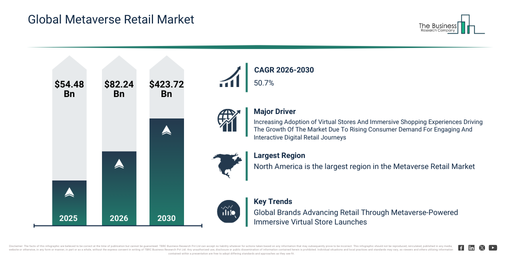
    The metaverse retail market size has experienced substantial expansion in recent years. It is anticipated to increase from $54.48 billion in 2025 to $82.24 billion in 2026, achieving a compound annual growth rate (CAGR) of 50.9%. The growth observed in the past can be attributed to several factors, including the increasing adoption of virtual and augmented reality platforms, enhanced consumer engagement in digital worlds, a rise in the use of immersive shopping experiences, the expansion of online and interactive retail channels, and a heightened focus on brand innovation and experiential marketing.

    The size of the metaverse retail market is projected to experience rapid expansion over the upcoming years. By 2030, this market is anticipated to reach $423.72 billion, exhibiting a compound annual growth rate (CAGR) of 50.7%. Key drivers for this growth during the forecast timeframe include the greater integration of artificial intelligence (AI) to enable personalized virtual shopping experiences, a surging demand for retail interactions that are both immersive and interactive, the increasing embrace of blockchain for digital ownership and transactions, the broadening of virtual commerce platforms, and increased capital flow into augmented and virtual reality-powered retail solutions. Significant trends anticipated for this period encompass technological breakthroughs in immersive retail interfaces, progress in artificial intelligence (AI)-driven recommendation engines, evolution in virtual reality (VR) and augmented reality (AR) shopping technologies, an increase in research and development concerning digital asset and payment integration, and novel approaches in interactive and gamified consumer engagement platforms.

    Download the Free Sample Report to Explore Key Market Insights:

    https://www.thebusinessresearchcompany.com/sample.aspx?id=30656&type=smp

    Which Market Drivers Are Supporting The Expansion Of The Metaverse Retail Market?

    The metaverse retail market is anticipated to expand due to the growing integration of virtual stores and immersive shopping experiences. These refer to digital retail environments where consumers can browse, interact with, and purchase products using 3D and extended reality platforms like virtual reality (VR) and augmented reality (AR). The increasing uptake of virtual stores and immersive shopping experiences stems from consumers’ rising demand for more engaging, interactive, and personalized shopping journeys that traditional e-commerce platforms cannot fully provide. Metaverse retail supports these experiences by enabling brands to establish digital storefronts, interactive try-on features, and avatar-based shopping environments, thereby enhancing customer engagement and expanding accessibility beyond physical locations. For instance, in 2023, as per Adobe Inc., a US-based software and digital experience company, retailers utilizing 3D renders on their e-commerce sites witnessed an increase in the share of shoppers adding items to their carts, climbing from 32% in 2022 to 45% in 2023, representing a 40.6% year-on-year rise. Consequently, the increasing embrace of virtual stores and immersive shopping experiences is a key driver for the metaverse retail market’s growth.

    What Are The Key Segments Of The Metaverse Retail Market?

    The metaverse retail market covered in this report is segmented –

    1) By Platform: Desktop, Virtual Reality (VR) Headsets, Mobile, Smart Glasses

    2) By Technology: Blockchain, Artificial Intelligence (AI), Augmented Reality (AR), Virtual Reality (VR), Cloud Computing, Other Technologies

    3) By Retail Activity Type: Virtual Storefronts And Showrooms, Virtual Try-On And Product Customization, Fashion And Apparel, Beauty And Cosmetics, Home And Automotive, Immersive Marketing And Live Events, Digital Product Commerce, Virtual Only Goods, Phygital Goods, Social Shopping And Advisory, Other Retail Activities

    4) By Application: Electronics, Automotive, Beauty And Personal Care, Clothing And Apparel, Footwear, Furniture And Home Décor, Sports And Fitness, Other Applications

    Subsegments:

    1) By Desktop: Web Browser Based Platform, Standalone Application Platform, Cloud Connected Platform

    2) By Virtual Reality (VR) Headsets: Tethered Headset Platform, Standalone Headset Platform, Mixed Reality Headset Platform

    3) By Mobile: iOS Platform, Android Platform, Cross Platform Mobile Application

    4) By Smart Glasses: Augmented Reality Glasses Platform, Mixed Reality Glasses Platform, Standalone Smart Glasses Platform

    What Key Trends Are Influencing The Development Of The Metaverse Retail Market?

    Key companies within the metaverse retail sector are concentrating on developing enhanced user experiences, including immersive virtual store environments, to enable consumers to discover and purchase items in digital realms. These immersive virtual store experiences describe digitally constructed retail settings that facilitate customer interaction with products and brands in a lifelike, engaging, and often 3D or VR-powered context. For example, in October 2023, Casio Computer Co. Ltd., an electronics and watch manufacturer from Japan, introduced the virtual G-SHOCK STORE on the VRChat metaverse platform, delivering an immersive virtual store experience within a dedicated virtual reality space. Users are able to craft personalized G-SHOCK watches in the G-SHOCK STORE virtual world by combining different parts. They can also visualize their VRChat avatars wearing the watches they’ve designed.

    Which Major Firms Influence Developments In The Metaverse Retail Market?

    Major companies operating in the metaverse retail market are Walmart Inc., Samsung Electronics Co. Ltd., Meta Platforms Inc., Alibaba Group Holding Limited, Nike Inc., H&M Group, Adidas AG, Ralph Lauren Corporation, Louis Vuitton, Roblox Corporation, Epic Games Inc., Balenciaga, Guccio Gucci SPA, Immutable Pty Ltd., The Sandbox, OpenSea Inc., ZEPETO Corporation, Decentraland, VRChat Inc., Spatial Systems Inc., Voxels LLC, Somnium Space Ltd., DRESSX

    Read the full metaverse retail market report here:

    https://www.thebusinessresearchcompany.com/report/metaverse-retail-market-report

    Which Region Is Expected To Experience The Fastest Growth In The Metaverse Retail Market?

    North America was the largest region in the metaverse retail market in 2025. Asia-Pacific is expected to be the fastest-growing region in the forecast period. The regions covered in the metaverse retail market report are Asia-Pacific, South East Asia, Western Europe, Eastern Europe, North America, South America, Middle East, Africa.

    Request A Tailored Metaverse Retail Market Research Report For Competitive Advantage:

    https://www.thebusinessresearchcompany.com/customise?id=30656&type=smp

    Browse Through More Reports Similar to the Global Metaverse Retail Market 2026, By The Business Research Company

    Retail Market Report 2026

    https://www.thebusinessresearchcompany.com/report/retail-global-market-report

    Miscellaneous Store Retailers Market Report 2026

    https://www.thebusinessresearchcompany.com/report/miscellaneous-store-retailers-global-market-report

    retail and wholesale global market report

    https://www.thebusinessresearchcompany.com/report/retail-and-wholesale-global-market-report

    Get in touch with us:

    The Business Research Company: https://www.thebusinessresearchcompany.com/

    Americas +1 310-496-7795

    Asia +44 7882 955267 & +91 8897263534

    Europe +44 7882 955267

    Email us at info@tbrc.info

    Follow us on:

    LinkedIn: https://in.linkedin.com/company/the-business-research-company

    YouTube: https://www.youtube.com/channel/UC24_fI0rV8cR5DxlCpgmyFQ

    Global Market Model: https://www.thebusinessresearchcompany.com/global-market-model
  • A key growth driver for the Medical Microfluidic Devices Market is the rising prevalence of chronic diseases, boosting demand for continuous monitoring and personalized diagnostics

    A key growth driver for the Medical Microfluidic Devices Market is the rising prevalence of chronic diseases, boosting demand for continuous monitoring and personalized diagnostics

    The Business Research Company’s 2026 market reports include new capabilities such as market attractiveness scoring and analysis, total addressable market analysis, company scoring matrix, interactive excel data dashboard, improved supply chain analysis, upcoming startups in the market, and overview of key products, aimed at improving the depth, usability, and strategic value of the insights delivered.

    How Will The Market Size Of The Medical Microfluidic Devices Market Evolve From 2026 To 2030?

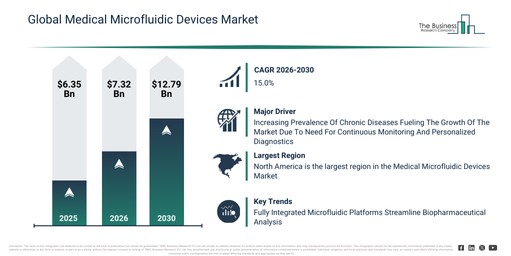
    The medical microfluidic devices market has experienced significant expansion recently. This market is projected to expand from $6.35 billion in 2025 to $7.32 billion in 2026, demonstrating a compound annual growth rate (CAGR) of 15.3%. Historically, this expansion has been driven by factors such as the wider adoption of point-of-care diagnostics, the increased application of lab-on-a-chip technology in research settings, a surge in demand for microfluidic-based clinical tests, the broadening of pharmaceutical and biotech R&D initiatives, and the greater incorporation of polymer-based microfluidic materials.

    The medical microfluidic devices market size is set to experience significant growth in the coming years. It is projected to expand to $12.79 billion by 2030, demonstrating a compound annual growth rate (CAGR) of 15.0%. This anticipated growth during the forecast period is driven by various factors, including the increasing demand for personalized medicine and organ-on-chip models, the greater integration of microfluidics into decentralized and home diagnostics, the rising adoption of microfluidic platforms for infectious disease monitoring, the expanding scope of microfluidic applications in high-throughput drug screening, and the growing penetration of microfluidic devices in emerging healthcare markets. Important trends observed in the forecast period encompass technological advancements in integrated lab-on-a-chip platforms, innovations in droplet-based and paper-based microfluidics, developments in miniaturized biosensors and detectors, ongoing research and development in organ-on-chip and tissue engineering systems, and technological progress in automated and AI-enabled microfluidic analysis.

    Download the Free Sample Report to Explore Key Market Insights:

    https://www.thebusinessresearchcompany.com/sample.aspx?id=30652&type=smp

    What Primary Drivers Are Shaping The Development Of The Medical Microfluidic Devices Market?

    The medical microfluidic devices market is anticipated to grow in the future, driven by the escalating incidence of chronic diseases. Chronic diseases are persistent health conditions that typically advance slowly, encompassing illnesses such as diabetes, heart disease, and arthritis, often necessitating continuous medical intervention and lifestyle modifications to manage symptoms and prevent complications. The rise in chronic diseases is largely attributable to unhealthy lifestyles, including poor diet, physical inactivity, and smoking, which heighten the risk of conditions like diabetes, heart disease, and obesity. Medical microfluidic devices contribute to chronic disease management by enabling precise handling and analysis of tiny fluid samples for ongoing monitoring and diagnostics. They enhance patient care through supporting rapid testing, customized treatment adjustments, and minimally invasive, long-term disease surveillance. For instance, in June 2024, according to the National Health Service, a UK-based government department, 3,615,330 individuals registered with a general practitioner (GP) received a diagnosis of non-diabetic hyperglycemia or pre-diabetes (a condition characterized by elevated blood sugar levels, not high enough to be classified as diabetes) in 2023. This marked an 18% increase from 3,065,825 cases in 2022. Thus, the increasing prevalence of chronic diseases is fueling the expansion of the medical microfluidic devices market.

    Which Segment Areas Are Covered In The Medical Microfluidic Devices Market Analysis?

    The medical microfluidic devices market covered in this report is segmented –

    1) By Product Type: Lab-On-A-Chip (LOC) Systems, Microfluidic Chips And Cartridges, Droplet-Based Microfluidic Systems, Paper-Based Microfluidic Devices, Continuous-Flow Microfluidic Systems, Organ-On-A-Chip Platforms

    2) By Material: Glass, Polymer, Silicon, Metals, Ceramics

    3) By Application: Point-Of-Care Diagnostics, Drug Discovery And Development, Organ-On-Chip And Tissue Engineering, Infectious Disease Monitoring

    4) By End User: Hospitals And Diagnostic Clinics, Diagnostic And Research Laboratories, Pharmaceutical And Biotechnology Companies, Academic And Research Institutes, Home Care Settings

    Subsegments:

    1) By Lab-On-A-Chip Systems: Clinical Diagnostic Chips, Environmental Monitoring Chips, Biochemical Analysis Chips, Single-Cell Analysis Platforms

    2) By Microfluidic Chips And Cartridges: Point-Of-Care Diagnostic Cartridges, Sample Preparation Chips, Cell Culture And Assay Chips, Polymerase Chain Reaction Chips

    3) By Droplet-Based Microfluidic Systems: Water-In-Oil Emulsion Systems, Oil-In-Water Emulsion Systems, Digital Droplet Systems, High-Throughput Screening Platforms

    4) By Paper-Based Microfluidic Devices: Lateral Flow Assay Strips, Three-Dimensional Paper Networks, Multiplexed Detection Devices, Colorimetric Analysis Strips

    5) By Continuous-Flow Microfluidic Systems: Microreactor Systems, Cell Sorting And Separation Systems, Micromixer Devices, Chemical Synthesis Platforms

    6) By Organ-On-A-Chip Platforms: Liver-On-A-Chip Models, Lung-On-A-Chip Models, Heart-On-A-Chip Models, Multi-Organ System Models

    What Key Developments And Trends Are Impacting The Medical Microfluidic Devices Market?

    Companies operating within the medical microfluidic devices market are prioritizing the creation of sophisticated platforms, such as fully integrated microfluidic chip-based systems, to accelerate the advancement of biopharmaceutical therapies for renal care and various other conditions. These fully integrated microfluidic chip-based platforms are defined as lab-on-a-chip devices that consolidate multiple laboratory operations—like sample preparation, fluid handling, reaction, separation, and detection—onto a single micro-scale chip. As an illustration, AB Sciex LLC, a US-based life science analytical technology company, unveiled the Intabio ZT system in June 2023. This product represents the inaugural fully-integrated microfluidic chip-based platform that combines imaged capillary isoelectric focusing (icIEF) separation with UV detection. The platform is engineered to obtain comprehensive data on charge isoforms for biopharmaceuticals, featuring effortless integration with the ZenoTOF 7600 system. Furthermore, the solution offers advanced data processing capabilities via its Biologics Explorer software, enabling deeper understandings of protein therapeutics and thereby speeding up the delivery of secure and efficacious biological treatments.

    Who Are The Prominent Organizations Shaping The Medical Microfluidic Devices Market?

    Major companies operating in the medical microfluidic devices market are Roche Diagnostics, Thermo Fisher Scientific Inc, Abbott Laboratories, Danaher Corporation, Agilent Technologies Inc., Illumina Inc., BioMérieux, PerkinElmer Inc., Bio-Rad Laboratories Inc., Fluidigm Corporation, Spectrum Fluidics, Biosurfit SA, Cellix Ltd., 3M Company, Dolomite Microfluidics, Micronit Microtechnologies B.V., Sphere Fluidics Ltd., BioFluidica Inc., uFluidix Inc., Elveflow, On-chip Biotechnologies, Achira Labs Pvt. Ltd., Akkonni Biosystems Inc.

    Read the full medical microfluidic devices market report here:

    https://www.thebusinessresearchcompany.com/report/medical-microfluidic-devices-market-report

    Which Region Currently Holds The Largest Share Of The Medical Microfluidic Devices Market?

    North America was the largest region in the medical microfluidic devices market in 2025. Asia-Pacific is expected to be the fastest-growing region in the forecast period. The regions covered in the medical microfluidic devices market report are Asia-Pacific, South East Asia, Western Europe, Eastern Europe, North America, South America, Middle East, Africa.

    Request A Tailored Medical Microfluidic Devices Market Research Report For Competitive Advantage:

    https://www.thebusinessresearchcompany.com/customise?id=30652&type=smp

    Browse Through More Reports Similar to the Global Medical Microfluidic Devices Market 2026, By The Business Research Company

    Microfluidics Market Report 2026

    https://www.thebusinessresearchcompany.com/report/microfluidics-global-market-report

    Medical Device Technologies Market Report 2026

    https://www.thebusinessresearchcompany.com/report/medical-device-technologies-global-market-report

    nanotechnology based medical devices global market report

    https://www.thebusinessresearchcompany.com/report/nanotechnology-based-medical-devices-global-market-report

    Get in touch with us:

    The Business Research Company: https://www.thebusinessresearchcompany.com/

    Americas +1 310-496-7795

    Asia +44 7882 955267 & +91 8897263534

    Europe +44 7882 955267

    Email us at info@tbrc.info

    Follow us on:

    LinkedIn: https://in.linkedin.com/company/the-business-research-company

    YouTube: https://www.youtube.com/channel/UC24_fI0rV8cR5DxlCpgmyFQ

    Global Market Model: https://www.thebusinessresearchcompany.com/global-market-model
  • Global Medical Microbiology Testing Technology Market Trends and Forecast 2026–2030

    Global Medical Microbiology Testing Technology Market Trends and Forecast 2026–2030

    The Business Research Company’s 2026 market reports include new capabilities such as market attractiveness scoring and analysis, total addressable market analysis, company scoring matrix, interactive excel data dashboard, improved supply chain analysis, upcoming startups in the market, and overview of key products, aimed at improving the depth, usability, and strategic value of the insights delivered.

    What Is The Forecasted Market Value Of The Medical Microbiology Testing Technology Market Across 2026–2030?

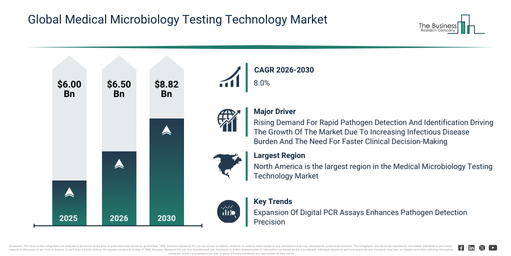
    The medical microbiology testing technology market size has demonstrated robust growth in recent years. It is projected to expand from $6.00 billion in 2025 to $6.50 billion in 2026, at a compound annual growth rate (CAGR) of 8.2%. This market’s historical growth can be attributed to the escalating incidence of infectious diseases, increased awareness regarding antimicrobial resistance, rising healthcare expenditure, the expansion of clinical laboratories, and the growing adoption of automated systems.

    The medical microbiology testing technology market is projected to experience robust expansion over the coming years, reaching $8.82 billion by 2030, driven by a compound annual growth rate (CAGR) of 8.0%. This growth during the forecast period is primarily fueled by an escalating need for swift and point-of-care testing solutions, expanding governmental initiatives and public health programs, a heightened emphasis on ensuring food and pharmaceutical safety through testing, significant market growth in developing regions, and the increasing incorporation of laboratory information systems. Key trends anticipated during this period include breakthroughs in molecular diagnostics, the introduction of innovative high-throughput testing platforms, the evolution of multiplex and rapid diagnostic tests, intensified research and development efforts in microbiology, and the integration of technology with serological and immunological testing.

    Download the Free Sample Report to Explore Key Market Insights:

    https://www.thebusinessresearchcompany.com/sample.aspx?id=30651&type=smp

    Which Major Factors Are Driving The Expansion Of The Medical Microbiology Testing Technology Market?

    The increasing need for quick pathogen detection and identification is anticipated to drive the expansion of the medical microbiology testing technology market in the future. Rapid pathogen detection and identification involve diagnostic technologies designed to promptly and precisely identify microbes, including bacteria, viruses, and other pathogens, directly from patient samples without lengthy culture times, which reduces the diagnostic timeline and facilitates quicker clinical choices. The requirement for rapid pathogen detection is growing because public health systems and clinical laboratories globally seek to enhance efficiency and respond robustly to infectious disease outbreaks and the challenges posed by antimicrobial resistance. Medical microbiology testing technology aids rapid pathogen detection by swiftly and accurately pinpointing infectious agents using sophisticated diagnostic techniques, thus enabling prompt treatment and curbing the spread of infections. For example, data from April 2025, released in November 2025 by the Infectious Disease Surveillance Center, a public health body based in Japan, showed that during one reporting period, between 2,104 and 2,153 respiratory pathogen tests were performed for each pathogen category, and the positivity rates for severe acute respiratory syndrome coronavirus 2, influenza, respiratory syncytial virus, and parainfluenza varied from 5.7% to 11.5%. Consequently, the escalating demand for rapid pathogen detection and identification is fueling the expansion of the medical microbiology testing technology market.

    What Segmentation Levels Are Considered In The Medical Microbiology Testing Technology Market?

    The medical microbiology testing technology market covered in this report is segmented –

    1) By Product Type: Reagents, Instruments, Consumables, Software, Services

    2) By Testing Method: Culture Test, Polymerase Chain Reaction, Immunoassays, Deoxyribonucleic Acid Sequence

    3) By Technology: Cell Culture, Microscopy, Serology

    4) By Application: Infectious Diseases, Non-infectious Diseases, Research And Development, Clinical Trials

    5) By End Use: Hospitals, Diagnostic Laboratories, Pharmaceutical Companies, Research Institutes, Food And Beverage Industry

    Subsegments:

    1) By Reagents: Culture Media, Detection Reagents, Antigen And Antibody Reagents, Molecular Diagnostic Kits, Stains And Dyes, Antibiotic Or Susceptibility Testing Reagents

    2) By Instruments: Microscopes, Incubators, Automated Culture Systems Or Microbiology Analyzers, Spectrophotometers, Centrifuges, Colony Counters Or Plate Readers, Autoclaves Or Sterilizers, Bioreactors Or Environmental Monitoring Systems

    3) By Consumables: Petri Dishes, Test Tubes, Pipette Tips, Microplates, Sample Swabs Or Collection Containers, Slides And Cover Slips, Disposable Filters Or Membranes, Disposable Consumable Kits

    4) By Software: Laboratory Information Management Software, Data Analysis Or Result Reporting Software, Quality Control Or Workflow Management Software, Automated Instrument Control Software, Database Or Reference Strain Or Pathogen Registry Software

    5) By Services: Contract Testing Or Outsourced Microbiological Testing, Equipment Maintenance And Calibration, Training And Technical Support, Consulting And Compliance Services, Validation And Quality Assurance Services

    What Trends Are Projected To Affect The Medical Microbiology Testing Technology Market?

    Leading companies in the medical microbiology testing technology market are concentrating on developing advanced molecular analysis products, like digital PCR (dPCR) assays, to enhance research efficiency, improve detection accuracy, and strengthen public health surveillance. Digital PCR assays are highly sensitive technologies that can identify and precisely quantify specific DNA sequences, even at very low concentrations, enabling accurate pathogen detection and monitoring. For example, in June 2024, QIAGEN N.V., a Netherlands-based provider of molecular biology and life sciences solutions, launched 35 new wet-lab tested digital PCR Microbial DNA Detection Assays for its QIAcuity digital PCR platform. These assays are available on QIAGEN’s research platform GeneGlobe and are designed to target a wide array of pathogens responsible for tropical diseases (e.g., Dengue, Chikungunya, Malaria), sexually transmitted infections (STIs), and urinary tract infections (UTIs).

    Which Key Industry Participants Are Active In The Medical Microbiology Testing Technology Market?

    Major companies operating in the medical microbiology testing technology market are F. Hoffmann-La Roche Ltd., Thermo Fisher Scientific Inc., Siemens Healthineers AG, Danaher Corporation, Becton Dickinson and Company, bioMérieux SA, Hologic Inc., Sysmex Corporation, Bruker Corporation, Bio-Rad Laboratories Inc., QIAGEN N.V., Abbott Laboratories, Meridian Bioscience Inc., Fujirebio Diagnostics Inc., Seegene Inc., Oxford Nanopore Technologies plc, Molbio Diagnostics Pvt. Ltd., Hardy Diagnostics, HiMedia Laboratories Pvt. Ltd., Accelerate Diagnostics Inc., Liofilchem S.r.l.

    Read the full medical microbiology testing technology market report here:

    https://www.thebusinessresearchcompany.com/report/medical-microbiology-testing-technology-market-report

    How Does The Medical Microbiology Testing Technology Market Perform Across Major Global Regions?

    North America was the largest region in the medical microbiology testing technology market in 2025. Asia-Pacific is expected to be the fastest-growing region in the forecast period. The regions covered in the medical microbiology testing technology market report are Asia-Pacific, South East Asia, Western Europe, Eastern Europe, North America, South America, Middle East, Africa.

    Request A Tailored Medical Microbiology Testing Technology Market Research Report For Competitive Advantage:

    https://www.thebusinessresearchcompany.com/customise?id=30651&type=smp

    Browse Through More Reports Similar to the Global Medical Microbiology Testing Technology Market 2026, By The Business Research Company

    Microbiology And Bacterial Culture For Industrial Testing Market Report 2026

    https://www.thebusinessresearchcompany.com/report/microbiology-and-bacterial-culture-for-industrial-testing-global-market-report

    Clinical Microbiology Market Report 2026

    https://www.thebusinessresearchcompany.com/report/clinical-microbiology-global-market-report

    hospital acquired infections testing kits global market report

    https://www.thebusinessresearchcompany.com/report/hospital-acquired-infections-testing-kits-global-market-report

    Get in touch with us:

    The Business Research Company: https://www.thebusinessresearchcompany.com/

    Americas +1 310-496-7795

    Asia +44 7882 955267 & +91 8897263534

    Europe +44 7882 955267

    Email us at info@tbrc.info

    Follow us on:

    LinkedIn: https://in.linkedin.com/company/the-business-research-company

    YouTube: https://www.youtube.com/channel/UC24_fI0rV8cR5DxlCpgmyFQ

    Global Market Model: https://www.thebusinessresearchcompany.com/global-market-model
  • Medical Magnets Market Outlook 2026–2030 Reflecting Demand Growth Trends

    Medical Magnets Market Outlook 2026–2030 Reflecting Demand Growth Trends

    The Business Research Company’s 2026 market reports include new capabilities such as market attractiveness scoring and analysis, total addressable market analysis, company scoring matrix, interactive excel data dashboard, improved supply chain analysis, upcoming startups in the market, and overview of key products, aimed at improving the depth, usability, and strategic value of the insights delivered.

    What Market Size Increase Is Anticipated For The Medical Magnets Market Over The 2026–2030 Period?

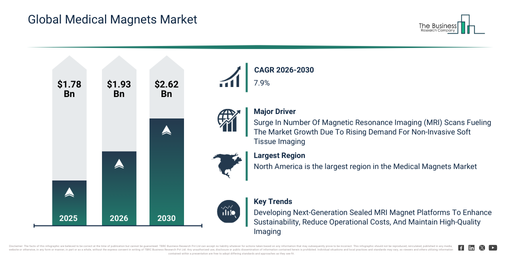
    The medical magnets market size has seen robust growth in recent years. It is projected to expand from $1.78 billion in 2025 to $1.93 billion in 2026, with a compound annual growth rate (CAGR) of 8.2%. Key drivers of this growth during the historical period include the rising adoption of MRI systems, the increasing prevalence of neurological disorders, higher investments in diagnostic infrastructure, the broader use of magnetic therapy, and the expanding production of high-performance magnets.

    The medical magnets market size is projected to experience substantial expansion in the coming years. By 2030, this market is forecasted to reach $2.62 billion, exhibiting a compound annual growth rate (CAGR) of 7.9%. This growth during the forecast period is fueled by several factors, including the increasing need for minimally invasive diagnostic procedures, advancements in research and development concerning magnetic drug delivery, the rising uptake of TMS devices, the broadening use of hyperthermia in cancer treatment, and the expanding array of dental applications that utilize precision magnets. Key trends anticipated for the forecast period encompass breakthroughs in high-field MRI magnet systems technology, novel developments in TMS coil and magnet designs, the creation of lightweight yet high-strength magnets, intensive research and development efforts in magnetic hyperthermia therapy, and technological progress leading to portable and compact magnetic devices.

    Download the Free Sample Report to Explore Key Market Insights:

    https://www.thebusinessresearchcompany.com/sample.aspx?id=30650&type=smp

    What Key Drivers Are Influencing The Growth Of The Medical Magnets Market?

    The increasing volume of magnetic resonance imaging (MRI) scans is anticipated to stimulate the expansion of the medical magnets market in the future. MRI scans are non-invasive diagnostic procedures that utilize powerful magnets and radio waves to generate intricate images of internal organs and tissues. The global rise in the elderly population contributes to the increase in MRI scans, as this demographic experiences a greater incidence of chronic ailments requiring precise, non-invasive soft tissue imaging for diagnosis and treatment planning. Medical magnets are crucial for MRI scans, providing the robust, consistent magnetic fields necessary for producing detailed images of internal body structures. They improve diagnostic precision and image quality by facilitating high-resolution visualization of soft tissues without the use of ionizing radiation. For example, in December 2024, data from NHS England, a UK-based publicly funded healthcare system, showed that magnetic resonance imaging scans in England climbed from 361,705 in August 2023 to 365,270 in August 2024, with a rolling 12-month total from September 2023 to August 2024 reaching 4,504,615 scans. Consequently, the growing application of medical magnets in both therapeutic and diagnostic fields is fostering the growth of the medical magnets market. The growing occurrence of chronic diseases is anticipated to drive the expansion of the medical magnets market in the coming years. Chronic diseases are enduring health conditions that typically develop gradually, such as diabetes, heart disease, and arthritis, often necessitating continuous medical care and lifestyle adjustments to manage symptoms and prevent complications. The rise in chronic diseases is largely attributed to unhealthy lifestyles, including poor dietary habits, lack of physical activity, and smoking, which elevate the risk of conditions like diabetes, heart disease, and obesity. Medical magnets assist in managing chronic diseases by facilitating targeted treatments and diagnostic imaging, thereby helping to monitor and ease symptoms over time. They enhance patient care by offering non-invasive treatment options and boosting the efficacy of ongoing medical interventions. For instance, in June 2024, the National Health Service, a UK-based government department, reported that 3,615,330 individuals registered with a general practitioner (GP) were diagnosed with non-diabetic hyperglycemia or pre-diabetes in 2023, representing an 18% increase from 3,065,825 cases in 2022. Consequently, the increasing prevalence of chronic diseases is a significant factor propelling the growth of the medical magnets market.

    How Is The Medical Magnets Market Segmented Across Key Categories?

    The medical magnets market covered in this report is segmented –

    1) By Product Type: High-Performance Magnets, Lower-Performance Magnets, Superconducting Magnets, Electromagnets

    2) By Material Type: Neodymium Iron Boron, Ferrite, Samarium Cobalt, Other Materials

    3) By Technology: Permanent Magnet Technology, Electromagnetic Systems, Superconducting Magnet Technology, Hybrid Magnetic Systems

    4) By Application: Magnetic Resonance Imaging, Transcranial Magnetic Stimulation, Magnetic Therapy, Drug Delivery, Dentistry

    5) By End User: Hospitals, Diagnostic Imaging Centers, Specialty Neurology Centers, Research And Academic Institutions, Rehabilitation And Wellness Centers

    Subsegment:

    1) By High-Performance Magnets: Neodymium Iron Boron, Samarium Cobalt, Alnico

    2) By Lower-Performance Magnets: Ferrite, Ceramic

    3) By Superconducting Magnets: Niobium Titanium, Niobium Tin, Magnesium Diboride

    4) By Electromagnets: Solenoid, Toroidal, Helical

    Which Upcoming Trends Are Expected To Influence The Medical Magnets Market?

    Major companies operating in the medical magnets market are concentrating on developing advanced technology, such as helium-efficient MRI magnet technologies, with the aim of reducing operational costs and improving sustainability without compromising imaging performance. Helium-efficient MRI magnet technologies refer to next-generation superconducting magnet designs that utilize minimal or no liquid helium through sealed or cryogen-free cooling systems, thereby cutting resource consumption, operating costs, and environmental impact while maintaining high-quality imaging performance. For instance, in February 2025, GE Healthcare Technologies Inc., a US-based medical technology company, introduced the Freelium sealed magnet platform. This platform features a helium-free design that consumes less than 1% of the helium required by traditional MRI magnets, integrates intelligent sensor technology for remote monitoring and automated magnet recovery, and provides a permanent helium enclosure for sustainability. Additional capabilities include compatibility with AI-enabled imaging solutions and a design optimized for installation in locations with limited helium access, enabling wider deployment of high-performance MRI systems. This launch signifies a significant advancement in MRI technology, combining environmental efficiency, operational reliability, and high-quality diagnostic performance.

    Who Are The Top Companies Competing In The Medical Magnets Market?

    Major companies operating in the medical magnets market are Hitachi Ltd., Siemens Healthineers AG, Koninklijke Philips N.V., GE HealthCare Technologies Inc., Shin-Etsu Chemical Co. Ltd., Canon Medical Systems Corporation, Neo Performance Materials Inc., Ningbo Tongchuang Magnetic Materials Co. Ltd., Stereotaxis Inc., MagnetsTek LLC, SM Magnetics Inc., Zhejiang Zhaobao Magnet Group Co. Ltd., Bunting-DuBois Magnetics, I.M.A. Industria Macchine Automatiche S.p.A., Magnetica Limited, VACUUMSCHMELZE GmbH & Co. KG, Newland Magnetics Europe Ltd., Noveon Magnetics Inc., Goudsmit Magnetics Group B.V., MainRich Magnetics Co. Ltd.

    Read the full medical magnets market report here:

    https://www.thebusinessresearchcompany.com/report/medical-magnets-market-report

    Which Region Is Anticipated To See The Fastest Growth In The Medical Magnets Market?

    North America was the largest region in the medical magnets market in 2025. Asia-Pacific is expected to be the fastest-growing region in the forecast period. The regions covered in the medical magnets market report are Asia-Pacific, South East Asia, Western Europe, Eastern Europe, North America, South America, Middle East, Africa.

    Request A Tailored Medical Magnets Market Research Report For Competitive Advantage:

    https://www.thebusinessresearchcompany.com/customise?id=30650&type=smp

    Browse Through More Reports Similar to the Global Medical Magnets Market 2026, By The Business Research Company

    Electronic Device Magnets Market Report 2026

    https://www.thebusinessresearchcompany.com/report/electronic-device-magnets-global-market-report

    Magnetic Materials Market Report 2026

    https://www.thebusinessresearchcompany.com/report/magnetic-materials-global-market-report

    magnetometer global market report

    https://www.thebusinessresearchcompany.com/report/magnetometer-global-market-report

    Get in touch with us:

    The Business Research Company: https://www.thebusinessresearchcompany.com/

    Americas +1 310-496-7795

    Asia +44 7882 955267 & +91 8897263534

    Europe +44 7882 955267

    Email us at info@tbrc.info

    Follow us on:

    LinkedIn: https://in.linkedin.com/company/the-business-research-company

    YouTube: https://www.youtube.com/channel/UC24_fI0rV8cR5DxlCpgmyFQ

    Global Market Model: https://www.thebusinessresearchcompany.com/global-market-model
  • Medical Imaging Reconstruction Artificial Intelligence (AI) Market Insights Highlighting Growth Drivers and Opportunities Through 2030

    Medical Imaging Reconstruction Artificial Intelligence (AI) Market Insights Highlighting Growth Drivers and Opportunities Through 2030

    The Business Research Company’s 2026 market reports include new capabilities such as market attractiveness scoring and analysis, total addressable market analysis, company scoring matrix, interactive excel data dashboard, improved supply chain analysis, upcoming startups in the market, and overview of key products, aimed at improving the depth, usability, and strategic value of the insights delivered.

    How Much Is The Medical Imaging Reconstruction Artificial Intelligence (AI) Market Expected To Grow In Terms Of Market Value Between 2026 And 2030?

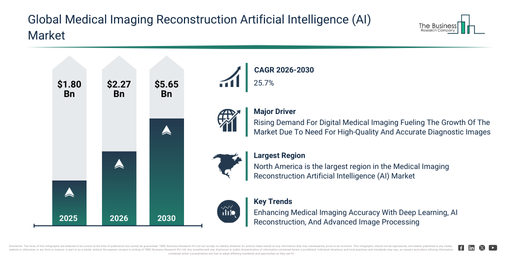
    The medical imaging reconstruction artificial intelligence (AI) market has experienced significant growth in its size over recent years. It is anticipated to increase from $1.80 billion in 2025 to $2.27 billion in 2026, achieving a compound annual growth rate (CAGR) of 26.0%. This market’s historical expansion can be linked to factors such as rising medical imaging volumes, the increasing adoption of digital radiology systems, a growing demand for quicker image reconstruction, an enhanced focus on radiation dose reduction, and the progressive integration of deep learning techniques.

    The medical imaging reconstruction artificial intelligence (AI) market is projected to experience substantial expansion in the coming years. This market is anticipated to reach $5.65 billion by 2030, exhibiting a compound annual growth rate (CAGR) of 25.7%. This expansion during the forecast period is primarily driven by factors such as the increasing demand for cloud-based imaging solutions, augmented investments in AI innovations for healthcare, the wider adoption of sophisticated reconstruction software, expanding hospital digital transformation efforts, and the escalating need for automating radiologist workflows. Key trends emerging in this period encompass the increased adoption of multimodal image reconstruction, the growing utilization of real-time reconstruction algorithms, the rising integration of generative artificial intelligence models, the broadening of hybrid cloud imaging platforms, and a progressive shift towards fully automated imaging pipelines.

    Download the Free Sample Report to Explore Key Market Insights:

    https://www.thebusinessresearchcompany.com/sample.aspx?id=30649&type=smp

    What Major Growth Drivers Are Shaping The Outlook Of The Medical Imaging Reconstruction Artificial Intelligence (AI) Market?

    The future expansion of the medical imaging reconstruction artificial intelligence (AI) market is anticipated to be driven by the rising need for digital medical imaging. Digital medical imaging involves employing digital technologies to acquire, retain, process, and present images of the human body for purposes such as diagnosis, monitoring, and therapeutic interventions. This surge in demand for digital imaging stems from a heightened requirement for superior visual quality and precise diagnostic imagery, given that digital methods facilitate quicker processing, enhanced resolution, and streamlined data management and exchange. Medical imaging reconstruction artificial intelligence (AI) bolsters digital medical imaging by boosting image clarity, reducing reconstruction durations, and allowing for a more precise interpretation of diagnostic examinations. This technology enhances patient care through enabling accurate diagnoses and fostering more informed clinical choices. As an illustration, NHS England, a UK-based government health authority, reported in May 2025 that 48.9 million imaging tests were conducted throughout England from February 2024 to January 2025, with January 2025 alone accounting for 4.03 million tests, underscoring the consistent high volume of diagnostic imaging procedures. Consequently, the escalating need for digital medical imaging is propelling the expansion of the medical imaging reconstruction artificial intelligence (AI) market.

    What Major Segment Divisions Exist Within The Medical Imaging Reconstruction Artificial Intelligence (AI) Market?

    The medical imaging reconstruction artificial intelligence (AI) market covered in this report is segmented –

    1) By Component: Software, Hardware, Services

    2) By Modality: Computed Tomography (CT), Magnetic Resonance Imaging (MRI), Positron Emission Tomography (PET), Ultrasound, X-Ray (X-Radiation), Other Modality

    3) By Deployment Mode: On-Premises, Cloud

    4) By Application: Oncology, Cardiology, Neurology, Orthopedics, Other Application

    5) By End-User: Hospitals, Diagnostic Imaging Centers, Research Institutes, Other End-User

    Subsegments:

    1) By Software: Image Reconstruction Software, Workflow Management Software, Cloud-Based Reconstruction Platforms, Artificial Intelligence Algorithm Software, Data Analytics And Visualization Software

    2) By Hardware: Imaging Processing Units, Medical Imaging Scanners, Storage And Server Systems, Graphics Processing Hardware, Edge Computing Devices

    3) By Services: Maintenance And Support Services, Training And Implementation Services, Consulting Services, Software As A Service, Research And Development Services

    How Are Trends Shaping The Direction Of The Medical Imaging Reconstruction Artificial Intelligence (AI) Market?

    Leading companies in the medical imaging reconstruction artificial intelligence (AI) market are concentrating on developing technologically advanced solutions, such as deep learning-based image processing software, to elevate diagnostic accuracy, decrease scan durations, and enhance image quality across various modalities. Deep learning-based image processing software refers to AI algorithms extensively trained on vast datasets to reconstruct medical images with superior clarity, reduce unwanted noise, and identify anatomical structures with greater precision, thereby facilitating improved clinical decision-making. For instance, in May 2023, GE HealthCare, a US-based medical technology company, secured FDA 510(k) clearance for Precision DL, its deep learning image processing software specifically for PET/CT scanners, which is deployed on the Omni Legend system. This solution utilizes deep learning-based image processing software to refine image quality while simultaneously maintaining low radiation exposure, expediting workflow, and providing clinicians with more exact diagnostic insights. It also strives to improve the detection of small lesions, optimize quantitative accuracy, and enable faster, lower-dose imaging, allowing clinicians to deliver more precise and personalized patient care.

    Which Major Players Dominate The Medical Imaging Reconstruction Artificial Intelligence (AI) Market?

    Major companies operating in the medical imaging reconstruction artificial intelligence (AI) market are NVIDIA Corporation, Siemens Healthineers AG, Fujifilm Holdings Corp., Philips International B.V., GE HealthCare Technologies Inc., United Imaging Healthcare Co. Ltd., Samsung Medison, Hitachi Medical Systems GmbH, Canon Medical Systems Corporation, Viz.ai Inc., Aidoc Medical Ltd., Lunit Inc., Infervision, Quibim SL, DeepHealth, Blackford Analysis Ltd., Airs Medical Inc., Subtle Medical Inc., Zebra Medical, Enlitic

    Read the full medical imaging reconstruction artificial intelligence (ai) market report here:

    https://www.thebusinessresearchcompany.com/report/medical-imaging-reconstruction-artificial-intelligence-ai-market-report

    Which Region Is Anticipated To See The Fastest Growth In The Medical Imaging Reconstruction Artificial Intelligence (AI) Market?

    North America was the largest region in the medical imaging reconstruction artificial intelligence (AI) market in 2025. Asia-Pacific is expected to be the fastest-growing region in the forecast period. The regions covered in the medical imaging reconstruction artificial intelligence (AI) market report are Asia-Pacific, South East Asia, Western Europe, Eastern Europe, North America, South America, Middle East, Africa.

    Request A Tailored Medical Imaging Reconstruction Artificial Intelligence (AI) Market Research Report For Competitive Advantage:

    https://www.thebusinessresearchcompany.com/customise?id=30649&type=smp

    Browse Through More Reports Similar to the Global Medical Imaging Reconstruction Artificial Intelligence (AI) Market 2026, By The Business Research Company

    Artificial Intelligence In Medical Imaging Market Report 2026

    https://www.thebusinessresearchcompany.com/report/artificial-intelligence-in-medical-imaging-global-market-report

    Ai In Medical Imaging Market Report 2026

    https://www.thebusinessresearchcompany.com/report/ai-in-medical-imaging-global-market-report

    artificial intelligence in magnetic resonance imaging MRI global market report

    https://www.thebusinessresearchcompany.com/report/artificial-intelligence-in-magnetic-resonance-imaging-mri-global-market-report

    Get in touch with us:

    The Business Research Company: https://www.thebusinessresearchcompany.com/

    Americas +1 310-496-7795

    Asia +44 7882 955267 & +91 8897263534

    Europe +44 7882 955267

    Email us at info@tbrc.info

    Follow us on:

    LinkedIn: https://in.linkedin.com/company/the-business-research-company

    YouTube: https://www.youtube.com/channel/UC24_fI0rV8cR5DxlCpgmyFQ

    Global Market Model: https://www.thebusinessresearchcompany.com/global-market-model
  • Global Magnetic Overband Separator Market Projected to Reach $0.96 Billion by 2030 at 7.3% CAGR

    Global Magnetic Overband Separator Market Projected to Reach $0.96 Billion by 2030 at 7.3% CAGR

    The Business Research Company’s 2026 market reports include new capabilities such as market attractiveness scoring and analysis, total addressable market analysis, company scoring matrix, interactive excel data dashboard, improved supply chain analysis, upcoming startups in the market, and overview of key products, aimed at improving the depth, usability, and strategic value of the insights delivered.

    What Market Value Is Expected For The Magnetic Overband Separator Market At The End Of The 2026–2030 Forecast Period?

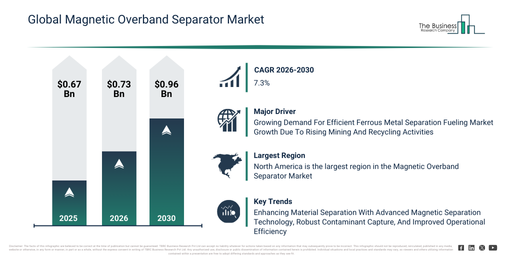
    The magnetic overband separator market size has experienced significant growth in recent years. It is projected to expand from $0.67 billion in 2025 to $0.73 billion in 2026, achieving a compound annual growth rate (CAGR) of 7.6%. The historical increase can be attributed to several factors, including heightened demand in the mining industry, increasing use in recycling applications, a growing requirement for equipment protection, the expansion of construction and manufacturing activities, and an elevated focus on product purity.

    The magnetic overband separator market size is projected to experience significant expansion in the coming years. This market is expected to reach $0.96 billion by 2030, progressing at a compound annual growth rate (CAGR) of 7.3%. This anticipated growth is driven by increased automation in material handling, the expanding adoption of permanent and electromagnets, rising investment in smart separators, broadening applications in e-waste recycling, and a heightened regulatory focus on safety and contamination control. Prominent trends within the forecast period encompass technological advancements in magnetic separator design, innovations in self-cleaning and automated systems, the development of energy-efficient and durable separators, research into hybrid separation and sensor-based sorting, and progress in AI and IoT integration for predictive maintenance.

    Download the Free Sample Report to Explore Key Market Insights:

    https://www.thebusinessresearchcompany.com/sample.aspx?id=30644&type=smp

    What Drivers Are Expected To Influence The Magnetic Overband Separator Market During The Forecast Period?

    The increasing need for effective ferrous metal separation is projected to fuel the expansion of the magnetic overband separator market going forward. Effective ferrous metal separation involves employing magnetic force to extract iron-based metallic impurities from bulk materials and scrap streams, thereby safeguarding equipment and maintaining material quality. The heightened demand for efficient ferrous metal separation arises from a growing global reliance on recycled ferrous scrap and increased mining throughput, which collectively boost the volume of metal-containing material requiring separation. Magnetic overband separator devices support efficient ferrous metal separation by enabling the continuous removal of ferrous contaminants, thereby enhancing process reliability and ensuring a cleaner material flow within mining and recycling facilities. For instance, in October 2024, according to the World Steel Association, a Belgium-based steel industry association, global steel production in 2023 incorporated approximately 630 million metric tons of recycled scrap, which accounted for nearly 30% of the total crude steel output, an increase from about 28% in 2022. Therefore, the escalating demand for efficient ferrous metal separation is driving the growth of the magnetic overband separator market.

    What Segment Types Make Up The Magnetic Overband Separator Market?

    The magnetic overband separator market covered in this report is segmented –

    1) By Magnet Type: Permanent Magnet, Electromagnet

    2) By Separator Type: Cross-Belt Separator, Over-Belt Separator, Inline Separator

    3) By Cleaning Mechanism: Self-Cleaning, Manual Cleaning

    4) By Application: Mining, Recycling, Material Handling, Power Generation

    5) By End Use: Construction, Manufacturing, Waste Management

    Subsegments:

    1) By Permanent Magnet: Ceramic Magnet, Alnico Magnet, Neodymium Magnet, Ferrite Magnet

    2) By Electromagnet: Solenoid Electromagnet, Coil Wound Electromagnet, Electro Permanent Magnet, Laminated Core Electromagnet

    Which Market Trends Are Creating New Opportunities In The Magnetic Overband Separator Market?

    Companies operating in the magnetic overband separator market are concentrating on developing advanced solutions, such as magnetic separation technology, to efficiently remove tramp metal and ferrous contaminants from bulk materials and conveyor lines, thereby safeguarding downstream equipment and enhancing product quality. This magnetic separation technology utilizes permanent magnets or electromagnets to attract and capture metallic particles from material streams, ensuring uninterrupted operation and reducing wear on processing equipment. A notable example occurred in September 2023, when Magnetic Products Inc., a US‑based manufacturer of industrial magnetic separation and material handling systems, unveiled the Intell‑I‑Mag drawer magnet, engineered with two‑inch‑diameter magnetic tubes to boost magnetic field strength and contaminant extraction performance. The Intell‑I‑Mag’s cavity design facilitates the effective capture of fine ferrous particles while offering easy maintenance and removal, making it well-suited for high‑throughput operations in recycling, quarrying, mining, and other bulk material processing sectors. This product introduction highlights the industry’s increasing emphasis on magnetic overband separator systems that combine potent magnetic separation technology with user‑friendly designs to improve material purity, minimize equipment downtime, and lower lifecycle costs.

    Who Are The Leading Companies Operating In The Magnetic Overband Separator Market?

    Major companies operating in the magnetic overband separator market are Metso Corporation, Multotec Group (Pty) Ltd, Eriez Manufacturing Co., Bunting Magnetics Co. Inc., Walker Magnetics Ltd., STEINERT GmbH, Saideep Magnetics Pvt. Ltd., Kumar Magnet Industries Pvt. Ltd., Jaykrishna Magnetics Pvt. Ltd., Vibromag Industries, Master Magnets Ltd., Goudsmit Magnetics Group B.V., Electro Flux Equipments Pvt. Ltd., IFE Aufbereitungstechnik GmbH, Excel Magnetics Pvt. Ltd., Dings Magnetics Group, Jaikar Magnet Equipments Pvt. Ltd., Shyam Magnet Pvt. Ltd., Magna Tronix Pvt. Ltd., Royal Magnetics Pvt. Ltd.

    Read the full magnetic overband separator market report here:

    https://www.thebusinessresearchcompany.com/report/magnetic-overband-separator-market-report

    Which Global Regions Are Shaping The Competitive Landscape Of The Magnetic Overband Separator Market?

    North America was the largest region in the magnetic overbend separator market in 2025. Asia-Pacific is expected to be the fastest-growing region in the forecast period. The regions covered in the magnetic overband separator market report are Asia-Pacific, South East Asia, Western Europe, Eastern Europe, North America, South America, Middle East, Africa.

    Request A Tailored Magnetic Overband Separator Market Research Report For Competitive Advantage:

    https://www.thebusinessresearchcompany.com/customise?id=30644&type=smp

    Browse Through More Reports Similar to the Global Magnetic Overband Separator Market 2026, By The Business Research Company

    Magnetic Beads Market 2026

    https://www.thebusinessresearchcompany.com/report/magnetic-beads-market

    Magnetic Sensor Market Report 2026

    https://www.thebusinessresearchcompany.com/report/magnetic-sensor-global-market-report

    ultra wideband global market report

    https://www.thebusinessresearchcompany.com/report/ultra-wideband-global-market-report

    Get in touch with us:

    The Business Research Company: https://www.thebusinessresearchcompany.com/

    Americas +1 310-496-7795

    Asia +44 7882 955267 & +91 8897263534

    Europe +44 7882 955267

    Email us at info@tbrc.info

    Follow us on:

    LinkedIn: https://in.linkedin.com/company/the-business-research-company

    YouTube: https://www.youtube.com/channel/UC24_fI0rV8cR5DxlCpgmyFQ

    Global Market Model: https://www.thebusinessresearchcompany.com/global-market-model
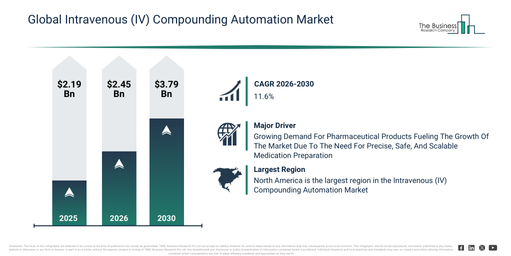
  • Global Intravenous (IV) Compounding Automation Market Expected to Reach $3.79 Billion by 2030 at 11.6% CAGR

    Global Intravenous (IV) Compounding Automation Market Expected to Reach $3.79 Billion by 2030 at 11.6% CAGR

    The Business Research Company’s 2026 market reports include new capabilities such as market attractiveness scoring and analysis, total addressable market analysis, company scoring matrix, interactive excel data dashboard, improved supply chain analysis, upcoming startups in the market, and overview of key products, aimed at improving the depth, usability, and strategic value of the insights delivered.

    What Market Valuation Is Forecasted For The Intravenous (IV) Compounding Automation Market By 2030 Starting From Its 2026 Size?

    The market for intravenous (IV) compounding automation has experienced rapid expansion in recent years. This sector is projected to expand from $2.19 billion in 2025 to reach $2.45 billion by 2026, demonstrating a compound annual growth rate (CAGR) of 11.9%. Historically, this growth has been driven by several factors, including the increased adoption of robotic compounding systems, a rising demand for chemotherapy automation, a heightened emphasis on medication safety, the broadening application of automation in hospitals and pharmacies, and an increased understanding of the importance of workflow efficiency.

    The market for automated intravenous (IV) compounding is projected to experience substantial expansion over the coming years. This market is forecast to reach $3.79 billion by 2030, exhibiting a compound annual growth rate (CAGR) of 11.6%. During the forecast period, this expansion is primarily driven by factors such as increased funding for AI-powered compounding solutions, wider adoption of automated IV workstations, enhanced software integration with hospital information systems, the spread of remote monitoring and predictive maintenance capabilities, and the creation of more modular and customizable compounding systems. Key trends anticipated during this period encompass breakthroughs in AI and machine learning applied to compounding, progress in robotic and automated devices, the evolution of smart pump and monitoring technologies, novel developments in sterile compounding isolators and safety cabinets, and improvements in compact, space-efficient automation solutions.

    Download the Free Sample Report to Explore Key Market Insights:

    https://www.thebusinessresearchcompany.com/sample.aspx?id=30629&type=smp

    What Underlying Factors Are Accelerating The Growth Of The Intravenous (IV) Compounding Automation Market?

    The increasing need for pharmaceutical products is projected to fuel the expansion of the intravenous (IV) compounding automation market moving forward. A pharmaceutical product refers to a substance or combination of substances developed for the purpose of diagnosing, treating, preventing, or relieving diseases and medical conditions in humans or animals. IV compounding automation plays a crucial role in supporting pharmaceutical products by allowing for the precise, safe, and efficient preparation of complex intravenous medications, thus ensuring accurate dosing, mitigating contamination risks, and enabling healthcare providers to fulfill the rising demand for high-quality therapies. For instance, in November 2023, according to the European Federation of Pharmaceutical Industries and Associations (EFPIA), a Belgium-based trade association, the total pharmaceutical production in Europe accounted for €390,000 million ($422,803 million) in 2023, up from €363,300 million ($393,857 million) in 2022. This demonstrates that the escalating demand for pharmaceutical products is a significant driver for the growth of the intravenous (IV) compounding automation market.

    Which Segment Categories Define The Intravenous (IV) Compounding Automation Market?

    The intravenous (iv) compounding automation market covered in this report is segmented –

    1) By Product Type: Robotic Compounding Systems, Automated Compounding Devices, Software Solutions, Other Product Types

    2) By Service: Installation, Maintenance, Training, Consulting, Support, System Integration, Validation, Software Updates, Calibration, Remote Monitoring

    3) By Application: Chemotherapy, Parenteral Nutrition, Antibiotics, Other Applications

    4) By End-User: Hospitals, Compounding Pharmacies, Oncology Centers, Other End-Users

    Subsegments:

    1) By Robotic Compounding Systems: Robotic Arm Based Systems, Closed System Robotic Compounding Units, Hazardous Drug Handling Robots, Sterile Preparation Robotic Platforms

    2) By Automated Compounding Devices: Volumetric Compounding Devices, Gravimetric Compounding Devices, Multi Chamber Compounding Units, Automated Parenteral Nutrition Compounding Devices

    3) By Software Solutions: Compounding Workflow Management Software, Dose Verification Software, Barcode Based Medication Safety Software, Compounding Data Analytics And Reporting Software

    4) By Other Product Types: Semi Automated Compounding Systems, Isolator Based Compounding Systems, Sterile Admixture Preparation Cabinets, Hybrid Compounding Assistance Devices

    Which Companies Are Leading Innovation In The Intravenous (IV) Compounding Automation Market?

    Major companies operating in the intravenous (iv) compounding automation market are Becton Dickinson and Company, Baxter International Inc., Grifols S.A., ICU Medical Inc., Omnicell Inc., Fresenius Kabi AG, Equashield Medical Ltd., Health Robotics S.r.l., Loccioni Group, Loccioni Group, OPTIMA pharma GmbH, Medimix Systems AG, ARxIUM Inc., General Healthy Co. Ltd., PharmaScope Onco Automation B.V., Comecer SpA, Syntegon Technology GmbH, Parata Pharmacy Automation, B. Braun SE, Aesynt Incorporated, Shenzhen Broadcare Robots Co. Ltd.

    Read the full intravenous (iv) compounding automation market report here:

    https://www.thebusinessresearchcompany.com/report/intravenous-iv-compounding-automation-market-report

    Which Region Currently Holds The Largest Share Of The Intravenous (IV) Compounding Automation Market?

    North America was the largest region in the intravenous (IV) compounding automation market in 2025. Asia-Pacific is expected to be the fastest-growing region in the forecast period. The regions covered in the intravenous (iv) compounding automation market report are Asia-Pacific, South East Asia, Western Europe, Eastern Europe, North America, South America, Middle East, Africa.

    Request A Tailored Intravenous (IV) Compounding Automation Market Research Report For Competitive Advantage:

    https://www.thebusinessresearchcompany.com/customise?id=30629&type=smp

    Browse Through More Reports Similar to the Global Intravenous (IV) Compounding Automation Market 2026, By The Business Research Company

    Automated Compounding Devices Market Report 2026

    https://www.thebusinessresearchcompany.com/report/automated-compounding-devices-global-market-report

    Intravenous Solutions Market Report 2026

    https://www.thebusinessresearchcompany.com/report/intravenous-solutions-global-market-report

    lab automation in drug discovery global market report

    https://www.thebusinessresearchcompany.com/report/lab-automation-in-drug-discovery-global-market-report

    Get in touch with us:

    The Business Research Company: https://www.thebusinessresearchcompany.com/

    Americas +1 310-496-7795

    Asia +44 7882 955267 & +91 8897263534

    Europe +44 7882 955267

    Email us at info@tbrc.info

    Follow us on:

    LinkedIn: https://in.linkedin.com/company/the-business-research-company

    YouTube: https://www.youtube.com/channel/UC24_fI0rV8cR5DxlCpgmyFQ

    Global Market Model: https://www.thebusinessresearchcompany.com/global-market-model
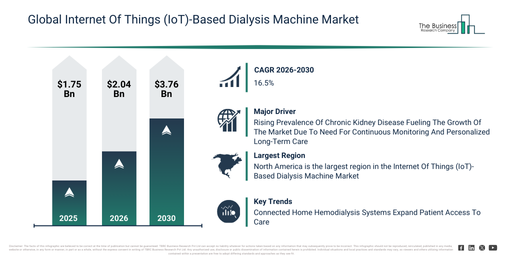
  • Internet of Things (IoT)-Based Dialysis Machine Market Forecast 2026–2035 Highlighting Cross-Industry Growth Opportunities

    Internet of Things (IoT)-Based Dialysis Machine Market Forecast 2026–2035 Highlighting Cross-Industry Growth Opportunities

    The Business Research Company’s 2026 market reports include new capabilities such as market attractiveness scoring and analysis, total addressable market analysis, company scoring matrix, interactive excel data dashboard, improved supply chain analysis, upcoming startups in the market, and overview of key products, aimed at improving the depth, usability, and strategic value of the insights delivered.

    What Is The Market Size Of The Internet Of Things (IoT)-Based Dialysis Machine Market In 2026 And What Value Is Projected For 2030?

    The IoT-based dialysis machine market has witnessed substantial growth in recent times. It is projected to expand from $1.75 billion in 2025 to $2.04 billion in 2026, achieving a compound annual growth rate (CAGR) of 16.8%. This historical growth is linked to several factors, including the increasing occurrence of chronic kidney disease, a wider embrace of home-based dialysis, the rising need for remote patient monitoring, improvements in digital health infrastructure, and higher healthcare spending on renal treatment.

    The IoT-based dialysis machine market is projected to experience substantial expansion in the coming years, reaching $3.76 billion by 2030, at a compound annual growth rate (CAGR) of 16.5%. This growth in the forecast period is primarily attributed to the increasing penetration of IoT-enabled medical devices, a growing preference for home and portable dialysis solutions, the rising adoption of telehealth and connected care, the expansion of value-based renal care models, and increasing government support for digital healthcare. Major trends expected during this period involve technology advancements in connected dialysis systems, innovations in sensor-based real-time monitoring, developments in artificial intelligence and data analytics, research and development of portable and wearable dialysis devices, and the integration of cloud platforms with electronic health records.

    Download the Free Sample Report to Explore Key Market Insights:

    https://www.thebusinessresearchcompany.com/sample.aspx?id=30627&type=smp

    What Primary Drivers Are Shaping The Development Of The Internet Of Things (IoT)-Based Dialysis Machine Market?

    The increasing incidence of chronic kidney disease is anticipated to drive the expansion of the internet of things (IoT)-based dialysis machine market in the future. Chronic kidney disease (CKD) is defined as a persistent condition in which the kidneys fail to function optimally, resulting in a build-up of bodily waste and fluids. The surge in chronic kidney disease cases primarily stems from a growing occurrence of diabetes and high blood pressure, which gradually harm kidney blood vessels and compromise the organs’ capacity to effectively filter waste. internet of things (IoT)-based dialysis machines assist in managing chronic kidney disease through real-time observation of treatment metrics and patient vital signs via remote data access. These machines enhance patient outcomes by facilitating customized therapy adjustments, prompt identification of complications, and more streamlined long-term care. As an illustration, data from June 2023, provided by Kidney Research UK, a non-profit organization based in the United Kingdom, indicated that around 7.2 million individuals in the United Kingdom suffered from chronic kidney disease, accounting for over 10% of the population. Among these, 3.25 million were in advanced stages and 3.9 million were in early stages, with projections showing the total number of affected people reaching 7.61 million by 2033. Consequently, the escalating prevalence of chronic kidney disease is propelling the expansion of the internet of things (IoT)-based dialysis machine market.

    What Are The Key Segments Of The Internet Of Things (IoT)-Based Dialysis Machine Market?

    The internet of things (iot)-based dialysis machine market covered in this report is segmented –

    1) By Component: Hardware, Software, Services, Consumables

    2) By Product Type: IoT-Enabled Hemodialysis Machines, IoT-Enabled Peritoneal Dialysis Machines, Portable And Wearable IoT-Based Dialysis Devices, Software Platforms And Connectivity Solutions, Accessories And Consumables

    3) By Connectivity: Wi-Fi And Broadband-Connected Dialysis Machines, Cellular Enabled Dialysis Devices, Cloud-Based Data Management And Analytics Platforms, Decision-Support Modules

    4) By Application: Chronic Kidney Disease Management, End-Stage Renal Disease Treatment, Acute Kidney Injury Management, Remote Patient Monitoring And Therapy Optimization

    5) By End User: Hospitals, Dialysis Centers, Home Care Settings, Ambulatory Care Centers, Specialty Clinics

    Subsegments:

    1) By Hardware: Dialysis Machine Units, Sensors And Monitoring Devices, Connectivity Modules, Embedded Control Systems, Power Supply Components

    2) By Software: Remote Monitoring Platforms, Data Analytics Software, Treatment Management Systems, Device Management Applications, Cloud Based Control Dashboards

    3) By Services: Installation And Integration Services, Maintenance And Support Services, Remote Monitoring Services, Training And Education Services, Data Management Services

    4) By Consumables: Dialyzers, Blood Tubing Sets, Dialysis Solutions, Filters And Cartridges, Disposable Sensors

    What Key Trends Are Influencing The Development Of The Internet Of Things (IoT)-Based Dialysis Machine Market?

    Major companies operating in the internet of things (IoT)-based dialysis machine market are focusing on developing advanced products, such as connected home hemodialysis systems, to enhance patient access and treatment adherence. These systems integrate intelligent software that guides patients through setup and treatment processes, simplifying the learning curve and enabling remote monitoring by healthcare providers, thereby fostering greater confidence and independence for patients managing kidney failure at home. For instance, in September 2024, Fresenius Medical Care, a Germany-based healthcare company, launched its NxStage VersiHD with GuideMe Software. This platform is designed to streamline connected home hemodialysis treatment by providing visual guidance and ease of learning, incorporating features that allow patients to complete training 7 to 10 days sooner than traditional methods. The solution also provides connected capabilities that support a growing network of over 14,000 U.S. patients to accelerate the adoption of home therapies and improve the overall user experience for those requiring chronic renal replacement therapy.

    Which Major Firms Influence Developments In The Internet Of Things (IoT)-Based Dialysis Machine Market?

    Major companies operating in the internet of things (iot)-based dialysis machine market are Medtronic plc, Fresenius Medical Care AG & Co. KGaA, Toray Industries Inc., Toray Medical Co. Ltd., Baxter International Inc., B. Braun Melsungen AG, Nipro Corporation, Wego Group, Bellco S.p.A., Mar Cor Purification, Mozarc Medical Holding LLC, Poly Medicure Limited, Outset Medical Inc., Quanta Dialysis Technologies Ltd., Infomed SA, Allmed Medical Care Holdings Limited, Innovative Renal Care, Gambro, Nextkidney BV, Newsol Technologies

    Read the full internet of things (iot)-based dialysis machine market report here:

    https://www.thebusinessresearchcompany.com/report/internet-of-things-iot-based-dialysis-machine-market-report

    Which Region Is Anticipated To See The Fastest Growth In The Internet Of Things (IoT)-Based Dialysis Machine Market?

    North America was the largest region in the IoT-based dialysis machine market in 2025. Asia-Pacific is expected to be the fastest-growing region in the forecast period. The regions covered in the internet of things (iot)-based dialysis machine market report are Asia-Pacific, South East Asia, Western Europe, Eastern Europe, North America, South America, Middle East, Africa.

    Request A Tailored Internet Of Things (IoT)-Based Dialysis Machine Market Research Report For Competitive Advantage:

    https://www.thebusinessresearchcompany.com/customise?id=30627&type=smp

    Browse Through More Reports Similar to the Global Internet Of Things (IoT)-Based Dialysis Machine Market 2026, By The Business Research Company

    Portable Dialysis Machines Market Report 2026

    https://www.thebusinessresearchcompany.com/report/portable-dialysis-machines-global-market-report

    Dialysis Devices And Equipment Market 2026

    https://www.thebusinessresearchcompany.com/report/dialysis-devices-and-equipment-market

    Internet Of Things IoT In Healthcare market

    https://www.thebusinessresearchcompany.com/report/internet-of-things-iot-in-healthcare-market

    Get in touch with us:

    The Business Research Company: https://www.thebusinessresearchcompany.com/

    Americas +1 310-496-7795

    Asia +44 7882 955267 & +91 8897263534

    Europe +44 7882 955267

    Email us at info@tbrc.info

    Follow us on:

    LinkedIn: https://in.linkedin.com/company/the-business-research-company

    YouTube: https://www.youtube.com/channel/UC24_fI0rV8cR5DxlCpgmyFQ

    Global Market Model: https://www.thebusinessresearchcompany.com/global-market-model