Category: Medical Equipment

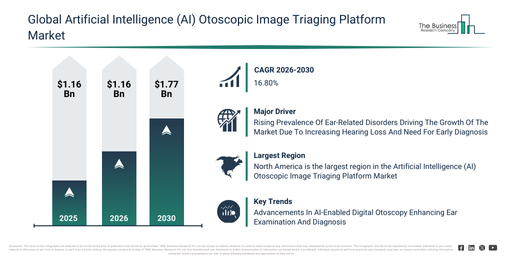
  • Global Artificial Intelligence (AI) Otoscopic Image Triaging Platform Market Expected To Reach $1.39 Billion By 2030 At 16.8% CAGR

    Global Artificial Intelligence (AI) Otoscopic Image Triaging Platform Market Expected To Reach $1.39 Billion By 2030 At 16.8% CAGR

    The Business Research Company’s 2026 market reports feature enhanced tools like market attractiveness analysis, TAM assessment, and company scoring matrices, along with interactive dashboards, deeper supply chain insights, and startup coverage strengthening the depth, usability, and strategic value of insights.

    What Is The Estimated Market Size Of The Artificial Intelligence (AI) Otoscopic Image Triaging Platform Market In 2026, And How Will Its Value Evolve By 2030?

    The market size for the artificial intelligence (ai) otoscopic image triaging platform has experienced rapid expansion in recent years. It is anticipated to increase from $0.64 billion in 2025 to $0.75 billion in 2026, achieving a compound annual growth rate (CAGR) of 17.1%. The expansion observed in the historical period can be attributed to several factors including the rising adoption of digital otoscopes, the proliferation of telemedicine services, a growing prevalence of ear infections, the necessity for efficient ENT diagnostics, and ongoing advancements in imaging sensors.

    The artificial intelligence (ai) otoscopic image triaging platform market size is anticipated to experience rapid expansion in the coming years. It is projected to reach $1.4 billion in 2030, demonstrating a compound annual growth rate (CAGR) of 16.8%. This growth during the forecast period can be attributed to factors such as the integration of AI with portable otoscopes, the expansion of cloud-based triaging platforms, the development of predictive diagnostic algorithms, increased investment in remote ENT monitoring solutions, and a rising adoption in primary care and telehealth services. Major trends identified for the forecast period include automated ear image classification, AI-powered workflow optimization, remote otoscopy solutions, cloud-based image analysis, and prioritized case triage.

    Access Your Free Sample Report For In-Depth Market Analysis:

    https://www.thebusinessresearchcompany.com/sample.aspx?id=28123&type=smp

    Which Factors Are Influencing The Growth Of The Artificial Intelligence (AI) Otoscopic Image Triaging Platform Market?

    The increasing prevalence of ear-related disorders is projected to propel the advancement of the artificial intelligence (AI) otoscopic image triaging platform market moving forward. These disorders are conditions that hinder the ear’s normal functioning, impacting hearing, balance, or overall ear health. A surge in exposure to loud noise is fueling the rise of ear-related disorders, as prolonged or repeated exposure to intense sounds can damage the delicate structures within the inner ear, leading to hearing loss and issues with balance. Artificial intelligence (AI) otoscopic image triaging platforms play a crucial role in managing ear-related disorders by swiftly and accurately analyzing ear images to pinpoint abnormalities, facilitating early detection, timely prioritization of urgent cases, and more effective treatment planning. For instance, in February 2025, the World Health Organization (WHO), a Switzerland-based intergovernmental organization, estimated that around 2.5 billion people will experience some degree of hearing loss by 2050, with over 700 million individuals requiring hearing rehabilitation. Therefore, the escalating burden of ear-related disorders is driving the growth of the artificial intelligence (AI) otoscopic image triaging platform market.

    How Is The Artificial Intelligence (AI) Otoscopic Image Triaging Platform Market Categorized Across Its Segment Groups?

    The artificial intelligence (ai) otoscopic image triaging platform market covered in this report is segmented –

    1) By Component: Software, Hardware, Services

    2) By Deployment Mode: Cloud-Based, On-Premises

    3) By Application: Telemedicine, Primary Care, ENT Clinics, Hospitals, Research And Academic Institutes, Other Applications

    Subsegments:

    1) By Software: AI Algorithms, Image Analysis Tools, Diagnostic Support Systems, Workflow Management Solutions, Cloud-Based Platforms

    2) By Hardware: Digital Otoscopes, Imaging Sensors And Detectors, Workstations And Displays, AI-Enhanced Imaging Devices

    3) By Services: Implementation And Integration Services, Training And Maintenance Services, Consulting Services, Data Management Services, Technical Support Services

    Which Trends Are Influencing Demand In The Artificial Intelligence (AI) Otoscopic Image Triaging Platform Market?

    Major companies active in the artificial intelligence (AI) otoscopic image triaging platform market are focusing their efforts on creating advanced solutions, including digital otoscopes, to enable easier documentation and remote consultation. Digital otoscopes function as electronic devices that deliver sharp images or videos of the ear canal and eardrum, assisting in precise examination and diagnosis. For example, in February 2025, JEDMED, a US-based medical instrument company, alongside Otologic Tech, a US-based firm dedicated to AI-enabled digital otoscopy, unveiled an AI-enabled digital otoscope. This device integrates effortlessly with Otologic Technologies’ platform to support medical professionals with automated diagnostics. It offers real-time analysis of middle ear conditions, thereby improving clinical decision-making. By converting the captured video feed into a singular, high-quality image, it simplifies the examination and review process. Moreover, it provides a probability assessment indicating whether the ear is normal or diseased, facilitating faster and more informed treatment decisions.

    Which Firms Are Influencing Competition In The Artificial Intelligence (AI) Otoscopic Image Triaging Platform Market?

    Major companies operating in the artificial intelligence (ai) otoscopic image triaging platform market are TytoCare Ltd, Digital Diagnostics Inc, Tympa Health Technologies, hearX, Otologic Technologies, OtoNexus Medical Technologies Inc, Siemens Healthineers AG, Philips Healthcare, Folio3 Software Inc, Aidoc Medical Ltd, Ajackus, DeepTek, CARPL AI, Zebra Medical Vision, Enlitic, VUNO Inc, CellScope, PhotoniCare, Otovation, Cupris Health, Aural Analytics, Earscan, Otoharmonics, ResApp Health

    Get The Full Artificial Intelligence (AI) Otoscopic Image Triaging Platform Market Report:

    https://www.thebusinessresearchcompany.com/report/artificial-intelligence-ai-otoscopic-image-triaging-platform-global-market-report

    Where Is The Artificial Intelligence (AI) Otoscopic Image Triaging Platform Market Primarily Concentrated By Region?

    North America was the largest region in the artificial intelligence (AI) otoscopic image triaging platform market in 2025. Asia-Pacific is expected to be the fastest-growing region in the forecast period. The regions covered in the artificial intelligence (AI) otoscopic image triaging platform market report are Asia-Pacific, South East Asia, Western Europe, Eastern Europe, North America, South America, Middle East, Africa.

    Request A Customized Artificial Intelligence (AI) Otoscopic Image Triaging Platform Market Report For Competitive Insights:

    https://www.thebusinessresearchcompany.com/customise?id=28123&type=smp

    Browse Through More Reports Similar to the Global Artificial Intelligence (AI) Otoscopic Image Triaging Platform Market 2026, By The Business Research Company

    Ai Enabled Medical Imaging Solutions Market Report 2026

    https://www.thebusinessresearchcompany.com/report/ai-enabled-medical-imaging-solutions-global-market-report

    Artificial Intelligence Ai Radiology Tool Market Report 2026

    https://www.thebusinessresearchcompany.com/report/artificial-intelligence-ai-radiology-tool-global-market-report

    Ai In Medical Imaging Market Report 2026

    https://www.thebusinessresearchcompany.com/report/ai-in-medical-imaging-global-market-report

    Get in touch with us:

    The Business Research Company: https://www.thebusinessresearchcompany.com/

    Americas +1 310-496-7795

    Asia +44 7882 955267 & +91 8897263534

    Europe +44 7882 955267

    Email us at info@tbrc.info

    Follow us on:

    LinkedIn: https://in.linkedin.com/company/the-business-research-company

    YouTube: https://www.youtube.com/channel/UC24_fI0rV8cR5DxlCpgmyFQ

    Global Market Model: https://www.thebusinessresearchcompany.com/global-market-model
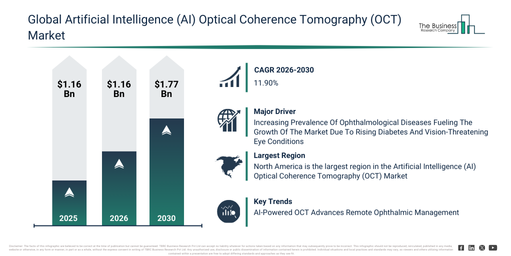
  • Artificial Intelligence (AI) Optical Coherence Tomography (OCT) Market Outlook Indicating Growth To $3.62 Billion By 2030

    Artificial Intelligence (AI) Optical Coherence Tomography (OCT) Market Outlook Indicating Growth To $3.62 Billion By 2030

    The Business Research Company’s 2026 market reports feature enhanced tools like market attractiveness analysis, TAM assessment, and company scoring matrices, along with interactive dashboards, deeper supply chain insights, and startup coverage strengthening the depth, usability, and strategic value of insights.

    How Does The Market Size Of The Artificial Intelligence (AI) Optical Coherence Tomography (OCT) Market Compare Between 2026 And 2030?

    The artificial intelligence (ai) optical coherence tomography (oct) market size has experienced rapid expansion in recent years. It is forecast to grow from $2.06 billion in 2025 to $2.32 billion in 2026, at a compound annual growth rate (CAGR) of 12.2%. The growth observed in the historic period can be attributed to the adoption of OCT in ophthalmology, demand for early disease detection, advancements in retinal imaging devices, increasing prevalence of eye disorders, and the integration of digital imaging technologies.

    The artificial intelligence (ai) optical coherence tomography (oct) market size is projected for substantial expansion over the next few years, anticipated to reach $3.63 billion in 2030 at a compound annual growth rate (CAGR) of 11.9%. This growth during the forecast period is fueled by the integration of AI with portable OCT devices, the expansion of cloud-based ophthalmic platforms, the development of real-time diagnostic algorithms, increasing investments in tele-ophthalmology, and a rising demand for personalized eye care solutions. Key trends expected in this timeframe include AI-assisted retinal imaging, automated disease detection, predictive ophthalmic analysis, cloud-based OCT platforms, and high-resolution image interpretation.

    Access Your Free Sample Report For In-Depth Market Analysis:

    https://www.thebusinessresearchcompany.com/sample.aspx?id=28121&type=smp

    What Leading Drivers Are Supporting The Artificial Intelligence (AI) Optical Coherence Tomography (OCT) Market Expansion?

    The anticipated expansion of the artificial intelligence (AI) optical coherence tomography (OCT) market is directly linked to the rising occurrence of ophthalmological diseases going forward. These diseases encompass various disorders and conditions affecting the eyes and visual system, with potential consequences for vision, eye structure, or overall ocular well-being. A key factor contributing to the rise in ophthalmological diseases is the increasing incidence of diabetes, which can harm retinal blood vessels and result in conditions that threaten vision. Artificial intelligence (AI) optical coherence tomography (OCT) facilitates the diagnosis of ophthalmological diseases through its high-resolution retinal imaging capabilities, proving valuable for the early identification and tracking of various eye conditions. This technology also shortens diagnostic periods by automating the analysis of retinal scans, thereby enhancing clinical efficiency and patient management. For example, data from May 2024, published by the Centers for Disease Control and Prevention (CDC), a US-based public health agency, indicated that over 3 million individuals were impacted by glaucoma, with projections showing this number could climb to 6.3 million by 2050. Consequently, the expanding prevalence of ophthalmological diseases acts as a significant catalyst for the growth of the artificial intelligence (AI) optical coherence tomography (OCT) market.

    How Are Segments Identified Within The Artificial Intelligence (AI) Optical Coherence Tomography (OCT) Market Segment Framework?

    The artificial intelligence (ai) optical coherence tomography (oct) market covered in this report is segmented –

    1) By Type: Table Type, Portable

    2) By Technology: Time Domain Optical Coherence Tomography, Spectral Domain Optical Coherence Tomography, Swept Source Optical Coherence Tomography

    3) By Application: Hospitals, Clinic, Other Applications

    Subsegments:

    1) By Table Type: Spectral-Domain Optical Coherence Tomography (SD-OCT), Time-Domain Optical Coherence Tomography (TD-OCT), Swept-Source Optical Coherence Tomography (SS-OCT), Full-Field Optical Coherence Tomography, Doppler Optical Coherence Tomography

    2) By Portable: Handheld Optical Coherence Tomography, Smartphone Or Tablet-Based Optical Coherence Tomography, Point-Of-Care Optical Coherence Tomography Devices, Compact Or Bedside Optical Coherence Tomography Units, Wearable Optical Coherence Tomography

    What Emerging Trends Are Seen In The Artificial Intelligence (AI) Optical Coherence Tomography (OCT) Market?

    Major companies engaged in the artificial intelligence (AI) optical coherence tomography (OCT) market are concentrating on creating sophisticated products, such as at-home optical coherence tomography (OCT) devices, to enhance diagnostic precision, enable remote monitoring, and optimize ophthalmic workflows. At-home optical coherence tomography (OCT) devices are portable instruments that allow patients to capture retinal scans from their homes for distant tracking of eye diseases. For example, in May 2024, Notal Vision Inc., a US-based healthcare company, obtained de novo authorization for its artificial intelligence (AI)-powered SCANLY Home OCT device from the US Food and Drug Administration (FDA), which is the first self-operated retinal imaging tool designed for monitoring wet age-related macular degeneration (AMD) in older adults. This device utilizes spectral-domain optical coherence tomography (OCT) and the AI-driven Notal OCT analyzer (NOA) to identify and measure retinal biomarkers, thereby facilitating remote, high-resolution surveillance between clinic appointments. Images from this device are securely transmitted to the Notal Health cloud for review by physicians. Additionally, SCANLY is supported by current procedural terminology (CPT) billing codes.

    Who Are The Companies Competing Within The Artificial Intelligence (AI) Optical Coherence Tomography (OCT) Market?

    Major companies operating in the artificial intelligence (ai) optical coherence tomography (oct) market are Abbott Laboratories, Canon Inc., Carl Zeiss AG, Excelitas Technologies Corp., Topcon Corporation, Thorlabs Inc., Santec Holdings Corporation, Notal Vision Inc., Optopol Technology Sp. z o.o., BigVision Tech Inc., Shenzhen Certainn Technology Co. Ltd., Conavi Medical Inc., Wasatch Photonics Inc., RSIP Vision Ltd., Visionix Ltd., Altris AI Ltd., NIDEK Co. Ltd., Perimeter Medical Imaging AI Inc., Michelson Diagnostics Ltd., Artelus Private Limited

    Get The Full Artificial Intelligence (AI) Optical Coherence Tomography (OCT) Market Report:

    https://www.thebusinessresearchcompany.com/report/artificial-intelligence-ai-optical-coherence-tomography-oct-global-market-report

    Which Region Has The Greatest Market Share In The Artificial Intelligence (AI) Optical Coherence Tomography (OCT) Market?

    North America was the largest region in the artificial intelligence (AI) optical coherence tomography (OCT) market in 2025. Asia-Pacific is expected to be the fastest-growing region in the forecast period. The regions covered in the artificial intelligence (AI) optical coherence tomography (oct) market report are Asia-Pacific, South East Asia, Western Europe, Eastern Europe, North America, South America, Middle East, Africa.

    Request A Customized Artificial Intelligence (AI) Optical Coherence Tomography (OCT) Market Report For Competitive Insights:

    https://www.thebusinessresearchcompany.com/customise?id=28121&type=smp

    Browse Through More Reports Similar to the Global Artificial Intelligence (AI) Optical Coherence Tomography (OCT) Market 2026, By The Business Research Company

    Ai In Medical Imaging Market Report 2026

    https://www.thebusinessresearchcompany.com/report/ai-in-medical-imaging-global-market-report

    Artificial Intelligence In Medical Imaging Market Report 2026

    https://www.thebusinessresearchcompany.com/report/artificial-intelligence-in-medical-imaging-global-market-report

    Ai Enabled Imaging Solutions Market Report 2026

    https://www.thebusinessresearchcompany.com/report/ai-enabled-imaging-solutions-global-market-report

    Get in touch with us:

    The Business Research Company: https://www.thebusinessresearchcompany.com/

    Americas +1 310-496-7795

    Asia +44 7882 955267 & +91 8897263534

    Europe +44 7882 955267

    Email us at info@tbrc.info

    Follow us on:

    LinkedIn: https://in.linkedin.com/company/the-business-research-company

    YouTube: https://www.youtube.com/channel/UC24_fI0rV8cR5DxlCpgmyFQ

    Global Market Model: https://www.thebusinessresearchcompany.com/global-market-model
  • Global Sports Psychology Services Market Forecast 2026–2035 Presenting Long-Term Growth Insights

    Global Sports Psychology Services Market Forecast 2026–2035 Presenting Long-Term Growth Insights

    The Business Research Company’s 2026 market reports include new capabilities such as market attractiveness scoring and analysis, total addressable market analysis, company scoring matrix, interactive excel data dashboard, improved supply chain analysis, upcoming startups in the market, and overview of key products, aimed at improving the depth, usability, and strategic value of the insights delivered.

    What Market Valuation Is Forecasted For The Sports Psychology Services Market By 2030 Starting From Its 2026 Size?

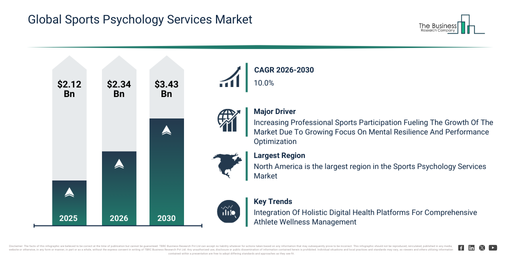
    The sports psychology services market has experienced rapid expansion in its size over recent years. This market is projected to expand from $2.12 billion in 2025 to $2.34 billion in 2026, demonstrating a compound annual growth rate (CAGR) of 10.3%. Historically, this growth can be ascribed to several factors, including heightened awareness of athlete mental well-being, an increased emphasis on improving performance, the wider uptake of sports counseling initiatives, broader involvement in competitive athletic activities, and a greater need for stress and anxiety management among athletes.

    The sports psychology services market size is projected for substantial expansion in the coming years. By 2030, this market is anticipated to reach $3.43 billion, exhibiting a compound annual growth rate (CAGR) of 10.0%. This expansion during the forecast period is primarily driven by factors such as the increasing integration of digital mental training tools, a rise in the adoption of personalized psychological coaching, greater demand for data-driven performance assessment, the widening use of virtual and remote therapy platforms, and a growing focus on the holistic well-being of athletes. Key developments expected throughout this period encompass technological advancements in digital mental training platforms, innovations within AI-supported performance psychology tools, advancements in biofeedback and neurofeedback systems, ongoing research and development in methods for cognitive performance enhancement, and progress in immersive VR-based mental conditioning tools.

    Download the Free Sample Report to Explore Key Market Insights:

    https://www.thebusinessresearchcompany.com/sample.aspx?id=30762&type=smp

    What Major Drivers Are Influencing Demand In The Sports Psychology Services Market?

    The anticipated rise in professional sports involvement is set to drive expansion within the sports psychology services market in the future. This involvement signifies individuals pursuing organized athletic endeavors as their main occupation, which includes intense training and high-level competition. The growth in professional sports participation is fueled by enhanced media exposure and profitable sponsorship agreements, drawing in more athletes with promises of financial security and worldwide recognition. Sports psychology offerings aid professional sports engagement through mental preparation techniques designed to sharpen concentration, handle competitive pressures, and boost consistent performance. For example, data from August 2024, provided by the Bureau of Labor Statistics, a US-based federal agency, indicates that the employment of athletes and sports competitors across the United States is forecasted to increase by 5% between 2024 and 2034. Consequently, the expanding participation in professional sports is stimulating the development of the sports psychology services market.

    Which Segment Categories Define The Sports Psychology Services Market?

    The sports psychology services market covered in this report is segmented –

    1) By Service Type: Performance Enhancement, Counseling, Mental Skills Training, Rehabilitation, Other Service Types

    2) By Delivery Mode: In-Person, Online Or Telehealth

    3) By Provider Type: Independent Sports Psychologists, Sports Psychology Clinics, Sports Performance Centers, University And Institutional Providers, Multidisciplinary Wellness Centers

    4) By Application: Individual Athletes, Teams, Coaches, Other Applications

    5) By End-User: Professional Sports, Amateur Sports, Educational Institutions, Other End-Users

    Subsegments:

    1) By Performance Enhancement: Goal Setting And Achievement Planning, Focus And Concentration Improvement Sessions, Competitive Strategy Development Programs, Reaction Time And Agility Training, Motivation And Confidence Building Programs

    2) By Counseling: Stress And Anxiety Management Counseling, Career Transition And Retirement Counseling, Personal Development And Self Awareness Sessions, Team Dynamics And Interpersonal Counseling, Emotional Resilience Support Programs

    3) By Mental Skills Training: Visualization And Imagery Training Programs, Attention And Concentration Enhancement Sessions, Cognitive Behavioral Techniques For Athletes, Mindfulness And Relaxation Skill Development, Performance Anxiety Reduction Programs

    4) By Rehabilitation: Post Injury Psychological Recovery Sessions, Rehabilitation Motivation And Support Programs, Mental Recovery Planning For Athletes, Coping Strategy Development For Injured Athletes, Resilience And Confidence Restoration Programs

    5) By Other Service Types: Nutritional Psychology Counseling Sessions, Sleep And Recovery Optimization Programs, Stress Management Workshops For Teams, Sports Related Trauma Counseling, Integrative Mental Health Enhancement Programs

    What Major Market Trends Are Driving Changes In The Sports Psychology Services Market?

    Leading companies in the sports psychology services market are prioritizing the development of innovative solutions, such as integrated digital health platforms, to deliver comprehensive support for athletes’ mental and physical well-being. These integrated digital health platforms are extensive software systems that merge multiple digital health services and tools into a single interface, enabling the collection, management, analysis, and sharing of health data among patients, providers, and various care environments. For example, in October 2023, CaringWire LLC, a US-based digital health platform provider, collaborated with the U.S. Council for Athletes’ Health (USCAH) to launch Holistic Athlete Health Solutions (HAHS). This platform connects athletes with telehealth providers and offers self-paced online courses and webinars on subjects related to sports health, wellness, and mental resilience. The solution is designed to integrate smoothly into current athletic department programs, offering 24/7 access to care that addresses the physical, mental, and emotional needs of modern athletes.

    Which Major Players Dominate The Sports Psychology Services Market?

    Major companies operating in the sports psychology services market are California Baptist University (CBU), United States Olympic & Paralympic Committee, Conscious Mind Solutions, Discovery Sport & Performance Lab, ORKA Performance, Premier Sport Psychology, Performance in Mind, Jo Hopkins Consulting, KPEX Consulting, Flourish & Thrive, Grow Wellness Group, SportPsych Consulting, Athlete Mind Performance (AMP), The Performance Pursuit Consulting, Head In The Game, Pete Jackson Sport Psychology, Focus Perform, Clark Performance Consulting, University of Wisconsin–Green Bay, Nudge Sports, Tacomi Training Solutions Pvt. Ltd.

    Read the full sports psychology services market report here:

    https://www.thebusinessresearchcompany.com/report/sports-psychology-services-market-report

    Which Region Currently Holds The Largest Share Of The Sports Psychology Services Market?

    North America was the largest region in the sports psychology services market in 2025. Asia-Pacific is expected to be the fastest-growing region in the forecast period. The regions covered in the sports psychology services market report are Asia-Pacific, South East Asia, Western Europe, Eastern Europe, North America, South America, Middle East, Africa.

    Request A Tailored Sports Psychology Services Market Research Report For Competitive Advantage:

    https://www.thebusinessresearchcompany.com/customise?id=30762&type=smp

    Browse Through More Reports Similar to the Global Sports Psychology Services Market 2026, By The Business Research Company

    Sports Coaching Platforms Market Report 2026

    https://www.thebusinessresearchcompany.com/report/sports-coaching-platforms-global-market-report

    Sports Medicine Market Report 2026

    https://www.thebusinessresearchcompany.com/report/sports-medicine-global-market-report

    marine and ports construction global market report

    https://www.thebusinessresearchcompany.com/report/marine-and-ports-construction-global-market-report

    Get in touch with us:

    The Business Research Company: https://www.thebusinessresearchcompany.com/

    Americas +1 310-496-7795

    Asia +44 7882 955267 & +91 8897263534

    Europe +44 7882 955267

    Email us at info@tbrc.info

    Follow us on:

    LinkedIn: https://in.linkedin.com/company/the-business-research-company

    YouTube: https://www.youtube.com/channel/UC24_fI0rV8cR5DxlCpgmyFQ

    Global Market Model: https://www.thebusinessresearchcompany.com/global-market-model
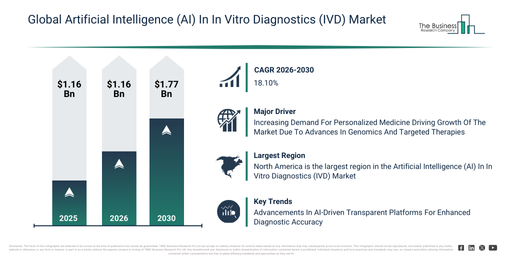
  • Artificial Intelligence (AI) In In Vitro Diagnostics (IVD) Market Forecast To Reach $7 Billion By 2030 At 18.1% CAGR

    Artificial Intelligence (AI) In In Vitro Diagnostics (IVD) Market Forecast To Reach $7 Billion By 2030 At 18.1% CAGR

    The Business Research Company’s 2026 market reports feature enhanced tools like market attractiveness analysis, TAM assessment, and company scoring matrices, along with interactive dashboards, deeper supply chain insights, and startup coverage strengthening the depth, usability, and strategic value of insights.

    What Is The Forecasted Market Size Trajectory Of The Artificial Intelligence (AI) In In Vitro Diagnostics (IVD) Market From 2026 To 2030?

    The market size for artificial intelligence (ai) in in vitro diagnostics (ivd) has seen considerable expansion in recent times. It is anticipated to expand from $3.04 billion in 2025 to reach $3.6 billion in 2026, exhibiting a compound annual growth rate (CAGR) of 18.4%. This market’s past growth can be attributed to several factors including an increased need for accurate diagnostic tools, the development of laboratory infrastructure, the growing occurrence of chronic illnesses, the integration of digital diagnostic instruments, and breakthroughs in biomarker research.

    The artificial intelligence (AI) in in vitro diagnostics (IVD) market is anticipated to show significant expansion in the coming years. Its value is projected to reach $7.01 billion by 2030, driven by a compound annual growth rate (CAGR) of 18.1%. This expansion during the forecast period is largely due to factors such as the broadening of cloud-based diagnostic platforms, the incorporation of AI with genomics, advancements in point-of-care AI diagnostics, increased capital in personalized medicine, and a rising requirement for quick and economical testing. Noteworthy trends for the forecast period include AI-enabled laboratory automation, predictive disease diagnostics, data-driven test interpretation, cloud-based diagnostic platforms, and personalized patient profiling.

    Access Your Free Sample Report For In-Depth Market Analysis:

    https://www.thebusinessresearchcompany.com/sample.aspx?id=28120&type=smp

    Which Key Factors Are Driving The Artificial Intelligence (AI) In In Vitro Diagnostics (IVD) Market Growth?

    The escalating need for personalized medicine is anticipated to drive the expansion of the artificial intelligence (AI) in in vitro diagnostics (IVD) market moving ahead. Personalized medicine signifies a healthcare approach that tailors prevention, diagnosis, and treatment based on an individual’s genetic profile, lifestyle, and environment. This field is expanding due to advancements in genomic data and sequencing technologies, which facilitate more accurate, targeted, and effective treatments customized for each patient. Artificial intelligence (AI) in in vitro diagnostics (IVD) aids personalized medicine by analyzing intricate diagnostic data to pinpoint patient-specific disease patterns, thereby enabling precise, timely, and individualized treatment choices. For instance, in February 2024, the Personalized Medicine Coalition, a US-based non-profit organization, reported that in 2023, the FDA approved 16 new personalized treatments for rare disease patients, a rise from six in 2022. The newly approved personalized treatments for 2023 also encompassed seven cancer drugs and three for other diseases and conditions. Consequently, the growing demand for personalized medicine is propelling the growth of artificial intelligence (AI) in in vitro diagnostics (IVD) market.

    What Are The Key Segment Divisions In The Artificial Intelligence (AI) In In Vitro Diagnostics (IVD) Market Segment Structure?

    The artificial intelligence (ai) in in vitro diagnostics (ivd) market covered in this report is segmented –

    1) By Component: Software, Hardware, Services

    2) By Technology: Machine Learning, Natural Language Processing, Computer Vision, Robotics Process Automation, Deep Learning

    3) By Deployment Model: Cloud-Based, On-Premise, Hybrid

    4) By Application: Diagnostic Imaging, Laboratory Testing, Pathology, Genomics, Personalized Medicine

    5) By End User: Hospitals And Clinics, Diagnostic Laboratories, Research Institutes, Pharmaceutical Companies, Medical Device Manufacturers

    Subsegments:

    1) By Software: Diagnostic Algorithms, Data Analytics Platforms, Decision Support Systems

    2) By Hardware: Laboratory Instruments, Imaging Devices, Point-Of-Care Devices

    3) By Services: Consulting And Implementation, Maintenance And Support, Training And Education

    Which Trends Are Guiding The Direction Of The Artificial Intelligence (AI) In In Vitro Diagnostics (IVD) Market?

    Leading firms within the artificial intelligence (AI) in in vitro diagnostics (IVD) market are prioritizing the creation of sophisticated solutions, including CE-IVDR-certified transparent AI platforms, with the goal of improving diagnostic precision, optimizing operational processes, and aiding individualized patient treatment. Such a platform refers to an AI system designed for in vitro diagnostics, which adheres to EU regulatory criteria and offers decision-making processes that are transparent, verifiable, and easy to comprehend. As an illustration, in May 2025, Diagnostics.ai, a diagnostic testing firm based in the UK, introduced PCR.AI, an intelligent offering intended to speed up and improve PCR diagnostics. This solution automates and quickens the analysis of real-time PCR diagnostics, boasting an accuracy of over 99.9%. It provides transparency by explicitly demonstrating the derivation of each result, thereby guaranteeing regulatory adherence and increasing clinical confidence. Ultimately, this substantially improves laboratory effectiveness, minimizes inaccuracies, and facilitates effortless regulatory conformity for molecular diagnostics.

    Which Organizations Are Engaged In The Artificial Intelligence (AI) In In Vitro Diagnostics (IVD) Market?

    Major companies operating in the artificial intelligence (ai) in in vitro diagnostics (ivd) market are Roche Diagnostics GmbH, Thermo Fisher Scientific Inc., Abbott Laboratories, Danaher Corporation, Siemens Healthineers AG, Illumina Inc., Hologic Inc., Sysmex Corporation, QIAGEN N.V., Tempus Labs Inc., BillionToOne Inc., PathAI Inc., Proscia Inc., Indica Labs Inc., Visiopharm A/S, aetherAI Co. Ltd., Ibex Medical Analytics Ltd., Mindpeak GmbH, OncoHost Ltd., Qritive, Aiforia Technologies Oyj

    Get The Full Artificial Intelligence (AI) In In Vitro Diagnostics (IVD) Market Report:

    https://www.thebusinessresearchcompany.com/report/artificial-intelligence-ai-in-in-vitro-diagnostics-ivd-global-market-report

    Which Region Accounts For The Largest Portion Of The Artificial Intelligence (AI) In In Vitro Diagnostics (IVD) Market?

    North America was the largest region in the artificial intelligence (AI) in in vitro diagnostics (IVD) market in 2025. Asia-Pacific is expected to be the fastest-growing region in the forecast period. The regions covered in the artificial intelligence (AI) in in vitro diagnostics (ivd) market report are Asia-Pacific, South East Asia, Western Europe, Eastern Europe, North America, South America, Middle East, Africa.

    Request A Customized Artificial Intelligence (AI) In In Vitro Diagnostics (IVD) Market Report For Competitive Insights:

    https://www.thebusinessresearchcompany.com/customise?id=28120&type=smp

    Browse Through More Reports Similar to the Global Artificial Intelligence (AI) In In Vitro Diagnostics (IVD) Market 2026, By The Business Research Company

    Artificial Intelligence In The Diagnostic Market Report 2026

    https://www.thebusinessresearchcompany.com/report/artificial-intelligence-in-the-diagnostic-global-market-report

    Ai In Cancer Diagnostics Market Report 2026

    https://www.thebusinessresearchcompany.com/report/ai-in-cancer-diagnostics-global-market-report

    Ai In Medical Devices Market Report 2026

    https://www.thebusinessresearchcompany.com/report/ai-in-medical-devices-global-market-report

    Get in touch with us:

    The Business Research Company: https://www.thebusinessresearchcompany.com/

    Americas +1 310-496-7795

    Asia +44 7882 955267 & +91 8897263534

    Europe +44 7882 955267

    Email us at info@tbrc.info

    Follow us on:

    LinkedIn: https://in.linkedin.com/company/the-business-research-company

    YouTube: https://www.youtube.com/channel/UC24_fI0rV8cR5DxlCpgmyFQ

    Global Market Model: https://www.thebusinessresearchcompany.com/global-market-model
  • Artificial Intelligence (AI) In Endoscopy Market Expected To Reach $46.53 Billion By 2030

    Artificial Intelligence (AI) In Endoscopy Market Expected To Reach $46.53 Billion By 2030

    The Business Research Company’s 2026 market reports feature enhanced tools like market attractiveness analysis, TAM assessment, and company scoring matrices, along with interactive dashboards, deeper supply chain insights, and startup coverage strengthening the depth, usability, and strategic value of insights.

    How Much Will The Market Value Of The Artificial Intelligence (AI) In Endoscopy Market Grow Between 2026 And 2030?

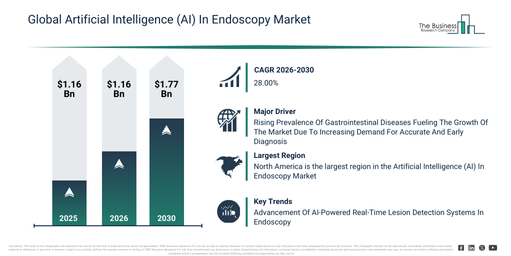
    The artificial intelligence (ai) in endoscopy market has experienced substantial expansion in recent times. This market is anticipated to expand from $13.52 billion in 2025 to $17.34 billion by 2026, achieving a compound annual growth rate (CAGR) of 28.3%. Factors contributing to this historical expansion include an increased incidence of gastrointestinal and colorectal diseases, the shortcomings of traditional endoscopic interpretation, a rise in the volume of endoscopy procedures, greater consciousness regarding early cancer detection, and the implementation of digital endoscopy platforms.

    The artificial intelligence (ai) in endoscopy market is projected to experience substantial expansion over the coming years. This sector is forecast to reach a size of $46.53 billion by 2030, exhibiting a compound annual growth rate (CAGR) of 28.0%. Several factors are expected to fuel this growth during the projection period, including enhancements in machine learning algorithms for medical imaging, increased capital allocation towards AI-powered healthcare solutions, the broadening scope of minimally invasive diagnostic techniques, greater uptake of clinical decision support systems, and a favorable regulatory environment for AI-driven medical devices. Significant trends anticipated during this period encompass the rising implementation of real-time lesion identification during endoscopic procedures, a stronger integration of AI software into existing endoscopic setups, an escalating need for better diagnostic precision and fewer overlooked lesions, the proliferation of AI-supported training and simulation within endoscopy, and an increased emphasis on operational efficiency and procedure uniformity.

    Access Your Free Sample Report For In-Depth Market Analysis:

    https://www.thebusinessresearchcompany.com/sample.aspx?id=25698&type=smp

    What Primary Drivers Are Shaping The Artificial Intelligence (AI) In Endoscopy Market?

    The increasing incidence of gastrointestinal diseases is projected to drive the growth of the artificial intelligence (AI) in endoscopy market in the coming years. Gastrointestinal diseases are a variety of conditions affecting the digestive system, characterized by symptoms such as stomach pain, distension, and changes in bowel habits. The escalation of these diseases is attributed to greater consumption of ultra-processed foods, which adversely affect gut microbiota and lead to ongoing inflammation and digestive issues. Artificial intelligence (AI) in endoscopy improves the detection of gastrointestinal diseases by accurately scrutinizing images in real time for abnormalities. This facilitates early intervention, minimizes diagnostic mistakes, and improves outcomes for patients. As an illustration, in December 2023, the IBD Registry, a UK-based non-profit organization, reported that in 2023, individuals with inflammatory bowel disease (IBD) joining the registry reached over 5,300, signifying an increase of more than 3,000 compared to 2022. Thus, the rising prevalence of gastrointestinal diseases is a key driver for the artificial intelligence (AI) in endoscopy market.

    Which Segment Categories Are Included In The Artificial Intelligence (AI) In Endoscopy Market Segment Analysis?

    The artificial intelligence (ai) in endoscopy market covered in this report is segmented –

    1) By Product Type: Artificial Intelligence-Driven Imaging Systems, Artificial Intelligence-Powered Endoscopic Equipment, Wearable Endoscopy Devices, Consumables Used In Artificial Intelligence Endoscopy, Software Solutions For Artificial Intelligence Integration

    2) By Functionality: Image Capture And Processing, Data Management, Enhanced Visualization, Real-Time Decision Support, Training And Simulation Systems

    3) By Application: Gastrointestinal Endoscopy, Respiratory Endoscopy, Urological Endoscopy, Pancreatic Endoscopy, Neurological Endoscopy

    4) By End-User: Hospitals, Endoscopy Centers, Outpatient Surgical Centers, Research Institutions, Specialized Clinics

    Subsegments:

    1) By Artificial Intelligence-Driven Imaging Systems: High Definition Imaging Platforms, Three-Dimensional (3D) Visualization Systems, Fluorescence-Based Imaging Devices, Low Light Sensitivity Imaging Systems, Contrast-Enhanced Endoscopic Imaging Systems

    2) By Artificial Intelligence-Powered Endoscopic Equipment: Flexible Endoscopic Systems With Artificial Intelligence Integration, Rigid Endoscopic Systems With Artificial Intelligence Support, Capsule-Based Endoscopic Devices With Smart Processing, Robotic Assisted Endoscopic Instrumentation, Navigation-Enabled Endoscopic Equipment With Artificial Intelligence

    3) By Wearable Endoscopy Devices: Swallowable Capsule Endoscopy Units, Sensor Integrated Wearable Endoscopy Devices, Wireless Data Enabled Endoscopic Monitoring Devices, Artificial Intelligence-Based Wearable Imaging Systems, Miniature High Resolution Endoscopic Cameras

    4) By Consumables Used In Artificial Intelligence Endoscopy: Biopsy Forceps Compatible With Artificial Intelligence Systems, Single Use Endoscopic Protective Sheaths, Medical-Grade Contrast Media For Enhanced Imaging, Artificial Intelligence Compatible Irrigation Tubing, Disposable Accessories For Visualization And Sampling

    5) By Software Solutions For Artificial Intelligence Integration: Real-Time Lesion Detection Software Modules, Computer-Aided Diagnostic Imaging Platforms, Cloud-Based Endoscopic Data Management Systems, Image Segmentation And Classification Software Tools, Data Visualization And Automated Reporting Interfaces

    What Trends Are Affecting The Growth Of The Artificial Intelligence (AI) In Endoscopy Market?

    Leading companies in the artificial intelligence in endoscopy market are concentrating on developing advanced technology, such as AI-powered real-time lesion detection systems, to enhance clinical decision-making during gastrointestinal examinations. These artificial intelligence-powered real-time lesion detection systems are sophisticated software tools that continuously analyze live endoscopic video feeds to accurately identify and highlight suspicious lesions, including polyps and tumors, during endoscopic procedures. For instance, in August 2024, Ainex Corporation, a medical technology company based in Singapore, launched its Endoscopy AI system. This system aims to improve the real-time detection and diagnosis of gastrointestinal abnormalities during endoscopic procedures, incorporating advanced machine learning algorithms to identify gastrointestinal lesions in real time during both upper and lower endoscopy. It enhances diagnostic accuracy, reduces false positives, and improves the visualization of mucosal abnormalities. The product is also designed to streamline clinical workflows, reduce procedure time, and improve the early detection of gastrointestinal cancers and other conditions.

    Who Are The Active Companies Shaping The Artificial Intelligence (AI) In Endoscopy Market?

    Major companies operating in the artificial intelligence (ai) in endoscopy market are Medtronic plc, Fujifilm Holdings Corporation, Olympus Corporation, Iterative Health, CapsoVision Inc, EndoSoft Inc, Mauna Kea Technologies SA, LPixel Inc, Sky Engine Limited, Endovision Limited, BioCam Sp z o o, MAIA Labs Inc, Magentiq Eye Ltd, EndoSurg AI Inc, iEndoscopic GmbH, Intelliscopes LLC, Odin Vision, Wision AI, NEC Corporation Medical AI, Shanghai Wision AI Co Ltd, Shanghai Ankon Technologies Co Ltd, Fujifilm Medical AI Solutions

    Get The Full Artificial Intelligence (AI) In Endoscopy Market Report:

    https://www.thebusinessresearchcompany.com/report/artificial-intelligence-ai-in-endoscopy-global-market-report

    Which Region Holds The Highest Market Share In The Artificial Intelligence (AI) In Endoscopy Market?

    North America was the largest region in the artificial intelligence (AI) in endoscopy market in 2025. Asia-Pacific is expected to be the fastest-growing region in the forecast period. The regions covered in the artificial intelligence (AI) in endoscopy market report are Asia-Pacific, South East Asia, Western Europe, Eastern Europe, North America, South America, Middle East, Africa.

    Request A Customized Artificial Intelligence (AI) In Endoscopy Market Report For Competitive Insights:

    https://www.thebusinessresearchcompany.com/customise?id=25698&type=smp

    Browse Through More Reports Similar to the Global Artificial Intelligence (AI) In Endoscopy Market 2026, By The Business Research Company

    Ai In Medical Diagnostics Market Report 2026

    https://www.thebusinessresearchcompany.com/report/ai-in-medical-diagnostics-global-market-report

    Ai In Medical Devices Market Report 2026

    https://www.thebusinessresearchcompany.com/report/ai-in-medical-devices-global-market-report

    Ai Based Surgical Robots Market Report 2026

    https://www.thebusinessresearchcompany.com/report/ai-based-surgical-robots-global-market-report

    Get in touch with us:

    The Business Research Company: https://www.thebusinessresearchcompany.com/

    Americas +1 310-496-7795

    Asia +44 7882 955267 & +91 8897263534

    Europe +44 7882 955267

    Email us at info@tbrc.info

    Follow us on:

    LinkedIn: https://in.linkedin.com/company/the-business-research-company

    YouTube: https://www.youtube.com/channel/UC24_fI0rV8cR5DxlCpgmyFQ

    Global Market Model: https://www.thebusinessresearchcompany.com/global-market-model
  • Global Space Intelligence Services Market Report 2026–2035 Highlighting Growth Outlook and Opportunities

    Global Space Intelligence Services Market Report 2026–2035 Highlighting Growth Outlook and Opportunities

    The Business Research Company’s 2026 market reports include new capabilities such as market attractiveness scoring and analysis, total addressable market analysis, company scoring matrix, interactive excel data dashboard, improved supply chain analysis, upcoming startups in the market, and overview of key products, aimed at improving the depth, usability, and strategic value of the insights delivered.

    What Is The Market Size Of The Space Intelligence Services Market In 2026 And What Value Is Projected For 2030?

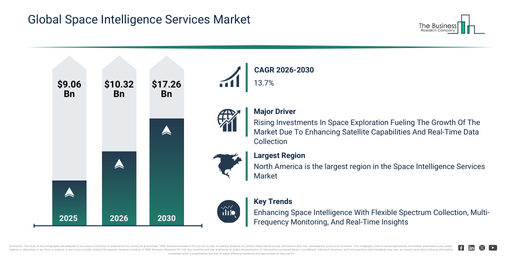
    The space intelligence services market has witnessed rapid expansion over recent years. It is anticipated to grow from $9.06 billion in 2025 to $10.32 billion in 2026, exhibiting a compound annual growth rate (CAGR) of 14.0%. This historical growth can be ascribed to an escalating demand for satellite-based monitoring, the increasing integration of geospatial analytics in defense operations, a heightened requirement for environmental and climate surveillance, the proliferation of commercial earth observation constellations, and the expanded application of remote sensing for agricultural insights.

    The space intelligence services market size is anticipated to undergo significant expansion in the coming years. It is projected to swell to $17.26 billion in 2030, advancing at a compound annual growth rate (CAGR) of 13.7%. This growth over the forecast period stems from factors such as the escalating demand for high-frequency imaging and rapid revisit capabilities, the increasing incorporation of artificial intelligence into space intelligence operations, the rising necessity for precision agriculture and resource optimization, the widening scope of security and border surveillance applications, and the growing commercial utilization of space-based risk assessment tools. Prominent trends for the forecast duration encompass technological progress in high-resolution imaging sensors, pioneering work in artificial intelligence-driven geospatial analytics, the evolution of cloud-based intelligence delivery platforms, research and development in multi-sensor fusion methodologies, and advancements in hyperspectral and radar satellite systems.

    Download the Free Sample Report to Explore Key Market Insights:

    https://www.thebusinessresearchcompany.com/sample.aspx?id=30759&type=smp

    What Underlying Factors Are Accelerating The Growth Of The Space Intelligence Services Market?

    Increased funding for space exploration is projected to fuel the expansion of the space intelligence services market in the future. Space exploration encompasses the discovery and examination of outer space utilizing both crewed and uncrewed spacecraft, satellites, and sophisticated technologies. This growing financial commitment to space exploration stems from intensified geopolitical rivalry, as countries strive for strategic command and technological superiority in space. Such investments bolster space intelligence services by advancing satellite capabilities, developing sophisticated sensors, and enhancing data collection methods. This, in turn, improves situational awareness and decision-making through the provision of more precise, real-time data concerning space activities, orbital objects, and environmental conditions. For instance, in September 2023, Novaspace, a France-based space governance provider, reported that government expenditure on space exploration reached $27 billion in 2024 and is anticipated to grow to almost $31 billion by 2034. Thus, the escalating investments in space exploration are a primary driver behind the growth of the space intelligence services market.

    What Are The Key Segments Of The Space Intelligence Services Market?

    The space intelligence services market covered in this report is segmented –

    1) By Service Type: Satellite Imaging, Geospatial Analytics, Data Processing, Remote Sensing, Other Service Types

    2) By Platform: Satellites, Unmanned Aerial Vehicles (UAVs), Ground Stations, Other Platforms

    3) By Application: Defense And Security, Agriculture, Environmental Monitoring, Urban Planning, Disaster Management, Other Applications

    4) By End-User: Government, Commercial, Military, Other End-Users

    Subsegments:

    1) By Satellite Imaging: Very High Resolution Optical Imagery, Medium Resolution Multispectral Imagery, Synthetic Aperture Radar Imagery, Hyperspectral and Thermal Imagery, Video from Space

    2) By Geospatial Analytics: Change Detection and Monitoring, Feature Extraction and Classification, Measurements and Modeling, Predictive Analytics and Forecasting, Visualization and Reporting

    3) By Data Processing: Image Correction and Enhancement, Data Fusion and Integration, Cloud Storage and Management, Automated Processing Pipelines, Quality Assurance and Validation

    4) By Remote Sensing: Land Cover and Land Use Mapping, Maritime Domain Awareness, Environmental Parameter Monitoring, Disaster Impact Assessment, Infrastructure Health Monitoring

    5) By Other Service Types: Consulting and Solution Design, Data Acquisition Planning, Training and Capacity Building, Intelligence Report Subscription, Custom Application Development

    What Key Trends Are Influencing The Development Of The Space Intelligence Services Market?

    Leading companies in the space intelligence services market are concentrating on developing advanced solutions, such as flexible spectrum collection options, to enhance the accessibility, precision, and versatility of RF signal monitoring and analysis. Flexible spectrum collection options refer to the capability to capture and analyze radio frequency data across various bands and configurations, allowing operators to customize data acquisition for diverse mission needs, maximize coverage, and adapt to changing signal environments. For instance, in September 2023, Hawkeye 360 Inc., a US-based space analytics company, launched the RFIQ product, which offers industry-leading flexible spectrum collection capabilities to provide deeper insights into RF activity. This product enables users to monitor a broad array of radio spectrum bands with adjustable collection parameters, supporting both tactical and strategic applications in communications, defense, and maritime domains. By leveraging flexible spectrum collection, the solution allows analysts to efficiently capture and interpret RF signals in real time, thereby improving situational awareness and decision-making capabilities.

    Which Companies Are Expanding Their Footprint In The Space Intelligence Services Market?

    Major companies operating in the space intelligence services market are Maxar Technologies Inc., ICEYE Ltd., Planet Labs PBC, EarthDaily Analytics Inc., Spire Global Inc., BlackSky Technology Inc., LeoLabs Inc., Capella Space Corp., Synspective Inc., GHGSat Inc., SpaceKnow Inc., HawkEye 360 Inc., Kayrros SAS, Satellogic Inc., Slingshot Aerospace Inc., Albedo Space Inc., Umbra Lab Inc., Kleos Space SA, Unseenlabs SAS, SkyWatch Space Applications Inc., Privateer Space Inc.

    Read the full space intelligence services market report here:

    https://www.thebusinessresearchcompany.com/report/space-intelligence-services-market-report

    Which Region Is Anticipated To See The Fastest Growth In The Space Intelligence Services Market?

    North America was the largest region in the space intelligence services market in 2025. Asia-Pacific is expected to be the fastest-growing region in the forecast period. The regions covered in the space intelligence services market report are Asia-Pacific, South East Asia, Western Europe, Eastern Europe, North America, South America, Middle East, Africa.

    Request A Tailored Space Intelligence Services Market Research Report For Competitive Advantage:

    https://www.thebusinessresearchcompany.com/customise?id=30759&type=smp

    Browse Through More Reports Similar to the Global Space Intelligence Services Market 2026, By The Business Research Company

    Artificial Intelligence Services Market Report 2026

    https://www.thebusinessresearchcompany.com/report/artificial-intelligence-services-global-market-report

    Space Launch Services Market Report 2026

    https://www.thebusinessresearchcompany.com/report/space-launch-services-global-market-report

    space technology spacetech global market report

    https://www.thebusinessresearchcompany.com/report/space-technology-spacetech-global-market-report

    Get in touch with us:

    The Business Research Company: https://www.thebusinessresearchcompany.com/

    Americas +1 310-496-7795

    Asia +44 7882 955267 & +91 8897263534

    Europe +44 7882 955267

    Email us at info@tbrc.info

    Follow us on:

    LinkedIn: https://in.linkedin.com/company/the-business-research-company

    YouTube: https://www.youtube.com/channel/UC24_fI0rV8cR5DxlCpgmyFQ

    Global Market Model: https://www.thebusinessresearchcompany.com/global-market-model
  • Artificial Intelligence (AI) Electrocardiogram (ECG) Analysis Market Forecast To Reach $4.81 Billion By 2030 At 19% CAGR

    Artificial Intelligence (AI) Electrocardiogram (ECG) Analysis Market Forecast To Reach $4.81 Billion By 2030 At 19% CAGR

    The Business Research Company’s 2026 market reports feature enhanced tools like market attractiveness analysis, TAM assessment, and company scoring matrices, along with interactive dashboards, deeper supply chain insights, and startup coverage strengthening the depth, usability, and strategic value of insights.

    What Changes In Market Value Are Expected For The Artificial Intelligence (AI) Electrocardiogram (ECG) Analysis Market Over The 2026–2030 Period?

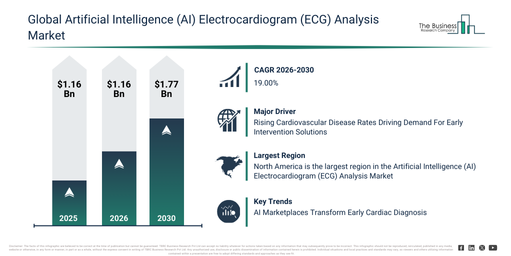
    The artificial intelligence (ai) electrocardiogram (ecg) analysis market size has shown swift expansion over recent years. This market is set to expand from $2.01 billion in 2025 to $2.4 billion in 2026, achieving a compound annual growth rate (CAGR) of 19.3%. Historically, this growth can be ascribed to a scarcity of AI-powered ECG analysis solutions, conventional manual ECG interpretation methods, an escalating prevalence of cardiac ailments, the increasing digitization of healthcare, and the reliance on hospital-based ECG systems.

    The artificial intelligence (ai) electrocardiogram (ecg) analysis market is anticipated to experience substantial growth over the coming years. It is projected to expand to a value of $4.81 billion by 2030, exhibiting a compound annual growth rate (CAGR) of 19.0%. This growth during the forecast period is attributable to advancements in deep learning algorithms for ecg, the increasing use of wearable and portable ecg devices, the expansion of telehealth and remote monitoring services, rising investments in cloud-based healthcare solutions, and regulatory approvals for ai-assisted diagnostic tools. Significant trends expected in this period include a greater adoption of ai-driven ecg analysis in hospitals, the integration of wearable ecg monitoring devices with ai platforms, an escalating demand for remote ecg monitoring and telecardiology services, a focus on real-time cardiac data visualization and decision support, and the expansion of cloud-based ecg analysis solutions.

    Access Your Free Sample Report For In-Depth Market Analysis:

    https://www.thebusinessresearchcompany.com/sample.aspx?id=27202&type=smp

    Which Major Drivers Are Influencing The Expansion Of The Artificial Intelligence (AI) Electrocardiogram (ECG) Analysis Market?

    The escalating prevalence of cardiovascular conditions is projected to fuel the expansion of the AI powered electrocardiogram (ECG) analysis market moving ahead. These diseases encompass disorders affecting the heart and blood vessels, including coronary heart disease, heart failure, stroke, and hypertension. This growing burden stems from factors such as aging populations, metabolic risks, inadequate nutrition, and inactive lifestyles, all of which collectively elevate the risk of heart-related complications. AI powered ECG analysis aids healthcare by facilitating the early identification of cardiac irregularities, optimizing diagnostic procedures, and refining clinical judgments to improve patient outcomes. For example, in October 2024, data from the Centers for Disease Control and Prevention, a US-based government agency, indicates that in 2023, cardiovascular disease was responsible for 919,032 lives lost, accounting for one in every three deaths. Coronary heart disease persisted as the most widespread type of heart condition, and significantly, about one in six deaths from cardiovascular diseases impacted individuals younger than 65 years. Consequently, the increasing occurrence of cardiovascular diseases is a key factor driving the adoption of AI powered ECG analysis.

    How Is The Artificial Intelligence (AI) Electrocardiogram (ECG) Analysis Market Broken Down By Segment Categories?

    The artificial intelligence (ai) electrocardiogram (ecg) analysis market covered in this report is segmented –

    1) By Component: Software, Hardware, Services

    2) By Type: On-Premise, Cloud-Based

    3) By Medical Condition: Cardiac Arrhythmias, Heart Failure, Ischemic Heart Disease And Coronary Artery Disease

    4) By Application: Hospital, Clinic, Other Applications

    Subsegments:

    1) By Software: Artificial Intelligence Electrocardiogram (ECG) Interpretation Platforms, Machine Learning-Based Electrocardiogram Diagnostic Tools, Deep Learning Electrocardiogram (ECG) Analysis Software, Cloud-Based Electrocardiogram Analysis Systems, Real-Time Electrocardiogram Data Visualization Software

    2) By Hardware: Wearable Electrocardiogram Monitoring Devices, Portable Electrocardiogram Acquisition Units, Smart Electrocardiogram Patches, Multi-Lead Electrocardiogram Recording Machines, Sensor-Integrated Electrocardiogram Devices

    3) By Services: Remote Electrocardiogram Monitoring Services, Electrocardiogram Data Annotation And Labeling Services, Artificial Intelligence Algorithm Training And Validation For Electrocardiogram, Technical Support And Software Integration For Electrocardiogram, Clinical Electrocardiogram Reporting And Interpretation Services

    Which Trends Are Shaping The Artificial Intelligence (AI) Electrocardiogram (ECG) Analysis Market?

    Key players in the artificial intelligence (AI) electrocardiogram (ECG) analysis market are prioritizing the creation of advanced solutions, such as artificial intelligence marketplaces, to streamline early cardiac diagnosis and enhance clinical workflows. These artificial intelligence marketplaces serve as centralized platforms that provide access to multiple validated AI diagnostic tools, enabling healthcare providers to integrate sophisticated algorithms into their clinical practices for faster and more accurate diagnoses. For instance, in July 2025, Koninklijke Philips N.V., a health technology company from the Netherlands, unveiled Philips’ electrocardiogram artificial intelligence marketplace. This cutting-edge platform is engineered to seamlessly integrate artificial intelligence-powered diagnostic tools directly into its IntelliSpace ECG and cardiograph systems. The marketplace initially includes FDA-cleared algorithms, beginning with Anumana’s electrocardiogram artificial intelligence low ejection fraction algorithm, and delivers these essential tools directly at the point of care. This development significantly accelerates ECG review, facilitates earlier detection of heart failure through the analysis of standard 12-lead resting ECGs, and ultimately improves both clinical efficiency and diagnostic accuracy.

    Which Players Are Present In The Artificial Intelligence (AI) Electrocardiogram (ECG) Analysis Market Space?

    Major companies operating in the artificial intelligence (ai) electrocardiogram (ecg) analysis market are iRhythm Technologies Inc., Viz.ai Inc., Tempus Labs Inc., HeartSciences Inc., Neurosoft Software Production S.A., Tricog Health Services Pvt. Ltd., Anumana Inc., IDOVEN S.L., Ultromics Limited., VUNO Inc., Cardio.AI Inc., Powerful Medical s.r.o., RSIP Vision Ltd., AccurKardia Inc., Cardiologs Technologies SAS, Cardiomatics Sp. z o.o., Cordys Analytics B.V., PulseAI Ltd., Vektor Medical Inc., DeepECG Inc

    Get The Full Artificial Intelligence (AI) Electrocardiogram (ECG) Analysis Market Report:

    https://www.thebusinessresearchcompany.com/report/artificial-intelligence-ai-electrocardiogram-ecg-analysis-global-market-report

    Where Is The Artificial Intelligence (AI) Electrocardiogram (ECG) Analysis Market Most Concentrated Geographically?

    North America was the largest region in the artificial intelligence (AI) electrocardiogram (ECG) analysis market in 2025. Asia-Pacific is expected to be the fastest-growing region in the forecast period. The regions covered in the artificial intelligence (AI) electrocardiogram (ecg) analysis market report are Asia-Pacific, South East Asia, Western Europe, Eastern Europe, North America, South America, Middle East, Africa.

    Request A Customized Artificial Intelligence (AI) Electrocardiogram (ECG) Analysis Market Report For Competitive Insights:

    https://www.thebusinessresearchcompany.com/customise?id=27202&type=smp

    Browse Through More Reports Similar to the Global Artificial Intelligence (AI) Electrocardiogram (ECG) Analysis Market 2026, By The Business Research Company

    Crack Free Concrete Market Report 2026

    https://www.thebusinessresearchcompany.com/report/crack-free-concrete-global-market-report

    Polished Concrete Market Report 2026

    https://www.thebusinessresearchcompany.com/report/polished-concrete-global-market-report

    Concrete Materials Market Report 2026

    https://www.thebusinessresearchcompany.com/report/concrete-materials-global-market-report

    Get in touch with us:

    The Business Research Company: https://www.thebusinessresearchcompany.com/

    Americas +1 310-496-7795

    Asia +44 7882 955267 & +91 8897263534

    Europe +44 7882 955267

    Email us at info@tbrc.info

    Follow us on:

    LinkedIn: https://in.linkedin.com/company/the-business-research-company

    YouTube: https://www.youtube.com/channel/UC24_fI0rV8cR5DxlCpgmyFQ

    Global Market Model: https://www.thebusinessresearchcompany.com/global-market-model
  • Artificial Eye Market Projected To Reach $3.15 Billion By 2030 At 7.8% CAGR

    Artificial Eye Market Projected To Reach $3.15 Billion By 2030 At 7.8% CAGR

    The Business Research Company’s 2026 market reports feature enhanced tools like market attractiveness analysis, TAM assessment, and company scoring matrices, along with interactive dashboards, deeper supply chain insights, and startup coverage strengthening the depth, usability, and strategic value of insights.

    By 2030, What Market Size Is The Artificial Eye Market Expected To Reach Based On Its 2026 Value?

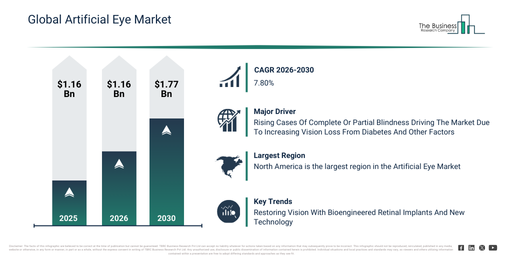
    The artificial eye market size has demonstrated significant expansion in recent years. It is anticipated to increase from $2.16 billion in 2025 to $2.34 billion in 2026, exhibiting a compound annual growth rate (CAGR) of 8.0%. This historical growth can be attributed to several factors, including the occurrence of eye trauma, cases of enucleation linked to cancer, the demand for cosmetic rehabilitation, the expansion of hospital ophthalmic services, and developments in prosthetic technology.

    The artificial eye market is anticipated to experience robust expansion in the coming years, projected to reach $3.16 billion by 2030, driven by a compound annual growth rate (CAGR) of 7.8%. This projected growth is attributable to factors such as the increasing adoption of 3D printing, the rising demand for personalized prosthetics, enhanced healthcare accessibility, a greater emphasis on psychological rehabilitation, and advancements in material science. Key trends anticipated during this period encompass the development of custom-made ocular prosthetics, the expanding application of digital eye printing, a strong preference for superior aesthetic results, the utilization of lightweight and biocompatible materials, and increasing recognition of ocular rehabilitation’s importance.

    Access Your Free Sample Report For In-Depth Market Analysis:

    https://www.thebusinessresearchcompany.com/sample.aspx?id=23311&type=smp

    What Key Drivers Are Fueling The Growth Of The Artificial Eye Market?

    The increasing number of people affected by complete or partial blindness is anticipated to drive the expansion of the artificial eye market in the future. Complete or partial blindness signifies a substantial or total loss of vision, impeding individuals’ ability to perceive light, shapes, or their environment, thereby severely impacting daily activities and their overall quality of life. The rise in those suffering from complete or partial blindness is linked to an increase in retinal degenerative diseases, which progressively harm photoreceptor cells, leading to irreversible vision impairment. Artificial eye technology provides advanced solutions, such as bioengineered retinal implants, capable of restoring or enhancing vision, thereby significantly improving the quality of life for those affected. For instance, in May 2024, according to a report published by the East Sussex Joint Strategic Needs Assessment, a UK-based public health assessment body, approximately 2 million people in the UK currently experience some degree of sight loss, a number predicted to grow to 2.7 million by 2030. Consequently, the rising prevalence of complete or partial blindness is fueling the growth of the artificial eye market.

    What Are The Different Segment Types In The Artificial Eye Market Segment Breakdown?

    The artificial eye market covered in this report is segmented –

    1) By Product: Integrated, Semi-Integrated, Non-Integrated

    2) By Technology: Passive Prosthetic Technology, Mechanical

    3) By Distribution Channel: Direct Sales, Online Sales, Third Party Distributors, Specialized Ocular Prosthetic Clinics

    4) By Application: Orbital Support And Aesthetic Restoration, Cosmetic Enhancement, Medical Treatment, Reconstructive Surgery

    5) By End User: Hospitals, Ambulatory Surgical Centers, Other End Users

    Subsegments:

    1) Integrated: Hydroxyapatite (HA), Porous Polyethylene (Medpor), Bioceramic

    2) Semi-Integrated: Acrylic-Based, Silicone-Based, Polymer Composite

    3) Non-Integrated: Glass Prosthetic Eye, Acrylic Prosthetic Eye, Digital-Printed Prosthetic Eye

    What Trends Are Influencing The Artificial Eye Market?

    Leading companies operating in the artificial eye domain are concentrating their efforts on developing advanced solutions like bioengineered retinal implants to help patients with retinal degenerative diseases regain their vision. A bioengineered retinal implant is an artificial device, crafted in a laboratory, that either replaces or augments damaged retinal tissue to restore or improve eyesight. Its primary function is to re-establish vision for individuals afflicted with retinal degenerative conditions by substituting or enhancing compromised retinal function. For example, in May 2024, LambdaVision Inc., a US-based biotechnology company, announced the successful closure of its initial seed funding round, which will facilitate the progression of preclinical studies for its protein-based artificial retina. This innovative bioengineered retinal implant utilizes bacteriorhodopsin, a protein sensitive to light, to emulate the natural photoreceptor activity within the human eye, potentially offering a more seamless approach to vision restoration than traditional electronic implants. Additionally, the company is pioneering microgravity-based manufacturing processes on the International Space Station, which has the potential to elevate the quality and efficiency of production, thereby establishing a new standard for precision in retinal prosthetics.

    Who Are The Well-Known Companies In The Artificial Eye Market?

    Major companies operating in the artificial eye market are Midwest Eye Laboratories Inc., Advanced Artificial Eyes, Boston Ocular Prosthetics Inc., Erickson Laboratories Inc., F.Ad. Muller Sohne GmbH & Co KG, Irises Unlimited Inc., Ocular Prosthetics Incorporated, International Prosthetic Eye Center Private Limited, New Zealand Prosthetic Eye Service, Southeastern Ocularists Inc., The Artificial Eye Co., John O. Hughes Prosthetic Eye Laboratory, Chadwick Optical Inc., Prosthetic Eye Center of New York, American Artificial Eye Center, Hanger Ocular Prosthetics, Romford Artificial Eye Service, Artificial Eye Services Australia, Queensland Artificial Eye Service, Moorfields Ocular Prosthetics Department, Artificial Eye Clinic of India, National Artificial Eye Service

    Get The Full Artificial Eye Market Report:

    https://www.thebusinessresearchcompany.com/report/artificial-eye-global-market-report

    Which Region Dominates The Artificial Eye Market By Market Share?

    North America was the largest region in the artificial eye market in 2025. Asia-Pacific is expected to be the fastest-growing region in the forecast period. The regions covered in the artificial eye market report are Asia-Pacific, South East Asia, Western Europe, Eastern Europe, North America, South America, Middle East, Africa.

    Request A Customized Artificial Eye Market Report For Competitive Insights:

    https://www.thebusinessresearchcompany.com/customise?id=23311&type=smp

    Browse Through More Reports Similar to the Global Artificial Eye Market 2026, By The Business Research Company

    Eye Testing Equipment Market Report 2026

    https://www.thebusinessresearchcompany.com/report/eye-testing-equipment-global-market-report

    Eye Tracking Market Report 2026

    https://www.thebusinessresearchcompany.com/report/eye-tracking-global-market-report

    Eye Health Supplements Market Report 2026

    https://www.thebusinessresearchcompany.com/report/eye-health-supplements-global-market-report

    Get in touch with us:

    The Business Research Company: https://www.thebusinessresearchcompany.com/

    Americas +1 310-496-7795

    Asia +44 7882 955267 & +91 8897263534

    Europe +44 7882 955267

    Email us at info@tbrc.info

    Follow us on:

    LinkedIn: https://in.linkedin.com/company/the-business-research-company

    YouTube: https://www.youtube.com/channel/UC24_fI0rV8cR5DxlCpgmyFQ

    Global Market Model: https://www.thebusinessresearchcompany.com/global-market-model
  • Global Artificial Disc Market Forecast To Reach $6.89 Billion By 2030 At 16.8% CAGR

    Global Artificial Disc Market Forecast To Reach $6.89 Billion By 2030 At 16.8% CAGR

    The Business Research Company’s 2026 market reports feature enhanced tools like market attractiveness analysis, TAM assessment, and company scoring matrices, along with interactive dashboards, deeper supply chain insights, and startup coverage strengthening the depth, usability, and strategic value of insights.

    What Is The Anticipated Rise In Market Value Of The Artificial Disc Market During The Forecast Period?

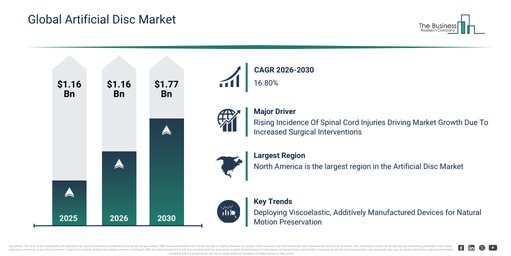
    The artificial disc market size has experienced significant growth in recent years. It is forecast to expand from $3.19 billion in 2025 to $3.71 billion in 2026, at a compound annual growth rate (CAGR) of 16.0%. This historical growth can be attributed to several factors, including the rising prevalence of degenerative spine diseases, increased adoption of disc replacement procedures over fusion, the availability of advanced spinal implant designs, the expansion of spine surgery centers, and improved surgical techniques.

    The artificial disc market is poised for significant expansion in the coming years, with projections indicating a rise to $6.9 billion by 2030, driven by a compound annual growth rate (CAGR) of 16.8%. This anticipated growth is primarily attributable to factors such as an aging population increasingly afflicted by spinal disorders, a growing inclination towards treatments that preserve motion, the expansion of outpatient spine procedures, escalating investments in advanced spinal implants, and a heightened demand for swift recovery solutions. Throughout this forecast period, prominent trends are expected to include the increasing adoption of motion-preserving spine implants, a surge in demand for cervical disc replacement procedures, the expanding utilization of sophisticated biomaterials, the widespread implementation of minimally invasive spine surgeries, and an intensified focus on ensuring the long-term performance of implants.

    Access Your Free Sample Report For In-Depth Market Analysis:

    https://www.thebusinessresearchcompany.com/sample.aspx?id=13283&type=smp

    Which Drivers Are Supporting The Artificial Disc Market Growth?

    The growing occurrence of spinal cord injuries is anticipated to stimulate the expansion of the artificial disc market moving forward. Spinal cord injuries encompass any form of trauma, damage, or harm to the spine’s fundamental structures, including bones (vertebrae), intervertebral discs, ligaments, muscles, nerves, and other supportive components. The increase in these injuries is attributed to a rising number of high-impact motor vehicle accidents and falls from heights, which stand as the principal global causes of acute traumatic damage to the spinal column and nerves. Artificial discs offer advantages in addressing spinal cord injuries by providing a surgical alternative to spinal fusion, thereby restoring typical motion, diminishing discogenic back pain, offering flexibility, and preventing potential adverse effects associated with fusion surgery. For instance, in July 2024, according to the Journal of Global Health, a Scotland-based open-access academic journal, a study involving 2.22 million youths identified scoliosis in 1.20% of cases, with a greater prevalence in girls (1.57 times more likely than boys). The highest rates observed were 1.42% in girls aged 13-14 and 1.07% in boys aged 15-16. Scoliosis was most frequently found in the central region (1.54%) and was predominantly mild, showing no correlation with altitude or latitude. As a result, the increasing incidence of spinal cord injuries is propelling the growth of the artificial disc market.

    Which Segment Classifications Are Used In The Artificial Disc Market Segment Analysis?

    The artificial disc market covered in this report is segmented –

    1) By Type: Cervical Disc, Artificial Disc, Lumbar

    2) By Material: Metal And Plastic, Metal

    3) By Indication: Spinal Trauma, Degenerative Spine Disease

    4) By End User: Hospitals, Specialty Clinics

    Subsegments:

    1) By Cervical Disc: Single-Level Cervical Discs, Multi-Level Cervical Discs

    2) By Artificial Disc: Total Disc Replacement, Semi-Constrained Disc Implants, Motion-Preserving Disc Implants

    3) By Lumbar Disc: Single-Level Lumbar Discs, Multi-Level Lumbar Discs

    Which Trends Are Expected To Impact The Artificial Disc Market?

    Major companies in the artificial disc market are increasingly innovating next-generation prostheses that combine sophisticated biomechanics with surgical simplicity. These designs aim to better mimic natural spinal movement, reduce wear, and streamline implantation. Such devices often utilize advanced materials, like additively manufactured metals, and viscoelastic cores to restore physiological motion across all six degrees of freedom, which improves long-term patient outcomes and fosters wider adoption. For example, in February 2024, NGMedical, a Germany-based medical device manufacturer, introduced its MOVE-C artificial cervical disc in the United Arab Emirates, representing a crucial step in its global commercialization. The first MOVE-C implant procedure was successfully completed in Abu Dhabi. The MOVE-C prosthesis integrates a second-generation viscoelastic design, featuring axial damping and progressive resistance, with an implantation technique simplified to resemble that of a cervical cage, making it user-friendly for surgeons. Notably, MOVE-C is the first disc to incorporate additively manufactured titanium endplates and eliminates the necessity for polyethylene cores, which helps in reducing long-term wear.

    Which Firms Are Contributing To The Artificial Disc Market Ecosystem?

    Major companies operating in the artificial disc market are Johnson & Johnson, Medtronic plc, Stryker Corporation, Zimmer Biomet Holding Inc., SIGNUS Medizintechnik GmbH, Globus Medical Inc., Medacta International SA, Aesculap Inc., NuVasive Inc., Orthofix Medical Inc., Spineart, VTI – Vertebral Technologies Inc., Life Spine Inc., Spinal Elements, DePuy Synthes, Neuro France Implants, Paradigm Spine LLC, Xenco Medical, Osimplant, Synergy Spine Solutions Inc., Ranier Technology Limited, FH Orthopedics S.A.S, X-spine Systems Inc., Aditus Medical GmbH, AxioMed LLC

    Get The Full Artificial Disc Market Report:

    https://www.thebusinessresearchcompany.com/report/artificial-disc-global-market-report

    Which Region Is The Largest In The Artificial Disc Market?

    North America was the largest region in the artificial disc market in 2025. Asia-Pacific is expected to be the fastest-growing region in the forecast period. The regions covered in the artificial disc market report are Asia-Pacific, South East Asia, Western Europe, Eastern Europe, North America, South America, Middle East, Africa.

    Request A Customized Artificial Disc Market Report For Competitive Insights:

    https://www.thebusinessresearchcompany.com/customise?id=13283&type=smp

    Browse Through More Reports Similar to the Global Artificial Disc Market 2026, By The Business Research Company

    Slip Disc Market Report 2026

    https://www.thebusinessresearchcompany.com/report/slip-disc-global-market-report

    Industrial Robots Warehousing And Storage Robots Market Report 2026

    https://www.thebusinessresearchcompany.com/report/industrial-robots-warehousing-and-storage-robots-global-market-report

    Artificial Intelligence In Accounting Market Report 2026

    https://www.thebusinessresearchcompany.com/report/artificial-intelligence-in-accounting-global-market-report

    Get in touch with us:

    The Business Research Company: https://www.thebusinessresearchcompany.com/

    Americas +1 310-496-7795

    Asia +44 7882 955267 & +91 8897263534

    Europe +44 7882 955267

    Email us at info@tbrc.info

    Follow us on:

    LinkedIn: https://in.linkedin.com/company/the-business-research-company

    YouTube: https://www.youtube.com/channel/UC24_fI0rV8cR5DxlCpgmyFQ

    Global Market Model: https://www.thebusinessresearchcompany.com/global-market-model
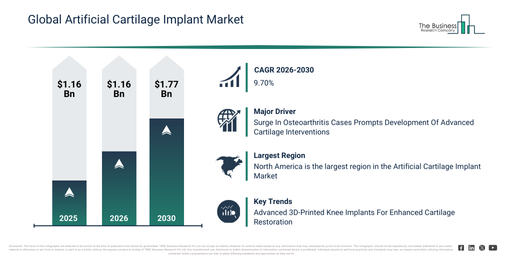
  • Artificial Cartilage Implant Market Expected To Reach $2.45 Billion By 2030 At 9.7% CAGR

    Artificial Cartilage Implant Market Expected To Reach $2.45 Billion By 2030 At 9.7% CAGR

    The Business Research Company’s 2026 market reports feature enhanced tools like market attractiveness analysis, TAM assessment, and company scoring matrices, along with interactive dashboards, deeper supply chain insights, and startup coverage strengthening the depth, usability, and strategic value of insights.

    How Is The Market Size Of The Artificial Cartilage Implant Market Expected To Scale Between 2026 And 2030?

    The artificial cartilage implant market has seen substantial expansion in recent years. This market is projected to expand from $1.54 billion in 2025 to $1.69 billion in 2026, achieving a compound annual growth rate (CAGR) of 9.7%. Historically, this expansion was driven by factors such as the restricted availability of advanced cartilage implant materials, an increase in orthopedic surgical procedures, growing awareness of joint health, insufficient local manufacturing capabilities, and a dependence on imported implants.

    The artificial cartilage implant market is projected to experience robust expansion over the coming years. This market is anticipated to reach $2.45 billion by 2030, exhibiting a compound annual growth rate (CAGR) of 9.7%. Several factors are expected to drive this expansion during the forecast period, including advancements in synthetic and intelligent implants, an increasing need for knee and hip replacement procedures, the proliferation of ambulatory surgical centers, the growing uptake of 3D-printed patient-specific implants, and augmented investment in orthopedic research and clinical uses. Key trends influencing the market during this period encompass the escalating occurrence of osteoarthritis and joint degeneration, the greater embrace of minimally invasive orthopedic techniques, a heightened call for biocompatible and long-lasting implants, the broadening scope of orthopedic research and clinical investigations, and the development of customized and patient-tailored implant solutions.

    Access Your Free Sample Report For In-Depth Market Analysis:

    https://www.thebusinessresearchcompany.com/sample.aspx?id=27201&type=smp

    What Key Factors Are Affecting The Artificial Cartilage Implant Market Demand?

    The increasing occurrence of osteoarthritis is anticipated to drive the expansion of the artificial cartilage implant market in the future. Osteoarthritis is a condition involving the deterioration of joints, marked by the progressive degradation of cartilage, which results in discomfort, rigidity, and limited movement. The increase in osteoarthritis stems from rising obesity rates, which exert additional stress on joints, accelerating both cartilage degradation and overall joint damage. Artificial cartilage implants serve to substitute compromised cartilage, thereby re-establishing smooth joint surfaces and minimizing friction, which in turn eases pain, enhances mobility, and decelerates joint degeneration. As an illustration, in August 2023, the Institute for Health Metrics and Evaluation, a US-based health research center, estimated that by 2050, almost 1 billion individuals are expected to suffer from osteoarthritis. Knees and hands are the most prevalent sites affected by osteoarthritis. It is projected that by 2050, knee osteoarthritis will see a 75% increase, and hand osteoarthritis will rise by 50%. Consequently, the escalating incidence of osteoarthritis is propelling the expansion of the artificial cartilage implant market.

    How Is The Artificial Cartilage Implant Market Organized By Segment Classification?

    The artificial cartilage implant market covered in this report is segmented –

    1) By Type Of Implant: Biological Implants, Synthetic Implants, Composite Implants, Smart Implants

    2) By Product Type: Upper Extremity Joints, Lower Extremity Joints, Vertebral Joints

    3) By Distribution Channel: Direct Sales, Online Retail, Distributors, Specialty Clinics

    4) By Application: Knee Replacement, Hip Replacement, Shoulder Reconstruction, Ankle Replacement

    5) By End-User: Hospitals, Orthopedic Clinics, Ambulatory Surgical Centers, Research Institutes, Other End-Users

    Subsegments:

    1) By Biological Implants: Autografts, Allografts, Xenografts, Tissue-Engineered Implants

    2) By Synthetic Implants: Polymer-Based Implants, Hydrogel Implants, Silicone Implants, Polyurethane Implants

    3) By Composite Implants: Polymer-Ceramic Composites, Polymer-Metal Composites, Hydrogel-Ceramic Composites, Bioactive Glass Composites

    4) By Smart Implants: Sensor-Integrated Implants, Drug-Eluting Implants, Shape-Memory Implants, Stimuli-Responsive Implants

    What Trends Are Influencing Changes In The Artificial Cartilage Implant Market?

    Leading companies in the artificial cartilage implant market are focusing on the development of sophisticated products, including three-dimensional (3D) printed knee implants, to enhance joint compatibility and provide lasting solutions for individuals with osteoarthritis. These patient-specific 3D printed knee implants are joint replacements meticulously built layer by layer utilizing advanced 3D printing technology, thereby ensuring a precise anatomical fit and improved joint function, while also supporting faster patient recovery. For example, in July 2025, Nanochon, a medical device startup based in the US, unveiled Chondrograft, which subsequently received authorization from Health Canada. This product is specifically engineered to substitute lost or compromised knee cartilage using a high-performance synthetic material. The implant is designed to imitate the porosity and structure of natural cartilage, facilitating its integration with the body and stimulating new tissue growth. This ready-to-use solution presents a minimally invasive option compared to traditional procedures like knee replacement, aiming to restore knee cartilage function and either delay or entirely avoid the need for more invasive surgeries.

    Who Are The Industry Participants Involved In The Artificial Cartilage Implant Market?

    Major companies operating in the artificial cartilage implant market are Johnson & Johnson, B. Braun Melsungen AG, Medtronic plc, Zimmer Biomet Holdings Inc., Smith & Nephew plc, Stryker Corporation, Arthrex Inc., Conmed Corporation, Orthofix Medical, Corin Group, Anika Therapeutics Inc., Vericel Corporation, Tissue Regenix Group plc, Nusurface, Uteshiya Medicare Inc., Sparta Biomedical Inc., BioPoly LLC, Orthocell Ltd, Sartorius CellGenix GmbH, CytoSeek Limited

    Get The Full Artificial Cartilage Implant Market Report:

    https://www.thebusinessresearchcompany.com/report/artificial-cartilage-implant-global-market-report

    Which Region Leads The Artificial Cartilage Implant Market In Terms Of Market Share?

    North America was the largest region in the artificial cartilage implant market in 2025. Asia-Pacific is expected to be the fastest-growing region in the forecast period. The regions covered in the artificial cartilage implant market report are Asia-Pacific, South East Asia, Western Europe, Eastern Europe, North America, South America, Middle East, Africa.

    Request A Customized Artificial Cartilage Implant Market Report For Competitive Insights:

    https://www.thebusinessresearchcompany.com/customise?id=27201&type=smp

    Browse Through More Reports Similar to the Global Artificial Cartilage Implant Market 2026, By The Business Research Company

    Doors Market Report 2026

    https://www.thebusinessresearchcompany.com/report/doors-global-market-report

    Commercial Overhead Doors Market Report 2026

    https://www.thebusinessresearchcompany.com/report/commercial-overhead-doors-global-market-report

    Aircraft Doors Market Report 2026

    https://www.thebusinessresearchcompany.com/report/aircraft-doors-global-market-report

    Get in touch with us:

    The Business Research Company: https://www.thebusinessresearchcompany.com/

    Americas +1 310-496-7795

    Asia +44 7882 955267 & +91 8897263534

    Europe +44 7882 955267

    Email us at info@tbrc.info

    Follow us on:

    LinkedIn: https://in.linkedin.com/company/the-business-research-company

    YouTube: https://www.youtube.com/channel/UC24_fI0rV8cR5DxlCpgmyFQ

    Global Market Model: https://www.thebusinessresearchcompany.com/global-market-model