Gastric Cancer Diagnostic Market Size Projected To Increase From $2.98 Billion To $3.87 Billion During The Forecast Period
Enhanced with market attractiveness analysis, total addressable market evaluation, company benchmarking matrices, interactive Excel dashboards, expanded supply chain intelligence, emerging startup coverage, and detailed product insights, The Business Research Company’s 2026 market reports deliver more actionable and strategically valuable research.
The market for gastric cancer diagnostics is experiencing steady growth, driven by advancements in technology and increasing awareness of early detection. As medical research progresses and new diagnostic tools emerge, this sector is positioned for notable expansion in the coming years. Here’s an in-depth look at the market size, key growth drivers, segment breakdowns, emerging trends, major players, and regional dynamics shaping the gastric cancer diagnostic landscape.
Current Market Size and Projected Growth in the Gastric Cancer Diagnostic Market
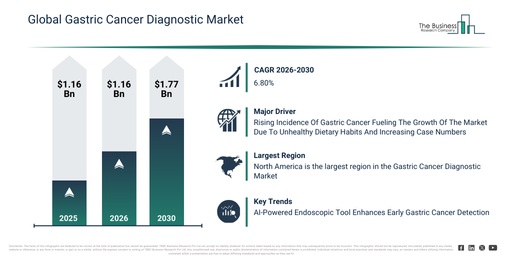
The gastric cancer diagnostic market has demonstrated robust expansion recently. It is expected to rise from $2.78 billion in 2025 to $2.98 billion in 2026, growing at a compound annual growth rate (CAGR) of 7.2%. This historical growth is linked to factors such as the limited availability of fluorescent probes, reliance on traditional single-color fluorescent in situ hybridization (FISH) methods, increasing genetic research initiatives, enhanced hospital and laboratory infrastructure, and the adoption of basic cytogenetic diagnostic techniques. Looking ahead, the market is poised to reach $3.87 billion by 2030, maintaining a CAGR of 6.8%. Expansion during this forecast period will be supported by the development of multiplex and high-throughput probes, a rising demand for precision medicine, ongoing growth in genetic and pharmaceutical research, improvements in imaging and quantification technologies, as well as stricter regulatory compliance and adherence to quality standards. Key trends will include greater use of multiplex and high-throughput FISH probes, broader applications of genetic and molecular diagnostics, increased involvement in clinical and pharmaceutical research, integration with advanced imaging and analytical tools, and intensified focus on the accuracy and sensitivity of diagnostic probes.
Download A Free Sample Report For Comprehensive Market Insights:
https://www.thebusinessresearchcompany.com/sample.aspx?id=27291&type=smp
Factors Propelling Growth in the Gastric Cancer Diagnostic Market
One of the primary drivers behind the growth of the gastric cancer diagnostic market is the rising incidence of gastric cancer worldwide. Gastric cancer is characterized by malignant tumors developing in the stomach lining, where uncontrolled cell growth forms masses capable of invading surrounding tissues and spreading to other organs. Increasing rates of this disease are attributed mainly to unhealthy eating habits, particularly the high intake of salted, smoked, and processed foods, which damage the stomach lining and elevate cancer risk. Diagnostic technologies for gastric cancer play a crucial role in identifying malignant lesions at an early stage, enabling timely treatment and enhancing patient outcomes. These diagnostics also improve clinical workflows by delivering accurate and quick results, which supports better disease management. For example, according to the American Cancer Society in May 2024, new stomach cancer cases in the United States reached 26,890, up from 26,500 cases in 2023, underscoring the growing need for effective diagnostic solutions in this market.
Additional Elements Supporting Market Expansion
Beyond rising disease prevalence, advancements in technology and research investments are fueling the gastric cancer diagnostic market. Increasing hospital and laboratory infrastructure enables the adoption of improved diagnostic tools, while ongoing genetic and pharmaceutical research expands the scope and precision of testing methods. Additionally, regulatory bodies are enforcing stricter quality standards, which encourages innovation and higher diagnostic accuracy. These developments collectively contribute to a favorable environment for market growth in the near term.
Access The Complete Gastric Cancer Diagnostic Market Report:
https://www.thebusinessresearchcompany.com/report/gastric-cancer-diagnostic-global-market-report
Breakdown of Key Market Segments in Gastric Cancer Diagnostics
The gastric cancer diagnostic market is categorized into several important segments for better clarity:
1) Diagnostic Type: Endoscopy, Imaging, Biopsy, Laboratory Tests, Biomarker-Based Testing
2) Product: Reagents and Consumables, Instruments
3) Technology: Molecular Diagnostics, Immunoassays, Next-Generation Sequencing, Other Technologies
4) Application: Early Diagnosis, Screening, Monitoring
5) End User: Hospitals, Clinics, Diagnostic Laboratories, Other End Users
Further details on subcategories include:
– Endoscopy options such as Conventional Endoscopy, Chromoendoscopy, Narrow Band Imaging, Confocal Laser Endomicroscopy, Capsule Endoscopy
– Imaging techniques comprising Computed Tomography, Magnetic Resonance Imaging, Positron Emission Tomography, Ultrasound
– Biopsy methods like Forceps Biopsy, Needle Biopsy, Endoscopic Ultrasound-Guided Biopsy, Laparoscopic Biopsy
– Laboratory Tests including Blood Tests, Stool Tests, Urea Breath Test, Serology
– Biomarker-Based Testing featuring Genetic Testing, Protein Biomarker Testing, Circulating Tumor DNA Testing, Microribonucleic Acid Testing
Technological Advancements and Their Impact on Gastric Cancer Diagnostics
Innovation continues to transform the gastric cancer diagnostic field, with many companies investing in AI-driven solutions to enhance precision and early detection. Artificial intelligence-based endoscopic diagnostic support devices are emerging as cutting-edge tools that help physicians identify gastrointestinal abnormalities during procedures. For instance, in March 2024, Japan’s AI Medical Service Inc. introduced GastroAI-model G, an AI-powered endoscopic support system. It analyzes video images in real time during endoscopy, detecting suspicious lesions that could indicate early gastric cancer. This system highlights potential areas for biopsy or further examination, alerting doctors instantly by marking the affected regions on the endoscopic screen. This technology greatly improves diagnostic accuracy and facilitates timely intervention.
Who Are the Leading Players in the Gastric Cancer Diagnostic Market
The competitive landscape of the gastric cancer diagnostic market is shaped by several prominent companies, including F. Hoffmann-La Roche Ltd., Thermo Fisher Scientific Inc., Abbott Laboratories, Becton Dickinson and Company, Quest Diagnostics Incorporated, Agilent Technologies Inc., Illumina Inc., bioMérieux SA, Qiagen N.V., DiaSorin S.p.A, Natera Inc., Myriad Genetics Inc., Fulgent Genetics Inc., Foundation Medicine Inc., Invitae Corporation, NeoGenomics Laboratories Inc., Fujirebio Inc., MiRXES Pte Ltd., BIOCEPT Inc., and Pillar Biosciences Inc. These organizations are driving competitive growth through continuous development of innovative diagnostic tools and expansion into new markets.
Regional Dynamics and Market Leadership in Gastric Cancer Diagnostics
North America held the largest share of the gastric cancer diagnostic market in 2025, reflecting strong healthcare infrastructure and widespread adoption of advanced diagnostic technologies. Meanwhile, the Asia Pacific region is anticipated to experience the fastest growth during the forecast period, driven by increasing healthcare investments, rising disease prevalence, and growing demand for precision diagnostics. The market report also covers other significant regions including South East Asia, Western Europe, Eastern Europe, South America, the Middle East, and Africa, offering a comprehensive view of global market trends and opportunities.
Get in touch with us:
The Business Research Company: https://www.thebusinessresearchcompany.com/
Americas: +1 310-496-7795
Asia: +44 7882 955267 & +91 8897263534
Europe: +44 7882 955267
Email us at: marketing@tbrc.info
Follow us on:
LinkedIn: https://in.linkedin.com/company/the-business-research-company
YouTube: https://www.youtube.com/channel/UC24_fI0rV8cR5DxlCpgmyFQ
Global Market Model: https://www.thebusinessresearchcompany.com/global-market-model