Low Vision Electronic Glasses Market Trends And Growth Drivers Point To Strong Future Potential
Enhanced with market attractiveness analysis, total addressable market evaluation, company benchmarking matrices, interactive Excel dashboards, expanded supply chain intelligence, emerging startup coverage, and detailed product insights, The Business Research Company’s 2026 market reports deliver more actionable and strategically valuable research.
The market for low vision electronic glasses has witnessed significant growth recently, driven by technological advancements and a growing need among visually impaired individuals. As innovations continue to emerge, this sector is set to expand further, offering enhanced solutions to improve vision and quality of life. Below is an in-depth overview of the market size, key drivers, segmentation, competitive landscape, and regional developments shaping this industry.
Steady Growth Projection for the Low Vision Electronic Glasses Market
The low vision electronic glasses market demonstrated rapid expansion over recent years, with its size expected to rise from $0.97 billion in 2025 to $1.08 billion in 2026. This growth reflects a compound annual growth rate (CAGR) of 11.6%. The earlier phase of market growth was influenced by factors such as the increasing prevalence of visual impairments, technological restrictions of traditional optical aids, the high pricing of earlier devices, limited awareness about low vision aids, and a shortage of trained eye care professionals.
Download A Free Sample Report For Comprehensive Market Insights:
https://www.thebusinessresearchcompany.com/sample.aspx?id=25814&type=smp
Future Expansion Forecast for Low Vision Electronic Glasses
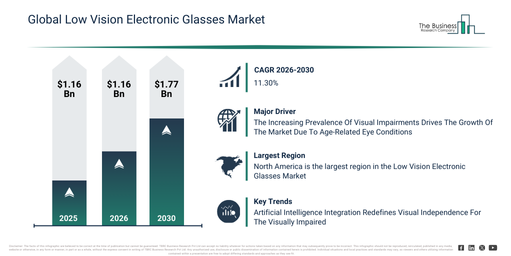
Looking ahead, the market is projected to continue this upward trend, reaching $1.66 billion by 2030 with a CAGR of 11.3%. This anticipated growth results from advances in AI-driven vision enhancement, the integration of augmented reality (AR) and virtual reality (VR) technologies to create immersive experiences, cost reductions achieved through mass production, a growing elderly population, and a stronger focus on enabling independent living for those with visual impairments. Key trends expected to shape the market include the miniaturization of devices, real-time image enhancement features, improved comfort and ergonomic designs for wearability, integration of voice and gesture controls, and customized vision assistance.
Rising Visual Impairments Fuel Demand for Low Vision Electronic Glasses
An important factor propelling the market forward is the increasing number of people affected by visual impairments. These impairments involve significant vision loss that cannot be corrected fully by glasses, contact lenses, medication, or surgical methods, impacting individuals’ ability to perform daily tasks. The growth in visual impairments is largely driven by aging populations, as age-related eye conditions such as cataracts, glaucoma, and macular degeneration become more common. Low vision electronic glasses enhance the remaining vision through magnification, contrast adjustments, and real-time image processing, thereby supporting greater autonomy in everyday life. For example, the World Health Organization reported in August 2023 that at least 2.2 billion people globally have either near or distance vision impairment. However, treatment rates remain low, with only 36% of those affected by refractive errors and a mere 17% with cataract-related vision impairment receiving adequate care. This gap underscores the rising demand for assistive devices like low vision electronic glasses.
Access The Complete Low Vision Electronic Glasses Market Report:
https://www.thebusinessresearchcompany.com/report/low-vision-electronic-glasses-global-market-report
Technological Progress and AI Integration Drive Market Growth
The enhancement of vision through low vision electronic glasses is increasingly being powered by artificial intelligence, which offers dynamic image optimization and environmental awareness. These AI-enabled devices help users recognize objects, read text aloud, and improve overall visual clarity. For instance, in August 2024, US-based company Eyedaptic Inc. introduced the EYE6 smart glasses designed for individuals with central vision loss. Combining augmented reality with AI-driven vision enhancement, these glasses provide real-time image adjustment to boost clarity and contrast. Additional features include a lightweight design, hands-free operation, multilingual visual assistance supporting 99 languages, and capabilities such as text reading and environmental descriptions to assist users with daily activities.
Comprehensive Segmentation of the Low Vision Electronic Glasses Market
The market analysis divides the low vision electronic glasses sector into several key segments:
1) Product Type: Wearable Glasses, Smart Glasses, Augmented Reality Glasses, Night Vision Glasses
2) Technology: Optical Technology, Digital Technology, Adaptive Technology, Artificial Intelligence Integrated Technology
3) Application: Personal Use, Professional Use
4) Distribution Channel: Online Retail, Offline Retail, Direct Sales, Healthcare Providers
5) End-User: Individuals with Visual Impairments, Healthcare Institutions, Educational Institutions, Occupational Rehabilitation Centers
Further subcategories include specific types of wearable glasses such as head-mounted low vision glasses, clip-on assistive glasses, and full-frame digital glasses. Smart glasses categories cover voice-controlled models, Bluetooth-enabled visual aids, and integrated camera glasses. Augmented reality glasses include varieties meant for object recognition, navigation assistance, and text-to-speech functionalities. Night vision glasses feature infrared-based, thermal imaging, and low-light enhancement technologies.
Leading Companies Driving Innovation in the Low Vision Electronic Glasses Market
The competitive landscape of the low vision electronic glasses market features major players who are innovating to meet the needs of visually impaired users. Prominent companies include OrCam Technologies Ltd., Enhanced Vision Systems Inc., Vuzix Corporation, Zoomax Technology Co. Ltd., IrisVision Global Inc., Acesight, Ceciaa SAS, Envision Technologies BV, Eyedaptic Inc., GiveVision Ltd., NuEyes Technologies Inc., OXSIGHT Ltd., Vision Buddy Inc., eSight Corporation, Everysight Labs Ltd., Nreal Technology Ltd., Rokid Corporation, Avegant Corporation, Magic Leap Inc., Lenovo Smart Glasses Division, Sony Smart Vision Systems, and Epson Smart Glasses Division.
Geographical Distribution and Market Leadership
In 2025, North America held the largest share of the low vision electronic glasses market. However, the Asia-Pacific region is expected to register the fastest growth rate during the forecast period. The market report covers key geographic regions including Asia-Pacific, South East Asia, Western Europe, Eastern Europe, North America, South America, the Middle East, and Africa, providing a comprehensive view of global market trends.
Get in touch with us:
The Business Research Company: https://www.thebusinessresearchcompany.com/
Americas: +1 310-496-7795
Asia: +44 7882 955267 & +91 8897263534
Europe: +44 7882 955267
Email us at: marketing@tbrc.info
Follow us on:
LinkedIn: https://in.linkedin.com/company/the-business-research-company
YouTube: https://www.youtube.com/channel/UC24_fI0rV8cR5DxlCpgmyFQ
Global Market Model: https://www.thebusinessresearchcompany.com/global-market-model