Low Vision Electronic Visual Aids Market Outlook Highlights The Next Major Growth Opportunities
Delivering more actionable and strategically valuable research, The Business Research Company’s 2026 market reports feature market attractiveness analysis, total addressable market evaluation, company benchmarking matrices, interactive Excel dashboards, expanded supply chain intelligence, emerging startup coverage, and detailed product insights.
The low vision electronic visual aids market is steadily gaining traction as the demand for vision enhancement technologies rises globally. With advances in technology and increasing awareness, this sector is set for significant growth in the coming years. Let’s explore the market size, key drivers, innovative trends, major players, and regional opportunities shaping this evolving industry.
Market Size and Growth Prospects of the Low Vision Electronic Visual Aids Market
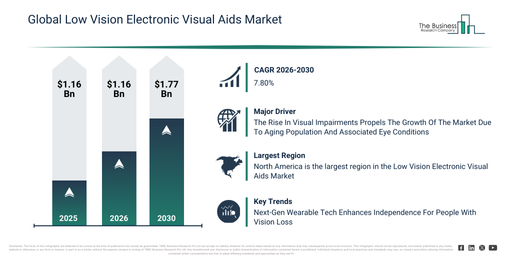
The low vision electronic visual aids market has witnessed strong growth recently and is projected to expand further. From $1.25 billion in 2025, it is expected to increase to $1.35 billion in 2026, growing at a compound annual growth rate (CAGR) of 8.0%. Looking ahead, the market is forecasted to reach $1.82 billion by 2030, with a CAGR of 7.8%. This growth is driven by factors such as a rising number of people with visual impairments, limited access to affordable aids, increased awareness about low vision devices, improvements in optical magnification technologies, and an aging global population. The market’s future trajectory will also be shaped by the integration of artificial intelligence (AI) and the Internet of Things (IoT), along with growing demand for portable and wearable products, government support initiatives, wider acceptance in educational settings, and expanded e-commerce sales channels.
Download A Free Sample Report For Comprehensive Market Insights:
https://www.thebusinessresearchcompany.com/sample.aspx?id=25815&type=smp
Growing Impact of Visual Impairments Boosting Market Demand
A key factor propelling the low vision electronic visual aids market is the increasing prevalence of visual impairments worldwide. These impairments encompass a range of vision loss conditions that cannot be fully corrected by conventional means like glasses, contact lenses, medication, or surgery. Age-related eye diseases such as macular degeneration, cataracts, and glaucoma are becoming more common due to population aging, contributing significantly to this rise. Low vision aids help enhance remaining vision by providing magnification, improved contrast, and digital image processing, thereby supporting greater independence in day-to-day activities for affected individuals. For example, in August 2023, the World Health Organization reported that at least 2.2 billion people globally experience near or distance vision impairment. However, only 36% of those with refractive error-related distance vision impairment and just 17% of cataract patients have received adequate treatment. This treatment gap highlights the need and opportunity for electronic low vision aids to improve quality of life.
Technological Innovations Transforming the Market Landscape
The low vision electronic visual aids market is witnessing dynamic innovation driven by technology integration. Companies are increasingly developing AI-powered wearable smart glasses and other advanced devices to enhance real-time visual interpretation and user autonomy. These aids utilize AI for image processing, object recognition, and voice output, enabling users to better perceive and interact with their environments. A notable example is Eyedaptic Inc., a US-based medical technology firm, which in August 2024 launched EYE6 with Ivy—a next-generation wearable visual assistant designed for individuals with age-related macular degeneration and other retinal conditions. This lightweight smart glasses system combines advanced vision enhancement with an AI assistant named Ivy, capable of reading text, identifying objects, describing surroundings, and supporting communication in 99 languages. The device features full HD 1080p displays, hands-free voice control, and remote upgrade capabilities, offering a highly customizable and user-friendly experience for people with low vision.
Access The Complete Low Vision Electronic Visual Aids Market Report:
Low Vision Electronic Visual Aids Market Segments and Product Categories
This market is segmented comprehensively across various categories to address diverse user needs. By type, the market includes Portable Electronic Magnifiers, Closed Circuit Television (CCTV) systems, Voice Readers, and other devices. Technology classifications cover Optical Devices, Electronic Magnifiers, Text-to-Speech Devices, and Speech Recognition Systems. Applications are categorized into Reading Assistance, Navigation Assistance, Social Interaction and Communication, and Entertainment. Distribution channels span Online Retail, Specialty Stores, Optical Stores, and others. The end-user segments involve Individuals, Hospitals and Clinics, Rehabilitation Centers, and Educational Institutions.
Further subcategories provide detailed breakdowns such as Portable Electronic Magnifiers including handheld, stand, wearable, and digital tablet magnifiers; CCTV devices divided into desktop, transportable, wearable, and those with text-to-speech integration; Voice Readers comprising screen readers, book readers, OCR-based readers, and smart audio assistants; and other types like Braille notetakers, smart glasses, screen magnification software, and navigation aids.
Key Players in the Low Vision Electronic Visual Aids Industry
Several prominent companies lead the low vision electronic visual aids market, driving innovation and accessibility. These players include Eschenbach Optik GmbH, Vispero, HumanWare Group, Freedom Scientific Inc., IrisVision Global Inc., VisionAid International Ltd., Zoomax Technology Co. Ltd., HIMS Inc., LS And S Products Inc., CTECH Low Vision And Blindness Solutions, Low Vision International AB, NuEyes Technologies Inc., Optelec U.S. Inc., Reinecker Vision GmbH, OrCam Technologies Ltd., Enhanced Vision, Dolphin Computer Access, Acesight, Eyedaptic Inc., eSight Corporation, Eurobraille, and Help Tech GmbH & Co. KG. Their efforts continue to expand the reach and capabilities of electronic visual aids worldwide.
Regional Market Outlook: North America Leads While Asia-Pacific Grows Rapidly
In 2025, North America held the largest share of the low vision electronic visual aids market, benefiting from advanced healthcare infrastructure and strong awareness levels. Meanwhile, the Asia-Pacific region is expected to experience the fastest growth during the forecast period, driven by rising population, increasing prevalence of visual impairments, improving healthcare access, and growing adoption of innovative technologies. The market report covers key geographical areas including Asia-Pacific, Southeast Asia, Western Europe, Eastern Europe, North America, South America, the Middle East, and Africa, providing a thorough understanding of global developments and regional opportunities.
Get in touch with us:
The Business Research Company: https://www.thebusinessresearchcompany.com/
Americas: +1 310-496-7795
Asia: +44 7882 955267 & +91 8897263534
Europe: +44 7882 955267
Email us at: marketing@tbrc.info
Follow us on:
LinkedIn: https://in.linkedin.com/company/the-business-research-company
YouTube: https://www.youtube.com/channel/UC24_fI0rV8cR5DxlCpgmyFQ
Global Market Model: https://www.thebusinessresearchcompany.com/global-market-model