Built to provide research that’s more actionable and strategically valuable, The Business Research Company’s 2026 market reports include market attractiveness analysis, total addressable market sizing, company benchmarking matrices, interactive Excel dashboards, broader supply chain intelligence, emerging startup tracking, and in-depth product insights.
Microbial Identification Methods Market Size And Revenue Outlook Through 2030
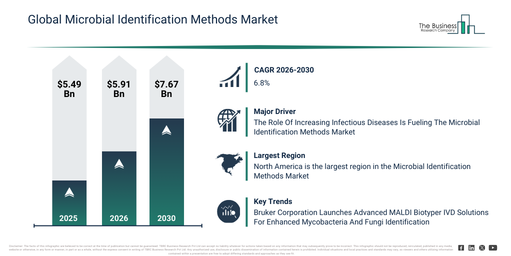
The microbial identification methods market has experienced strong growth in recent years. It is projected to expand from $5.49 billion in 2025 to $5.91 billion in 2026, achieving a compound annual growth rate (CAGR) of 7.7%. Historically, this growth can be attributed to increasing infectious disease outbreaks, reliance on culture-based identification, growth in food safety testing, a regulatory focus on contamination control, and the expansion of clinical diagnostic microbiology.
The microbial identification methods market size is anticipated to undergo significant expansion over the next few years. It is projected to reach $7.67 billion by 2030, demonstrating a compound annual growth rate (CAGR) of 6.8%. This growth during the forecast period stems from factors such as the increasing uptake of genomic sequencing tests, the rising demand for automation within identification workflows, advancements in rapid microbial testing technologies, the broader integration of digital lab infrastructure, and increased investments in precision microbiology. Noteworthy trends for the forecast period include the integration of genomic sequencing in microbial identification, the emergence of cloud-based microbial data analytics, AI-assisted microbial classification, automated identification platforms in industrial laboratories, and IoT-enabled contamination monitoring solutions.
Get A Free Sample Report With In-Depth Market Insights:
Microbial Identification Methods Market Opportunity Drivers: What’s Unlocking New Revenue Potential?
The increasing prevalence of infectious diseases is projected to propel the growth of the microbial identification methods market moving forward. Infectious diseases are conditions caused by detrimental agents (pathogens) such as viruses, bacteria, fungi, and parasites, entering the human body. Significant infectious diseases include HIV/AIDS (human immunodeficiency virus/acquired immunodeficiency syndrome), tuberculosis, and malaria, among others. The heightened prevalence of infectious diseases can be attributed to factors like antimicrobial resistance, climate change, and population growth. Microbial identification methods are critical for diagnosing, treating, and preventing these diseases by providing detailed insights into the pathogens responsible for an infection, which allows healthcare professionals to make informed choices for patient management. Consequently, the increasing prevalence of infectious diseases drives the expansion of the microbial identification methods market.
Microbial Identification Methods Market Segment Performance And Emerging Opportunities
The microbial identification methods market covered in this report is segmented –
1) By Method: Genotypic, Phenotypic, Proteotypic
2) By Type: Bacterial Identification System, Microbial Enumeration System, Bacterial Resistance Identification Systems, Microbiology Analyzer, Other Types
3) By End User: Pharmaceutical And Biotechnology Companies, Hospitals And Diagnostic Laboratories, Food Testing Laboratories, Other End-Users
Subsegments:
1) By Genotypic: Polymerase Chain Reaction (PCR), 16S rRNA Sequencing, DNA Microarrays, Next-Generation Sequencing (NGS), Whole Genome Sequencing (WGS), Ribotyping, Fluorescence In Situ Hybridization (FISH), Random Amplified Polymorphic DNA (RAPD) Analysis
2) By Phenotypic: Culture-Based Methods, Biochemical Testing, Microscopic Examination, Gram Staining, Antibiotic Susceptibility Testing (AST), Growth Pattern Identification, Colony Morphology Characterization
3) By Proteotypic: Mass Spectrometry (MALDI-TOF MS), Western Blotting, Protein Profiling, Immunoassays (ELISA), Two-Dimensional Gel Electrophoresis
Microbial Identification Methods Market Innovation Trends Shaping Future Development
Key players within the microbial identification methods market are concentrating on creating advanced solutions, including mycobacteria and fungi IVD solutions, to enhance their competitive standing. Mycobacteria and fungi in vitro diagnostic (IVD) solutions encompass various products and technologies tailored for the detection, identification, and characterization of mycobacterial and fungal pathogens found in clinical samples.
Microbial Identification Methods Market Key Players: Which Companies Lead Industry Competition?
Major companies operating in the microbial identification methods market are Merck KGaA, Thermo Fisher Scientific Inc., Abbott Laboratories, Becton Dickinson and Company, GE Healthcare, Avantor Inc., Eurofins Scientific SE, Lonza Group AG, Sartorius AG, Charles River Laboratories International Inc., bioMerieux SA, Shimadzu Corporation, Waters Corporation, Bio-Rad Laboratories Inc., Bruker Corporation, Qiagen N.V., Beckman Coulter Inc., HiMedia Laboratories, Hardy Diagnostics, LuminUltra Technologies Ltd., Biolog Inc.
View The Full Microbial Identification Methods Market Report:
Microbial Identification Methods Market Geographic Analysis: Where Is Demand Rising Fastest?
North America was the largest region in the microbial identification methods market in 2025. The regions covered in the microbial identification methods market report are Asia-Pacific, South East Asia, Western Europe, Eastern Europe, North America, South America, Middle East, Africa.
Reach Out To Our Team:
The Business Research Company: https://www.thebusinessresearchcompany.com/
Americas: +1 310-496-7795
Asia: +44 7882 955267 & +91 8897263534
Europe: +44 7882 955267
Email us at: marketing@tbrc.info
Follow us on:
LinkedIn: https://in.linkedin.com/company/the-business-research-company
YouTube: https://www.youtube.com/channel/UC24_fI0rV8cR5DxlCpgmyFQ
Global Market Model: https://www.thebusinessresearchcompany.com/global-market-model
Leave a Reply