Artificial Intelligence (AI) In Orthopedic Surgery Market Analysis: How The Industry Is Evolving Toward A $0.87 Billion Future
Backed by market attractiveness analysis, total addressable market sizing, company benchmarking matrices, interactive Excel dashboards, wider supply chain intelligence, emerging startup coverage, and detailed product-level insights, The Business Research Company’s 2026 market reports are designed to offer research that is more actionable and strategically valuable than ever.
Artificial Intelligence (AI) In Orthopedic Surgery Market Growth Analysis: How Will Revenue Trend Over The Forecast Period?
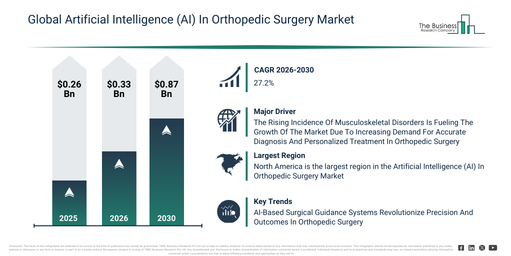
The market size for artificial intelligence (AI) in orthopedic surgery has experienced rapid growth in recent years. It is projected to expand from $0.26 billion in 2025 to $0.33 billion by 2026, demonstrating a compound annual growth rate (CAGR) of 27.5%. Historically, this expansion can be attributed to an increasing volume of orthopedic surgeries, advancements in medical imaging technologies, the growing adoption of minimally invasive procedures, the expansion of hospital digital infrastructure, and a rising focus on surgical accuracy.
The market for artificial intelligence (AI) in orthopedic surgery is projected to experience rapid expansion in the coming years. Its valuation is anticipated to reach $0.87 billion by 2030, demonstrating a compound annual growth rate (CAGR) of 27.2%. This projected growth is driven by several factors, including a heightened demand for tailored orthopedic solutions, increased capital allocation towards surgical robotics, the wider adoption of AI-powered clinical decision support systems, an escalating emphasis on healthcare models centered around patient outcomes, and the enhanced merging of AI with electronic health records. Key trends anticipated during this period encompass the greater uptake of AI-supported surgical planning instruments, the expanding application of computer vision in orthopedic operations, the increasing incorporation of robotic surgical platforms, the broader deployment of predictive analytics to forecast patient results, and improvements in the accuracy of implant positioning.
Get A Free Sample Report With In-Depth Market Insights:
Artificial Intelligence (AI) In Orthopedic Surgery Market Industry Drivers: What’s Behind The Revenue Growth?
An increasing prevalence of musculoskeletal disorders is anticipated to propel the growth of artificial intelligence (AI) in orthopedic surgery market going forward. These disorders refer to injuries or conditions that affect the muscles, bones, joints, tendons, or ligaments, frequently causing pain and limiting movement. The rise in musculoskeletal disorders is largely fueled by sedentary lifestyles, as prolonged inactivity tends to weaken muscles and strain joints. AI in orthopedics supports the management of musculoskeletal disorders by enabling precise and early diagnosis through advanced image analysis and data patterns. It also facilitates customized treatment planning and predicts outcomes, thereby enhancing patient care and recovery. For instance, in January 2024, according to the Office for Health Improvement and Disparities, a UK-based government department, in 2023, 18.4% of people aged 16 and over reported having a long-term MSK condition, an increase from 17.6% in 2022. Therefore, the rising incidence of musculoskeletal disorders is driving the growth of artificial intelligence (AI) in orthopedic surgery market.
Artificial Intelligence (AI) In Orthopedic Surgery Market Segmentation And Category Overview
The artificial intelligence (AI) in orthopedic surgery market covered in this report is segmented –
1) By Component Type: Software, Services, Hardware
2) By Technology: Machine Learning, Natural Language Processing, Computer Vision, Context-Aware Computing
3) By Anatomy: Knee, Hip, Spine, Other Anatomies
4) By End-User: Hospitals, Orthopedic Clinics, Other End-Users
Subsegments:
1) By Software: Clinical Decision Support Systems (CDSS), Drug Interaction Software, Electronic Health Record (EHR) Integration Modules, Prescription Management Software, Patient Monitoring Software
2) By Services: Consulting Services, Training and Education, Support and Maintenance, Implementation Services, Drug Distribution Services
3) By Hardware: Robotic Surgical Systems, Handheld Navigation Devices, Wearable Monitoring Devices, Imaging Systems, Sensors and Actuators, Computing Infrastructure
#Artificial Intelligence (AI) In Orthopedic Surgery Market Growth Trends: What’s Shaping The Future Outlook?
Leading companies within the artificial intelligence (AI) orthopedic surgery market are concentrating on developing advanced solutions, such as AI-driven surgical guidance systems, with the aim of enhancing surgical precision and improving patient outcomes. An AI-based surgical guidance system utilizes real-time data, imaging, and predictive algorithms to support surgeons in achieving precise navigation and informed decision-making during operations. This technology significantly boosts surgical accuracy and lowers the potential for errors. For example, in April 2025, Proprio, a US-based company specializing in AI-powered surgical technology, unveiled its Paradigm platform, which subsequently received clearance from the Food and Drug Administration (FDA). This innovative platform provides real-time, 3D, dynamic measurement and visualization of anatomy throughout surgery. This allows surgeons to instantly assess and quantify surgical outcomes, removing the need for intraoperative X-rays or CT scans and thereby reducing both delays and exposure to radiation. The technology is poised to transform surgical procedures, especially in spine surgery, by offering continuous, data-driven guidance and improving patient recovery.
Artificial Intelligence (AI) In Orthopedic Surgery Market Competitive Analysis Of Leading Industry Participants
Major companies operating in the artificial intelligence (AI) in orthopedic surgery market are Medtronic plc, Stryker Corporation, Zimmer Biomet Holdings Inc., Smith & Nephew PLC, Globus Medical Inc., Brainlab AG, Proprio, Augmedics LTD, OrthAlign Inc., Caresyntax, Activ Surgical, THINK Surgical Inc., Perlove Medical, Pixee Medical, Formus Labs, Intuitive Surgical Inc., Johnson & Johnson DePuy Synthes, Renishaw plc, Medacta Group SA, Curexo Inc., Exactech Inc., AlgoSurg Inc., RSIP Vision, Surgalign HOLO Portal Technologies
View The Full Artificial Intelligence (AI) In Orthopedic Surgery Market Report:
Artificial Intelligence (AI) In Orthopedic Surgery Market Largest Region: Which Geography Holds The Biggest Share?
North America was the largest region in the AI in orthopedic surgery market in 2025. The regions covered in the artificial intelligence (AI) in orthopedic surgery market report are Asia-Pacific, South East Asia, Western Europe, Eastern Europe, North America, South America, Middle East, Africa.
Reach Out To Our Team:
The Business Research Company: https://www.thebusinessresearchcompany.com/
Americas: +1 310-496-7795
Asia: +44 7882 955267 & +91 8897263534
Europe: +44 7882 955267
Email us at: marketing@tbrc.info
Follow us on:
LinkedIn: https://in.linkedin.com/company/the-business-research-company
YouTube: https://www.youtube.com/channel/UC24_fI0rV8cR5DxlCpgmyFQ
Global Market Model: https://www.thebusinessresearchcompany.com/global-market-model
[KClientError] [REQ_ERR: OPERATION_TIMEDOUT] [KTrafficClient] Something is wrong.