Featuring market attractiveness scoring, total addressable market sizing, company benchmarking matrices, interactive Excel dashboards, deeper supply chain intelligence, emerging startup tracking, and granular product-level insights, The Business Research Company’s 2026 market reports are built to deliver research that is both more actionable and more strategically valuable.
Paroxysmal Nocturnal Hemoglobinuria (PNH) Treatment Market Poised To Hit $11.32 Billion By 2030 With A 13.2% CAGR
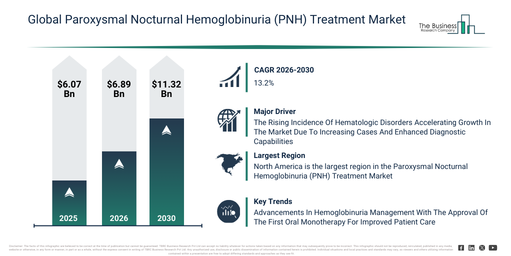
The market for paroxysmal nocturnal hemoglobinuria (pnh) treatment has experienced rapid growth in recent years. This sector is anticipated to increase from $6.07 billion in 2025 to $6.89 billion in 2026, reflecting a compound annual growth rate (CAGR) of 13.4%. The historical expansion of this market can be attributed to factors like the limited availability of effective targeted therapies, a reliance on supportive care and transfusions, delayed diagnosis stemming from the disease’s rarity, the significant risk of life-threatening thrombosis, and the absence of standardized long-term treatment protocols.
The paroxysmal nocturnal hemoglobinuria (pnh) treatment market is poised for significant expansion over the next few years. Its valuation is expected to reach $11.32 billion by 2030, progressing at a compound annual growth rate (CAGR) of 13.2%. This projected increase during the forecast period can be attributed to the emergence of next-generation complement inhibitors, a broadening clinical pipeline for oral and subcutaneous therapies, a heightened focus on drug innovation for orphan diseases, improved diagnosis rates through advanced testing, and enhanced reimbursement coverage for rare hematologic disorders. Major trends anticipated during this period include a rising adoption of complement c5 inhibitor therapies, an increasing shift towards long-acting and subcutaneous treatments, the development of alternative pathway inhibitors, the expansion of combination and dual complement inhibition strategies, and better management of thrombotic and bone marrow complications.
Get A Free Sample Report With In-Depth Market Insights:
Paroxysmal Nocturnal Hemoglobinuria (PNH) Treatment Market Growth Factors: What’s Supporting Expansion?
A rise in the occurrence of hematologic disorders is anticipated to fuel the expansion of the paroxysmal nocturnal hemoglobinuria (PNH) treatment market in the future. Hematologic disorders encompass a wide range of medical conditions impacting the blood and its producing organs, manifesting as irregularities in red blood cells, white blood cells, platelets, bone marrow, and the coagulation system, potentially resulting in conditions such as anemia, clotting problems, or cancers. The growing frequency of these disorders is attributed to elements like aging populations and genetic predispositions, with genetic mutations being crucial by initiating irregular blood cell production, which leads to various hematologic conditions. Paroxysmal nocturnal hemoglobinuria (PNH) treatment effectively addresses hematologic disorders through specialized therapies that lessen complement-mediated hemolysis, decrease thrombotic complications, and enhance patient survival outcomes. Consequently, the increasing prevalence of hematologic disorders is a key driver for the paroxysmal nocturnal hemoglobinuria (PNH) treatment market’s growth.
Paroxysmal Nocturnal Hemoglobinuria (PNH) Treatment Market Segment Landscape: Which Areas Lead Development?
The paroxysmal nocturnal hemoglobinuria (pnh) treatment market covered in this report is segmented –
1) By Treatment Type: Complement C5 Inhibitors, Anti-Complement Component 5a Receptor (C5aR) Monoclonal Antibodies, Alternative Pathway Inhibitors, Hematopoietic Stem Cell Transplantation, Other Therapies
2) By Route Of Administration: Intravenous, Subcutaneous, Oral
3) By Market Availability: Approved, In Pipeline, Investigational
4) By End-Use: Hospitals, Specialty Clinics, Homecare Settings, Other End-Users
Subsegments:
1) By Complement: C5 InhibitorsEculizumab (Soliris), Ravulizumab (Ultomiris), Emerging C5 Inhibitors, Biosimilars Of C5 Inhibitors,
2) By Anti-Complement Component 5a Receptor Monoclonal Antibodies: Avacopan (Tavneos), Other Investigational C5aR mAbs, Monotherapy vs Combination Therapy, Clinical Trial Phase (Phase I, II, III)
3) By Alternative Pathway Inhibitors: C3 Inhibitors, Factor B Inhibitors, Factor D Inhibitors, Targeting Complement Amplification, Combination Therapies And Dual Inhibition
4) By Hematopoietic Stem Cell Transplantation (HSCT): Autologous HSCT vs. Allogeneic HSCT, Pre-Transplant Conditioning Therapies, Post-Transplant Immunosuppressive Therapies
5) By Other Therapies: Immunosuppressive Therapy, Supportive Care, Anticoagulation Therapy, Gene Therapy
Paroxysmal Nocturnal Hemoglobinuria (PNH) Treatment Market Trends Shaping Long-Term Demand
Major companies operating in the paroxysmal nocturnal hemoglobinuria (PNH) treatment market are concentrating on developing innovative solutions, such as oral factor B inhibitors, to introduce novel treatment options that enhance therapeutic effectiveness and improve patient convenience in managing PNH. An oral Factor B inhibitor acts as a targeted small-molecule drug, selectively inhibiting Factor B in the alternative complement pathway, aiming to regulate immune system overactivation and reduce inflammation in complement-mediated diseases.
Paroxysmal Nocturnal Hemoglobinuria (PNH) Treatment Market Industry Leaders And Competitive Landscape
Major companies operating in the paroxysmal nocturnal hemoglobinuria (pnh) treatment market are F. Hoffmann-La Roche Ltd, Novartis AG, Mayo Clinic, Cleveland Clinic Foundation, Johns Hopkins Medicine, Memorial Sloan Kettering Cancer Center, Stanford Health Care, University of California San Francisco (UCSF) Health, Emory Healthcare, Cedars-Sinai Medical Center, Duke University Health System, Mount Sinai Health System, Dana-Farber Cancer Institute, Swedish Orphan Biovitrum, Alnylam Pharmaceuticals, BioCryst Pharmaceuticals, Apellis Pharmaceuticals, Omeros Corporation, Takeda Pharmaceutical Company, Sanofi S A, Pfizer Inc, Akari Therapeutics Plc, NovelMed Therapeutics, Ionis Pharmaceuticals, Johnson & Johnson, Biogen Inc.
View The Full Paroxysmal Nocturnal Hemoglobinuria (PNH) Treatment Market Report:
Paroxysmal Nocturnal Hemoglobinuria (PNH) Treatment Market Geographic Spread And Regional Opportunities
North America was the largest region in the paroxysmal nocturnal hemoglobinuria (PNH) treatment market in 2025. Asia-Pacific is expected to be the fastest-growing region in the forecast period. The regions covered in the paroxysmal nocturnal hemoglobinuria (pnh) treatment market report are Asia-Pacific, South East Asia, Western Europe, Eastern Europe, North America, South America, Middle East, Africa.
Reach Out To Our Team:
The Business Research Company: https://www.thebusinessresearchcompany.com/
Americas: +1 310-496-7795
Asia: +44 7882 955267 & +91 8897263534
Europe: +44 7882 955267
Email us at: marketing@tbrc.info
Follow us on:
LinkedIn: https://in.linkedin.com/company/the-business-research-company
YouTube: https://www.youtube.com/channel/UC24_fI0rV8cR5DxlCpgmyFQ
Global Market Model: https://www.thebusinessresearchcompany.com/global-market-model
Leave a Reply