Built to provide research that’s more actionable and strategically valuable, The Business Research Company’s 2026 market reports include market attractiveness analysis, total addressable market sizing, company benchmarking matrices, interactive Excel dashboards, broader supply chain intelligence, emerging startup tracking, and in-depth product insights.
Plasma Protease C1-Inhibitor Market Growth Potential: How Will Market Size Shift Through 2030?
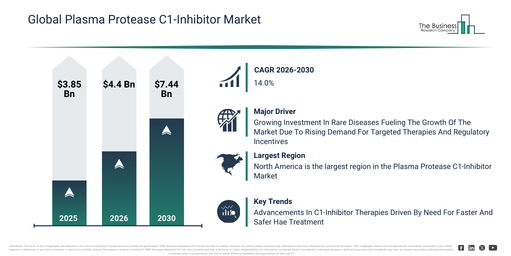
The plasma protease c1-inhibitor market has experienced considerable expansion in recent years. It is anticipated to expand from $3.85 billion in 2025 to $4.4 billion in 2026, achieving a compound annual growth rate (CAGR) of 14.3%. This historical development can be attributed to increased diagnosis of hereditary angioedema, the widespread availability of plasma-derived inhibitors, advancements in plasma fractionation processes, the proliferation of specialty immunology clinics, and improved patient access to targeted therapies.
The plasma protease c1-inhibitor market size is projected to experience significant expansion over the next few years. It is anticipated to grow to $7.44 billion by 2030, demonstrating a compound annual growth rate (CAGR) of 14.0%. This growth during the forecast period can be attributed to the escalating development of next-generation inhibitors, increasing demand for self-administered therapies, the broadening of rare disease treatment programs, rising investment in recombinant biologics, and a growing focus on long-term disease control. Prominent trends within the forecast period encompass the increasing adoption of recombinant c1-inhibitors, a surge in demand for plasma-derived therapies, an intensified focus on rare disease management, the expansion of subcutaneous administration options, and an enhanced emphasis on treatment safety and efficacy.
Get A Free Sample Report With In-Depth Market Insights:
Plasma Protease C1-Inhibitor Market Development Factors: What’s Supporting Demand?
Increased funding directed towards rare diseases is anticipated to boost the expansion of the plasma protease C1-inhibitor market in the future. A rare disease is defined as a medical condition impacting a small fraction of the populace, generally less than 1 in 2,000 individuals. Such conditions frequently present as chronic, progressive ailments, potentially leading to life-threatening or disabling outcomes. Funding for rare diseases stems mainly from an increasing awareness of unmet healthcare requirements and the prospect of substantial returns via regulatory incentives, including orphan drug status, exclusive market rights, and lower development expenses. This investment in rare diseases fuels the creation of plasma protease C1-inhibitors by financing research and innovative solutions for hereditary angioedema and similar rare disorders where C1-inhibitor deficits lead to severe manifestations, thereby speeding up the delivery of specific treatments.
Plasma Protease C1-Inhibitor Market Segment Analysis Spotlighting Growth Areas
The plasma protease c1-inhibitor market covered in this report is segmented –
1) By Drug Class: C1-Inhibitors, C1-Esterase Inhibitor, Recombinant Inhibitor, Kallikrein Inhibitor, Selective Bradykinin B2 Receptor Antagonist
2) By Dosage Form: Lyphophlised, Injectables
3) By Distribution Channel: Hospital Pharmacies, Retail Pharmacies, Online Pharmacies
Subsegments:
1) By C1-Inhibitors: Plasma-Derived C1-Inhibitor, Recombinant C1-Inhibitor
2) By C1-Esterase Inhibitor: Intravenous (IV) C1-Esterase Inhibitor, Subcutaneous (SC) C1-Esterase Inhibitor
3) By Recombinant Inhibitor: Recombinant Human C1-Inhibitor, Recombinant Analog Inhibitor
4) By Kallikrein Inhibitor: Plasma Kallikrein Inhibitor, Oral Kallikrein Inhibitor
5) By Selective Bradykinin B2 Receptor Antagonist: Injectable B2 Receptor Antagonist, Oral B2 Receptor Antagonist
Plasma Protease C1-Inhibitor Market Trends Powering Strategic Industry Growth
Major companies operating in the plasma protease C1-inhibitor market are focusing on developing innovative solutions, such as recombinant and plasma-derived C1-inhibitors. These solutions aim to prevent and treat hereditary angioedema (HAE) attacks, offering faster symptom control and improved safety when compared to older therapies that had limited availability or slower onset. C1-inhibitors are proteins responsible for regulating the complement system, thereby controlling excessive bradykinin production and reducing the severity of HAE-related swelling episodes.
Plasma Protease C1-Inhibitor Market Leading Companies: Who Holds The Strongest Market Presence?
Major companies operating in the plasma protease c1-inhibitor market are Takeda Pharmaceutical Company Limited, CSL Behring LLC, Octapharma AG, Ionis Pharmaceuticals Inc, Sanquin, Biotest AG, BioCryst Pharmaceuticals Inc, Pharming Group NV, KalVista Pharmaceuticals Inc, Pharvaris NV, Lev Pharmaceuticals, Shire Pharmaceuticals, Dyax Corp, Intellia Therapeutics Inc, Alnylam Pharmaceuticals Inc, Moderna Therapeutics Inc, Arrowhead Pharmaceuticals Inc, Protalix BioTherapeutics Inc, Apellis Pharmaceuticals Inc, Alexion Pharmaceuticals Inc, UCB SA, Pfizer Inc
View The Full Plasma Protease C1-Inhibitor Market Report:
Plasma Protease C1-Inhibitor Market Top Region By Revenue And Market Share
North America was the largest region in the plasma protease C1-inhibitor market in 2025. Asia-Pacific is expected to be the fastest-growing region in the forecast period. The regions covered in the plasma protease c1-inhibitor market report are Asia-Pacific, South East Asia, Western Europe, Eastern Europe, North America, South America, Middle East, Africa.
Reach Out To Our Team:
The Business Research Company: https://www.thebusinessresearchcompany.com/
Americas: +1 310-496-7795
Asia: +44 7882 955267 & +91 8897263534
Europe: +44 7882 955267
Email us at: marketing@tbrc.info
Follow us on:
LinkedIn: https://in.linkedin.com/company/the-business-research-company
YouTube: https://www.youtube.com/channel/UC24_fI0rV8cR5DxlCpgmyFQ
Global Market Model: https://www.thebusinessresearchcompany.com/global-market-model
Leave a Reply