Backed by market attractiveness analysis, total addressable market sizing, company benchmarking matrices, interactive Excel dashboards, wider supply chain intelligence, emerging startup coverage, and detailed product-level insights, The Business Research Company’s 2026 market reports are designed to offer research that is more actionable and strategically valuable than ever.
Polymyalgia Rheumatica Market Revenue Growth On Track For A 5.9% CAGR Through 2030
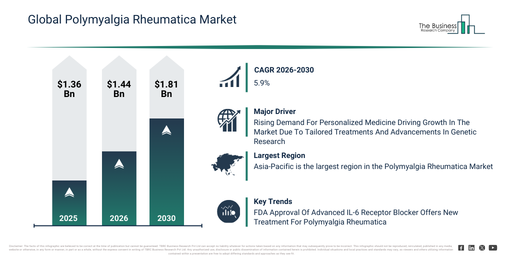
The polymyalgia rheumatica market size has seen robust expansion in recent years. Projections indicate it will rise from $1.36 billion in 2025 to $1.44 billion in 2026, at a compound annual growth rate (CAGR) of 6.2%. The upward trend observed in the past can be ascribed to several factors, including increasing aging population size, improved clinical awareness of inflammatory disorders, established use of corticosteroids as first-line therapy, growing diagnosis rates in geriatric patients, and the availability of hospital-based rheumatology services.
The polymyalgia rheumatica market is projected to experience substantial expansion in the coming years. By 2030, this market is anticipated to reach $1.81 billion, demonstrating a compound annual growth rate (CAGR) of 5.9%. This projected growth is driven by factors such as the increasing development of steroid-sparing therapies, expanding research into inflammatory biomarkers, the wider uptake of biologics and targeted medications, improved access to specialized medical care, and a heightened emphasis on minimizing the long-term adverse effects of treatments. Key trends anticipated during this period encompass the increased acceptance of biologic therapies, a greater emphasis on prompt and precise diagnosis, the broadening application of long-term corticosteroid management, the evolution of individualized treatment strategies, and improved methods for tracking disease progression.
Get A Free Sample Report With In-Depth Market Insights:
Polymyalgia Rheumatica Market Industry Drivers: What’s Behind The Revenue Growth?
The polymyalgia rheumatica market is projected to expand due to increasing demand for individualized medical treatments in the future. This approach involves medical care customized according to a patient’s unique genetic makeup, way of life, and particular health issues, aiming for enhanced results. This demand stems from progress in genetic studies, patients’ rising desire for customized therapies, and better diagnostic tools. Genetic research has deepened our comprehension of individual genetic differences, enabling more targeted therapies that address specific genetic indicators. Personalized medicine aids in choosing medications most likely to be effective given a patient’s specific traits, resulting in a safer and more impactful treatment strategy.
Polymyalgia Rheumatica Market Breakdown By Product Type And Application
The polymyalgia rheumatica market covered in this report is segmented –
1) By Treatment: Corticosteroids, Nonsteroidal Anti-Inflammatory Drugs, Disease-Modifying Antirheumatic Drugs, Biologics
2) By Route Of Administration: Oral, Intravenous, Subcutaneous
3) By Patient Type: Adult, Geriatric, Elderly Or Aging Population
4) By Distribution Channel: Hospital Pharmacies, Retail Pharmacies, Online Pharmacies
Subsegments:
1) By Corticosteroids: Prednisone, Methylprednisolone, Hydrocortisone, Dexamethasone
2) By Nonsteroidal Anti-Inflammatory Drugs (NSAIDs): Ibuprofen, Naproxen, Aspirin, Celecoxib
3) By Disease-Modifying Antirheumatic Drugs (DMARDs): Methotrexate, Leflunomide, Sulfasalazine, Hydroxychloroquine
4) By Biologics: Tumor Necrosis Factor (TNF) Inhibitors, Interleukin-6 (IL-6) Inhibitors, B-Cell Inhibitors, Janus Kinase (JAK) Inhibitors
Polymyalgia Rheumatica Market Growth Trends Reshaping The Competitive Landscape
Companies operating within the polymyalgia rheumatica market are concentrating on developing advanced medications, such as interleukin-6 (IL-6) receptor blockers, to offer more targeted and effective treatment choices. These interleukin-6 (IL-6) receptor blockers are biological drugs designed to suppress IL-6, which is a primary pro-inflammatory cytokine linked to autoimmune conditions. By inhibiting IL-6, these treatments alleviate inflammation and mitigate symptoms, thereby improving the quality of life for PMR patients.
Polymyalgia Rheumatica Market Company Landscape And Competitive Strategy
Major companies operating in the polymyalgia rheumatica market are AbbVie Inc., Sanofi S.A., Eli Lilly and Co., Regeneron Pharmaceuticals Inc., Horizon Therapeutics plc, Sparrow Pharmaceuticals Inc., Roche Holding AG, Novartis AG, Pfizer Inc., Bristol Myers Squibb Company, GlaxoSmithKline plc, AstraZeneca plc, Merck & Co. Inc., Janssen Pharmaceuticals Inc., Takeda Pharmaceutical Company Limited, UCB S.A., Amgen Inc., Boehringer Ingelheim, Bayer AG, Teva Pharmaceutical Industries Ltd., Sun Pharmaceutical Industries Ltd., Lupin Limited, Aurobindo Pharma Limited
View The Full Polymyalgia Rheumatica Market Report:
Polymyalgia Rheumatica Market Geographic Spread And Regional Opportunities
Asia-Pacific was the largest region in the polymyalgia rheumatica market in 2025. The regions covered in the polymyalgia rheumatica market report are Asia-Pacific, South East Asia, Western Europe, Eastern Europe, North America, South America, Middle East, Africa.
Reach Out To Our Team:
The Business Research Company: https://www.thebusinessresearchcompany.com/
Americas: +1 310-496-7795
Asia: +44 7882 955267 & +91 8897263534
Europe: +44 7882 955267
Email us at: marketing@tbrc.info
Follow us on:
LinkedIn: https://in.linkedin.com/company/the-business-research-company
YouTube: https://www.youtube.com/channel/UC24_fI0rV8cR5DxlCpgmyFQ
Global Market Model: https://www.thebusinessresearchcompany.com/global-market-model
Leave a Reply