Built to provide research that’s more actionable and strategically valuable, The Business Research Company’s 2026 market reports include market attractiveness analysis, total addressable market sizing, company benchmarking matrices, interactive Excel dashboards, broader supply chain intelligence, emerging startup tracking, and in-depth product insights.
Therapeutic Proteins Market Expansion Outlook: What Revenue Opportunities Are Ahead?
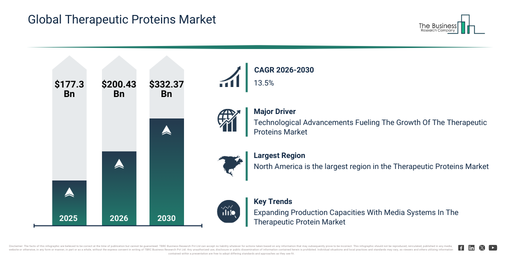
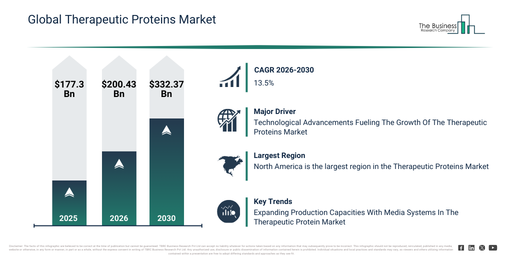
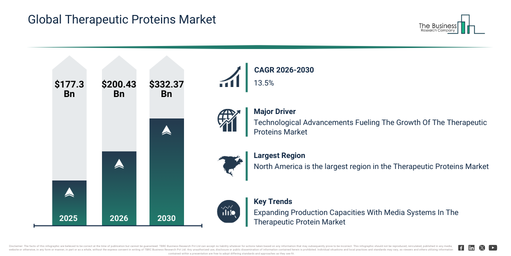
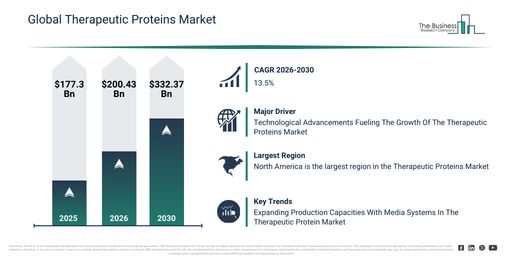
The therapeutic proteins market has experienced rapid growth in recent years. It is anticipated to expand from $177.3 billion in 2025 to $200.43 billion in 2026, demonstrating a compound annual growth rate (CAGR) of 13.0%. The market’s historical expansion can be attributed to several factors, including the successful commercialization of insulin therapies, the increasing prevalence of chronic diseases, the strong clinical efficacy of protein drugs, the growth in biotechnology research, and a rise in regulatory approvals.
The therapeutic proteins market is anticipated to undergo significant expansion in the coming years. Projections indicate it will reach a value of $332.37 billion by 2030, growing at a compound annual growth rate (CAGR) of 13.5%. This growth throughout the forecast period is primarily driven by expanding oncology and immunology pipelines, an increasing number of biologics approvals, rising investment in biopharmaceutical research and development, the growing adoption of biosimilars, and improved manufacturing scalability. Furthermore, key trends for this period include the broadening of recombinant protein therapies, an escalating demand for targeted biologics, the development of personalized protein medicines, greater uptake of long-acting proteins, and advancements in protein expression systems.
Get A Free Sample Report With In-Depth Market Insights:
Therapeutic Proteins Market Demand Drivers Opening New Revenue Streams
The therapeutic proteins market is experiencing growth fueled by technological progress in developing protein-based drugs. Unlike chemical synthesis, therapeutic proteins necessitate production through genetic engineering and recombinant DNA technology within living cells or organisms. Platform technologies in protein engineering, including glycoengineering, pegylation, Fc-fusion, albumin fusion, and albumin drug conjugation, are instrumental in improving the production yield, purity, circulating half-life, targeting capabilities, and overall functionality of therapeutic protein drugs. Notable therapeutic protein drugs, such as Belimumab, ipilimumab, taliglucerase alfa, albiglutide, and recombinant human coagulation factor IX, have been developed using these protein engineering technologies and received FDA approval within the last five years. The therapeutic protein market’s expansion is notably fueled by the rising occurrence of chronic conditions, particularly diabetes. Chronic diseases are defined as ailments that persist for a minimum of one year, interfere with daily life, or necessitate ongoing medical attention. Diabetes, a chronic health condition, arises when the body fails to produce adequate insulin or utilize it effectively. In managing diabetes, various protein therapeutics, such as insulin and GLP-1 receptor agonists, are employed to control blood sugar levels. These therapeutics function by stimulating insulin release in response to elevated blood glucose and by curbing the production of glucagon, another hormone that raises blood sugar. As an illustration, data from May 2024, provided by the British Diabetic Association (Diabetes UK), a UK-based patient, healthcare professional and research charity, indicates that approximately 4.4 million people in the UK were diagnosed with diabetes in 2022-23. Type 1 diabetes constitutes about 8% of these cases, while type 2 diabetes accounts for approximately 90%, with the remaining 2% covering other less prevalent forms of diabetes. Consequently, the growing prevalence of chronic illnesses such as diabetes significantly propels the therapeutic protein market.
Therapeutic Proteins Market Segment Landscape And Growth Outlook
The therapeutic proteins market covered in this report is segmented –
1) By Product Type: Insulin, Fusion Protein, Erythropoietin, Interferon, Human Growth Hormone, Follicle Stimulating Hormone
2) By Function: Enzymatic And Regulatory Activity, Special Targeting Activity, Vaccines
3) By Application: Metabolic Disorders, Immunologic Disorders, Hematological Disorders, Cancer, Hormonal Disorders, Genetic Disorders, Other Applications
Subsegments:
1) By Insulin: Rapid-Acting Insulin, Short-Acting Insulin, Intermediate-Acting Insulin, Long-Acting Insulin
2) By Fusion Protein: Tnf-Alpha Inhibitors, Anti-Cd20 Fusion Proteins, Other Targeted Fusion Proteins
3) By Erythropoietin: Epoetin Alpha, Darbepoetin Alfa, Other Erythropoietin Variants
4) By Interferon: Interferon Alpha, Interferon Beta, Interferon Gamma
5) By Human Growth Hormone: Somatropin, Somatrem
6) By Follicle Stimulating Hormone: Follitropin Alpha, Follitropin Beta
Therapeutic Proteins Market Trends Powering Strategic Industry Growth
Leading companies operating within the therapeutic protein market are concentrating on introducing media systems to address the rising demand for therapeutic proteins and achieve a competitive advantage. These media systems for therapeutic proteins are production platforms specifically designed to optimize the manufacturing of therapeutic monoclonal antibodies. For example, in July 2023, Lonza Group AG, a Switzerland-based pharmaceutical manufacturing company, unveiled the TheraPRO CHO (Chinese Hamster Ovary) Media System, a new cell culture platform intended to enhance productivity and quality in therapeutic protein manufacture. This two-part, chemically specified production technique is user-friendly and streamlines media preparation. It offers complete scalability and is backed by technical professionals with extensive troubleshooting knowledge.
Therapeutic Proteins Market Competitive Landscape: Who Leads The Industry?
Major companies operating in the therapeutic proteins market are Pfizer Inc., Johnson & Johnson Services Inc., F. Hoffmann-La Roche Ltd., Merck & Co. Inc., AbbVie Inc., Novartis International AG, Sanofi S.A, Bristol Myers Squibb Co., AstraZeneca plc, Abbott Laboratories, GlaxoSmithKline plc, Eli Lilly and Company, Boehringer Ingelheim International GmbH, Amgen Inc., Novo Nordisk A/S, Baxter International Inc., Teva Pharmaceutical Industries Ltd., CSL Behring LLC, Chugai Pharmaceutical Co. Ltd., Biogen Inc., Kyowa Kirin Co. Ltd., Oramed Pharmaceuticals Inc., Sandoz International GmbH, Hualan Biological Engineering Inc., Genentech Inc., ProBiogen AG, Diasome Pharmaceuticals Inc., Generex Biotechnology Corp., GeneScience Pharmaceuticals Co. Ltd.
View The Full Therapeutic Proteins Market Report:
Therapeutic Proteins Market Geographic Landscape: Which Region Leads Industry Growth?
North America was the largest region in the therapeutic proteins market in 2025. The regions covered in the therapeutic proteins market report are Asia-Pacific, South East Asia, Western Europe, Eastern Europe, North America, South America, Middle East, Africa.
Reach Out To Our Team:
The Business Research Company: https://www.thebusinessresearchcompany.com/
Americas: +1 310-496-7795
Asia: +44 7882 955267 & +91 8897263534
Europe: +44 7882 955267
Email us at: marketing@tbrc.info
Follow us on:
LinkedIn: https://in.linkedin.com/company/the-business-research-company
YouTube: https://www.youtube.com/channel/UC24_fI0rV8cR5DxlCpgmyFQ
Global Market Model: https://www.thebusinessresearchcompany.com/global-market-model